Osteoporosis and bone aging: DEXA scans, prevention, and what you can actually reverse
Bone density peaks at 30 and declines steadily after. Learn how DEXA scores work, which exercises build bone, and how to prevent osteoporosis after 40.
Your skeleton is not a static structure — it is a living organ that constantly rebuilds itself. Every 10 years, you essentially have a new skeleton. But after age 30, the demolition crew starts working faster than the construction crew: bone breakdown outpaces bone formation, and you begin losing 0.5–1% of bone density per year.
For women after menopause, this accelerates dramatically. In the first 5–7 years after menopause, women can lose up to 20% of their bone density — a collapse driven by plummeting estrogen levels that removes one of bone’s most important protective signals.
The result: 1 in 2 women and 1 in 4 men over 50 will suffer an osteoporotic fracture in their remaining lifetime. Hip fractures alone carry a 20% one-year mortality rate in adults over 65 — making osteoporosis not just a quality-of-life issue but a survival one.
The challenge is that bone loss is silent. You cannot feel your bones thinning. By the time most people discover they have osteoporosis, they have already lost 30–40% of their peak bone mass. This is why understanding DEXA scans, prevention strategies, and what can realistically be reversed matters — starting now.
What you’ll learn:
- How bone aging works and why it accelerates after menopause
- How to read and interpret your DEXA scan results
- The exercises, nutrients, and interventions that actually build bone
- What can and cannot be reversed once bone loss has occurred
How bone aging works
Bone is maintained by a continuous cycle of remodeling involving two key cell types:
Quick definition: Osteoporosis is a condition characterized by low bone mineral density (BMD) and deterioration of bone microarchitecture, leading to increased fracture risk. It is diagnosed by DEXA scan with a T-score of −2.5 or lower.
The remodeling cycle
- Osteoclasts break down old or damaged bone (resorption)
- Osteoblasts build new bone in its place (formation)
Until about age 30, formation exceeds resorption — you are still building peak bone mass. From 30 to 50, the cycle is roughly balanced. After 50, resorption increasingly outpaces formation.
Why menopause is the critical inflection point
Estrogen is a powerful inhibitor of osteoclast activity. When estrogen levels drop during menopause, osteoclasts become hyperactive — breaking down bone much faster than osteoblasts can rebuild it. This creates a window of rapid bone loss (3–5% per year in early menopause) that gradually slows but never fully stops.
Men experience a similar but slower decline driven by gradually decreasing testosterone and estrogen (yes, men need estrogen for bone too). Andropause contributes to male osteoporosis, though it is often underdiagnosed because men are screened less frequently.
The fracture cascade
The danger of osteoporosis is not the thin bones themselves — it is the fractures they enable. And fractures beget fractures:
- A vertebral compression fracture doubles the risk of a second vertebral fracture
- A hip fracture increases the risk of another hip fracture by 2.5x
- After any fragility fracture, the risk of a subsequent fracture within 2 years increases by 5x
This “fracture cascade” is why prevention is so much more effective than treatment — once the first fracture occurs, the trajectory becomes very difficult to reverse.
Understanding your DEXA scan
A DEXA (Dual-energy X-ray Absorptiometry) scan is the gold standard test for measuring bone mineral density. It uses two different X-ray beams to calculate the density of your bones at the hip, spine, and sometimes forearm.
When to get a DEXA scan
| Population | Recommended screening age |
|---|---|
| Women | Age 65 (earlier if risk factors present) |
| Men | Age 70 (earlier if risk factors present) |
| Anyone with fragility fracture | Immediately, regardless of age |
| Postmenopausal women with risk factors | At menopause |
| Anyone on long-term corticosteroids | At treatment initiation |
DEXA is not a blood test, so do not use normal serum calcium as reassurance that bone density is fine. If you are already postmenopausal, pair DEXA timing with a postmenopause blood test checklist that reviews calcium context, kidney function, vitamin D indications, thyroid status, and medication safety.
Reading your results: T-score and Z-score
T-score compares your bone density to a healthy 30-year-old of the same sex (peak bone mass):
| T-score | Classification | What it means |
|---|---|---|
| −1.0 or above | Normal | Bone density within 1 standard deviation of peak |
| −1.0 to −2.5 | Osteopenia | Low bone mass — not yet osteoporosis but increased risk |
| −2.5 or below | Osteoporosis | Significantly increased fracture risk |
| −2.5 or below + fracture | Severe osteoporosis | Active fracture disease |
Z-score compares you to others of the same age and sex. A Z-score below −2.0 suggests an underlying condition (not just age) may be driving bone loss — warranting further investigation.
The limitations of DEXA
DEXA measures quantity (mineral density) but not quality (microarchitecture). Two people with identical T-scores can have very different fracture risks based on bone quality, trabecular connectivity, and cortical thickness. Newer technologies like Trabecular Bone Score (TBS) and high-resolution peripheral QCT supplement DEXA with microarchitecture data.
6 evidence-based strategies to prevent and manage bone loss
1. Weight-bearing and impact exercise
This is the single most important non-pharmacological intervention for bone health — and the one most people do too little of.
Bone responds to mechanical loading: the more force transmitted through a bone, the stronger the remodeling signal. Activities ranked by bone-building effectiveness:
| Exercise | Bone loading impact | Best for |
|---|---|---|
| Jumping/plyometrics | Very high | Premenopausal, no existing fractures |
| Resistance training | High | All ages, most important after 50 |
| Stair climbing | High | Hip and spine density |
| Rucking (weighted walking) | Moderate-high | Accessible, sustained loading |
| Brisk walking | Low-moderate | Maintenance, not building |
| Swimming/cycling | Very low | Cardiovascular only, minimal bone benefit |
Key evidence: The LIFTMOR trial showed that high-intensity resistance training (heavy deadlifts, squats, overhead press) in postmenopausal women with low bone mass improved bone density at the hip and spine by 2.9% and 0.3% respectively over 8 months — while the control group continued to lose bone.
Practical recommendation: 2–3 sessions per week of progressive resistance training focusing on compound movements (squats, deadlifts, lunges, rows, overhead press). Eccentric training — emphasizing the lowering phase — produces particularly strong bone-loading forces.
2. Calcium (1,000–1,200 mg/day from food first)
Calcium is the primary mineral in bone, but supplementation is more nuanced than “take more calcium.” Calcium deficiency after 40 is best understood as part of a broader nutrient picture — see our guide to micronutrient deficiencies after 40 for how calcium, vitamin D, and magnesium interact.
Food sources first: Dairy products (300 mg per cup of milk), sardines with bones (325 mg per serving), fortified plant milks, kale, broccoli, and tofu provide calcium in a form the body absorbs efficiently.
Supplementation if needed: If food intake falls short of 1,000–1,200 mg daily, supplement the difference — not the total amount. Take no more than 500 mg at one time (absorption is saturable). Calcium citrate is better absorbed than carbonate, especially in older adults with lower stomach acid.
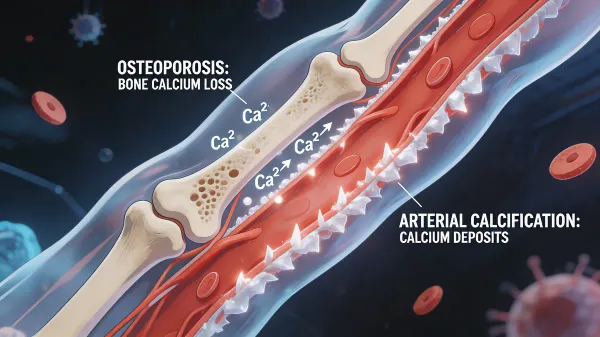
The calcium paradox: Excess calcium without adequate vitamin K2 may deposit in arteries rather than bones. This is why calcium should always be paired with vitamin D3 and K2.
3. Vitamin D3 (2,000–4,000 IU/day)
Vitamin D is essential for calcium absorption in the gut. Without adequate vitamin D, you can consume all the calcium in the world and most of it will pass through unabsorbed.
Testing: Request a 25-hydroxyvitamin D blood test. Optimal range for bone health is 40–60 ng/mL (100–150 nmol/L). Over 40% of adults are deficient (below 20 ng/mL).
Dosing: Most adults need 2,000–4,000 IU of D3 (not D2) daily to achieve optimal levels. Dark-skinned individuals, those living at northern latitudes, and people who avoid sun exposure may need higher doses.
4. Vitamin K2 (100–200 mcg/day)
Vitamin K2 (specifically MK-7 form) activates osteocalcin — a protein that directs calcium into bones rather than arteries. The combination of D3 + K2 is synergistic: D3 increases calcium absorption, K2 ensures it goes where it is needed.
Food sources include natto (fermented soybeans — the richest source), hard cheeses, egg yolks, and liver.
5. Protein (1.0–1.2 g/kg body weight daily)
Bone is not just mineral — it is 50% protein by volume (primarily collagen). Inadequate protein intake impairs bone formation and accelerates sarcopenia — the muscle loss that further reduces mechanical loading on bones. Several small trials have also found that hydrolyzed collagen peptides modestly improve bone mineral density in postmenopausal women by providing glycine and proline, the amino acid building blocks of the collagen scaffold that osteoblasts mineralize.
The outdated fear that high protein intake “leaches calcium from bones” has been thoroughly debunked. Meta-analyses show that higher protein intake is associated with greater bone density and fewer fractures.
6. Address hormonal factors
For women in early menopause experiencing rapid bone loss:
- Discuss hormone replacement therapy (HRT) with your healthcare provider — estrogen replacement is the most effective intervention for menopause-related bone loss
- Monitor bone density more frequently (DEXA every 1–2 years)
For men with low testosterone or symptoms of andropause:
- Request testosterone levels
- Address modifiable factors (sleep, exercise, body fat percentage, stress)
What can and cannot be reversed
This is where many articles get it wrong. Let us be direct about what the evidence supports.
What IS reversible
-
Osteopenia (T-score −1.0 to −2.5): With aggressive lifestyle intervention — weight-bearing exercise, nutrition optimization, and hormonal management if appropriate — bone density can improve by 1–3% per year. Some people do shift out of the osteopenia range.
-
Rate of bone loss: Even if bone density does not increase, slowing the rate of loss is a major win. Reducing annual loss from 2% to 0.5% can mean the difference between fracture and no fracture over a decade.
-
Fracture risk: This can improve even without large changes in bone density. Exercise improves balance, muscle strength, and reaction time — reducing fall risk independently of bone density changes.
What is NOT easily reversible
-
Severe osteoporosis (T-score below −3.0): You cannot rebuild bone back to peak density through lifestyle alone. Pharmacological intervention (bisphosphonates, denosumab, teriparatide, or romosozumab) is typically necessary.
-
Bone microarchitecture: Once trabecular connections are broken, they do not fully regenerate. DEXA density may improve, but the internal structure remains compromised. This is why prevention is always more effective than treatment.
-
Fracture history: You cannot undo a fracture, and each fracture increases future fracture risk. The goal shifts to preventing the next one.
A 2024 case report published in PMC documented a patient who reversed bone loss through comprehensive lifestyle changes alone — but this required sustained, aggressive intervention over several years. It is possible but requires commitment.
How bone health connects to biological age
Bone density is not just a structural metric — it reflects the cumulative effects of hormonal status, nutritional adequacy, physical activity, and inflammatory burden. All of these factors are central to biological aging.
People with osteoporosis have measurably higher biological ages on epigenetic clocks, partly because the same processes that thin bone — chronic inflammation, hormonal decline, oxidative stress, glycation — simultaneously age other organ systems.
The interventions that build bone — resistance training, adequate protein, vitamin D optimization, and hormonal balance — are the same ones that slow biological aging across every tissue. Bone health is not a separate category of health — it is a mirror of your whole-body aging trajectory.
How SuperAge helps you monitor bone-related metrics
While SuperAge does not measure bone density directly (that requires a DEXA scan), it tracks the activity and lifestyle factors that determine bone health trajectory.
Weight-bearing activity tracking
SuperAge monitors your daily steps, flights climbed, and exercise time — all proxy measures of the mechanical loading your bones receive daily. Consistently hitting high step counts and regular stair climbing signals your bones are getting adequate stimulus.
Exercise consistency
The app’s exercise consistency tracking shows whether you are maintaining the regular weight-bearing activity pattern that bone requires. Bone responds to sustained, consistent loading — not occasional intense sessions.
Your biological age, tracked
Bone health is one of many systems that contribute to biological age. When your activity levels increase, your body composition improves, and your functional capacity grows, SuperAge’s biological age calculation reflects these systemic improvements.
Frequently asked questions
At what age should I worry about bone density?
Start prevention at 30 — that is when peak bone mass is reached and the slow decline begins. Get a baseline DEXA at 65 (women) or 70 (men), or earlier if you have risk factors: family history of osteoporosis, early menopause, low body weight, long-term corticosteroid use, or a history of fragility fractures.
Can walking alone prevent osteoporosis?
Walking helps maintain bone density in the lower extremities but has minimal effect on spine and hip density — the most critical fracture sites. For comprehensive bone protection, you need higher-impact and resistance exercises. Walking is necessary but not sufficient.
How much calcium do I really need?
1,000–1,200 mg per day from food and supplements combined. Prioritize food sources (dairy, fortified foods, sardines, leafy greens). If supplementing, take no more than 500 mg at a time and pair with vitamin D3 (2,000–4,000 IU) and K2 (100–200 mcg MK-7).
Is osteoporosis reversible without medication?
Mild osteoporosis and osteopenia can improve with aggressive lifestyle intervention — weight-bearing exercise, nutritional optimization, and hormonal management. Severe osteoporosis (T-score below −3.0) typically requires pharmacological treatment. The key is early intervention: the earlier you start, the more bone you can preserve.
Does weight training actually increase bone density?
Yes — this is one of the best-supported findings in bone research. The LIFTMOR trial showed 2.9% hip bone density improvement in postmenopausal women doing heavy resistance training over 8 months. The key is progressive overload: the weight must be challenging enough to signal osteoblasts to build bone. Light weights with high repetitions are less effective for bone than heavy weights with fewer repetitions.
Key takeaways
- Bone loss is silent and starts at 30 — by the time you feel it (fracture), you have already lost 30–40% of peak bone mass
- Menopause is the critical window: Women can lose 20% of bone density in 5–7 years post-menopause due to estrogen decline
- Weight-bearing exercise is the #1 non-drug intervention: Resistance training with progressive overload produces the strongest bone-building stimulus
- Calcium + D3 + K2 is the essential nutrient trio: Calcium alone is insufficient and potentially harmful without D3 (for absorption) and K2 (for directing calcium to bone)
- Prevention beats reversal: Once trabecular microarchitecture is lost, it does not fully regenerate. Start bone-protective habits in your 30s–40s for maximum impact
Protect your bones starting today
You cannot feel your bones thinning — but you can measure and track the activities that protect them. Every step, every stair, every weight you lift sends a signal to build stronger bone.
Ready to take action? Download SuperAge and start tracking the activity metrics that reflect your bone health trajectory — alongside your biological age.
References
- Watson, S. L., et al. (2018). “High-intensity resistance and impact training improves bone mineral density and physical function in postmenopausal women with osteopenia and osteoporosis: the LIFTMOR trial.” Journal of Bone and Mineral Research, 33(2). — LIFTMOR resistance training trial
- Kanis, J. A., et al. (2019). “European guidance for the diagnosis and management of osteoporosis.” Osteoporosis International, 30(1). — European osteoporosis guidelines
- National Osteoporosis Foundation (2024). “Clinician’s Guide to Prevention and Treatment of Osteoporosis.” — NOF treatment guidelines
- Khosla, S., & Hofbauer, L. C. (2017). “Osteoporosis treatment: recent developments and ongoing challenges.” The Lancet Diabetes & Endocrinology, 5(11). — Treatment review
- Weaver, C. M., et al. (2016). “Calcium plus vitamin D supplementation and risk of fractures.” Osteoporosis International, 27(1). — Calcium/D3 meta-analysis
- Tanaka, S., et al. (2024). “Reversal of bone mineral density loss through lifestyle changes.” PMC. — Lifestyle reversal case report
Last updated: March 2026. This article is regularly reviewed to ensure accuracy.
Related Articles
Midlife health audit: what to measure before symptoms appear
Build a midlife health audit before symptoms appear with labs, blood pressure, wearables, function, sleep, body composition, and family history.