Calcium paradox: Too much ages arteries, too little ages bones
The calcium paradox links bone loss and vascular calcification with age. Learn how to think about calcium, vitamin D, vitamin K, and monitoring.
Calcium is essential for bones, muscles, nerves, and heart rhythm. The paradox is that aging can bring two separate calcium problems at the same time: bones lose mineral density while arteries and valves can accumulate calcified plaque.
The practical lesson is not to avoid calcium. It is to meet calcium needs without overshooting, prefer food sources when possible, avoid unnecessary high-dose supplement boluses, and interpret calcium with vitamin D status, vitamin K biology, magnesium intake, kidney function, medications, DEXA, and coronary calcium context. The evidence on supplements and vitamin K2 is mixed, so treat dosing decisions as medical context, not a one-size-fits-all protocol.
What you’ll learn:
- What the calcium paradox means for bones and arteries
- Why dietary calcium and supplemental calcium are not always equivalent
- How vitamin D, vitamin K, magnesium, and exercise fit into calcium regulation
- Which tests can track bone density and vascular calcification
Quick answer
The calcium paradox describes a common aging pattern: bone mineral density can fall while vascular calcification rises. Food calcium within recommended intake ranges supports bone health. Calcium supplements can be useful for some people, but high-dose or unnecessary use should be individualized because cardiovascular and kidney-stone evidence is mixed. Vitamin D, vitamin K-dependent proteins, magnesium, resistance training, DEXA, and CAC scoring help put the pattern in context.
Key facts
- Aging -> can increase -> bone loss and vascular calcification risk.
- Dietary calcium -> is not identical to -> high-dose supplement boluses.
- Vitamin K-dependent proteins -> help regulate -> bone and vascular calcium handling.
- Vitamin D -> supports -> calcium absorption, but more is not always better.
- Calcium planning -> should consider -> diet, supplements, kidney function, medications, DEXA, CAC, and clinician guidance.
What is the calcium paradox?
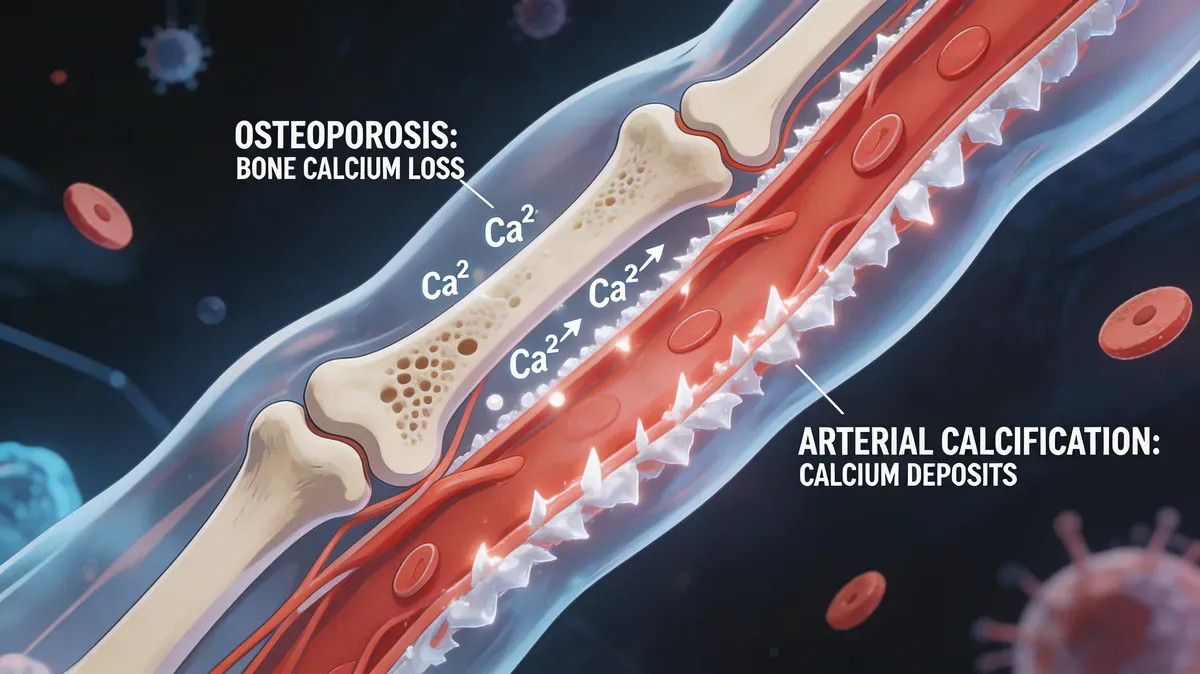
The calcium paradox describes the simultaneous occurrence of two seemingly contradictory conditions in aging adults: bones losing calcium (osteoporosis) while arteries accumulate calcium (vascular calcification).
Quick definition: The calcium paradox is the age-related redistribution of calcium from bones — where it’s needed — to arteries, joints, and soft tissues — where it causes damage, resulting in both skeletal weakness and cardiovascular stiffening.
Why the calcium paradox matters for longevity
This isn’t a minor metabolic curiosity. Vascular calcification is the primary driver of arterial stiffening — which independently predicts cardiovascular mortality. Coronary artery calcium scores directly measure this calcification and are among the strongest predictors of heart attack risk.
Meanwhile, osteoporotic fractures — particularly hip fractures — carry a 20–30% one-year mortality rate in adults over 65. The calcium paradox means that aging adults face a dual threat: weakened bones and hardened arteries, driven by the same mineral going to the wrong places. For a comprehensive approach to reversing bone loss, see our guide on osteoporosis prevention and reversal.
The science behind the calcium paradox
How calcium metabolism changes with age
In healthy adults, calcium homeostasis is tightly regulated by the gut, bone, kidneys, parathyroid hormone, vitamin D, and local vascular defenses. With age, several pressures can push bone and arteries in opposite directions.
Bone side - why calcium can be lost:
- Bone remodeling can shift toward resorption when osteoclast activity outpaces osteoblast activity.
- Estrogen decline after menopause and age-related testosterone decline can accelerate bone loss.
- Low vitamin D status, low protein intake, inactivity, corticosteroids, and some medical conditions can reduce bone strength.
- Chronic inflammation can contribute to higher bone turnover and weaker bone quality.
Arterial side - why calcification can increase:
- Vascular calcification is an active, cell-mediated process, not just passive mineral buildup.
- Matrix Gla protein is a vitamin K-dependent inhibitor of calcification, and its activity is one reason vitamin K status is being studied.
- Atherosclerotic plaque, kidney disease, diabetes, inflammation, and aging can all create calcification-prone vascular tissue.
- The clinical question is therefore not only “how much calcium,” but also diet quality, kidney function, cardiometabolic risk, medications, and imaging context.
The supplement evidence
Observational data do not all point in the same direction, but they support a practical distinction between calcium from food and high-dose supplemental calcium.
In MESA, higher total calcium intake was associated with lower incident coronary artery calcification, especially when intake came without supplements. Calcium supplement use, after accounting for total intake, was associated with higher incident CAC. A German cohort analysis reported higher myocardial infarction risk among calcium supplement users, and an earlier BMJ meta-analysis raised a similar concern. Other reviews and expert panels have disputed the size and causality of this risk, so the safest framing is conservative: prefer food first, avoid unnecessary high-dose boluses, and use supplements only when intake, fracture risk, kidney function, medications, and clinician guidance justify them.
Why the difference may matter: calcium from food is absorbed across meals. A large supplement dose can create a short-term rise in serum calcium. That does not prove arterial deposition in an individual person, but it is one reason clinicians often split doses and avoid supplementing beyond recommended total intake.
The missing cofactors
The calcium paradox is not just a calcium-intake problem. Several nutrients and proteins influence where calcium is absorbed, stored, and regulated:
- Vitamin D: supports intestinal calcium absorption and bone health.
- Vitamin K-dependent proteins: osteocalcin and matrix Gla protein are involved in bone and vascular calcium handling.
- Magnesium: participates in vitamin D metabolism and bone mineral physiology.
This does not mean everyone should automatically take a high-dose stack. Warfarin and other vitamin K antagonists, chronic kidney disease, kidney-stone history, hypercalcemia, osteoporosis medication, and baseline diet all change the decision. The goal is adequacy and context, not maximal supplementation.
7 practical strategies for the calcium paradox
1. Get calcium from food, not supplements
Why it works: Food-based calcium is absorbed gradually, preventing the serum calcium spikes that drive arterial deposition. Food sources also come packaged with cofactors (phosphorus, magnesium, protein) that support proper calcium utilization.
Best food sources:
| Food | Calcium per serving |
|---|---|
| Sardines with bones (3 oz / 85 g) | 325 mg |
| Plain yogurt (1 cup / 245 g) | 300 mg |
| Cheese, cheddar (1.5 oz / 42 g) | 307 mg |
| Kale (1 cup / 130 g cooked) | 177 mg |
| Almonds (1 oz / 28 g) | 76 mg |
| Broccoli (1 cup / 156 g cooked) | 62 mg |
How to do it:
- Target 800–1,200 mg daily from food sources distributed across meals
- Include dairy if tolerated — it’s the most efficient food calcium source
- Sardines and canned salmon (with bones) combine calcium with omega-3 fatty acids
- Dark leafy greens (kale, bok choy, collards) provide calcium with minimal oxalate interference
Expected results: Food-based calcium meets needs without the cardiovascular risk associated with supplement boluses.
2. Make vitamin K status part of the conversation
Why it matters: Vitamin K is required to carboxylate proteins involved in calcium handling, including osteocalcin and matrix Gla protein. This makes vitamin K status biologically relevant to bone and vascular calcification, but human trial evidence for K2 preventing or reversing arterial calcification is still limited and mixed.
How to do it:
- Emphasize vitamin K-rich foods: leafy greens for K1, fermented foods such as natto, and some cheeses for menaquinones.
- Discuss K2 supplements with a clinician if you use calcium supplements, have osteoporosis risk, or are tracking CAC.
- Do not start vitamin K supplements without medical guidance if you use warfarin or another vitamin K antagonist.
Expected results: Adequate vitamin K supports normal calcium-regulating proteins. It should not be presented as guaranteed arterial decalcification.
3. Keep vitamin D adequate, not excessive
Why it matters: Vitamin D helps absorb calcium and supports bone health. The practical goal is adequate status, not chasing a universal high target.
How to do it:
- Follow local RDA and clinician guidance; many healthy adults under 75 do not need routine high-dose vitamin D for disease prevention.
- Test 25(OH)D when you have risk factors, osteoporosis, malabsorption, kidney disease, symptoms, or a clinician indication.
- Avoid high-dose long-term supplementation unless prescribed; vitamin D excess can raise calcium and kidney-stone risk.
- Take vitamin D with food if supplementing.
Expected results: Correcting deficiency can support bone and muscle function. More is not automatically better.
4. Include magnesium through diet first
Why it matters: Magnesium participates in vitamin D metabolism and bone mineral physiology. Low intake can make calcium planning less reliable.
How to do it:
- Build the base with foods: nuts, seeds, legumes, whole grains, and dark leafy greens.
- If supplementing, use a modest dose and account for kidney function, medications, and gastrointestinal tolerance.
- Separate calcium and magnesium supplements if they bother your stomach or if your clinician recommends different timing.
Expected results: Adequate magnesium supports vitamin D and calcium physiology. It is a cofactor, not a standalone fix.
5. Weight-bearing exercise for bone calcium retention
Why it works: Bones respond to mechanical stress by increasing calcium deposition and mineral density. Without weight-bearing exercise, no amount of calcium supplementation prevents bone loss — the bones simply don’t receive the signal to absorb and retain calcium.
How to do it:
- Resistance training 2–3 times per week (squats, deadlifts, pressing movements)
- Impact activities: walking, jogging, stair climbing, dancing
- Balance training to prevent falls that lead to fractures
- Consistency matters more than intensity — aim for 150+ minutes weekly
Expected results: Weight-bearing exercise increases bone mineral density by 1–3% annually in postmenopausal women — comparable to or exceeding many pharmacological interventions. Pairing resistance training with creatine supplementation amplifies the skeletal response: randomized trials in postmenopausal women show creatine + resistance training preserves femoral neck density significantly better than training alone.
6. Manage inflammation to protect both bones and arteries
Why it works: Chronic inflammation drives both sides of the calcium paradox. It activates osteoclasts (increasing bone breakdown) while simultaneously transforming vascular smooth muscle cells into osteoblast-like cells (increasing arterial calcification).
How to do it:
- Address inflammatory markers — target hs-CRP below 1.0 mg/L
- Anti-inflammatory nutrition: omega-3 fatty acids, polyphenol-rich foods
- Sleep optimization: sleep deprivation increases inflammatory cytokines
- Stress management: chronic stress elevates cortisol, which directly accelerates bone loss
Expected results: Reducing systemic inflammation slows both bone loss and arterial calcification simultaneously.
7. Monitor both sides of the equation
Why it works: The calcium paradox requires dual monitoring — bone density alone isn’t sufficient if arterial health is deteriorating.
How to do it:
- DEXA scan every 2 years after age 50 for bone density
- Coronary calcium score (CAC) as baseline after age 40 (or earlier with risk factors)
- Blood markers: serum calcium, ionized calcium, vitamin D, PTH (parathyroid hormone)
- Osteocalcin (undercarboxylated) reflects K2 status
Expected results: Dual monitoring catches both bone loss and arterial calcification early, allowing targeted intervention before clinical disease develops.
How to track and measure calcium balance
Key metrics to monitor
| Metric | Useful context | What it indicates |
|---|---|---|
| Serum 25(OH)D | Interpret with your clinician; avoid deficiency and excess | Vitamin D status |
| CAC score | 0 or stable over time, interpreted by age, sex, and risk profile | Coronary calcification burden |
| DEXA T-score | Normal > -1.0; osteopenia -1.0 to -2.5; osteoporosis <= -2.5 | Bone mineral density |
| Serum calcium | Interpret with albumin, kidney function, PTH, and vitamin D | Calcium homeostasis |
| PTH | Interpret by lab range and kidney/vitamin D context | Calcium regulation |
How SuperAge helps you track cardiovascular and metabolic health
The calcium paradox is not measured by one wearable metric, but SuperAge helps keep the surrounding cardiovascular and lifestyle signals in view.
Blood pressure and cardiovascular trends
As arteries stiffen with age, systolic blood pressure can rise. SuperAge helps you follow blood-pressure trends through Apple Health integration, so changes are easier to discuss with your clinician alongside CAC, lipids, kidney function, and medication history.
Resting heart rate and recovery
Resting heart rate and recovery trends do not diagnose calcification, but they add context to cardiovascular fitness, sleep, training load, and stress while you work on bone and vascular health.
Biological age as a broader signal
SuperAge combines multiple cardiovascular and metabolic inputs. Better nutrition, resistance training, sleep, and blood-pressure control can all support a healthier biological age trend over time.
Frequently asked questions
Should I stop taking calcium supplements?
Do not stop a prescribed supplement on your own. If your diet already provides enough calcium, extra supplementation may be unnecessary. If you need a supplement because of low intake, osteoporosis risk, diet restrictions, or clinician advice, keep total calcium within recommended limits, consider divided doses, and account for kidney stones, kidney disease, hypercalcemia, and medications.
At what age does the calcium paradox begin?
Measurable changes start in the late 30s to early 40s for both bone density loss and arterial calcification. However, the clinical consequences typically become significant after 50 for women (post-menopause) and after 60 for men. Prevention should begin decades before clinical disease appears.
Does vitamin K2 really prevent arterial calcification?
Vitamin K-dependent proteins are involved in vascular and bone calcium handling, and observational studies link higher menaquinone intake with better cardiovascular outcomes. That is not the same as proof that K2 supplements prevent or reverse arterial calcification in everyone. Randomized trial evidence is still limited and mixed, and vitamin K supplements require medical guidance if you take warfarin.
Can the calcium paradox be reversed?
Bone density can sometimes improve, and bone loss can often be slowed, with resistance training, adequate nutrition, fall prevention, and osteoporosis medication when indicated. Arterial calcification is harder: current evidence supports slowing progression and improving overall risk factors more than promising complete reversal of established calcification.
How much calcium do I actually need per day?
Most adults need about 1,000 mg/day of calcium, rising to 1,200 mg/day for women over 50 and men over 70 in U.S. guidance. Count food plus supplements together, and avoid exceeding the adult upper limit unless your clinician has a specific reason. People with kidney disease, kidney stones, hyperparathyroidism, or osteoporosis treatment plans need individualized advice.
Key takeaways
- The calcium paradox is not simply a calcium-intake problem: aging can combine bone loss with vascular calcification.
- Food calcium is usually the first target: supplements can help selected people, but unnecessary high-dose boluses deserve caution.
- Vitamin D, vitamin K, and magnesium matter as context: they support calcium physiology, but they are not guaranteed arterial-decalcification tools.
- Track both sides of the pattern: DEXA helps assess bones, while CAC and cardiovascular risk markers help assess arteries.
- Individualize supplementation with a clinician when osteoporosis, kidney disease, kidney stones, medications, or abnormal calcium labs are involved.
Start protecting your bones and arteries today
Bone and vascular health move slowly. SuperAge helps you keep cardiovascular metrics, lifestyle trends, and biological age signals organized while DEXA, CAC, and bloodwork provide the clinical context.
Ready to track your cardiovascular health? Download SuperAge and start monitoring the biological age metrics that reflect both arterial and metabolic health.
Related reading:
- Arterial stiffness and vascular aging
- Osteoporosis prevention and DEXA tracking
- Vitamin D and biological age
References
- NIH Office of Dietary Supplements. Calcium: Fact Sheet for Health Professionals.
- NIAMS. Calcium and Vitamin D: Important for Bone Health.
- NIH Office of Dietary Supplements. Vitamin K: Fact Sheet for Health Professionals.
- Endocrine Society. Vitamin D for the Prevention of Disease: Clinical Practice Guideline.
- Anderson et al. (2016). Calcium intake from diet and supplements and risk of coronary artery calcification: MESA.
- Bolland et al. (2010). Effect of calcium supplements on risk of myocardial infarction and cardiovascular events. BMJ.
- Li et al. (2012). Associations of dietary calcium intake and calcium supplementation with myocardial infarction and stroke risk. Heart.
- Geleijnse et al. (2004). Dietary intake of menaquinone and coronary heart disease: Rotterdam Study.
- Vlasschaert et al. (2020). Vitamin K supplementation for the prevention of cardiovascular disease: where is the evidence?
- Li et al. (2023). Vitamin K supplementation and vascular calcification: systematic review and meta-analysis of randomized controlled trials.
- USPSTF. Vitamin D, calcium, or combined supplementation for primary prevention of fractures.
- Masse et al. (2026). Calcium, vitamin D, or combined supplementation to prevent fractures and falls. BMJ.
Related Articles

Vitamin K2 and biological aging: What the evidence says about arteries, bones, and longevity
The Rotterdam Study linked higher vitamin K2 intake with lower coronary mortality, and a 2026 randomized trial found slower CAC progression with MK-7. Here is what K2 can and cannot prove for artery, bone, and longevity health.