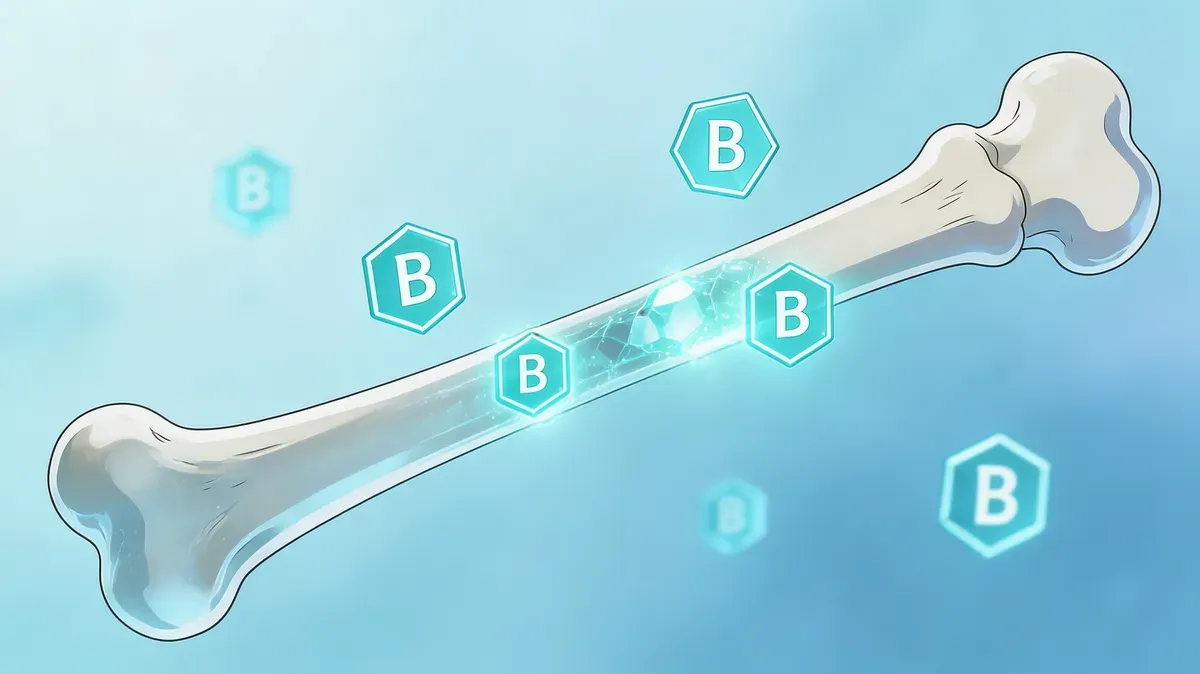
Boron: The overlooked mineral for hormones and bones
Boron supports testosterone, estrogen, vitamin D metabolism, and bone density — yet most adults get too little. Evidence-based guide to boron and longevity.
There’s a trace mineral that increases free testosterone, enhances vitamin D metabolism, strengthens bones, reduces inflammatory markers, and improves cognitive function — and almost nobody knows about it. Meet boron. Despite its impressive evidence profile, boron remains absent from most longevity supplement stacks — a gap that may be costing many adults measurable hormonal and bone benefits.
Boron doesn’t appear on standard blood panels. It’s absent from most multivitamins. No government has established an RDA for it. Yet research consistently shows that boron modulates the very hormones and metabolic pathways that determine how fast you age — testosterone, estrogen, vitamin D, and magnesium utilization.
The average American gets only 1–2 mg of boron daily from food — well below the 3–6 mg range where studies demonstrate measurable benefits. In regions with high natural boron intake (parts of Turkey, Israel, and Chile), populations show significantly lower rates of osteoarthritis, osteoporosis, and prostate cancer. Coincidence? The accumulating evidence says otherwise.
What you’ll learn:
- How boron modulates testosterone, estrogen, and vitamin D
- The bone-protective mechanisms that make boron essential after 40
- The anti-inflammatory evidence, dosing limits, and where the data is still preliminary
- Evidence-based dosing for hormonal and skeletal optimization
Quick answer
Boron is a trace mineral in plant foods that may support hormone signaling, vitamin D and calcium-magnesium metabolism, bone markers, and inflammation, but the human evidence is mostly small trials and observational data.
Key facts
- Boron has no official RDA; U.S. data suggest typical adult intake is about 1.0-1.5 mg/day.
- Small human studies usually use 3-10 mg/day; the adult tolerable upper intake level is 20 mg/day.
- Best food sources include avocado, raisins, prunes or prune juice, beans, nuts, and fruit.
- Evidence is strongest for mineral metabolism and joint-discomfort signals; cancer and testosterone claims remain preliminary.
What is boron?
Boron is an ultra-trace mineral found in soil, water, and plant foods — particularly fruits, nuts, and legumes. It’s classified as “possibly essential” rather than formally essential, largely because deficiency symptoms are subtle and develop slowly.
Quick definition: Boron is a trace mineral that modulates the metabolism of calcium, magnesium, vitamin D, and steroid hormones — influencing bone density, hormonal balance, inflammation, and cognitive function.
Why boron matters for aging
Boron sits at the intersection of three aging-critical systems:
- Hormonal regulation: Boron increases free testosterone and estradiol while reducing sex hormone-binding globulin (SHBG) — the protein that binds and inactivates sex hormones
- Bone metabolism: Boron improves calcium and magnesium retention, enhances vitamin D’s effects on bone, and reduces urinary calcium excretion
- Inflammation control: Boron supplementation has been shown to reduce hs-CRP, TNF-α, and IL-6 — the inflammatory cytokines that drive biological aging
The science behind boron and aging
How boron affects your hormones
A landmark 2011 study published in the Journal of Trace Elements in Medicine and Biology found that just 6 mg of boron daily for one week produced remarkable hormonal changes in healthy men:
- Free testosterone increased 28% (from 11.83 to 15.18 pg/mL)
- Free estradiol decreased 39% (reducing excess estrogenic activity)
- SHBG decreased (freeing more bioavailable testosterone)
- DHT (dihydrotestosterone) increased 10%
- hs-CRP decreased 50% (from 1.55 to 0.74 mg/L)
These results are interesting, but they come from a small, short-term human study. Treat them as a measurable signal, not a guaranteed effect or a substitute for medical treatment.
In women, boron’s effects are equally relevant but different. Boron supports estrogen metabolism, which is critical for bone preservation during and after menopause. Postmenopausal women with higher boron intake show better bone mineral density and lower fracture risk.
How boron protects bones
Boron’s bone-protective effects work through multiple mechanisms:
- Reduces urinary calcium and magnesium excretion — keeping bone minerals in the body
- Enhances vitamin D activation — boron is required for the hydroxylation of vitamin D to its active 1,25-dihydroxy form
- Stimulates osteoblast activity — the bone-building cells
- Inhibits osteoclast activity — the bone-resorbing cells
- Improves the integration of calcium into bone matrix
A USDA study found that boron deprivation in postmenopausal women significantly increased urinary calcium excretion by 44% and magnesium excretion by 33% — essentially accelerating mineral loss from bones. Restoring boron reversed these losses.
Boron and longevity: what the research says
Epidemiological data paints a consistent picture. Regions with naturally high boron in water and food show:
- A Turkish observational study found more favorable prostate measurements with higher boron exposure, but it did not prove prostate-cancer prevention
- Significantly lower arthritis prevalence in countries with boron intake above 3 mg/day
- Better bone mineral density in populations consuming boron-rich diets
The boron evidence has longevity relevance, but it does not prove causality. Short human studies show shifts in hs-CRP and inflammatory markers; cancer and lifespan outcomes still need stronger trials.
6 proven ways to optimize boron for longevity
1. Increase boron-rich foods
Why it works: Dietary boron comes primarily from plant foods grown in boron-rich soils. Fruits, nuts, and legumes are the best sources.
| Food | Boron per serving |
|---|---|
| Prunes (1/2 cup / 85 g) | 1.18 mg |
| Raisins (1/4 cup / 40 g) | 0.95 mg |
| Avocado (1 medium) | 1.07 mg |
| Almonds (1 oz / 28 g) | 0.70 mg |
| Chickpeas (1/2 cup / 82 g cooked) | 0.71 mg |
| Red grapes (1 cup / 150 g) | 0.61 mg |
| Peanut butter (2 tbsp / 32 g) | 0.58 mg |
| Apples (1 medium) | 0.56 mg |
How to do it:
- Include 2–3 servings of boron-rich foods daily
- A handful of almonds + an avocado + dried fruit easily provides 2–3 mg
- Mediterranean-style diets naturally deliver higher boron intake
Expected results: Dietary optimization can bring intake from 1–2 mg to 3–4 mg daily — approaching the threshold where hormonal and bone benefits appear.
2. Supplement 3–6 mg daily
Why it works: Reaching the 6 mg threshold where most studies show significant hormonal and anti-inflammatory effects is difficult from food alone for many Western diets.
How to do it:
- 3 mg daily for general maintenance and mild hormonal support
- 6 mg daily for targeted testosterone optimization or bone support
- 9–10 mg daily is the tolerable upper limit — do not exceed without medical supervision
- Common supplement forms: boron citrate, boron glycinate, or sodium borate
- Take with food to improve absorption
Expected results: Hormonal changes (increased free testosterone, reduced SHBG) typically measurable within 1–2 weeks at 6 mg/day.
3. Combine with vitamin D and magnesium
Why it works: Boron enhances vitamin D activation and magnesium retention. Taking boron with these cofactors creates a synergistic effect greater than any supplement alone.
The synergy stack:
- Boron 6 mg + Vitamin D3 4,000–5,000 IU + Magnesium 400 mg
- Boron increases the serum half-life of both vitamin D and magnesium
- Together, they optimize calcium metabolism without the risks of calcium supplementation
Expected results: The combination addresses the bone-vascular calcium paradox more effectively than calcium supplements — directing calcium to bones while protecting arteries.
4. Address the sarcopenia connection
Why it works: Boron’s testosterone-boosting effects directly support muscle preservation — a critical factor in preventing sarcopenia after 40. Free testosterone is the primary hormonal driver of muscle protein synthesis.
How to do it:
- Combine boron supplementation with resistance training for synergistic muscle support
- Ensure adequate protein intake (1.2–1.6 g/kg body weight daily)
- Consider boron as part of a broader hormonal optimization strategy
Expected results: Free-testosterone markers may shift within 1-2 weeks in small studies, but the size of the effect varies and should be confirmed with labs rather than symptoms alone.
5. Leverage anti-inflammatory effects
Why it works: Small studies suggest boron or calcium fructoborate can lower CRP and other inflammatory markers. That makes it promising, not a proven stand-alone anti-inflammatory treatment.
How to do it:
- Track hs-CRP before and 4 weeks after starting boron supplementation
- Combine with omega-3 fatty acids for additive anti-inflammatory effects
- Address other inflammatory drivers: sleep quality, stress, visceral fat
Expected results: hs-CRP reduction from boron supplementation is typically evident within 1–2 weeks and sustained with continued use.
6. Support joint health proactively
Why it works: Boron may influence inflammatory mediators and joint comfort. Small calcium fructoborate trials report improvements in knee discomfort or inflammation markers, but the evidence does not prove arthritis prevention.
How to do it:
- 6 mg daily for joint maintenance
- Combine with glucosamine and omega-3 for comprehensive joint support
- Start before symptomatic arthritis develops — prevention is more effective than treatment
Expected results: Reduced joint stiffness and inflammation, particularly noticeable in combination with exercise and anti-inflammatory nutrition.
How to track and measure boron’s impact
Key metrics to monitor
| Metric | Optimal Range | What It Indicates |
|---|---|---|
| Free testosterone | Upper third of age-adjusted range | Hormonal optimization |
| hs-CRP | < 1.0 mg/L | Systemic inflammation |
| 25(OH) vitamin D | 40–60 ng/mL | Vitamin D status (enhanced by boron) |
| DEXA T-score | > -1.0 | Bone mineral density |
| SHBG | Lower third of range | Hormone bioavailability |
How SuperAge helps you track hormonal health
Hormonal changes affect everything from energy levels to recovery speed — and SuperAge captures these downstream effects daily.
Recovery and performance metrics
Testosterone influences muscle recovery, exercise capacity, and training adaptation. As boron supplementation increases free testosterone, SuperAge tracks the improvements in recovery time, exercise tolerance, and daily activity patterns.
Sleep quality indicators
Hormonal balance directly affects sleep architecture. SuperAge monitors sleep duration, consistency, and quality — metrics that often improve with optimized testosterone and reduced inflammation.
Biological age trends
SuperAge’s biological age calculation reflects the cardiovascular, metabolic, and recovery metrics that hormonal optimization improves. The anti-inflammatory and hormonal effects of boron contribute to the broader pattern of metrics that trend toward a younger biological age.
Frequently asked questions
Is boron safe for long-term use?
Small human studies usually use 3-10 mg/day; the adult tolerable upper intake level is 20 mg/day.
Does boron increase estrogen in men?
No — paradoxically, boron tends to decrease excess estradiol in men while increasing free testosterone. The mechanism involves modulation of SHBG and sex hormone metabolism rather than direct estrogenic activity. This makes boron particularly useful for men with elevated estrogen-to-testosterone ratios.
Can women take boron supplements?
Absolutely. Boron supports bone mineral density, which is critical for women during and after menopause. It also supports healthy estrogen metabolism — not increasing estrogen levels dangerously, but supporting proper hormonal cycling and bone calcium retention.
How does boron compare to other testosterone boosters?
Unlike many “testosterone boosters,” boron has small human studies showing measurable changes in free testosterone and SHBG. The evidence is still not strong enough to treat boron as a therapy for low testosterone.
Should I take boron with food or on an empty stomach?
With food is preferred. Boron absorption is generally good (about 85–95% bioavailability) but taking it with a meal reduces potential GI discomfort and ensures consistent absorption.
Key takeaways
- Boron is one of the most underappreciated longevity minerals — modulating testosterone, estrogen, vitamin D, and inflammation simultaneously
- In small studies, 6-10 mg/day changed free-testosterone and CRP markers over short periods, but individual effects should be confirmed with lab testing
- Boron protects bones through multiple pathways — reducing calcium/magnesium excretion, enhancing vitamin D, and stimulating osteoblasts
- Combine with vitamin D3 and magnesium for synergistic hormonal and bone benefits that exceed any single supplement
- Track your full trace mineral picture — boron works alongside copper, zinc, and selenium; the zinc-copper balance in particular is a longevity biomarker worth monitoring if you supplement zinc, and molybdenum rounds out the group as the cofactor for the body’s detox enzyme system
Start optimizing your hormonal health today
A mineral that costs pennies per day and supports testosterone, bone density, and inflammation control simultaneously is too impactful to ignore.
Ready to track how your body responds? Download SuperAge and start monitoring the biological age metrics that reflect hormonal optimization and metabolic health.
References
- NIH Office of Dietary Supplements. “Boron - Health Professional Fact Sheet.” https://ods.od.nih.gov/factsheets/Boron-HealthProfessional/
- Naghii, M.R. et al. (2011). “Comparative effects of daily and weekly boron supplementation on plasma steroid hormones and proinflammatory cytokines.” Journal of Trace Elements in Medicine and Biology, 25(1), 54-58. https://doi.org/10.1016/j.jtemb.2010.10.001
- Nielsen, F.H. (2014). “Update on human health effects of boron.” Journal of Trace Elements in Medicine and Biology, 28(4), 383-387. https://doi.org/10.1016/j.jtemb.2014.06.023
- Nielsen, F.H. et al. (1987). “Effect of dietary boron on mineral, estrogen, and testosterone metabolism in postmenopausal women.” The FASEB Journal, 1(5), 394-397. https://doi.org/10.1096/fasebj.1.5.3678698
- Scorei, R. et al. (2011). “A double-blind, placebo-controlled pilot study to evaluate the effect of calcium fructoborate on systemic inflammation and dyslipidemia markers for middle-aged people with primary osteoarthritis.” Biological Trace Element Research, 144, 253-263. https://doi.org/10.1007/s12011-011-9083-0
- Pietrzkowski, Z. et al. (2014). “Short-term efficacy of calcium fructoborate on subjects with knee discomfort.” Clinical Interventions in Aging, 9, 895-899. https://doi.org/10.2147/CIA.S64590
- Muezzinoglu, T. et al. (2011). “Prevalence of prostate cancer in high boron-exposed population: a community-based study.” Biological Trace Element Research, 144, 49-57. https://doi.org/10.1007/s12011-011-9023-z
- Hakki, S.S. et al. (2010). “Boron regulates mineralized tissue-associated proteins in osteoblasts.” Journal of Trace Elements in Medicine and Biology, 24(4), 243-250. https://doi.org/10.1016/j.jtemb.2010.03.003
Last updated: March 2026. This article is regularly reviewed to ensure accuracy.
The information provided does not replace professional medical advice. Consult your healthcare provider before starting any supplementation.
Related Articles
Andropause vs low testosterone: what is the difference?
Learn how andropause differs from low testosterone, which symptoms matter, what labs confirm, and when lifestyle context is not enough for men.