Cardio without running: choose your activity and build a week
Build cardio without running with walking, cycling, water exercise, or indoor options. Learn effort cues, practical sessions, and a weekly plan you can adapt.
Quick answer
You can build cardiovascular fitness without running. Choose an activity that raises breathing for a sustainable period: brisk walking, cycling, swimming, water aerobics, an elliptical trainer, rowing, or continuous dancing. Start with a mode you can repeat comfortably, use the talk test to control effort, and increase your weekly minutes gradually. Running is one option for aerobic exercise, not a requirement.
This guide helps you choose among modes and put them into a week. It is a general fitness framework, not rehabilitation for an injury or a substitute for a condition-specific exercise prescription.
Key facts
- Aerobic exercise increases the sustained demand on the heart, lungs, and working muscles.
- The talk test distinguishes moderate effort from more demanding exercise.
- Low-impact activities reduce landing impact without necessarily reducing cardiovascular effort.
- A repeatable schedule builds aerobic training volume across different activities.
- Strength training complements aerobic exercise rather than being replaced by it.
Start with the constraint, then choose the activity
The useful question is not which activity is universally best. It is which one you can perform regularly at an appropriate effort, with acceptable symptoms and realistic access. A pool session that requires a long journey may happen less often than a brisk walk from your door. Conversely, water exercise may make movement feasible when standing exercise is uncomfortable.
Identify your main constraint before choosing:
- Landing impact: try a supported or water-based mode rather than adding jumps to a circuit.
- Time: choose something with little preparation and count shorter sessions.
- Balance or confidence: consider a stable indoor setup and appropriate supervision.
- Boredom: alternate two accessible modes or use music for continuous movement.
- A running goal: use alternatives to supplement training while remembering that running skill and tissue tolerance still need specific practice.
The complete exercise guide places aerobic activity alongside strength, balance, and mobility. Here, the narrower task is to find your non-running aerobic options.
Compare seven ways to do cardio without running
These are practical selection notes, not a ranking of calorie burn or a promise that an activity will suit every joint.
| Activity | Useful starting situation | How to adjust the session | Main point to watch |
|---|---|---|---|
| Brisk walking | Simple outdoor or indoor access | Change pace, duration, or a gentle incline | Avoid forcing a long stride or painful hills |
| Cycling | You prefer supported, rhythmic leg work | Change resistance while keeping smooth pedaling | Adjust the setup; discomfort is not necessary |
| Swimming or water aerobics | You want less weight bearing | Alternate manageable lengths or continuous water movements | Water confidence, supervision, and technique matter |
| Elliptical trainer | You want standing movement without repeated landings | Adjust resistance and cadence | Use a comfortable stride and stable posture |
| Rowing machine | You enjoy coordinated whole-body movement | Begin with short, controlled bouts | Learn the sequence before adding force or speed |
| Continuous dancing | Enjoyment and home access help you repeat it | Use longer movement blocks and fewer jumps | Clear the floor and choose controlled turns |
| Seated aerobic movement | Standing is a barrier | Use continuous arm and leg patterns within your capacity | Use a stable chair; seek guidance for individual limitations |
Walking: make ordinary movement purposeful
Choose a route where you can keep moving without constant stops. Begin easily, then settle into a pace that noticeably raises breathing. Speed is individual; a fixed miles-per-hour target is unnecessary. If you want detailed posture and stride cues, use the fitness walking technique guide.
Cycling and indoor machines: make the setup repeatable
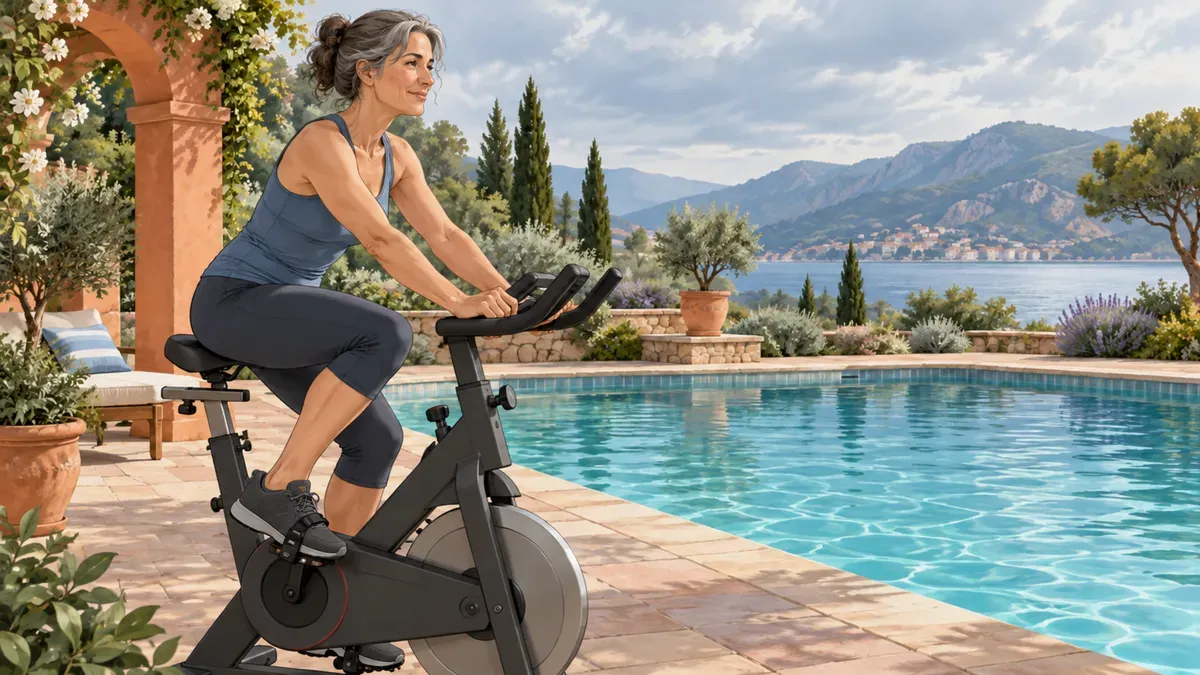
An indoor bike makes workload easy to adjust without traffic or weather. Begin with a resistance that lets you pedal smoothly instead of pushing through an awkward, heavy stroke. On an elliptical, avoid hanging your weight through the handles. With rowing, keep the first sessions focused on a controlled legs-body-arms drive and reverse recovery, ideally with instruction.
Being breathless does not prove that technique is sound. If one small muscle group gives out before you can sustain the intended effort, reduce the load, check the setup, or choose another mode.
Water and music: choose movement you will return to
The NIDDK activity guide describes cycling, dancing, chair dancing, and water exercise as accessible options. Water reduces weight bearing, but swimming still requires skill. A supervised shallow-water class can be a different choice from swimming lengths; neither should be treated as automatically safe for everyone.
Dancing can be aerobic when movement is sustained. You do not have to jump. Side steps, controlled marches, and arm patterns can create a continuous session, provided the effort actually rises above an easy shuffle.
Match the effort before comparing the minutes
Use breathing and perceived effort to make the session purposeful. According to the CDC intensity guidance, moderate effort generally allows conversation but makes singing difficult. Vigorous effort restricts speech to a few words before another breath. On its general 0–10 effort scale, moderate activity is around 5–6 and vigorous activity starts around 7–8.
Those numbers describe perceived effort, not joint pain. For the differences between scales and how to calibrate them, see the perceived exertion guide.
Check yourself after you have settled into the activity rather than during the first few seconds. A useful sequence is: notice breathing, try a short sentence, rate whole-body effort, and adjust resistance or pace. If breathing is comfortable but your knees hurt, raising the resistance is the wrong response.
Low impact and low intensity describe different things. A hard cycling interval can have little landing impact; an easy walk may have modest cardiovascular demand. Likewise, matching a heart-rate number across swimming, rowing, and walking does not guarantee an identical stimulus. Use the heart-rate zones by sport guide for that distinction.
Build a session you can finish with control
Here is an illustrative starter session for an adult who already tolerates easy movement. It is a coaching example, not a tested treatment protocol.
- Begin with 5 minutes easy in your chosen mode.
- Do 10–15 minutes at a controlled, moderate effort. If necessary, alternate 2 minutes purposeful movement with 1 minute easier movement.
- Finish with 5 minutes easy and check how you feel afterward.
Count the minutes that actually reach the intended intensity separately from warm-up and recovery. A 25-minute visit to the bike is not necessarily 25 minutes of moderate exercise.
For example, Maya chooses 12 minutes of moderate cycling between two 5-minute easy periods. She records 22 total minutes and 12 moderate minutes. On another day, three purposeful 5-minute walks provide 15 moderate minutes. Both entries help her see the week clearly without pretending that the sessions are identical.
At home, a balanced equipment-free workout is useful when you also need strength movements. Keep enough continuous aerobic work to serve the cardio goal; a few fast repetitions separated by long rests are a different session.
Grow from a starting week toward the guideline
The WHO adult recommendations advise 150–300 minutes of moderate aerobic activity per week, 75–150 minutes vigorous, or an equivalent combination, plus muscle strengthening on at least two days. Some activity is better than none. The target is a direction to build toward when you are inactive, not a compulsory first-week dose.
The example below uses moderate main-set minutes, excluding easy preparation and recovery. Choose any suitable mix of modes. Repeat a stage when needed; the row number is not a deadline.
| Stage | Aerobic sessions | Moderate minutes per session | Weekly moderate total | Purpose |
|---|---|---|---|---|
| Find a repeatable dose | 3 | 10 | 30 | Test access, comfort, and recovery |
| Extend the main set | 3 | 15 | 45 | Sustain effort with control |
| Add an opportunity | 4 | 15 | 60 | Make frequency manageable |
| Build the habit | 4 | 20 | 80 | Tolerate a longer week |
| Work toward the guideline | 5 | 30 | 150 | Reach the lower moderate target when ready |
Do not jump directly from 80 to 150 minutes because those rows are adjacent. Add intermediate weeks or stages. Increase duration or frequency first, then consider harder effort once the current amount feels manageable. If fatigue accumulates or discomfort persists, reduce the dose and reassess rather than following the table mechanically.
For a person already comfortable with 150 minutes, one possible week is 30 minutes of brisk walking on Monday, cycling on Tuesday, dancing on Thursday, water exercise on Saturday, and walking on Sunday. Add suitable strength work on two days, with recovery arranged around the whole schedule. The strength and cardio guide explains how those pieces fit together.
What improvement can you reasonably expect?
Look for a repeatable activity becoming easier, a longer controlled session at the same perceived effort, or more consistent weekly participation. Compare like with like: the same bike setup, similar walking conditions, or a similar pool session. Learning a new movement can improve performance before a large change in aerobic capacity occurs.
The randomized DREW trial studied 464 previously sedentary, overweight or obese postmenopausal women with elevated blood pressure over six months. Fitness improved in a graded fashion across exercise doses. This supports the value of manageable aerobic training volume, but it does not prove that our example schedule produces a particular percentage improvement or that every activity gives identical results.
General cardiovascular fitness can improve through different modes, while sport performance remains partly specific. Cycling may help your aerobic base without fully preparing your feet and legs for running. If injury led you to stop running, being able to cycle comfortably is not clearance to resume it.
Put activity trends in context with SuperAge
After you have a workable routine, a record can help you assess consistency. SuperAge brings activity and recovery trends together so you can review your wider pattern alongside the sessions you choose. A simple note of activity, duration, effort, and symptoms remains useful even when a particular workout produces no fitness estimate.
Treat trends as context for decisions, not proof that an activity has reversed aging or a medical clearance to train. The WHO overview supports regular movement for physical and mental health; it does not require running or a proprietary score.
Explore SuperAge on the App Store if you want activity and recovery information in one place.
Adjust for symptoms and avoid false shortcuts
If a joint problem limits activity, choose the mode and dose with an appropriate clinician or physiotherapist. MedlinePlus guidance for arthritis discusses options including stationary cycling and water exercise, with gradual adjustment. A label such as low impact does not guarantee pain-free movement for your condition.
Stop exercising and seek urgent medical help for chest pain or pressure, fainting, or severe or unusual breathlessness. Seek individual advice before progressing when you have concerning symptoms, an unstable medical condition, or an injury that changes movement.
Avoid three common shortcuts: using a higher sweat rate as a fitness score, choosing the activity with the largest estimated calorie number, and replacing every easy session with intervals. Heat, movement efficiency, and local fatigue can distort those comparisons. A session is useful when it serves its purpose and leaves you able to continue the plan.
Key takeaways
- Choose non-running cardio around comfort, access, skill, and enjoyment.
- Distinguish landing impact from aerobic intensity.
- Count purposeful main-set minutes and build the week gradually.
- Keep strength work and recovery in the schedule.
- Assess progress within a repeatable activity rather than comparing machine displays.
FAQ
Can I improve cardio fitness without running at all?
Yes. Sustained walking, cycling, swimming, dancing, and other aerobic activities can train cardiovascular fitness. The activity needs enough effort and repeatable volume for your starting level. Running remains useful when running performance itself is the goal.
What is the easiest non-running cardio to start?
A short walk is often practical because it needs little setup. A stationary bike, water class, or seated routine may be more suitable when standing, balance, or joint symptoms are barriers. Start with the most repeatable appropriate option, not a universal ranking.
Does low impact mean the workout is easy?
No. Impact describes mechanical loading associated with contact and landings. Intensity describes physiological demand. Cycling can be vigorous without repeated landings, and an easy walk can remain light activity.
Do short sessions count?
Yes. Activity can accumulate in shorter periods. Record the time you actually spend at the intended effort, and do not assume that an entire session is moderate because it contains a few demanding moments.
Should I do intervals instead of steady cardio?
Intervals are optional. Start with a dose you can control and repeat. Alternating purposeful and easy movement can help break up a session, but maximal efforts are unnecessary for beginning a useful aerobic routine.
Is swimming always the best choice for sore knees?
No single mode suits every cause of knee pain. Water reduces weight bearing, but strokes, kicking, access, and individual symptoms matter. Persistent pain needs assessment and an individualized choice rather than a generic best-exercise claim.
Can I replace my runs minute for minute with cycling?
You can use cycling to contribute to aerobic activity, but equal time does not make two workouts identical. Consider effort, training history, and the goal. Alternative cardio does not fully reproduce running-specific loading or technique.
How do I know when to progress?
Progress when the current session is controlled, you can repeat the schedule, and symptoms and fatigue are acceptable afterward. Add a little duration or another manageable session before changing several variables together. Repeat a stage if you need more time.
References
- World Health Organization. Recommendations: WHO guidelines on physical activity and sedentary behaviour. 2020.
- Centers for Disease Control and Prevention. How to measure physical activity intensity. Updated 2025.
- National Institute of Diabetes and Digestive and Kidney Diseases. Staying active at any size.
- Church TS, et al. Effects of different doses of physical activity on cardiorespiratory fitness: a randomized controlled trial. JAMA. 2007;297:2081–2091.
- MedlinePlus. Stay active and exercise when you have arthritis.
- World Health Organization. Physical activity. 2024.
Related Articles

Bunion treatment options: what helps and when surgery makes sense
Bunion treatment can ease pain without straightening the joint. Learn what shoes, pads, orthoses, and exercises can do, and when surgery makes sense for you.