How to start skateboarding: balance, push, turn, and stop
Learn how to start skateboarding with a safe first-session plan for stance, balance, pushing, turning, and stopping before you try tricks or speed.
To start skateboarding, learn to control a rolling board before you think about tricks. Find a smooth, level space away from traffic; wear a fitted skateboard helmet and protective gear; then practise standing, stepping off, pushing once, rolling, turning gently, and braking with your back foot. Keep the first session slow enough that you can walk off the board.
That order makes the task manageable. A new rider needs to learn where their weight belongs, how the board responds, and how to end a run on purpose. Skateboard GB’s beginner framework similarly focuses on stance, balance, pushing, turning, stopping, and safety (Cruiser Award). The drills below turn those skills into a practical first-session sequence. They are coaching cues, not a guarantee against falls.
Quick answer
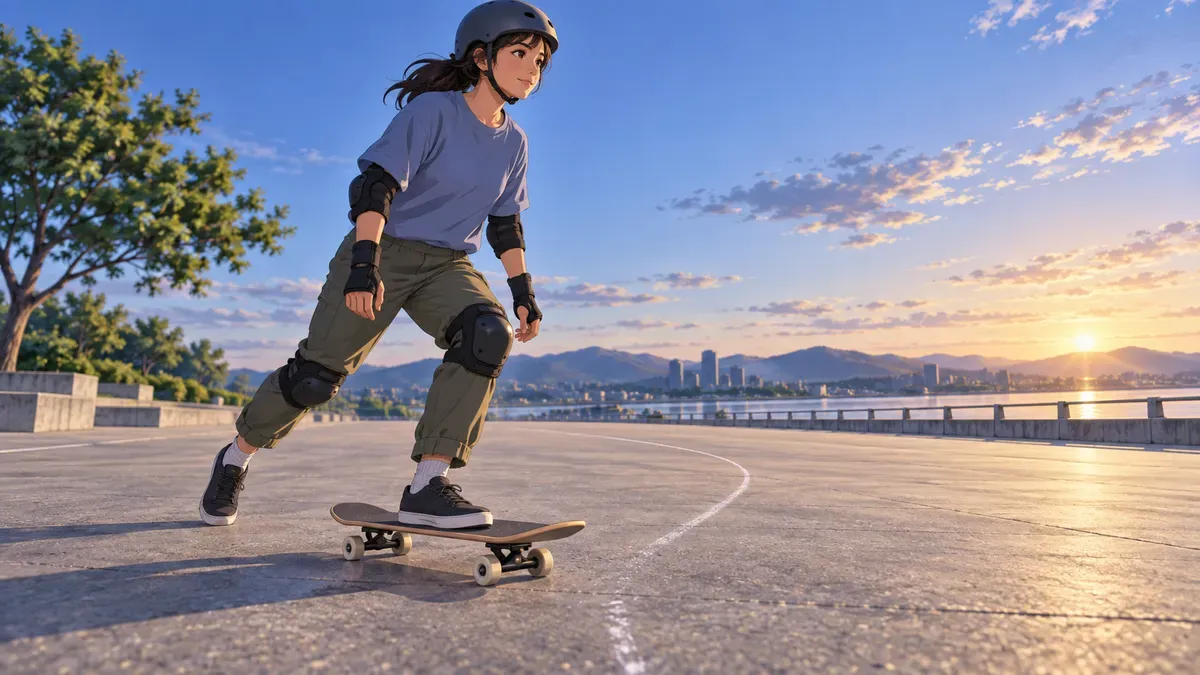
Start on flat, dry ground with a helmet, wrist guards, knee and elbow pads, and closed, flat-soled shoes. Put your front foot over the front bolts, bend both knees, and practise stepping off while the board is still. Add one gentle push, return your pushing foot to the deck, look ahead, and coast. Learn a gradual foot brake before gaining speed. Turn by shifting pressure gently toward your toes or heels. Repeat each skill at walking pace until you can start, steer, and stop deliberately.
Key facts
- A controlled step-off gives a beginner an exit, before speed makes a mistake harder to correct.
- A front foot over the front truck anchors the push, while soft knees help the rider absorb small changes in the surface.
- A foot brake removes speed progressively, making it a useful first stopping method on level ground.
- A fitted skateboard helmet protects against serious head injury, but no helmet is concussion-proof.
- A safe practice area reduces avoidable hazards, including traffic, loose stones, wet pavement, and unexpected slopes.
Choose a place and equipment for the first session
Use a wide, smooth, dry, level area with plenty of empty space ahead and to both sides. A quiet indoor sports space or suitable open paved area can work; you do not need a ramp or a crowded skatepark to learn the basics. Inspect the surface for cracks, gravel, puddles, oil, and any slight downhill grade. Keep well away from cars, cyclists, pedestrians, and obstacles. The U.S. Consumer Product Safety Commission recommends inspecting terrain, avoiding traffic, and riding within your control.
Wear a helmet designed and certified for skateboarding. It should sit level and snug with its strap fastened, without blocking your view. The CDC’s skateboard helmet guide explains fit in detail and cautions that no helmet prevents every concussion. Wrist guards, knee pads, elbow pads, and closed shoes with grippy flat soles are sensible while falls are frequent. A helmet and pads reduce consequences; they do not make an unsafe setting safe.
Before stepping on, check that the deck is not cracked, wheels rotate freely, and trucks and mounting hardware are secure. Ask a knowledgeable skater or qualified coach if you are unsure about a mechanical fault. Avoid trying to repair a damaged board with an improvised fix. You need a sound, controllable board, not a special product or a speed-oriented setup.
For children, supervision matters. The American Academy of Pediatrics advises that children under five should not skateboard and that children aged six to ten need close adult supervision. Adults who have balance problems, a recent concussion, or a recent limb injury should seek individual advice before trying a fall-prone activity.
Find a stable stance before rolling
Place the board on a grippy mat or grass so it cannot roll. Step on with one foot near the front bolts, then the other over the rear bolts. Keep the feet roughly shoulder-width apart, knees soft, hips centered between the trucks, and eyes on the path ahead. Your upper body should be relaxed enough to make small corrections. Do not lock the knees or lean far backward.
There is no superior lead foot for everyone. Try left foot forward and right foot forward while stationary. Choose the arrangement in which stepping on, stepping off, and pushing feel more controlled; do not infer stance from a surprise shove. Practise ten calm mount-and-dismount repetitions, alternating which foot steps off first. If the board shoots away, return to the stationary setup and shorten your steps.
Next, on smooth flat ground, have a qualified coach or trusted helper steady the board lightly if needed. Shift your weight a little toward the toes and heels, then return to center. Notice that the deck tilts under your feet while your head can remain roughly over the board. The goal is small recoverable shifts, not a long stationary balance contest. For broader balance work away from the board, see our balance training guide.
Push once, then ride with both feet on the board
Stand with the front foot over the front truck, pointing mostly forward. Place most of your weight on that leg. Lower the other foot beside the board, push the ground gently backward, then return it over the rear bolts. Rotate the front foot toward a sideways riding stance once you are coasting. Look ahead rather than down at the wheels.
Begin with one short push and a brief glide. Step off before the board reaches an uncomfortable speed. Repeat until the sequence feels predictable: front foot supports, back foot pushes, back foot returns, both knees soften. Then add a second push only when you can coast and step off in control. Skateboard GB’s learn-to-skate guide uses the same basic front-foot and back-foot roles.
If you veer during the push, check whether your front knee and chest are pointing where you want to travel. If the board darts ahead when the pushing foot returns, avoid jumping onto it; place the foot down softly over the rear bolts. A rider who can make one clean push repeatedly has a better base than a rider who can make three hurried pushes but cannot settle into a balanced glide.
Learn the foot brake before adding speed
At a slow glide on level ground, keep your front foot on the board and put your weight mostly over it. Lift the rear foot off the deck and bring it beside the board. Let its sole skim the ground with light, increasing pressure until you stop. Keep the knee bent and the body upright; do not jam the heel into the pavement or let the braking foot trail far behind.
Practise braking after a single push. Try to stop inside a generous marked zone, then gradually make the zone shorter without speeding up. If you wobble, step off at walking pace and reset. The foot brake is for low-speed control here. Hills, ramps, traffic, and high speeds need skills that this first-session guide does not teach. Do not use a slope to test whether you can stop.
The ability to stop is a readiness gate, not an optional extra. The American Academy of Pediatrics advises learning to turn, control speed, and stop before using a trail. If you cannot reliably stop on level ground, stay in the practice area.
Steer gently and look where you want to go
Once you can brake, roll slowly through a wide open lane. Keep both feet on the board and make a broad curve by applying a little more pressure through the toes, then return to center. Repeat with gentle heel-side pressure. Let the shoulders and hips follow the direction of travel rather than twisting sharply against the board. Different truck setups respond differently, so begin with small inputs.
Place two visible markers well apart and ride a wide S-shaped line between them. Start each turn early and leave enough space to brake. Make five smooth turns to each side at walking speed before narrowing the path. If your upper body whips around or the board tips, widen the line and reduce the pressure change. A sharp tail pivot is a later skill; ordinary carving is enough for a first session.
A 25-minute first-session plan
This is a suggested learning schedule, not a scientifically established dose. Stop earlier when attention, surface conditions, or control worsen. A qualified coach can adapt it to age, confidence, and mobility.
| Time | Practice | Ready-to-continue signal |
|---|---|---|
| 0-5 minutes | Check the area, board, helmet, and pads; mount and step off while stationary | You can exit without the board rolling away |
| 5-10 minutes | Make one gentle push and return the foot to the deck | Five controlled short glides |
| 10-15 minutes | Add a foot brake after one push | You can stop in a wide marked zone |
| 15-20 minutes | Make wide toe-side and heel-side curves | You can steer both directions without abrupt pivots |
| 20-25 minutes | Link push, glide, turn, brake, and step-off | Three calm sequences with space to spare |
Take a short break between blocks. A beginner who becomes tense or repeatedly loses control should return to the last reliable skill. One-on-one coaching is worthwhile when fear, repeated falls, or a confusing stance prevents progress. You can repeat this plan across several sessions; there is no deadline for moving on.
Common first-day mistakes and useful fixes
Looking at the feet: the eyes drop and the body follows. Pick a marker ahead, then glance down only briefly to check foot placement. Standing straight-legged: small surface changes become abrupt. Bend the knees softly. Pushing too hard: speed arrives before balance. Use a lighter push and practise the return of the rear foot. Trying to turn with the shoulders alone: the board may continue straight. Use gentle pressure through the feet and let the torso follow. Skipping the brake: the rider learns to accelerate but has no planned finish. Every short glide should end with a brake or controlled step-off.
Falls remain possible even when the drills are careful. A retrospective review of 5,026 skateboard-related emergency presentations found fractures were common, with wrist and hand injuries accounting for much of the upper-limb burden and ankle injuries prominent in the lower limb (Quinn et al., 2024). These are hospital cases, so the figures do not tell you your risk during one beginner session. They do support taking falls and protective setup seriously. If you hit your head, develop persistent pain, or cannot bear weight after a fall, stop and seek appropriate medical assessment. Do not return to riding with a suspected concussion.
When to progress and how skating fits an active life
You are ready to explore more only when you can start, glide, make wide turns, foot-brake, and step off consistently on level ground. Change one challenge at a time: a longer glide before a faster glide, a wider curve before a tighter one. Keep hazards and traffic out of the progression. Our separate beginner skateboard tricks guide begins where this basic-riding guide ends, with readiness checks and a flat-ground skill ladder.
Skateboarding can be an enjoyable way to move regularly, but a short first lesson is mainly motor-skill practice. Do not assume every minute counts as moderate aerobic exercise. Adults seeking the wider health benefits of activity can use the CDC’s 150-minutes-per-week moderate activity and two-days-per-week strength guidance, adjusted to individual ability. Our exercise and longevity guide explains how different kinds of movement fit together. Board control, walking, and strength work can complement one another without pretending that one activity covers every need.
How SuperAge can support the habit
Once basic riding feels controlled, SuperAge can help you view skate sessions alongside walking, strength training, sleep, and recovery in your broader activity picture. Use it to notice whether practice is becoming a sustainable habit and whether you feel ready for another session. No app can judge pavement conditions, fit a helmet, diagnose an injury, or replace a coach’s eyes on your technique. Let real-world control determine your next step.
Download SuperAge if you want to follow the wider activity and recovery pattern as you build a steady practice habit.
Key takeaways
- Start on flat, dry, open ground with a fitted skateboard helmet and protective gear.
- Learn a calm step-off, one push, a short glide, a foot brake, and broad turns before speed or tricks.
- Repeat basic skills until you can start, steer, and stop on purpose; use coaching when needed.
- Stop after a head impact, persistent pain, or a loss of reliable control.
FAQ
How long does it take to learn to skateboard?
There is no fixed timeline. Some people can make a controlled push, glide, and brake in one supervised session; others need several. Progress by repeatable control rather than by the calendar.
Which foot should go forward on a skateboard?
Try both lead feet while the board is stationary. Choose the stance that makes mounting, pushing, and stepping off feel more controlled. Either left foot or right foot forward can work.
Do I need a skatepark for my first session?
No. A wide, smooth, dry, level practice area away from traffic and other users is more useful for learning to start, turn, and stop. Save ramps and crowded spaces for later instruction.
How do beginners stop a skateboard?
At low speed on level ground, keep the front foot over the board, place the rear foot beside it, and add gentle pressure through that sole until you stop. Practise after one push before adding speed.
Should I learn tricks before I can stop?
No. Reliable steering, braking, and a controlled step-off are the foundation. The trick progression builds on those skills.
Is skateboarding safe for a complete beginner?
Falls can cause injury. A fitted skateboard helmet, protective pads, sound equipment, a suitable practice area, slow speed, and instruction reduce avoidable hazards but cannot remove risk. Children need age-appropriate supervision.
Can a skateboard session count as exercise?
It is physical activity, but intensity varies with the session. A few minutes of standing and short glides should not automatically be counted as moderate aerobic exercise. Build a broader activity routine for health goals.
What should I do after a fall?
Stop, move out of the riding line, and assess pain and symptoms. Seek medical care for a head impact with possible concussion symptoms, significant swelling, deformity, or inability to bear weight. Do not keep practising through a suspected injury.
References
- Skateboard GB. Cruiser Award: beginner stance, balance, pushing, turning, stopping, and safety.
- Skateboard GB. Learn to Skate Guide.
- U.S. Consumer Product Safety Commission. Skateboarding Safety.
- CDC HEADS UP. Skateboard Helmet Safety.
- American Academy of Pediatrics. Skateboarding and In-Line Skating Safety.
- Quinn J et al. The Epidemiology of Skateboarding Injuries: A 10-Year Review at a Major Australian Centre. Cureus, 2024.
- CDC. Adult Activity: An Overview.
Related Articles
Rock climbing techniques: footwork, balance, and efficient movement
Learn rock climbing techniques for quieter feet, better balance, efficient hips, relaxed arms, safer falls, and a progressive four-week practice plan.