Climbing and grip strength: the longevity biomarker you train without knowing
Learn why grip strength predicts longevity, how climbing trains it, and how to start safely with recovery, balance, and biological-age tracking.
A clinician can measure grip strength in seconds with a hand dynamometer. In large cohorts, lower grip strength consistently predicts higher all-cause and cardiovascular mortality, but it should be read as a proxy for muscle quality, nervous-system function, inflammation, and frailty risk, not as a stand-alone destiny.
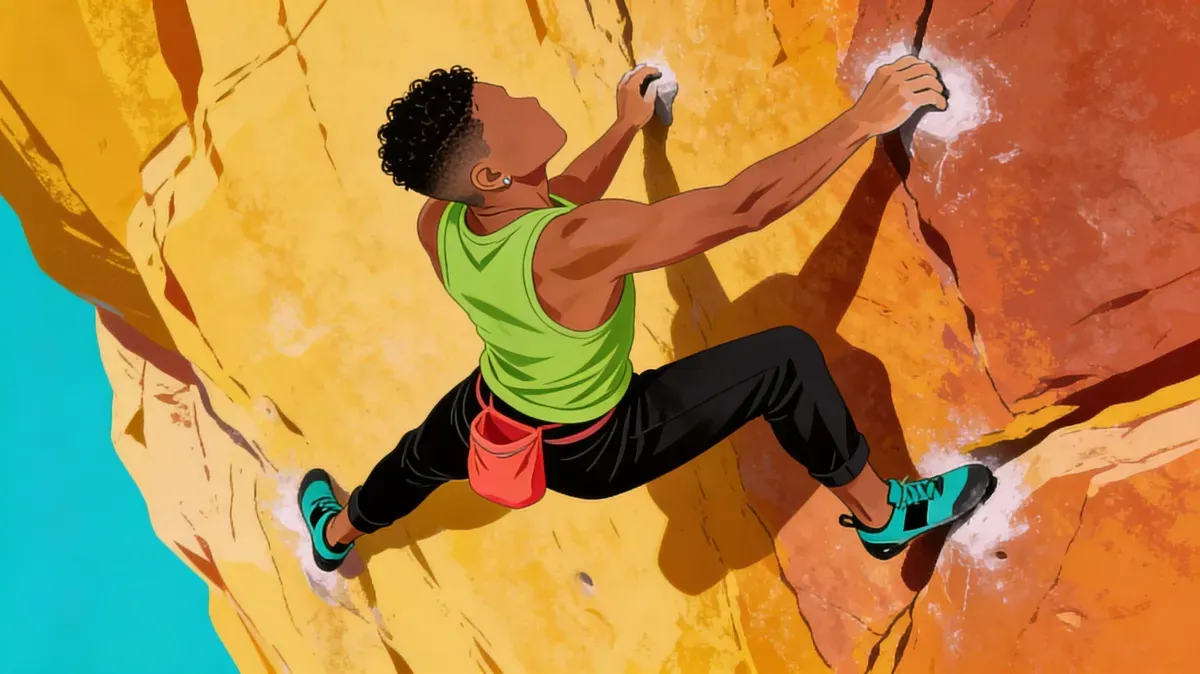
Climbing strengthens many of those capacities in every session. Every hold asks your hands, forearms, shoulders, core, hips, and nervous system to coordinate force under control. That makes climbing unusually efficient for longevity: it builds grip strength while also training balance, mobility, cognition, and social connection.
This article explains why grip strength matters, how climbing develops it without turning training into a chore, and how to start safely if you are over 40, 50, or 60.
What you’ll learn:
- Why grip strength is one of the strongest simple biomarkers of aging and mortality risk
- How climbing trains grip, balance, cognition, and muscle mass together
- The differences between indoor bouldering, roped climbing, and outdoor climbing for health
- How to start climbing safely after 40, including tendon recovery rules
- How to track climbing’s impact with HRV, training readiness, and biological-age trends
Quick answer
Grip strength is one of the most useful simple markers of healthy aging because it reflects total-body muscle quality, neuromuscular function, inflammation, and frailty risk. Climbing is a practical way to train it because every route requires repeated, varied hand and forearm force rather than isolated squeezing.
The longevity case for climbing is strongest when it is framed as a combined stimulus: grip strength, pulling strength, balance, coordination, cognitive problem-solving, and social engagement. It is not a guarantee of longer life, and it should be progressed gradually to avoid finger, elbow, and shoulder overuse injuries.
Key facts
- Grip strength -> mortality signal: lower handgrip strength is repeatedly associated with higher all-cause and cardiovascular mortality in large cohorts.
- Climbing -> varied grip loading: crimps, pinches, open-hand holds, slopers, and dynamic catches train more than one squeezing pattern.
- Climbing -> functional aging capacity: balance, trunk control, coordination, and relative strength matter for falls, independence, and daily movement.
- Progression -> injury prevention: tendons adapt more slowly than muscles, so beginners need rest days and easy volume before high-intensity holds.
- Tracking -> recovery context: HRV, resting heart rate, sleep, and training readiness help show whether climbing is building capacity or creating overload.
Related guides: grip strength, VO2 max, biological age.
Why grip strength predicts how long you’ll live
Grip strength is not just about your hands. It is a proxy for total-body muscle quality, neuromuscular function, and systemic inflammation — three pillars that determine how well you age.
Quick definition: Grip strength measures the maximum force your hand and forearm muscles can generate. Clinically measured with a handheld dynamometer, it is expressed in kilograms (kg) and serves as a validated biomarker of overall muscular health and biological aging.
The research is overwhelming
The evidence base is not small or speculative. It is among the most replicated findings in aging research:
- Leong et al. (2015) — The Prospective Urban Rural Epidemiology (PURE) study followed 139,691 adults in 17 countries for four years. Each 5 kg decrease in grip strength was associated with a 17% increase in cardiovascular mortality and a 16% increase in all-cause mortality. Grip strength was a stronger predictor of death than systolic blood pressure.
- Garcia-Hermoso et al. (2018) — A meta-analysis of 38 studies (1.9 million participants) confirmed that higher grip strength is associated with lower risks of all-cause mortality, cardiovascular disease, cancer, and respiratory disease.
- Celis-Morales et al. (2018) — Using UK Biobank data from over 500,000 participants, this study found that grip strength predicted cardiovascular disease, cancer, respiratory disease, and all-cause mortality independently of other risk factors.
For a deeper dive into the research connecting grip to mortality and how to measure yours, read our complete guide on grip strength as a longevity biomarker.
Why grip strength is such a powerful signal
Grip isn’t special because your hands are magic. It’s special because it reflects several systemic processes simultaneously:
- Total-body muscle mass: Grip strength correlates strongly with overall lean muscle mass. As you lose muscle — a process called sarcopenia that accelerates after age 40 — grip strength declines in parallel.
- Neuromuscular integrity: Producing force requires healthy motor neurons, intact nerve-muscle connections, and efficient neural recruitment patterns. Grip strength captures all of this in one measurement.
- Chronic inflammation: Systemic inflammation erodes muscle quality over time. Low grip strength often reflects elevated inflammatory markers like IL-6 and CRP.
- Nutritional status: Adequate protein intake, vitamin D levels, and overall caloric sufficiency all influence grip. A declining grip can be an early warning of nutritional deficits.
- Hormonal health: Testosterone, growth hormone, and IGF-1 all contribute to muscle maintenance. Grip strength decline often tracks hormonal shifts of aging.
In short, grip strength is not just one metric. It’s a window into your body’s overall capacity to resist the forces of aging.
Climbing: the sport that trains longevity without trying
Most people who start climbing do it because it’s fun — because the puzzle of figuring out how to move your body up a wall is genuinely engaging in a way that a treadmill never will be. But from a longevity science perspective, climbing is remarkably efficient at developing exactly the capacities that predict healthy aging.
Grip strength: the obvious one
Every climbing movement requires you to hold your body weight with your hands. A single bouldering session of 60 to 90 minutes might involve 40 to 80 individual grips — crimps, pinches, slopers, jugs — each demanding sustained isometric contraction of the finger flexors, wrist stabilizers, and forearm muscles.
Research on climbers confirms what you’d expect: they have significantly higher grip strength than non-climbers and even than athletes in most other sports. A 2020 study in the Journal of Sports Sciences found that experienced climbers had grip endurance (the ability to maintain force over time) that was 40% to 60% higher than matched controls. This endurance component is particularly relevant because grip endurance, not just peak force, predicts functional independence in older adults.
The type of grip training climbing provides is also uniquely varied. In a gym, you might do a few sets of farmer’s carries or dead hangs. Climbing demands pinch grips, open-hand grips, crimps, finger locks, and dynamic catches — all within a single route. This variety builds not just strength but resilience across multiple grip positions, reducing the risk of repetitive strain that comes from monotonous training.
Full-body functional strength
Climbing is not an arm sport. Experienced climbers know that power comes from the legs, stability comes from the core, and the arms are often just the connection between your body and the wall. A 2019 study published in PLOS ONE found that climbing activates muscles across the entire kinetic chain — latissimus dorsi, biceps, forearms, core stabilizers, hip flexors, quadriceps, and calves — in patterns that closely mimic natural human movement.
This matters for aging because functional strength — the ability to push, pull, lift, twist, and stabilize in varied positions — is what determines whether you can carry groceries, get off the floor, or catch yourself during a stumble at age 75. Isolated exercises like bicep curls or leg extensions build muscle, but climbing builds the integrated movement patterns that keep you independent.
Balance and proprioception
Every climbing move is a balance problem. You’re managing your center of gravity over a shifting base of support, often on one foot, at unusual angles. Indoor bouldering amplifies this by using volumes and overhanging walls that force you to balance in three dimensions.
This directly trains the proprioceptive systems that deteriorate with age. The ability to maintain balance — particularly single-leg balance — is one of the strongest predictors of fall risk in older adults. A 2022 study in the British Journal of Sports Medicine found that inability to stand on one leg for 10 seconds in people over 50 was associated with an 84% higher risk of all-cause mortality over seven years. For more on this, see our guide on the single-leg balance test and what it reveals about aging.
Climbers constantly train this capacity without thinking about it. Every time you shift your weight onto one foot on a small hold, you’re performing a loaded single-leg balance exercise. Over months and years, this builds a proprioceptive reserve that pays dividends decades later.
Cognitive demand
Climbing is often described as “vertical chess.” Before you pull onto a wall, you read the route — analyzing the sequence of holds, planning movements, anticipating where your body needs to be three moves ahead. While climbing, you’re making real-time decisions under physical stress, adjusting your plan as you discover what works and what doesn’t.
This combination of physical execution and cognitive problem-solving is rare in exercise. Running, cycling, and swimming are physically demanding but cognitively simple. Climbing demands working memory, spatial reasoning, motor planning, and attentional focus simultaneously.
Why does this matter for longevity? Because cognitive decline is one of the most feared aspects of aging, and physical activities that incorporate cognitive challenge appear to protect brain function more effectively than purely physical exercise. A 2019 study in BMC Geriatrics found that rock climbing improved working memory and spatial processing in adults over 60 — benefits that were not seen with a matched-intensity cardiovascular exercise program.
Social connection
Climbing is inherently social. At a bouldering gym, you share problems with strangers, offer beta (advice on how to solve a climb), and celebrate sends. In rope climbing, you literally trust your partner with your life. This builds the kind of regular, low-stakes social interaction that research consistently links to better mental health, lower cortisol, and reduced all-cause mortality.
Loneliness and social isolation are now recognized as mortality risk factors comparable to smoking 15 cigarettes per day. Climbing provides a built-in community — one that crosses age, fitness level, and background — without the forced sociability of a group fitness class.
Indoor vs outdoor climbing: what’s best for health?
Both indoor and outdoor climbing deliver the core longevity benefits described above. But they differ in important ways.
Indoor bouldering
Best for: Grip strength, power, problem-solving, accessibility.
- Routes are short (10 to 15 moves), intense, and reset regularly, so there’s always something new.
- No ropes, harnesses, or partner required — just climbing shoes and chalk.
- Padded floors reduce fall consequences (though injuries still occur, primarily ankle sprains).
- Highly controlled environment: temperature, lighting, and route difficulty are all managed.
- Sessions typically last 60 to 90 minutes with natural rest between attempts.
Indoor bouldering is the easiest entry point for beginners. Most climbing gyms offer introductory sessions and grade routes from V0 (beginner) to V10+ (elite), so you can start at whatever level your body allows.
Indoor sport climbing (roped)
Best for: Endurance, sustained grip strength, cardiovascular fitness.
- Routes are longer (30 to 80 moves) and involve sustained effort over 5 to 15 minutes.
- Requires a belayer (partner) and basic rope skills.
- Builds aerobic endurance alongside strength — heart rates during sport climbing often reach 75% to 85% of max.
- Lower intensity per move than bouldering, but higher total volume.
Outdoor climbing
Best for: Mental health, nature exposure, community, adventure.
- Adds the well-documented mental health benefits of time in nature (reduced cortisol, improved mood, better sleep).
- Routes are longer, varied, and present genuine problem-solving challenges.
- Requires more technical knowledge (safety systems, weather awareness, route finding).
- Higher barrier to entry but often described as transformative by those who make the transition.
Ice climbing adds crampon and tool technique, variable ice, cold, and possible avalanche exposure. Treat it as a distinct discipline and use the beginner ice-climbing technique and safety guide before planning a supervised first day.
The practical recommendation
For longevity purposes, indoor bouldering provides the highest return on investment in terms of accessibility and grip-strength development per session. If you can add one or two outdoor sessions per month, you’ll gain the additional nature-exposure and mental-health benefits that indoor climbing can’t fully replicate.
Starting to climb after 40: what you need to know
One of climbing’s most underappreciated features is that it’s a sport you can start at any age. Unlike running or team sports, climbing rewards technique and body awareness over raw power — which means older beginners often progress faster than they expect.
The first month
- Go to a bouldering gym. Tell the staff you’ve never climbed. They’ll show you the grading system, basic footwork, and safety rules. Most gyms offer beginner sessions or introductory classes; the beginner rock climbing techniques guide gives you a structured way to practice quiet feet, balance, and efficient body position afterward.
- Climb easy routes (V0–V1). Focus on using your feet, keeping your arms straight, and moving slowly. Your grip will be the limiting factor initially — this is normal and will improve rapidly.
- Climb 2 to 3 times per week, 60 minutes per session. Your tendons and ligaments adapt more slowly than muscles. Resist the temptation to climb daily in the first month.
- Expect sore forearms and fingers. This is the grip-strength adaptation happening. It resolves within the first 3 to 4 weeks as your tissues adapt.
Managing recovery
Tendon and ligament adaptation is the rate-limiter for new climbers, especially those over 40. Connective tissue receives less blood flow than muscle and remodels on a timeline of weeks to months, not days.
Key principles:
- Never climb on acute finger or elbow pain. Mild forearm soreness is fine. Sharp pain in a finger joint or the inside of the elbow is not.
- Rest at least 48 hours between climbing sessions for the first 2 to 3 months.
- Warm up gradually. Climb 10 to 15 minutes of routes well below your maximum before attempting harder problems.
- Monitor your readiness. If your training readiness score is low, take an easy session or rest. Climbing on an under-recovered body increases injury risk significantly. Your HRV trend is one of the best objective signals — a suppressed HRV for two or more consecutive days suggests your body needs more recovery before the next session.
Climbing and bone density
Climbing applies load to the skeleton in patterns that are beneficial for bone density — particularly in the upper body and spine, areas that are under-loaded in walking and running. While no large randomized trial has specifically studied climbing and bone density in older adults, the mechanical loading profiles are consistent with the types of exercise known to stimulate bone remodeling.
For those concerned about osteopenia or osteoporosis, climbing offers a weight-bearing activity that loads the wrists, forearms, and spine — areas that are most vulnerable to fracture with age.
Climbing as cross-training
Climbing pairs exceptionally well with other longevity-promoting sports. If your primary exercise is cardiovascular (running, cycling, swimming), climbing adds the upper-body strength, grip work, and balance training that endurance sports miss. If you primarily do strength training, climbing adds the movement complexity, proprioceptive challenge, and cardiovascular component that a barbell can’t provide.
The combination of climbing with regular cardiovascular exercise and daily step counts (including flights climbed) covers virtually every physical capacity linked to healthy aging. For those monitoring training intensity, understanding heart rate zones by sport helps calibrate climbing sessions optimally. And because climbing loads joints in unusual patterns, pairing it with advice on exercise and joint health after 40 is worthwhile: grip strength, muscle mass, balance, flexibility, cardiovascular fitness, and cognitive engagement.
How SuperAge helps you track your climbing longevity gains
Climbing is inherently difficult to quantify. You can’t easily measure how strong your grip got during a bouldering session the way you can log a 5K time. But the physiological signals that climbing improves — cardiovascular recovery, nervous system resilience, sleep quality — are all trackable.
HRV: your recovery compass
Heart rate variability is one of the most useful metrics for climbers. A healthy climbing routine should improve your HRV baseline over weeks and months. If your HRV is trending downward, it’s a signal that you’re either climbing too frequently, not sleeping enough, or accumulating stress from other sources.
SuperAge tracks your HRV trends automatically through Apple Watch and HealthKit, giving you a clear picture of whether your climbing habit is building your health — or quietly overloading it.
Training readiness for session planning
Your training readiness score integrates HRV, resting heart rate, sleep quality, and recent training load into a single number. On high-readiness days, you can attempt harder problems and push your limits. On low-readiness days, focus on technique work, easy traversing, or active recovery — your body will thank you.
Biological age: the long game
The goal of climbing for longevity is not to send a V10. It’s to build and maintain the physical capacities — grip strength, balance, muscle mass, cardiovascular fitness — that keep your biological age lower than your chronological age. SuperAge calculates your biological age from physiological markers tracked over time, giving you a long-term measure of whether your climbing habit is paying off where it matters most.
How to build grip strength if you can’t climb yet
If you don’t have access to a climbing gym, or if an injury prevents you from climbing, you can still train grip strength with simple equipment:
- Dead hangs: Hang from a pull-up bar with straight arms for as long as possible. Start with 3 sets of 10 to 15 seconds and build to 3 sets of 45 to 60 seconds.
- Farmer’s carries: Carry heavy dumbbells or kettlebells at your sides while walking. 3 sets of 30 to 40 meters.
- Plate pinches: Hold two weight plates together (smooth sides out) between your thumb and fingers. 3 sets of 15 to 20 seconds per hand.
- Towel hangs: Drape a towel over a pull-up bar, grip both ends, and hang. This mimics climbing’s open-hand grip better than a bar.
- Rice bucket exercises: Plunge your hands into a bucket of uncooked rice and perform gripping, extending, and rotating movements. Excellent for finger extensor balance and injury prevention.
These exercises will build baseline grip strength, but they won’t replicate climbing’s combination of cognitive challenge, full-body activation, and movement variety. Think of them as preparation for, or supplements to, a climbing practice — not a replacement.
Frequently asked questions
Is climbing safe for people over 50?
Yes, with appropriate progression. Indoor bouldering on easy routes (V0–V2) is low-risk and highly controlled. The most common injuries are ankle sprains from awkward landings and finger tendon strains from progressing too quickly. Both are preventable with proper warm-up, rest days, and climbing within your ability level. Many climbing gyms have thriving communities of climbers in their 50s, 60s, and beyond.
How quickly will my grip strength improve?
Most new climbers see measurable grip-strength gains within 4 to 6 weeks of climbing 2 to 3 times per week. Tendon adaptation takes longer — expect 3 to 6 months before your connective tissue fully adapts to climbing loads. The strongest grip gains come in the first year.
Can climbing replace my strength training?
Climbing is excellent for pulling strength (back, biceps, forearms) and core stability, but it undertrains pushing movements (chest, shoulders, triceps) and direct leg strength. For a complete longevity training program, combine climbing with pushing exercises (push-ups, overhead press) and lower-body work (squats, lunges). This mirrors the comprehensive approach recommended in research on preventing age-related muscle loss.
Do I need to be fit to start climbing?
No. Modern climbing gyms set routes at every difficulty level. V0 routes at most gyms can be completed by anyone who can climb a ladder. The sport meets you where you are and provides a natural, self-paced progression that builds fitness as you go.
How does climbing compare to other sports for longevity?
Climbing ranks among the most longevity-relevant sports because it simultaneously develops grip strength, muscle mass, balance, cognitive function, and social connection — all independent predictors of healthy aging. Few other activities hit all of these targets in a single session. For a full comparison, see our analysis of the best sports for longevity according to science.
The bottom line
Grip strength is one of the most validated biomarkers of longevity in all of medical research. It predicts all-cause mortality, cardiovascular disease, disability, and cognitive decline — independently of age, sex, and body size. And yet, most people never deliberately train it.
Climbers are the exception. Every session is a grip-strength workout, wrapped in a full-body functional exercise, layered with balance training and cognitive challenge, and delivered in a social environment. You don’t need to think about longevity biomarkers while you’re figuring out how to reach the next hold. The training happens as a byproduct of the sport itself.
If you’re looking for a single physical activity that covers the widest range of aging-relevant capacities — while being genuinely enjoyable enough to sustain for decades — climbing is hard to beat. Start easy, progress slowly, and let the wall do what no supplement, no gadget, and no hack can do: build the physical resilience that keeps you functional, independent, and biologically younger for the rest of your life.
Ready to track the impact? Download SuperAge and monitor your HRV, training readiness, and biological age as your climbing practice transforms your health from the inside out.
References
- Leong DP et al. - “Prognostic value of grip strength: findings from the Prospective Urban Rural Epidemiology (PURE) study” - The Lancet (2015) - PubMed
- Garcia-Hermoso A et al. - “Muscular strength as a predictor of all-cause mortality in an apparently healthy population: a systematic review and meta-analysis” - Archives of Physical Medicine and Rehabilitation (2018) - DOI
- Celis-Morales CA et al. - “Associations of grip strength with cardiovascular, respiratory, and cancer outcomes and all cause mortality” - BMJ (2018) - PubMed
- Araujo CG et al. - “Successful 10-second one-legged stance performance predicts survival in middle-aged and older individuals” - British Journal of Sports Medicine (2022) - PubMed
- Orth D et al. - “Grip force coordination in experienced rock climbers” - Journal of Sports Sciences (2020) - DOI
- LaMonte MJ et al. - “Muscular Strength and Mortality in Women Aged 63 to 99 Years” - JAMA Network Open (2026) - JAMA Network
- Lopez-Bueno R et al. - “Thresholds of handgrip strength for all-cause, cancer, and cardiovascular mortality” - Ageing Research Reviews (2022) - ScienceDirect
- Butte C et al. - “Epidemiology of Musculoskeletal Injuries Among Climbers: A Systematic Review” - Current Reviews in Musculoskeletal Medicine (2025) - PMC
- Larsson R et al. - “Effectiveness of indoor rock climbing and bouldering as treatment for depression: a systematic review” - BMC Psychiatry (2025) - PMC
Last updated: 2026-06-07. This article is regularly reviewed for accuracy.
Related Articles

Neuroplasticity: How your brain adapts and learns at any age
Learn how neuroplasticity allows your brain to rewire itself throughout life, how plasticity changes with age, and evidence-based ways to support brain health.