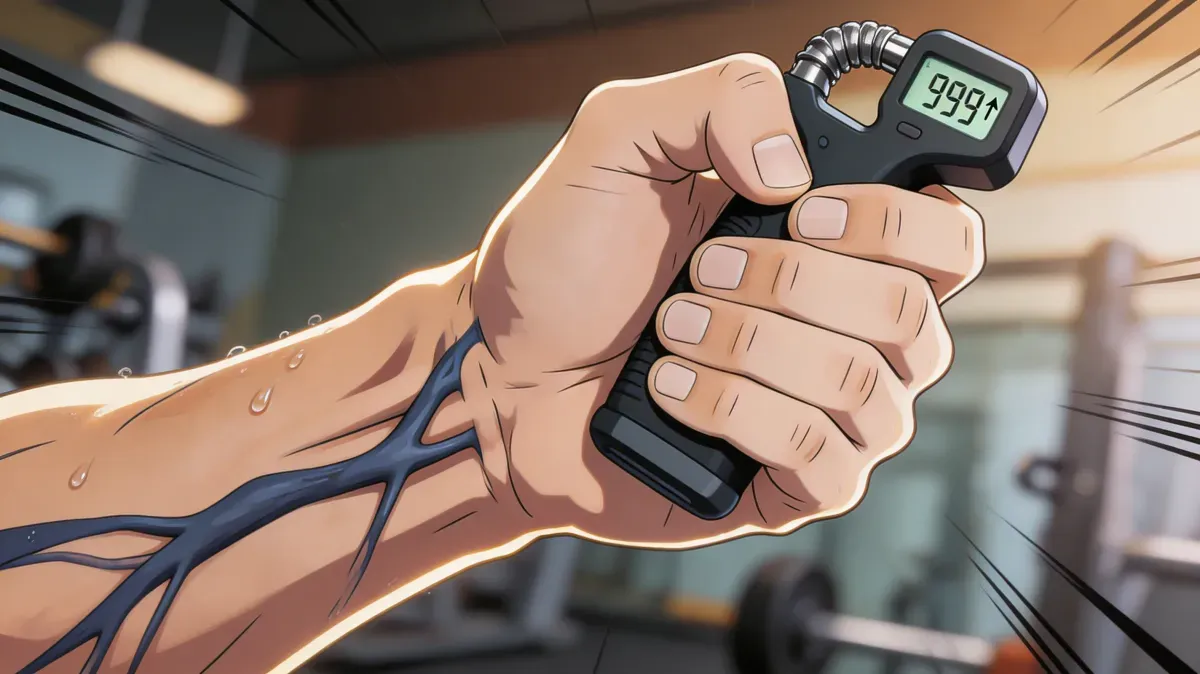
Grip strength and mortality: a practical biomarker of healthy aging
Grip strength is linked with mortality, disability, sarcopenia, and biological aging. Learn the evidence, age norms, testing protocol, and exercises.
What if one of the most practical predictors of healthy aging was not your cholesterol, your blood pressure, or even your VO2 max — but how hard you can squeeze a small device in your hand?
Grip strength is one practical way to see muscle quality vs muscle size in action, because it measures output rather than tissue quantity.
That is what made the PURE study in The Lancet so influential. In nearly 140,000 adults across 17 countries, every 11 lb (5 kg) lower grip strength was associated with higher all-cause mortality, cardiovascular death, and stroke risk. In that cohort, grip strength outperformed systolic blood pressure as a predictor of all-cause and cardiovascular mortality.
This is not an isolated finding. A 2022 dose-response meta-analysis of 48 studies and more than 3 million participants found strong evidence that lower handgrip strength is associated with higher all-cause, cardiovascular, and cancer mortality risk. Researchers have therefore proposed handgrip strength as a practical “vital sign” style measurement, especially in older adults.
In this article, you’ll learn what a simple hand squeeze can and cannot tell you about biological aging, and how to improve the metric safely.
Quick answer
Grip strength is a low-cost functional biomarker that reflects total-body strength, neuromuscular function, frailty risk, and mortality risk. It does not determine how long you will live, but low or rapidly declining grip strength is a useful signal to check muscle health, nutrition, training consistency, inflammation risk, and sarcopenia with a clinician or coach.
Key facts
- Grip strength -> mortality risk -> strong cohort evidence: PURE found a 16% higher all-cause mortality hazard per 5 kg lower grip strength, and later meta-analyses support an inverse dose-response relationship.
- Grip strength -> sarcopenia -> clinical screening value: EWGSOP2 uses low grip strength cutoffs of <27 kg for men and <16 kg for women as part of sarcopenia case-finding.
- Grip strength -> biological aging -> association, not diagnosis: lower grip strength has been linked with DNA methylation age acceleration, but it is not a full-body aging clock.
- Grip strength -> dementia and disability -> risk marker: low grip strength predicts later disability and is associated with dementia risk in older cohorts, although causality is still being studied.
- Resistance training -> grip strength -> trainable signal: direct grip work and whole-body resistance training can improve grip, especially when progressed over months rather than a few intense sessions.
What you’ll learn:
- Why grip strength can outperform blood pressure as a mortality predictor in large cohorts
- The grip strength ranges that give age and sex context
- 8 evidence-based exercises to build grip strength at any age
- How grip strength connects to your biological age
What is grip strength?
Grip strength measures the maximum force your hand and forearm muscles can generate when squeezing an object. It’s typically measured with a handheld dynamometer — a device you squeeze as hard as possible for a few seconds.
Quick definition: Grip strength is the maximum isometric force produced by the hand and forearm muscles, measured in kilograms or pounds using a dynamometer. It is commonly used as a proxy for total-body muscle strength and functional risk.
Why grip strength matters far beyond your hands
Grip strength is not just about your forearms. It is a systemic functional biomarker — a window into musculoskeletal and neurological health. Stronger grip is associated with:
- Higher total-body muscle mass and strength
- Greater bone mineral density
- Better cognitive function
- Lower inflammatory burden in some cohorts
- Healthier overall muscle and endocrine status
- Reduced risk of falls, fractures, and disability
When grip strength declines, it rarely happens in isolation. It can signal worsening muscle function, lower activity, poorer nutrition, illness burden, or neurological change.
A 2025 study in older Indonesian adults linked lower handgrip strength with aging-related laboratory patterns, including leukocyte measures, neutrophil-to-lymphocyte ratio, and erythrocyte sedimentation rate. That supports the idea that weak grip can travel with chronic low-grade inflammation, but it does not prove grip weakness causes inflammation.
The science: why grip strength predicts death
The PURE study: 140,000 people, 17 countries
The Prospective Urban Rural Epidemiology (PURE) study, published in The Lancet in 2015, followed 139,691 adults aged 35-70 across 17 countries for four years. The results were clinically important:
| Outcome | Risk increase per 11 lbs (5 kg) loss |
|---|---|
| All-cause mortality | +16% |
| Cardiovascular mortality | +17% |
| Non-cardiovascular mortality | +17% |
| Myocardial infarction | +7% |
| Stroke | +9% |
The study concluded that grip strength was a stronger predictor of all-cause and cardiovascular mortality than systolic blood pressure within that analysis. That does not make blood pressure unimportant; it means grip strength captured functional risk that standard vitals can miss.
How grip strength reflects biological aging
Your grip does not usually weaken because your forearms get lazy. It often weakens because of a cascade of age-related changes:
- Sarcopenia: After age 30, many adults lose 3-8% of muscle mass per decade, accelerating after 60. Grip strength tracks part of this decline.
- Neuromuscular junction degradation: The connections between nerves and muscle fibers deteriorate, reducing the number of motor units you can recruit.
- Hormonal decline: Testosterone, growth hormone, and IGF-1 decrease with age, all directly affecting muscle protein synthesis.
- Chronic inflammation: Elevated inflammatory markers (IL-6, TNF-alpha, hs-CRP) accelerate muscle protein breakdown.
- Mitochondrial dysfunction: Muscle cells produce less energy as mitochondrial efficiency drops.
Research in the Health and Retirement Study found that lower grip strength was inversely associated with DNA methylation age acceleration across several clocks. That supports grip strength as an aging-related signal, but it does not mean grip strength alone measures cellular aging.
That still does not make grip strength identical to a whole-body aging clock. The practical difference is covered in our guide to strength age vs biological age, which explains when muscle-function decline and biological-age scores disagree.
The brain shows a related pattern. A 2025 longitudinal analysis of 5,916 adults aged 50+ from the English Longitudinal Study of Ageing found that low handgrip strength was associated with a higher risk of incident dementia. Mendelian randomization studies also suggest a possible directional relationship between grip strength and cognitive performance, although genetic evidence should be interpreted alongside cohort and intervention data.
Grip strength and longevity: the dose-response curve
A 2022 systematic review with dose-response meta-analysis in Ageing Research Reviews estimated risk thresholds:
- Men: Values around or below 57 lbs (26 kg) were associated with higher mortality risk in several analyses.
- Women: Values around or below 35 lbs (16 kg) were associated with higher risk in several analyses.
- The relationship is generally inverse, but thresholds differ by age, sex, population, cause of death, and measurement protocol.
Grip strength norms by age and sex
Understanding where you stand requires context. These ranges are practical orientation bands drawn from hand-therapy norms and population studies; exact cutoffs vary by dynamometer, posture, dominant hand, sex, and body size.
Men
| Age | Below average | Average | Above average | Excellent |
|---|---|---|---|---|
| 20-29 | < 97 lbs (44 kg) | 97-115 lbs (44-52 kg) | 115-128 lbs (52-58 kg) | > 128 lbs (58 kg) |
| 30-39 | < 93 lbs (42 kg) | 93-112 lbs (42-51 kg) | 112-126 lbs (51-57 kg) | > 126 lbs (57 kg) |
| 40-49 | < 88 lbs (40 kg) | 88-108 lbs (40-49 kg) | 108-120 lbs (49-54 kg) | > 120 lbs (54 kg) |
| 50-59 | < 82 lbs (37 kg) | 82-101 lbs (37-46 kg) | 101-112 lbs (46-51 kg) | > 112 lbs (51 kg) |
| 60-69 | < 71 lbs (32 kg) | 71-90 lbs (32-41 kg) | 90-101 lbs (41-46 kg) | > 101 lbs (46 kg) |
| 70-79 | < 57 lbs (26 kg) | 57-79 lbs (26-36 kg) | 79-90 lbs (36-41 kg) | > 90 lbs (41 kg) |
Women
| Age | Below average | Average | Above average | Excellent |
|---|---|---|---|---|
| 20-29 | < 57 lbs (26 kg) | 57-70 lbs (26-32 kg) | 70-79 lbs (32-36 kg) | > 79 lbs (36 kg) |
| 30-39 | < 55 lbs (25 kg) | 55-68 lbs (25-31 kg) | 68-77 lbs (31-35 kg) | > 77 lbs (35 kg) |
| 40-49 | < 51 lbs (23 kg) | 51-64 lbs (23-29 kg) | 64-73 lbs (29-33 kg) | > 73 lbs (33 kg) |
| 50-59 | < 46 lbs (21 kg) | 46-59 lbs (21-27 kg) | 59-68 lbs (27-31 kg) | > 68 lbs (31 kg) |
| 60-69 | < 42 lbs (19 kg) | 42-55 lbs (19-25 kg) | 55-64 lbs (25-29 kg) | > 64 lbs (29 kg) |
| 70-79 | < 35 lbs (16 kg) | 35-48 lbs (16-22 kg) | 48-55 lbs (22-25 kg) | > 55 lbs (25 kg) |
How to test at home: If you don’t have a dynamometer, you can estimate relative grip strength with a bathroom scale. Place it on a table, grip the edges with one hand, and squeeze downward. While less precise, it provides a rough baseline you can track over time.
8 evidence-informed exercises to build grip strength
Grip strength is trainable at older ages, especially when direct grip work is combined with whole-body resistance training and enough recovery. Here are practical exercises, organized by grip type.
1. Dead hangs
Why it works: Engages the entire flexor chain from fingers to forearms while simultaneously decompressing the spine. Builds isometric endurance — the type of grip that correlates most with mortality outcomes.
How to do it:
- Grab a pull-up bar with both hands, palms facing away
- Hang with arms fully extended, shoulders engaged (not shrugging to ears)
- Hold for as long as possible
Target: 30-60 seconds. Work up to 2 minutes for excellent grip endurance.
2. Farmer’s walks
Why it works: Combines grip strength with total-body stabilization, core engagement, and cardiovascular demand. Mimics real-world carrying tasks that predict functional independence in aging. Declining carry capacity is one of the early signals tracked by the frailty index — a composite score that quantifies how many age-related deficits have accumulated.
How to do it:
- Hold a heavy dumbbell or kettlebell in each hand
- Walk with upright posture for 100-165 ft (30-50 meters)
- Keep shoulders back and core braced
Target: Use 50-70% of your body weight (total, both hands). 3 sets of 100-165 ft (30-50 meters).
3. Plate pinches
Why it works: Targets the thumb-finger pinch grip, which declines fastest with age and is critical for daily tasks like opening jars, turning keys, and handling utensils.
How to do it:
- Place two weight plates together, smooth sides out
- Pinch them between your thumb and fingers
- Hold for 20-30 seconds per hand
Target: Start with two 10 lb (4.5 kg) plates. Progress to 25 lb (11 kg) plates.
4. Towel hangs
Why it works: Thickens the grip surface, forcing greater finger flexor activation. Develops crush grip strength that directly translates to dynamometer testing.
How to do it:
- Drape a thick towel over a pull-up bar
- Grab both ends and hang
- Hold as long as possible
Target: 20-45 seconds per set. 3-4 sets.
5. Wrist curls and reverse wrist curls
Why it works: Isolates the forearm flexors and extensors, building balanced grip strength and reducing injury risk.
How to do it:
- Sit with forearms resting on thighs, wrists hanging over knees
- Curl a light barbell or dumbbell upward (wrist curls)
- Flip hands over and extend upward (reverse wrist curls)
Target: 3 sets of 15-20 reps per variation. Use light weight — forearm tendons need gradual progression.
6. Hand gripper training
Why it works: The most specific exercise for dynamometer-measured grip strength. Portable and convenient for consistent training.
How to do it:
- Choose a gripper rated at about 60-70% of your max close
- Perform full closes for 5-8 reps
- Hold the close for 3-5 seconds per rep
Target: 3 sets, 3 times per week. Progress to a heavier gripper when you can close it for 10 reps.
7. Kettlebell bottoms-up press
Why it works: Combines crush grip with shoulder stability and core engagement. The unstable load demands maximum grip recruitment.
How to do it:
- Hold a kettlebell upside down (bottom facing ceiling) at shoulder height
- Squeeze the handle hard to prevent tipping
- Press overhead while maintaining control
Target: 3 sets of 5-8 reps per arm. Start light — the instability is humbling.
8. Heavy barbell holds
Why it works: Overloads the grip beyond normal training weights, building peak grip strength. Simulates the maximal effort of a dynamometer test.
How to do it:
- Set a barbell in a rack at hip height
- Grip with double overhand (no straps, no mixed grip)
- Lift and hold for 15-30 seconds
Target: Advanced lifters can use heavy rack holds for 15-30 seconds. Start below your normal deadlift load, avoid straps, and progress only if your hands, elbows, and shoulders tolerate it.
Training frequency
For grip development, train grip directly 2-3 times per week with at least 48 hours between hard sessions. This gives the forearm tendons — which recover more slowly than muscles — time to adapt.
A 2025 Bayesian network meta-analysis of 13 trials in 711 older adults with sarcopenia found that resistance-training programs around 3 sessions per week, moderate intensity, and roughly 19 weeks were associated with the largest grip-strength gains. Treat that as clinical sarcopenia evidence, not a one-size-fits-all prescription: grip responds best to progressive work sustained over months, not a few heavy short blocks.
How to track and measure grip strength
Consistent measurement is key to understanding whether your training is working and how your grip trends compare to age-related norms.
Key metrics to monitor
| Metric | How to measure | What it indicates |
|---|---|---|
| Absolute grip strength | Dynamometer, max squeeze (best of 3 attempts) | Raw strength capacity |
| Relative grip strength | Grip strength / body weight | Strength adjusted for size |
| Left-right asymmetry | Compare dominant vs non-dominant hand | Large or sudden differences may indicate injury or neurological concern |
| Rate of change | Track quarterly | Persistent decline after 50 warrants attention |
The testing protocol
- Sit with your elbow bent at 90 degrees, forearm in neutral position
- Squeeze the dynamometer as hard as possible for 3-5 seconds
- Rest 60 seconds between attempts
- Take 3 attempts per hand
- Record the highest value from each hand
Test consistently: Same time of day, same warm-up, same position. Small protocol changes can shift results by 10-15%.
How SuperAge helps you track strength and aging
Measuring grip strength once is useful. Tracking it alongside your training, recovery, and biological-age trend gives better context.
Strength domain tracking
SuperAge monitors your strength training through Apple Health and Apple Watch data, tracking workout frequency, intensity, and consistency. The app maps each exercise type to a strength domain score, giving you a clear picture of how your muscle-building activities contribute to healthy aging.
Biological age context
When you see your grip strength plateau or decline, SuperAge helps you compare that pattern with your overall biological age trend and other inputs. That context makes a standalone measurement more actionable.
Progress visualization
SuperAge displays your strength-related metrics alongside cardiovascular fitness, sleep quality, and recovery data. You can see whether periods of consistent strength training coincide with better biological-age inputs over time.
Frequently asked questions
What is a good grip strength for my age?
For men aged 40-49, an average grip strength is roughly 88-108 lbs (40-49 kg), while above-average is roughly 108-120 lbs (49-54 kg). For women of the same age, average is roughly 51-64 lbs (23-29 kg), while above-average is roughly 64-73 lbs (29-33 kg). Relative grip strength, adjusted for body weight, can add useful context.
Can you improve grip strength after 60?
Yes. Older adults can improve grip strength with progressive resistance training, direct grip work, and enough protein and recovery. The exact improvement depends on baseline strength, sarcopenia status, training history, joint health, and program length. The key is progressive overload and consistency — the same principles that work at any age.
Does grip strength actually predict how long you’ll live?
It predicts risk; it does not determine lifespan. The Lancet PURE study found that grip strength predicted all-cause and cardiovascular mortality better than systolic blood pressure in that cohort, and later meta-analyses support a strong inverse association. Low grip strength is best interpreted as one powerful risk marker among many.
How often should I test my grip strength?
Test every 3-4 months using the same protocol each time. More frequent testing introduces noise from daily variations in fatigue, hydration, and sleep. If you’re actively training grip, test monthly during the first 3 months to confirm your program is working, then shift to quarterly monitoring.
Which sport builds grip strength most effectively?
Climbing is the sport that trains grip strength most comprehensively. Every session involves dozens of sustained grips across multiple positions — crimps, pinches, open-hand holds — building both peak strength and grip endurance. Our dedicated article on climbing and grip strength as a longevity biomarker examines how the sport trains this exact metric alongside balance, cognition, and muscle mass.
Is grip strength related to sarcopenia?
Grip strength is one of the primary screening criteria for sarcopenia — the age-related loss of muscle strength, function, and often muscle mass. The European Working Group on Sarcopenia in Older People (EWGSOP2) uses grip strength cutoffs of < 60 lbs (27 kg) for men and < 35 lbs (16 kg) for women as low-strength indicators.
Key takeaways
- Grip strength predicts risk, not destiny: The Lancet PURE study found a 16% higher all-cause mortality hazard for every 11 lb (5 kg) lower grip strength.
- It is a systemic functional marker, not just a hand test: grip strength reflects muscle function, neuromuscular coordination, frailty risk, and overall health status.
- It is trainable at older ages: progressive resistance training and direct grip work can improve grip, especially when sustained over months.
- Track it quarterly: consistent monitoring reveals trends that single measurements miss. Pair it with the 30-second chair stand test and the single-leg balance test for a broader functional assessment — or run all five functional tests at once with our biological age home testing guide.
- Combine strength training with protein intake: Adequate protein — especially leucine-rich sources — supports the muscle protein synthesis that grip strength depends on. Adding creatine monohydrate to resistance training produces significantly greater strength and lean mass gains in older adults — with bone density benefits as a bonus.
Start building your grip strength today
Grip strength is one of the few functional biomarkers you can test at home, improve through training, and track over time. It is simple, low-cost, and backed by strong cohort evidence.
Ready to track strength with better context? Download SuperAge and monitor your strength metrics alongside recovery, sleep, cardiovascular fitness, and biological-age trends.
References
- Leong DP, et al. (2015). “Prognostic value of grip strength: findings from the Prospective Urban Rural Epidemiology (PURE) study.” The Lancet, 386(9990), 266-273. https://pubmed.ncbi.nlm.nih.gov/25982160/
- Garcia-Hermoso A, et al. (2022). “Thresholds of handgrip strength for all-cause, cancer, and cardiovascular mortality: A systematic review with dose-response meta-analysis.” Ageing Research Reviews, 82, 101778. https://www.sciencedirect.com/science/article/pii/S1568163722002203
- Bohannon RW. (2019). “Grip Strength: An Indispensable Biomarker For Older Adults.” Clinical Interventions in Aging, 14, 1681-1691. https://pmc.ncbi.nlm.nih.gov/articles/PMC6778477/
- Celis-Morales CA, et al. (2018). “Associations of grip strength with cardiovascular, respiratory, and cancer outcomes and all cause mortality.” BMJ, 361, k1651. https://www.bmj.com/content/361/bmj.k1651
- Peterson MD, et al. (2023). “Grip strength is inversely associated with DNA methylation age acceleration.” Journal of Cachexia, Sarcopenia and Muscle, 14, 108-115. https://pmc.ncbi.nlm.nih.gov/articles/PMC9891916/
- Chainani V, et al. (2024). “Hand grip strength as a proposed new vital sign of health: a narrative review of evidences.” Journal of Health, Population and Nutrition, 43, 7. https://pubmed.ncbi.nlm.nih.gov/38195493/
- Rantanen T, et al. (1999). “Midlife Hand Grip Strength as a Predictor of Old Age Disability.” JAMA, 281(6), 558-560. https://pubmed.ncbi.nlm.nih.gov/10022113/
- Setiati S, et al. (2025). “Handgrip strength as a potential indicator of aging: insights from its association with aging-related laboratory parameters.” Frontiers in Medicine, 12, 1491584. https://www.frontiersin.org/journals/medicine/articles/10.3389/fmed.2025.1491584/pdf
- Hua-Rui L, et al. (2025). “Optimal dose of resistance training to improve handgrip strength in older adults with sarcopenia: a systematic review and Bayesian model-based network meta-analysis.” Frontiers in Physiology, 16, 1564988. https://pmc.ncbi.nlm.nih.gov/articles/PMC12263917/
- Cruz-Jentoft AJ, et al. (2019). “Sarcopenia: revised European consensus on definition and diagnosis.” Age and Ageing, 48(1), 16-31. https://pubmed.ncbi.nlm.nih.gov/31081853/
Last updated: 2026-06-08. This article is regularly reviewed to ensure accuracy.
Related Articles

Frailty index: How to measure and prevent the silent progression of aging
Frailty predicts falls, hospitalization, and loss of independence better than age alone. Learn screening tools, risk factors, and prevention steps.