Muscle quality vs muscle size: what matters more with age?
Compare muscle quality vs muscle size in aging: why strength, power, and function can decline faster than lean mass, and what to test after 40.
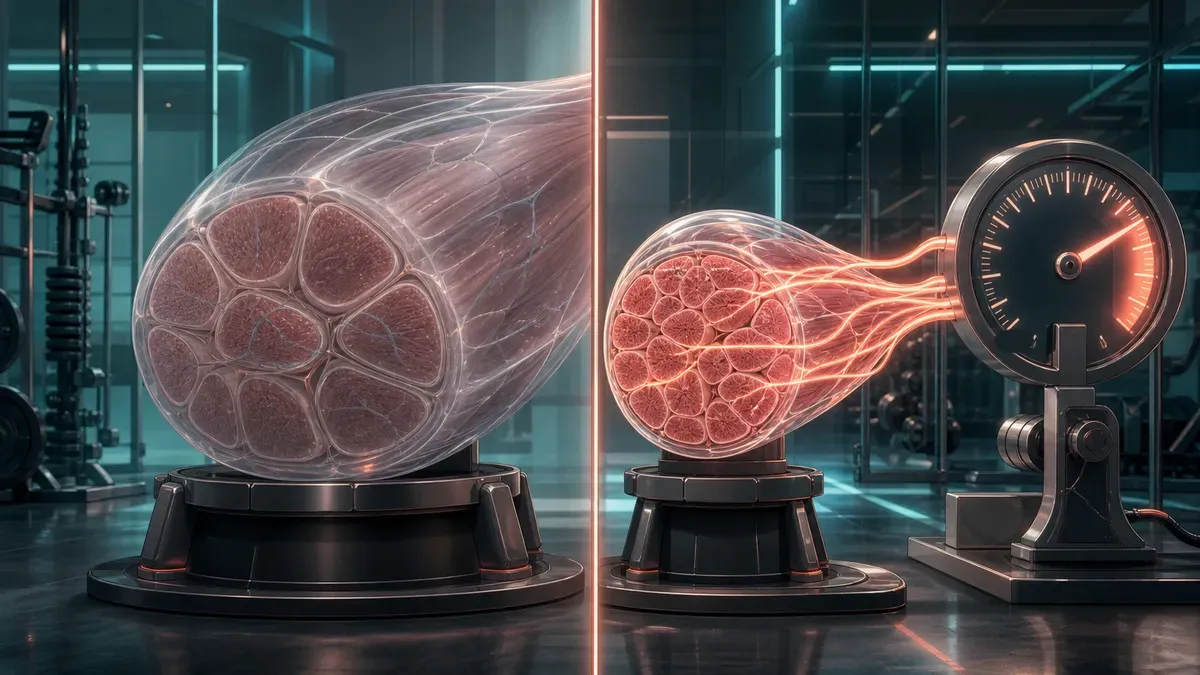
Muscle quality vs muscle size is the difference between how much muscle you appear to have and how well that muscle actually works.
For the perimenopause-specific muscle timeline, see Muscle loss in perimenopause: how early does it start?.
That distinction becomes more important with age. A DEXA scan, smart scale, or body-composition report can say your lean mass is stable while your chair-stand speed, stair power, grip strength, or walking confidence is quietly falling. The reverse can also happen: someone with modest muscle size can stay strong, quick, and independent because their muscle is trained, coordinated, and usable.
The practical answer is simple: muscle quality matters more for daily function and healthy aging, but muscle size still matters as the raw tissue reserve you train from. Do not choose one metric forever. Track size for reserve, and track quality for output.
If you need the foundation first, read lean body mass and how to calculate it. This article is narrower: when muscle size and muscle function disagree, which signal should guide your training after 40?
Key takeaways:
- Muscle size is quantity. It usually means skeletal muscle mass, appendicular lean mass, or a body-composition estimate from DEXA, BIA, MRI, or circumference.
- Muscle quality is output per unit of muscle. It reflects strength, power, coordination, fat infiltration, tendon stiffness, motor-unit recruitment, and how well muscle supports real movement.
- Strength often declines faster than mass. In older adults, leg strength can fall about three times faster than leg lean mass.
- Guidelines prioritize strength. EWGSOP2 uses low muscle strength as the primary parameter for probable sarcopenia, with low muscle quantity or quality used to confirm it.
- The best dashboard is combined: lean mass, waist size, grip strength, chair-stand count, gait speed, stair power, and training recovery.
- Training should build both: enough hypertrophy to preserve reserve, plus heavy strength, controlled power, balance, and movement practice so the tissue stays useful.
Quick answer
If your goal is healthy aging, independence, and lower frailty risk, muscle quality is usually the more actionable signal.
Muscle size answers: “How much contractile and lean tissue do I have?”
Muscle quality answers better functional questions:
- Can that tissue produce force?
- Can it produce force quickly?
- Can your nervous system recruit it when you need it?
- Can you stand, climb, carry, turn, and catch yourself safely?
- Is your muscle tissue being replaced or diluted by fat, fibrosis, or inactivity?
Size still matters. Very low muscle mass leaves less reserve during illness, injury, weight loss, or hospitalization. But once you have enough tissue, the next healthy-aging question is whether that tissue is strong, powerful, metabolically active, and coordinated.
That is why the best aging signal is not “muscle size alone.” It is muscle size plus function.
What is muscle size?
Muscle size is the amount of skeletal muscle or lean tissue your body carries. In real-world tracking, people usually estimate it through:
- DEXA: regional lean mass and appendicular lean mass
- BIA smart scales: trend estimates of muscle or lean mass
- MRI or CT: muscle cross-sectional area, usually in research or clinical settings
- Circumferences: thigh, calf, arm, waist, and waist-to-calf context
- Performance context: body weight, waist size, and strength trends together
Muscle size is important because skeletal muscle is not just cosmetic tissue. It stores glycogen, supports insulin sensitivity, protects joints, helps maintain bone load, and provides reserve when appetite or activity drops.
The problem is that size does not automatically equal usable function.
A larger muscle can be weak if it is poorly trained, infiltrated with fat, affected by pain, limited by the nervous system, or never asked to move through full ranges. A smaller muscle can produce excellent force if it is trained consistently and coordinated well.
For a scale-weight comparison, see muscle mass vs body weight for healthy aging. Muscle size beats body weight as an aging signal, but function often beats size.
What is muscle quality?
Muscle quality has several definitions, but the most practical one is:
Muscle quality is how much strength or power you can produce for the amount of muscle you have.
In research, it is often expressed as strength per unit of muscle mass or cross-sectional area. In everyday tracking, it shows up as the mismatch between body-composition data and performance.
High muscle quality looks like this:
- solid grip strength for your age and sex
- fast, controlled chair stands
- strong stair ascent without grabbing the rail
- good walking speed and step confidence
- stable single-leg or staged balance
- ability to carry, hinge, squat, push, pull, and rotate without compensation
- strength numbers that rise even if scale weight is stable
Low muscle quality can look like this:
- DEXA or BIA says lean mass is acceptable, but strength is low
- legs look muscular, but stairs feel slow or unstable
- workouts build soreness but not force
- walking speed drops before weight or muscle mass changes
- you avoid floor transfers, uneven ground, or quick direction changes
Muscle quality is partly tissue quality and partly nervous-system quality. Fat infiltration, inflammation, mitochondrial function, tendon behavior, balance, coordination, and motor-unit recruitment all affect how well muscle performs.
Why quality can fall before size
The aging muscle problem is not only atrophy. It is also dynapenia: age-related loss of strength and power that is not fully explained by muscle mass loss.
A major Health ABC study followed older adults aged 70-79 and found that annual leg strength decline was roughly three times greater than loss of leg lean mass. In other words, muscle was not just shrinking. It was becoming less effective.
That pattern is why muscle quality deserves attention after 40. You can hold onto size better than output for a while, especially if body weight is stable. The dashboard may look fine while function starts slipping.
Several mechanisms explain the gap.
Neural drive declines
Strength is not just muscle tissue. It is also your brain and spinal cord recruiting motor units at the right time. With age, motor neurons are lost, firing patterns change, and coordination can become less efficient. That reduces force even when muscle size is not dramatically lower.
Fast fibers and power decline
Type II muscle fibers, which help with speed, power, and catching yourself, are especially vulnerable with age and inactivity. This matters because daily life often requires quick force, not just slow force: recovering from a stumble, climbing stairs, lifting luggage, or standing quickly.
Fat infiltration changes the tissue
Muscle can look present on a crude lean-mass estimate while its composition changes. Intramuscular fat and connective-tissue changes can reduce force production and metabolic quality.
Pain and low confidence reduce output
Joint pain, fear of falling, and poor balance can make you underuse available muscle. The tissue may be there, but your body avoids applying it.
Training can become too narrow
Hypertrophy work is useful, but if every session is slow, supported, machine-based, and never includes balance, power, carries, stairs, or real-world ranges, muscle size may improve faster than usable quality.
What the evidence says
The research points in the same direction: size matters, but strength and physical capability often predict outcomes more clearly.
Sarcopenia guidelines put strength first
The revised European consensus on sarcopenia (EWGSOP2) states that low muscle strength is a key characteristic of sarcopenia and uses it as the primary parameter for probable sarcopenia. Low muscle quantity or quality confirms the diagnosis, and low physical performance indicates severe sarcopenia.
That is a major practical shift. A person can have borderline muscle mass but clear weakness, and the weakness deserves attention now.
Strength loss can outpace mass loss
The Health ABC data show that leg strength can decline about three times faster than leg lean mass. A review on dynapenia makes the same point: loss of strength with aging is partly independent of muscle mass and is strongly tied to disability risk.
Physical capability predicts mortality
A BMJ systematic review and meta-analysis found that objective physical capability measures such as grip strength, walking speed, chair rising, and standing balance were associated with mortality in community-dwelling populations.
Those tests are not perfect, and they do not diagnose disease by themselves. But they capture something body composition alone misses: whether the body can still produce useful movement.
How to measure muscle size
Use size measures as slow-moving trend markers, not daily judgments.
| Method | Best use | Main limitation |
|---|---|---|
| DEXA | Accurate baseline for lean mass, fat mass, and regional trends | Cost, availability, hydration and positioning effects |
| BIA smart scale | Frequent home trend tracking | Water, salt, exercise, and device algorithms can distort single readings |
| Circumference | Cheap screening for limb and waist changes | Cannot separate muscle from fat or fluid |
| Body weight plus waist | Context for recomposition | Still indirect |
| Training log | Shows whether size has useful output | Does not measure tissue compartments |
For most people, the practical rhythm is:
- Get a body-composition baseline if accessible.
- Track waist and body weight weekly or monthly.
- Repeat DEXA or a consistent BIA trend every 3-6 months, not daily.
- Interpret size only alongside strength and movement tests.
If you rely on BIA, use the same device, same time of day, similar hydration, and the trend line rather than one reading. For accuracy tradeoffs, read DEXA scan vs bioimpedance for body composition.
How to measure muscle quality at home
You do not need a lab to get useful muscle-quality signals. Use repeatable tests that reflect strength, power, and function.
| Test | What it reveals | Good tracking cadence |
|---|---|---|
| Grip strength | Whole-body strength proxy and neuromuscular reserve | Every 4-8 weeks |
| 30-second chair stand | Lower-body strength, power, and endurance | Every 8-12 weeks |
| Stair ascent speed | Leg power and confidence under load | Every 8-12 weeks |
| Comfortable gait speed | Integrated mobility and reserve | Every 8-12 weeks |
| Loaded carry | Grip, trunk, hips, gait, and posture | Every 4-8 weeks |
| Single-leg or staged balance | Control, proprioception, and fall-risk context | Every 8-12 weeks |
| Training performance | Whether strength is actually improving | Weekly trend |
Do not turn testing into maximal daily effort. Repeating the same safe setup every 8-12 weeks is usually enough. If a test causes pain, dizziness, chest symptoms, or unsafe balance, stop and get medical or physical-therapy guidance.
If you want a broader testing checklist, use the mobility screen after 50 to combine strength, gait, balance, ankle mobility, shoulders, and floor-transfer confidence.
Four common scenarios
1. Muscle size is low and strength is low
This is the clearest red flag. You need both tissue and output. Priorities usually include progressive resistance training, enough protein, enough total energy, recovery, and medical review if the decline is rapid or unexplained.
Start with the basics in muscle mass by age and consider whether sarcopenia symptoms apply.
2. Muscle size is acceptable but strength is low
This is the classic muscle-quality problem. Do not chase only more mass. Add heavier strength work, power practice, carries, balance, and movement-specific training. Also look for pain, low activity, poor sleep, under-recovery, medication effects, or neurological symptoms.
This scenario is where strength age vs biological age can be more useful than another body-composition scan.
3. Muscle size is low but function is good
This is not an emergency if performance is stable, waist is healthy, and you are not losing weight unintentionally. But after 50, low reserve can become a problem during illness, injury, or dieting. Build gradually rather than waiting for function to drop.
4. Muscle size is rising but waist and fatigue are rising too
This may be productive hypertrophy, or it may be fat gain with a small lean-mass increase. Pair body-composition data with waist size, glucose markers, training readiness, and performance. More tissue is not always better if the broader metabolic picture worsens.
For that tradeoff, use body recomposition and biological age as the frame.
How to improve muscle quality
1. Keep progressive strength training
Muscle quality does not mean abandoning hypertrophy. It means making sure size can produce force. Train major movement patterns:
- squat or sit-to-stand pattern
- hinge pattern
- push
- pull
- carry
- step-up or stair pattern
- anti-rotation and trunk control
Use loads that are challenging but technically clean. Older adults can gain strength, but the progression has to respect joints, recovery, and skill.
To distribute productive work without confusing frequency with extra volume, use our training frequency guide for muscle growth to compare full-body and split schedules.
2. Add power in a safe form
Power is force produced quickly. You do not need risky jumps to train it. Options include fast sit-to-stands, light medicine-ball throws, step-ups with intent, hill walking, sled pushes, kettlebell deadlifts with crisp speed, or stair practice.
Keep power work low volume and high quality. Stop before form deteriorates.
3. Train through usable range
Partial ranges can build strength, but aging well requires strength where daily life happens: getting off a low chair, reaching overhead, climbing stairs, lowering to the floor, and turning under control.
Use controlled full-range work where safe. Pair strength with mobility rather than treating stretching as a separate afterthought.
4. Feed the adaptation
Older adults often need a stronger protein signal per meal because of anabolic resistance. Protein, total energy, vitamin D status, and recovery all affect whether training becomes muscle and strength.
Avoid aggressive weight loss without resistance training. Losing fat without preserving muscle is one of the fastest ways to worsen muscle quality.
5. Recover enough to express strength
Poor sleep, high stress, heavy training load, and illness can make strength look worse even when muscle tissue has not changed. If your output is falling, compare it with training readiness, sleep, resting heart rate, and soreness before assuming you lost muscle.
6. Track the ratio, not one number
The useful question is not “Did my muscle mass go up?” It is:
- Did strength improve relative to body weight?
- Did chair stands improve relative to waist size?
- Did gait speed stay high while weight changed?
- Did grip strength improve while lean mass stayed stable?
- Did stairs feel easier without needing more recovery?
Those ratios are where muscle quality becomes visible.
How SuperAge helps you connect the signals
SuperAge is useful here because muscle quality is not one metric. It is the pattern across body composition, Apple Health movement data, recovery, and repeatable functional tests.
You can use SuperAge to:
- track weight, waist, and body-composition context without letting the scale dominate
- watch Apple Health mobility trends such as walking speed and stair speed
- compare strength or chair-stand notes with HRV, resting heart rate, sleep, and readiness
- see whether a training block is improving function or only creating fatigue
- keep biological-age interpretation grounded in movement, not just lab or wearable numbers
The goal is not to prove that one metric is superior forever. The goal is to catch mismatches early: stable muscle mass but weaker function, more training but worse recovery, or weight loss that costs too much strength.
FAQ
Is muscle quality more important than muscle size?
For daily function, fall risk, and independence, muscle quality is often more important. But very low muscle size still matters because it reduces reserve. The best goal is enough muscle mass plus high strength and power for that mass.
Can you have good muscle size but poor muscle quality?
Yes. This can happen with inactivity, pain, poor neuromuscular coordination, fat infiltration, limited range of motion, or training that builds size without strength and power. If lean mass looks fine but chair stands, stairs, grip, or gait speed are worsening, muscle quality deserves attention.
What is the easiest muscle-quality test?
Grip strength is the easiest standardized test if you have a dynamometer. Without one, the 30-second chair stand is practical and useful because it reflects lower-body strength, power, balance, and confidence.
Does lifting heavy improve muscle quality?
Progressive resistance training is one of the best tools for muscle quality, especially when it includes full-range movement, technique, and gradual overload. Add safe power work and carries when the base is ready.
Should older adults train for hypertrophy or strength?
Most should train for both. Hypertrophy preserves tissue reserve, while strength and power make that tissue usable. A good program includes enough volume to maintain or build muscle and enough intensity to improve force production.
When should I get medical help?
Get evaluated if weakness is sudden, one-sided, painful, associated with numbness, linked to falls, accompanied by unexplained weight loss, or progressing despite reasonable training and nutrition. Home tests are screening tools, not diagnoses.
References
- Cruz-Jentoft AJ, et al. Sarcopenia: revised European consensus on definition and diagnosis. Age and Ageing. 2019.
- Goodpaster BH, et al. The loss of skeletal muscle strength, mass, and quality in older adults: the Health ABC Study. The Journals of Gerontology: Series A. 2006.
- Clark BC, Manini TM. What is dynapenia?. Nutrition. 2012.
- McGregor RA, et al. It is not just muscle mass: muscle quality, composition and metabolism during ageing. Longevity & Healthspan. 2014.
- Cooper R, et al. Objectively measured physical capability levels and mortality: systematic review and meta-analysis. BMJ. 2010.
Related Articles

How much should I weigh? Healthy weight by age, height, and body type
Find out how much you should weigh based on age, height, and body composition. Learn why the scale doesn't tell the full story and what metrics actually matter.