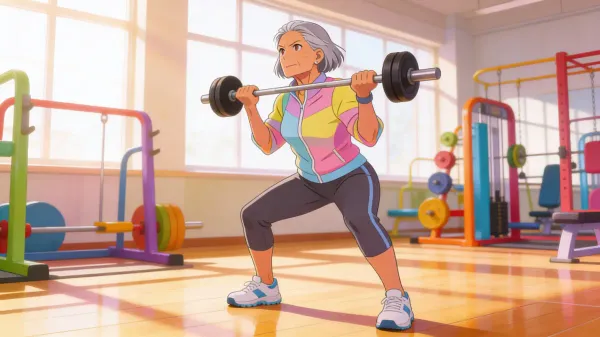
Muscle mass by age: how much you lose per decade and how to stop it
See how much muscle mass you lose per decade after 30 with charts by age and gender. Learn the science of sarcopenia and proven strategies to preserve muscle.
Here is a number most people never think about: by the time you reach 80, you will have lost roughly 30–50% of the muscle mass you had at 30. That is not a hypothetical projection — it is the average trajectory documented across dozens of longitudinal studies.
For the perimenopause-specific muscle timeline, see Muscle loss in perimenopause: how early does it start?.
Because strength can fall faster than mass, compare muscle quality vs muscle size before assuming stable lean mass means stable function.
The process is called sarcopenia, and it starts earlier than you think. Research published in the Journal of the American Geriatrics Society shows that muscle mass begins declining as early as age 30, initially at a barely noticeable 3–5% per decade. But after 60, the rate doubles. By 75, it can reach 1–2% per year — turning a gradual slide into a steep cliff.
The consequences are not cosmetic. Muscle loss drives the cascade of frailty: weaker bones, slower metabolism, increased fall risk, insulin resistance, and ultimately, loss of independence. But here is what most people do not realize — this decline is largely preventable.
What you’ll learn:
- Exactly how much muscle you lose per decade with charts by age
- The difference between normal aging and sarcopenia
- Why muscle loss accelerates after 60
- 6 evidence-based strategies to preserve muscle at any age
How much muscle do you lose with age?
The rate of muscle loss is not linear — it accelerates with each passing decade, especially after 60.
Quick definition: Sarcopenia is the age-related loss of skeletal muscle mass, strength, and function. It affects approximately 10–16% of adults over 65 and up to 50% of those over 80.
Muscle mass loss by decade
| Age Range | Estimated Muscle Loss | Cumulative Loss from Peak | Key Changes |
|---|---|---|---|
| 20–30 | Peak muscle mass | Baseline (0%) | Maximum strength and mass |
| 30–40 | 3–5% per decade | ~3–5% | Subtle, often unnoticed |
| 40–50 | 3–5% per decade | ~6–10% | Strength starts declining |
| 50–60 | 5–8% per decade | ~11–18% | Decline becomes measurable |
| 60–70 | 8–12% per decade | ~19–30% | Accelerated loss begins |
| 70–80 | 10–15% per decade | ~29–45% | Functional impact significant |
| 80+ | 1–2% per year | ~40–50%+ | Sarcopenia highly prevalent |
Strength declines even faster than mass
Here is what makes this problem worse: muscle strength declines 2–3 times faster than muscle mass. A 50-year-old who has lost 10% of their muscle mass may have lost 20–30% of their peak strength. This is because aging also impairs the neuromuscular system — the brain’s ability to recruit and coordinate muscle fibers.
Gender differences
- Men lose muscle mass at a relatively steady rate but start with more, so absolute losses are larger. The average man loses about 30% of his total muscle mass between ages 30 and 80.
- Women experience a sharper acceleration after menopause (ages 50–55) due to declining estrogen, which has a protective effect on muscle tissue. Postmenopausal women lose muscle 2× faster than premenopausal women of the same activity level.
What causes age-related muscle loss?
Sarcopenia is not caused by a single factor — it results from the convergence of several biological processes.
Hormonal changes
Testosterone, growth hormone, and IGF-1 all decline with age, reducing the anabolic signals that stimulate muscle protein synthesis. In men, testosterone drops approximately 1% per year after age 30. In women, the menopausal drop in estrogen removes its protective effect on muscle.
Anabolic resistance
Older muscles respond less efficiently to protein intake and exercise — a phenomenon called “anabolic resistance.” A 25-year-old needs roughly 20 g of protein per meal to maximally stimulate muscle protein synthesis. A 65-year-old may need 35–40 g to achieve the same response.
Physical inactivity
Sedentary behavior is the single largest modifiable contributor to muscle loss. Bed rest studies show that healthy young adults lose 1–2% of leg muscle mass per day of complete immobilization. While daily life is not bed rest, chronic low activity levels produce a gradual version of the same effect.
Motor neuron loss
After age 60, the body loses motor neurons — the nerve cells that activate muscle fibers. When a motor neuron dies, its connected muscle fibers either atrophy or are “adopted” by neighboring neurons, creating larger but less functional motor units. This impairs fine motor control and power output.
Chronic inflammation
Low-grade chronic inflammation (sometimes called “inflammaging”) increases levels of pro-inflammatory cytokines like IL-6 and TNF-α, which directly inhibit muscle protein synthesis and accelerate muscle breakdown.
Nutritional deficiencies
Inadequate protein intake, vitamin D deficiency, and poor overall nutrition compound the biological factors. Studies show that 30–50% of adults over 65 do not meet the minimum recommended protein intake.
Normal muscle mass vs sarcopenia
Not all muscle loss is sarcopenia. Some decline is a normal part of aging. The distinction matters because sarcopenia is a recognized medical condition with specific diagnostic criteria.
Diagnostic criteria (EWGSOP2, 2019)
The European Working Group on Sarcopenia in Older People defines sarcopenia using three criteria:
| Criterion | Measurement | Threshold — Men | Threshold — Women |
|---|---|---|---|
| Low strength | Grip strength | <57 lbs (26 kg) | <35 lbs (16 kg) |
| Low muscle mass | DXA or BIA | ASMI <7.0 kg/m² | ASMI <5.5 kg/m² |
| Low physical performance | Gait speed | <2.6 ft/s (0.8 m/s) | <2.6 ft/s (0.8 m/s) |
- Probable sarcopenia: Low strength alone
- Confirmed sarcopenia: Low strength + low muscle mass
- Severe sarcopenia: All three criteria met
How to measure muscle mass
- DXA scan: The clinical gold standard. Measures lean mass, fat mass, and bone density in a single 10-minute scan. Cost: $50–200 depending on location.
- Bioelectrical impedance analysis (BIA): Consumer scales (Withings, InBody) estimate lean mass by passing a small electrical current through the body. Less accurate than DXA but useful for tracking trends. For a full comparison of DEXA vs bioimpedance accuracy, see our dedicated guide.
- Waist-to-calf circumference ratio: A simple screening tool — decreasing calf circumference relative to waist may indicate disproportionate muscle loss.
For a broader priority check, compare muscle mass vs body weight in healthy aging before letting scale weight override strength or function trends.
6 proven strategies to preserve muscle mass
1. Resistance training (most important)
Why it works: Resistance training is the most potent stimulus for muscle protein synthesis at any age. A meta-analysis in Medicine & Science in Sports & Exercise found that adults over 60 who performed resistance training gained an average of 2.4 lbs (1.1 kg) of lean mass over 20 weeks.
How to do it:
- Train all major muscle groups 2–3 times per week
- Focus on compound movements: squats, deadlifts, bench press, rows, overhead press
- Use progressive overload — gradually increase weight, reps, or sets
- 3–4 sets of 8–12 repetitions per exercise
Expected results: Measurable strength and muscle gains within 8–12 weeks, even in adults over 70.
2. Optimize protein intake
Why it works: Protein provides the amino acids (especially leucine) that drive muscle protein synthesis. Due to anabolic resistance, older adults need more protein per meal than younger adults.
How to do it:
- Target 0.7–1.0 g of protein per pound (1.6–2.2 g/kg) of body weight daily
- Distribute protein evenly across meals — aim for 30–40 g per meal
- Include a leucine-rich protein source (eggs, dairy, fish, poultry, soy) at every meal
- Consider a protein-rich snack before bed — nighttime muscle protein synthesis benefits from casein-rich foods
For a 154 lb (70 kg) adult: This means 110–154 g of protein per day, spread across 3–4 meals.
3. Ensure adequate vitamin D
Why it works: Vitamin D receptors are present in skeletal muscle, and deficiency is associated with muscle weakness and accelerated sarcopenia. Studies show that adults with vitamin D levels below 20 ng/mL (50 nmol/L) have significantly lower muscle mass and strength.
How to do it:
- Get your 25(OH)D level tested
- Target 40–60 ng/mL (100–150 nmol/L)
- Food sources: fatty fish, fortified dairy, egg yolks
- Supplementation may be needed, especially in northern latitudes — consult your healthcare provider
4. Maintain adequate caloric intake
Why it works: Many older adults unintentionally eat less, creating a caloric deficit that forces the body to break down muscle for energy. Even small deficits sustained over months lead to significant muscle loss.
Our muscle catabolism explainer shows how energy deficit, disuse, illness, and aging can shift normal protein turnover toward sustained net loss.
How to do it:
- Avoid crash diets or severe caloric restriction
- If losing weight, aim for no more than 1 lb (0.5 kg) per week to minimize muscle loss
- Increase protein when in a caloric deficit — this preserves lean mass during weight loss
5. Prioritize sleep
Why it works: Growth hormone — a key driver of muscle repair and growth — is released primarily during deep sleep. Chronic sleep deprivation reduces growth hormone secretion by up to 70% and impairs muscle recovery.
How to do it:
- Target 7–9 hours of sleep per night
- Maintain consistent sleep and wake times
- Optimize sleep environment: cool, dark, quiet
- Avoid heavy meals and alcohol within 3 hours of bedtime
6. Stay physically active throughout the day
Why it works: Prolonged sitting triggers a catabolic state in muscles, even if you exercise regularly. Research shows that breaking up sitting time with brief activity bouts preserves muscle protein synthesis rates.
How to do it:
- Stand or walk for 2–3 minutes every 30–60 minutes
- Take stairs instead of elevators
- Walk after meals (improves both muscle health and blood glucose)
- Aim for 7,000–10,000 steps daily as a baseline
How to track muscle health over time
Key metrics to monitor
| Metric | What It Tells You | How to Track |
|---|---|---|
| Grip strength | Overall muscle strength | Hand dynamometer (every 3–6 months) |
| Walking speed | Functional muscle power | iPhone Health app (continuous) |
| Body weight + body composition | Lean mass trends | Smart scale with BIA (weekly) |
| Exercise performance | Strength trajectory | Training log (ongoing) |
| Calf circumference | Lower-body muscle mass | Tape measure (monthly) |
Warning signs of accelerated muscle loss
- Unintentional weight loss of more than 5% in 6 months
- Difficulty rising from a chair without using arms
- Declining grip strength across two or more measurements
- Walking speed falling below 2.6 ft/s (0.8 m/s)
- Increased frequency of falls or near-falls
Muscle mass and biological age: what the research says
Muscle mass is one of the most powerful predictors of how your body is aging — and one of the most modifiable. A 2020 study in The Journal of Cachexia, Sarcopenia and Muscle found that adults with sarcopenia had biological ages 5–8 years older than their chronological age, measured by epigenetic clocks.
The relationship is bidirectional: losing muscle accelerates aging, and aging accelerates muscle loss. But the cycle can be broken. The same study found that older adults who maintained muscle mass through resistance training showed biological ages 3–5 years younger than sedentary peers of the same chronological age.
This is why muscle-related metrics like grip strength and walking speed are included in biological age calculators — they capture the real-world functional impact of aging that blood tests alone cannot measure.
How SuperAge helps you track functional strength
While no app can directly measure your muscle mass, SuperAge tracks the functional consequences of muscle health through your everyday movements.
Walking speed and step length
SuperAge monitors these gait metrics from Apple Health data. Since both are directly influenced by lower-body muscle strength, declining trends can serve as early warnings of muscle loss.
Stair climbing speed
Your ability to climb stairs quickly requires muscular power. SuperAge tracks this metric automatically, giving you insight into your lower-body strength over time.
Biological age integration
SuperAge combines your mobility data, resting heart rate, HRV, and other markers into a single biological age estimate — capturing the overall picture that muscle health contributes to.
Frequently asked questions
At what age does muscle loss start?
Muscle mass begins declining around age 30, initially at a rate of 3–5% per decade. However, the decline is so gradual in the 30s and 40s that most people do not notice it. The loss becomes functionally significant around age 60, when the rate accelerates to 8–12% per decade and strength loss outpaces mass loss by 2–3 times.
How much protein do older adults need to prevent muscle loss?
Current evidence suggests that adults over 65 should consume 0.7–1.0 g of protein per pound (1.6–2.2 g/kg) of body weight daily — significantly more than the 0.36 g/lb (0.8 g/kg) RDA, which was based on studies in younger adults. Equally important is distributing protein evenly across meals, aiming for 30–40 g per meal to overcome anabolic resistance.
Can you rebuild muscle after 70?
Yes. Numerous studies demonstrate that adults over 70 can gain significant muscle mass and strength with resistance training. A landmark study in JAMA Internal Medicine showed that nursing home residents aged 72–98 who performed high-intensity resistance training for 10 weeks increased their leg strength by an average of 113% and muscle cross-sectional area by 11%. Age is never a barrier to muscle adaptation.
Is cardio or weights better for preventing muscle loss?
Resistance training (weights) is far more effective for preventing and reversing muscle loss. Cardio improves cardiovascular fitness but does not provide the mechanical stimulus needed to build or maintain muscle mass. The ideal approach combines both: resistance training 2–3 times per week for muscle preservation, plus cardio 3–5 times per week for heart health.
What are the first signs of sarcopenia?
Early signs include: difficulty opening jars or bottles, struggling to rise from a low chair, feeling unsteady on stairs, noticing that your arms and legs look thinner, and unexplained fatigue during daily activities. A grip strength test at home is the simplest objective screening — below 57 lbs (26 kg) for men or 35 lbs (16 kg) for women meets the threshold for probable sarcopenia.
Key takeaways
- Muscle loss starts at 30 and accelerates after 60: The average person loses 30–50% of their peak muscle mass by age 80, but the rate varies dramatically based on activity level.
- Strength declines 2–3× faster than mass: Even modest muscle loss translates to significant functional impairment because neuromuscular efficiency also declines.
- Resistance training is the single most effective intervention: Adults of any age — including those over 80 — can build muscle with progressive resistance training.
- Protein needs increase with age: Older adults need 0.7–1.0 g/lb (1.6–2.2 g/kg) daily, distributed across meals, to maximally support muscle protein synthesis.
Start protecting your muscle today
You cannot stop aging, but you can dramatically slow muscle loss with the right training and nutrition. The earlier you start, the more muscle you will preserve — but it is never too late to begin.
Ready to track your functional age? Download SuperAge and see how your strength and mobility metrics connect to your biological age.
For a tighter interpretation framework, see strength age vs biological age, which explains when declining muscle function should change how you read a biological-age score.
References
- Cruz-Jentoft, A.J. et al. (2019). Sarcopenia: revised European consensus on definition and diagnosis. Age and Ageing, 48(1), 16-31.
- Mitchell, W.K. et al. (2012). Sarcopenia, dynapenia, and the impact of advancing age on human skeletal muscle size and strength. Frontiers in Physiology, 3, 260.
- Peterson, M.D. et al. (2011). Resistance exercise for muscular strength in older adults: a meta-analysis. Ageing Research Reviews, 10(2), 226-237.
- Fiatarone, M.A. et al. (1994). Exercise training and nutritional supplementation for physical frailty in very elderly people. NEJM, 330(25), 1769-1775.
- Wilkinson, D.J. et al. (2018). The age-related loss of skeletal muscle mass and function. Ageing Research Reviews, 47, 123-132.
Last updated: 2026-03-28. This article is regularly reviewed to ensure accuracy.
Related Articles

How much protein do you need after 40? The science-based guide
Find out exactly how much protein you need after 40 to maintain muscle, boost metabolism, and stay strong. Science-backed recommendations by age and activity.