
Mountain climber exercise: form, muscles, and workouts
Learn mountain climber exercise form, muscles worked, realistic benefits, joint-friendly modifications, progressions, and three practical workouts.
Quick answer
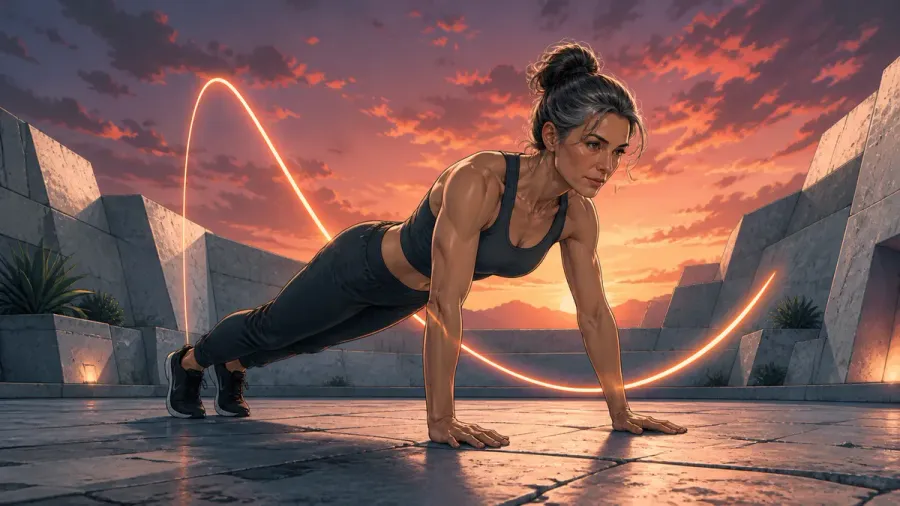
The mountain climber exercise is a moving high plank in which you alternately bring one knee toward the chest while the hands and opposite foot support the body. Place your hands under or slightly ahead of your shoulders, press the floor away, extend into a stable plank, and move one leg at a time without letting the hips bounce, sag, or rotate. Learn it as a slow march before adding speed.
Mountain climbers mainly challenge the trunk and shoulder girdle to stabilize the body while the hip flexors move each thigh forward. The quadriceps, gluteal muscles, calves, chest, triceps, and other muscles contribute according to your position and pace. Fast intervals can raise cardiovascular and metabolic demand, but one exercise does not replace a complete aerobic and strength program.
A useful beginner dose is 2–3 sets of 6–10 controlled repetitions per side, resting 45–75 seconds. For conditioning, try 10–20 seconds of work followed by 40–50 seconds of walking recovery. Stop the set when hand pressure, trunk position, knee path, or breathing becomes difficult to control.
Key facts
- The mountain climber combines high-plank support with alternating hip flexion.
- The trunk muscles resist extension and rotation while each leg changes the support base.
- A raised hand support reduces wrist, shoulder, trunk, and hip-range demands.
- Faster repetitions increase cardiovascular strain only while technique remains repeatable.
- Whole-body interval studies support the training format, not extraordinary benefits from one exercise alone.
This guide is for generally healthy adults learning an exercise. It is not a diagnosis or rehabilitation prescription. Seek individualized advice if you have recent surgery or injury, exercise restrictions, recurrent wrist or shoulder instability, or a cardiovascular, pulmonary, neurological, balance, or musculoskeletal condition affected by floor exercise. Stop and obtain medical help for chest pain, fainting, severe breathlessness, or other acute warning symptoms.
What is a mountain climber exercise?
A standard mountain climber starts in a high plank and alternates a knee drive under the torso. The hands usually remain planted while the legs exchange positions. At a slow pace, it is a coordination and trunk-control drill. At a fast pace, it becomes a whole-body conditioning movement whose quality depends on keeping the supporting shoulder, pelvis, and stance organized.
The name describes several versions, so define the version before comparing repetitions:
| Version | Main action | Best use |
|---|---|---|
| Elevated march | Hands on a stable raised surface; one knee advances at a time | Learning support and knee path with less load |
| Slow floor climber | Controlled alternating steps from a high plank | Technique, trunk control, and strength endurance |
| Running climber | Quick foot exchange, usually with a brief airborne transition | Short conditioning intervals |
| Cross-body climber | Knee travels toward the opposite side of the torso | Controlled anti-rotation challenge |
| Wide climber | Foot or knee advances outside the same-side hand | Greater hip-range and mobility demand |
| Sliding climber | Feet move on sliders or towels while staying in contact with the floor | Continuous tension with less impact but more friction control |
One repetition may mean one knee drive or a right-left pair. Neither convention is inherently correct. Write down the rule you use so that volume remains comparable from session to session.
What muscles do mountain climbers work?
Mountain climbers do not isolate one muscle. They combine a changing lower-body action with an upper-body support task.
Trunk and pelvic stabilizers
The rectus abdominis, obliques, deeper abdominal muscles, spinal muscles, and muscles around the pelvis share the task of controlling the relationship between the ribs and pelvis. Their visible job is not to perform a crunch with every repetition. It is to prevent excessive arching, side-to-side rotation, and bouncing while one leg leaves its rear support position.
This is why a climber can feel more demanding than a static plank even when the knee does not travel far. Each leg exchange changes the support base and introduces movement that the trunk must organize. If trunk strength is the priority, use the complete core strength guide to combine anti-extension, anti-rotation, lateral stability, and loaded movement rather than relying on one drill.
Shoulders, chest, and arms
The serratus anterior, trapezius, rotator-cuff muscles, chest, triceps, and forearm muscles help transfer body weight through the hands. The elbows stay straight but not aggressively locked, and the shoulder blades remain supported rather than collapsing toward the spine.
Direct mountain-climber muscle-activation evidence is limited. A laboratory study of ten low- and high-plank variations in 21 healthy men found that elbow position and the number of body-support points changed shoulder and scapular muscle activity. That supports a cautious coaching principle—changing support changes the muscular demand—but it does not provide a universal activation ranking for mountain climbers (Can et al., 2024).
Hips and legs
The hip flexors move the thigh forward. The quadriceps help control the knee and support the rear leg, while the gluteal muscles contribute to pelvic and hip control. The calf and foot muscles stabilize contact with the floor and help drive a quick exchange in faster versions.
Which area limits the set depends on the version. A slow climber may end because the trunk or shoulders lose position. A sprint-style interval may end because breathing and leg speed deteriorate first. Feeling many muscles work does not mean mountain climbers maximize strength or muscle growth in all of them; progressive resistance and exercise-specific loading still matter.
What benefits does the evidence support?
The evidence is stronger for whole-body bodyweight intervals than for mountain climbers in isolation. That distinction prevents a common mistake: crediting one movement with every adaptation produced by a mixed program.
Equipment-free conditioning
Mountain climbers use substantial muscle mass and can be performed rapidly, so they can help produce a vigorous cardiorespiratory stimulus. In a single-session study of 20 young men, a 30-minute whole-body interval protocol that included jumping jacks, mountain climbers, burpees, and squat jumps produced high internal load, elevated lactate, and declining recovery ratings. Because four exercises were combined, the study demonstrates the demand of the session—not a mountain-climber-only effect (Machado et al., 2018).
A randomized crossover study in 14 physically inactive adults found that a 12-interval whole-body calisthenics session reached a peak heart rate near 87% of maximum and created greater blood-lactate strain than the comparison cycling protocols. Participants also reported favorable enjoyment and self-efficacy. The result supports whole-body intervals as a viable option, while again leaving the contribution of each exercise unresolved (Poon et al., 2023).
Cardiorespiratory and muscular-fitness potential
Longer training studies show that mixed bodyweight intervals can improve fitness:
- In 19 healthy inactive young adults, an 11-minute bodyweight program performed three times per week for six weeks improved peak oxygen uptake compared with no prescribed training. The sessions used burpees, high knees, and squat jumps rather than mountain climbers, so the finding supports the broader method, not this specific movement (Archila et al., 2021).
- In 50 previously untrained men, six weeks of whole-body high-intensity interval training improved measured fitness, muscular endurance, strength, and muscle thickness compared with a non-training control. Nine exercises shared the dose, making single-exercise attribution impossible (Evangelista et al., 2022).
- In 45 young adults with overweight or obesity, 12 weeks of functional intervals that included mountain climbers and other exercises improved cardiorespiratory fitness and body-composition outcomes. The small group sizes and multiexercise program call for modest interpretation (Liu et al., 2024).
These studies make a practical case for accessible, mixed bodyweight training. They do not prove that mountain climbers uniquely burn belly fat, build a six-pack, outperform running, or replace progressive resistance training.
Coordination under changing support
At a controlled tempo, the drill teaches you to move one hip while the hands and opposite foot maintain support. That can be a useful coordination task within warm-ups and circuits. Transfer remains specific: becoming skilled at mountain climbers does not automatically improve sprinting, climbing, lifting, or sport technique unless those activities are also trained.
How to do mountain climbers step by step
Learn on a firm, non-slip surface. A raised support is often the best first version because it lets you understand the movement before wrist load, hip range, or speed becomes the limiting factor.
1. Set the hands and shoulders
Place the whole hands on the floor around shoulder width, with fingers comfortably spread. Stack the shoulders over or slightly behind the wrists. Press through the heel of the hand and finger pads rather than dumping all pressure into one small area.
Create a gently active shoulder position by pushing the floor away. Avoid squeezing the shoulder blades tightly together. The neck remains long and the gaze falls between the hands or slightly ahead.
2. Build a stable high plank
Step both feet back until the head, rib cage, pelvis, and heels form an organized line. Use a stance around hip width at first; a very narrow base increases rotation demand. Tighten the legs and exhale without forcing the lower back flat.
You should be able to pause here for several calm breaths. If the shoulders, wrists, or back already feel poorly controlled, raise the hands to a stable bench or countertop before adding leg movement.
3. Drive one knee forward
Lift one foot and bring that knee toward the chest only as far as you can without sharply rounding the upper back, tucking the pelvis, or losing hand pressure. The exact endpoint differs with limb proportions, mobility, and the purpose of the variation.
The moving foot may hover or touch lightly near the hand in a slow version. Do not force the knee to the elbow as a pass-fail standard.
4. Return the leg under control
Extend the moving leg until the toes regain the floor in the original plank position. Re-establish a stable base before moving the other leg. In a slow set, imagine that a glass of water rests across the pelvis and minimize tipping.
5. Alternate sides before adding speed
Repeat on the other side. Start with a deliberate one-second-in, one-second-out rhythm. Only shorten the contact time when both knees follow a consistent path and the torso remains controlled.
In a running climber, the feet exchange positions quickly. The exercise still needs a recognizable plank between drives. Speed that turns the motion into small, frantic hops with no knee travel is a different—and usually less useful—dose.
Eight common mistakes and precise fixes
| What happens | Why it matters | Try this |
|---|---|---|
| Hips stay high above the shoulders | The movement becomes a short leg shuffle with less trunk demand | Slow down and lengthen the plank, or raise the hands |
| Lower back sags | Trunk control has yielded to speed or fatigue | Widen the feet, shorten the set, and use a slower march |
| Pelvis rotates with every knee | The support base is too narrow or the tempo too fast | Move the feet slightly wider and pause after each return |
| Shoulders drift far behind the wrists | Knee travel crowds the torso and the arms stop supporting efficiently | Shift the chest gently forward and use a higher support if needed |
| Hands lift or roll outward | Pressure is poorly distributed or speed exceeds control | Spread the fingers, keep the whole hand down, and reduce pace |
| Front foot slams into the floor | The return is uncontrolled | Practise quiet step-ins before a running exchange |
| Breath is held | The set becomes hard to monitor and repeat | Exhale during each knee drive or every second drive |
| Repetitions become shorter each round | Fatigue is changing the task | End earlier or increase recovery instead of chasing a number |
Film five to ten repetitions from the side and front if you want feedback. Look for repeatability, not a textbook snapshot. A rep can be technically useful without the knee touching the chest or the back appearing perfectly horizontal.
Regressions and progressions that preserve the intent
Progress by changing one variable at a time: support height, range, tempo, stance width, interval length, or variation.
| Level | Version | Starting dose | Progress when |
|---|---|---|---|
| 1 | Standing wall climber | 2–3 × 6–10 per side | You can coordinate opposite pressure and knee drive |
| 2 | High incline march | 2–3 × 6–10 per side | The support is stable and the torso does not rotate |
| 3 | Low incline climber | 2–3 × 8–12 per side | Wrist, shoulder, and trunk control stay comfortable |
| 4 | Slow floor climber | 2–3 × 6–10 per side | Each leg returns to the same plank position |
| 5 | Tempo floor climber | 3 × 15–25 seconds | Speed rises without shorter range or hip bounce |
| 6 | Cross-body or sliding climber | 2–3 × 6–10 per side | The added rotation or friction is controlled |
An incline is a complete exercise, not merely a temporary beginner substitute. It may remain the best version when the goal is brisk conditioning without excessive wrist extension or a difficult floor transfer.
Avoid making instability the default progression. Hands on a moving or soft surface can raise coordination demand while reducing force and confidence. More wobble is not automatically more effective.
Wrist-, shoulder-, hip-, and back-aware options
If the wrists are uncomfortable
Raise the hands on a stable surface to reduce the share of body weight and the angle demands. Neutral-grip push-up handles may help some people only if they cannot slide or tip. A folded towel changes comfort but does not remove wrist extension. Persistent pain, tingling, or weakness deserves assessment rather than repeated exposure.
If the shoulders fatigue first
Use an incline, shorten the work interval, and practise a supported high plank separately. Keep the shoulders near the hands instead of rocking backward during each knee drive. Mountain climbers load the shoulder girdle continuously; they are not mandatory when another conditioning movement better fits your capacity.
If the hips feel blocked
Reduce knee travel and widen the starting stance slightly. The goal is not to force the thigh against the ribs. A wide climber demands more hip range, so it is usually a progression rather than the easiest option.
If the lower back loses position
Slow the movement, widen the feet, reduce the knee range, and raise the hands. Pair the drill with a stable plank or dead bug to learn trunk control at a lower speed. Sharp, radiating, or persistent pain is not a technique cue; stop and seek appropriate guidance.
Three mountain climber workouts
Warm up for 5–8 minutes with easy walking or cycling, shoulder circles, comfortable squats, a few raised planks, and slow rehearsal repetitions. Choose the variation before the timer starts.
Workout 1: technique and control
Goal: learn a repeatable knee drive without cardiovascular pressure.
- Perform 6 slow repetitions per side.
- Rest by standing and walking for 45–60 seconds.
- Repeat for 3 sets.
- Use an effort around 4–6 out of 10.
Pause for one breath in the plank after every right-left pair. Add two repetitions per side only when the final set looks like the first.
Workout 2: beginner conditioning intervals
Goal: raise breathing while preserving movement quality.
- Work for 15 seconds with an incline or floor climber.
- Walk for 45 seconds.
- Repeat for 6–8 rounds.
- Keep the overall effort around 6–7 out of 10.
The rate of perceived exertion guide helps you scale intensity to your capacity. Increase work to 20 seconds before reducing recovery, and do not change both in the same session.
Workout 3: balanced bodyweight circuit
Goal: distribute the session across different movement patterns.
Complete 2–4 rounds:
- 20 seconds of controlled mountain climbers;
- 8–12 chair squats or comfortable bodyweight squats;
- 6–10 incline push-ups;
- 8–12 band or supported rows;
- 30–60 seconds of easy walking;
- rest another 60 seconds before repeating if needed.
The metabolic conditioning guide explains how exercise order and work-to-rest ratios change a circuit. Avoid placing mountain climbers immediately after another long plank task if the shared shoulder and trunk fatigue makes both exercises worse.
How often should you do mountain climbers?
Begin with one or two sessions per week. Slow technique sets can fit into a warm-up more often, while all-out intervals need enough recovery to preserve quality and fit the rest of your training. Count overlap from push-ups, burpees, planks, pressing, running intervals, and hard circuits rather than treating each exercise name as a separate stress.
Progress just one variable for the next week:
- add one set or round;
- add two repetitions per side;
- add 5 seconds of work;
- add a little knee range;
- lower the support slightly; or
- increase speed while keeping the same range.
The recovery between workouts guide can help you place demanding sessions. Reduce the dose if soreness, wrist or shoulder irritation, sleep disruption, or declining performance persists into the next session.
Mountain climbers versus similar exercises
| Exercise | Main pattern | Choose it when |
|---|---|---|
| Mountain climber | Alternating knee drive from high plank | You want trunk control plus scalable whole-body conditioning |
| High plank | Static hand-supported anti-extension | You need a simpler position before adding leg movement |
| Burpee | Floor transition, plank, and return to standing | You want a larger level change and optional jump or push-up |
| High knees | Upright rapid running action | Wrist or shoulder support is unsuitable |
| Dead bug | Supine alternating arm or leg movement | You want lower-speed trunk coordination without hand support |
| Running interval | Locomotion with readily measurable pace | Sport-specific aerobic development is the main priority |
The burpee technique and modification guide covers the more complex floor-to-standing sequence. Do not turn a climber into a burpee by lifting the hands and standing between every repetition; decide which movement you are training.
Where mountain climbers fit in a complete plan
Adults should generally accumulate 150–300 minutes of moderate aerobic activity, 75–150 minutes of vigorous activity, or an equivalent combination each week, plus muscle-strengthening work for all major muscle groups on at least two days (US Physical Activity Guidelines; WHO guidelines).
Mountain-climber intervals may contribute to vigorous activity when they actually reach that relative intensity. Controlled sets may contribute to local muscular endurance. But the exercise does not train pulling, provide a complete lower-body strength stimulus, or deliver the sustained, easily regulated volume that walking, cycling, swimming, and running can provide.
The 2026 American College of Sports Medicine resistance-training update emphasizes that consistency matters more than needless complexity and that bodyweight and home-based training can improve strength and function. It also notes that the program must still match the desired outcome (ACSM, 2026). Use mountain climbers as one tool inside an exercise plan for longevity, not as a shortcut around aerobic, strength, balance, mobility, and recovery needs.
Track a repeatable dose with SuperAge
Record the version, support height, work and recovery time, rounds, and perceived effort. Add a short note about wrist, shoulder, hip, and back comfort. This turns “I did mountain climbers” into a dose you can compare over several weeks.
Download SuperAge to view exercise sessions beside activity, resting heart rate, sleep, HRV, and longer-term health trends. The app cannot judge technique or diagnose pain, but consistent records can show whether increasing interval volume fits your broader training and recovery pattern.
Key takeaways
- Build a supported high plank before moving either leg.
- Learn a slow alternating march before using a running foot exchange.
- Expect the trunk and shoulder girdle to stabilize while the hips and legs move.
- Treat mixed bodyweight-interval evidence as support for the format, not proof of unique mountain-climber effects.
- Raise the hands, shorten the interval, or reduce knee range when support or mobility limits technique.
- Progress one variable at a time and define how you count repetitions.
- Use mountain climbers within a balanced plan rather than as a complete cardio or strength program.
FAQ
How many mountain climbers should a beginner do?
Start with 2–3 sets of 6–10 slow repetitions per side, resting 45–75 seconds. If you prefer time, use 10–15 seconds of controlled work and 45–50 seconds of recovery. Stop before the hips bounce, the lower back sags, or hand pressure becomes uncomfortable.
Do mountain climbers work the abs?
Yes, the abdominal and other trunk muscles help resist excessive extension and rotation while the legs move. That does not make the exercise an isolated abdominal movement or guarantee visible abs. The training effect depends on technique, dose, progression, and the rest of your program.
Are mountain climbers cardio or strength training?
They can create both cardiovascular demand and local muscular endurance. Slow, controlled repetitions emphasize support and coordination; fast intervals emphasize conditioning. They do not provide a complete strength program because loading and movement patterns are limited.
Should the knee touch the chest?
No. Bring the knee forward only as far as you can while maintaining hand pressure and an organized trunk and pelvis. Limb proportions and hip mobility change the available range. Consistent, controlled motion matters more than touching a specific point.
Why do mountain climbers hurt my wrists?
The high-plank position loads the hands with the wrists extended. Try a stable raised support or secure neutral-grip handles and reduce the interval. Stop if pain, tingling, weakness, or swelling persists; repeatedly forcing the same position is not a useful progression.
Should my hips stay perfectly still?
Small movement is normal, especially at faster speeds. Aim to limit excessive bouncing, sagging, and rotation rather than freezing the pelvis completely. If the movement grows with every repetition, slow down, widen the feet, or shorten the set.
Are cross-body mountain climbers better?
Not universally. Bringing the knee toward the opposite side changes the hip path and rotation demand. Use it after you can control a standard climber, and choose it because that variation matches your goal—not because it is automatically more advanced or effective.
Can I do mountain climbers every day?
Daily low-dose technique practice may suit some trained people, but hard daily intervals can accumulate wrist, shoulder, trunk, hip, and cardiovascular fatigue. Most beginners do better with one or two focused sessions per week while monitoring overlap from other pressing, plank, running, and circuit work.
References
- Machado AF, et al. Description of training loads using whole-body exercise during high-intensity interval training. Clinics. 2018. PubMed
- Poon ETC, et al. Acute physiological and perceptual responses to whole-body high-intensity interval training compared with equipment-based interval and continuous training. Journal of Sports Science & Medicine. 2023. PubMed
- Archila LR, et al. Simple bodyweight training improves cardiorespiratory fitness with minimal time commitment. International Journal of Exercise Science. 2021. PubMed
- Evangelista AL, et al. Effect of a short-term whole-body high-intensity interval training on fitness, morphological, and functional parameters in untrained individuals. Journal of Sports Medicine and Physical Fitness. 2022. PubMed
- Liu J, et al. Effects of low-volume functional and running high-intensity interval training on physical fitness in young adults with overweight or obesity. 2024. PubMed
- Can EN, Harput G, Turgut E. Shoulder and scapular muscle activity during low and high plank variations with different body-weight-bearing statuses. Journal of Strength and Conditioning Research. 2024. PubMed
- American College of Sports Medicine. Resistance training prescription for muscle function, hypertrophy, and physical performance in healthy adults: an overview of reviews. 2026. ACSM summary
- US Department of Health and Human Services. Physical Activity Guidelines for Americans, 2nd edition. Official guideline
- World Health Organization. WHO guidelines on physical activity and sedentary behaviour. 2020. Official guideline
Related Articles
How to do burpees: form, modifications, and workouts
Learn how to do burpees with reliable form, low-impact modifications, sensible progressions, and three workouts that protect movement quality under fatigue.