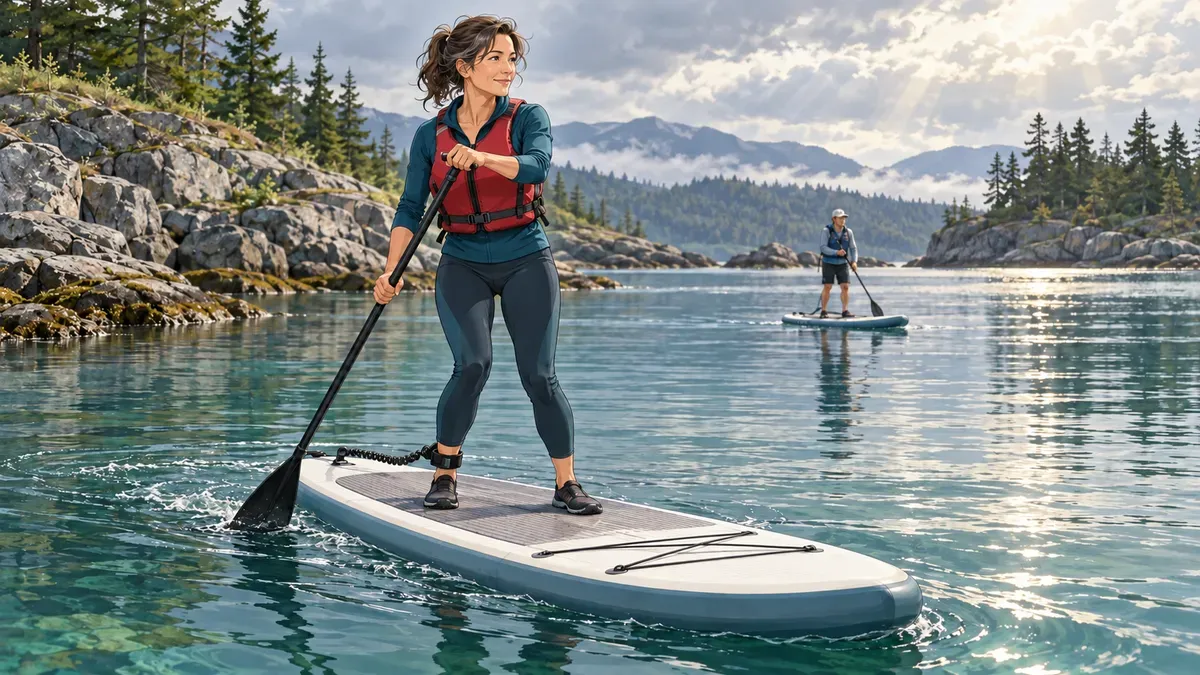
Stand up paddleboarding benefits: fitness, balance, and getting started
Explore stand up paddleboarding benefits, what the research actually shows, and how to start safely with a simple fitness plan. Build a habit you can enjoy.
Quick answer
Stand up paddleboarding (SUP) can provide aerobic exercise, trunk endurance, and an enjoyable reason to move outdoors. The workload depends on how continuously and forcefully you paddle. Standing on a moving board challenges balance, but research does not establish SUP as a treatment for falls, back pain, or aging. Start with a qualified instructor, sheltered water, a fitted personal flotation device, and the correct leash for the environment. Learn to stop, turn, fall safely, and get back aboard before pursuing distance or fitness targets.
Key facts
- Paddling generates forward movement through coordinated arm, trunk, and leg activity.
- Continuous paddling raises aerobic demand more consistently than drifting or resting.
- A small training study found improved fitness and trunk endurance without significant improvement on balance tests.
- Wind and current change the difficulty and safety of the return journey.
- Rescue practice prepares a paddler for falling in before fatigue makes recovery harder.
What benefits does the evidence support?
SUP combines a skill with a physical activity. The skill is controlling your body and board; the activity is repeatedly moving a paddle against water. Someone learning to stand may work hard without traveling far, while an experienced paddler can cruise comfortably. Neither distance nor wobbling alone measures training quality.
In a 2016 intervention study, 13 previously untrained participants completed three one-hour SUP sessions weekly for six weeks after a six-week control period. Aerobic and anaerobic fitness, several trunk-endurance tests, and self-rated quality of life improved. Static and dynamic balance tests did not improve significantly. The small sample and absence of a separate randomized control group limit confidence and generalization. These findings support SUP as a promising exercise option; they do not predict your personal results.
| Possible benefit | What to expect realistically | What remains unproven |
|---|---|---|
| Aerobic fitness | Sustained paddling can create a cardiovascular training stimulus | A guaranteed gain from occasional relaxed outings |
| Trunk endurance | Repeated strokes and stabilization can challenge the torso | A replacement for a complete strength program |
| Balance practice | You learn to control a board beneath your feet | Automatic transfer to fewer falls on land |
| Enjoyment and wellbeing | A pleasant session may make activity easier to repeat | Treatment of anxiety, depression, or chronic pain |
The practical question is whether you enjoy it enough to return regularly. An appealing activity that fits your access, budget, and abilities may be more sustainable than an ambitious routine you avoid. Our complete exercise and longevity guide explains how regular movement fits into long-term health without making one sport essential.
Is paddleboarding a full-body workout?
The paddle stroke involves the shoulders and arms, while the trunk transfers force and the lower body helps stabilize your position. That makes SUP a coordinated activity, but “full body” does not mean every muscle receives enough resistance to build strength. You still benefit from land-based pushing, pulling, squatting, and other appropriate strength work.
Does it improve balance or burn fat?
Board control improves with practice, but a skill learned on water is not interchangeable with a clinical balance outcome. If fall prevention is your main goal, prioritize progressive balance and strength training on land. SUP can be a recreation choice alongside that work when safe.
Paddling uses energy, but there is no universal calorie figure or special fat-burning effect. Conditions, body size, technique, and time actually spent paddling vary. Avoid turning an uncertain calorie estimate into a reason to stay out after your safe return margin has disappeared.
Decide whether SUP fits your starting point
A beginner does not need athletic performance, but should be comfortable around water and able to follow instruction. A lesson lets you test kneeling, standing, and remounting in a controlled setting. Difficulty getting back aboard is a useful finding to address before going farther from an exit.
If you have recurrent fainting, uncontrolled seizures, significant dizziness, an unstable medical condition, or a recent injury that affects paddling or rescue, get individual advice before going on the water. Pregnancy and disability may require adaptations and specialist instruction. A flotation device supports safety; it does not make every person or environment suitable.
If standing is uncomfortable, discuss a seated craft or adapted activity rather than forcing the position. The canoe-versus-kayak guide can help you compare a different way to paddle. Pool-based exercise may also be easier to supervise, although pool and open-water swimming have distinct demands.
Put water safety ahead of the workout
The RNLI’s SUP guidance emphasizes flotation, a means of calling for help carried on your body, an appropriate leash, and avoiding offshore winds. Choose a sheltered venue with an easy landing, paddle with an instructor or competent companion, and tell someone ashore your plan and return time. Dress for immersion and the water temperature, not only the air.
Calm-looking water can hide wind blowing away from shore. A strong outward drift can turn a short fitness outing into a difficult return. Check wind, weather, current, and relevant local conditions before launching; postpone when uncertain. Fitness is not a substitute for judgment about the venue.
Match the leash to the environment
A leash can prevent separation from the board, but entanglement changes the risk in moving water. Paddle Cymru’s September 2026 guidance distinguishes relatively still water from environments containing flow and snagging hazards. An ankle or calf leash can be appropriate in still, open water; it is not a universal choice for rivers, estuaries, or white water. Quick-release systems require correct fitting, training, and an environment-specific assessment. Some hazardous situations call for different arrangements, including no leash under specialist guidance.
For a first fitness session, choose sheltered flat water and let a qualified instructor specify and check the system. Do not treat buying a quick-release belt as permission to enter moving water.
Practice the exit before the effort
The RNLI beginner guide recommends learning board access, a stable stance, and awareness of your surroundings. Rehearse falling clear of the board and remounting with instruction in an appropriate practice area. Avoid diving headfirst into unknown or shallow water. Know how to call the local rescue service before launching.
Learn control before adding intensity
Treat your first outing as a lesson with short practice blocks. You should be able to return to the launch area, turn both ways, and stop intentionally. Standing for a photograph is a much smaller achievement than controlling where the board goes.
- Find a centered position. Start kneeling near the board’s middle. Progress to standing only when the instructor and conditions make it appropriate.
- Keep the stance adaptable. Place feet roughly hip-width apart, soften the knees, and look ahead rather than continuously at your toes.
- Use coordinated strokes. Learn the blade orientation, hand placement, and torso movement from your instructor. Avoid hauling every stroke with a tense upper arm.
- Practice steering and stopping. Work inside a small supervised area, with room between boards and other water users.
- Finish with energy left. Leave enough capacity for a controlled landing and an unexpected remount.
These are learning priorities, not a remote substitute for coaching. You may need several sessions before standing and steering feel comfortable. Kneeling is an available position, not a failed attempt.
For a closer look at blade placement and board control, the SUP paddling technique guide explains forward strokes, sweep turns, gentle braking, and remount practice to discuss during a supervised lesson.
If you prefer a stationary movement practice to sustained paddling, explore beginner SUP yoga positions and safety. Low poses and supervised transitions form a separate skill; paddling experience does not automatically prepare you for yoga on a board.
Turn paddling into a repeatable fitness session
Once control and rescue skills are established, separate time on the water from time actively paddling. A 45-minute outing containing frequent instruction and rests is not automatically 45 minutes of moderate exercise.
The CDC talk test describes moderate aerobic effort as being able to talk but not sing; vigorous effort makes more than a few words difficult. Apply that idea only where attention and conditions allow. You can also use perceived exertion alongside breathing and technique. An elevated heart rate caused by fear or heat should not become a target to chase.
Here is an illustrative progression, not a tested SUP prescription. Advance by skill, conditions, and next-day response rather than the calendar.
| Stage | Example session | Advance when |
|---|---|---|
| Familiarization | Supervised lesson with brief paddling and frequent pauses | You can steer, stop, and rehearse remounting |
| Comfortable practice | 15–20 minutes of easy paddling, broken into short blocks | Control remains consistent and shoulders feel comfortable |
| Steady activity | 20–30 minutes including easy periods and comfortable continuous paddling | You finish with a clear return margin |
| Established habit | One or two appropriate outings weekly, alongside other activity | Recovery, access, and conditions support repetition |
Increase duration or continuous-paddling time first, one variable at a time. Do not add stronger wind, longer distance, and harder efforts together. A repeated sheltered loop can be more useful than a new destination when you are learning what workload you tolerate.
Protect the shoulders and keep the week balanced
A 2017 injury survey identified the shoulder or upper arm, lower back, and elbow or forearm as common injury locations among respondents. Survey findings do not establish your personal risk, but they reinforce the value of technique, gradual exposure, and responding early to pain.
If you feel sharp shoulder pain, numbness, or worsening back pain, stop and reassess rather than changing sides and continuing. Persistent symptoms deserve clinical evaluation. Mild unfamiliar effort and a progressive loss of comfortable movement are different signals.
Leave an easier day after a demanding unfamiliar outing. Avoid scheduling your longest first paddle immediately after exhausting upper-body training. The recovery-between-workouts guide helps put the session beside the rest of your week.
The WHO activity guidelines recommend 150–300 minutes of moderate aerobic activity, or 75–150 vigorous minutes, weekly for adults, plus muscle-strengthening activity on at least two days. SUP can contribute when the effort qualifies. It need not supply the whole target, replace strength training, or become your only activity.
Review your activity pattern with SuperAge
After the practical decisions are settled, a simple log can help: active paddling time, conditions, perceived effort, technique confidence, and next-day shoulder comfort. Compare similar outings; a windy session is not a fair speed comparison with a still-water lesson.
SuperAge can help you review available Apple Health workout and recovery trends, including sleep, resting heart rate, HRV, and cardio fitness when present. Use those trends as context alongside symptoms and your actual paddling experience. Wrist data can be incomplete during water activity, and a favorable recovery reading cannot certify water safety. A biological-age estimate cannot demonstrate that SUP reversed aging.
Frequently asked questions
Is stand up paddleboarding good exercise?
Yes, continuous paddling can provide aerobic work and challenge trunk endurance. Drifting and relaxed sightseeing may be light activity. Effort and consistency matter more than the sport’s label.
Will SUP improve my balance?
It trains board-specific control. The small six-week intervention did not find significant improvements on static or dynamic balance tests. Do not assume it replaces evidence-based fall-prevention exercise.
Is paddleboarding suitable for beginners over 50?
Age alone does not decide suitability. Water confidence, health, mobility, ability to remount, instruction, and conditions matter. Start with a supervised assessment and adapt the activity when necessary.
Can I start without a lesson?
A qualified lesson is the recommended starting point. Steering, falling, remounting, leash choice, and recognizing conditions deserve practice before independent outings.
Do I need to stand the whole time?
No. Kneeling or sitting can be useful during learning and when instructed. Remaining low does not remove wind, current, cold-water, or separation risks.
How often should I paddle for fitness?
Begin with a schedule you can recover from, perhaps one supervised outing weekly. Build consistency before duration or intensity. The research schedule of three weekly hours is not a universal beginner requirement.
Does a leash replace a flotation device?
No. They serve different purposes. Wear a properly fitted flotation device and have the leash system selected for your environment. Moving-water hazards need specialist assessment.
When should I stop a session?
Stop for deteriorating conditions, loss of control, unusual fatigue, or pain. Chest pressure, fainting, or severe unusual breathlessness require urgent medical help. Return before fatigue threatens your landing or rescue ability.
Key takeaways
- SUP can be enjoyable aerobic activity and trunk-endurance practice; the direct research base remains limited.
- Learn control and remounting before chasing distance, intensity, or calorie targets.
- Choose flotation, communication, clothing, and leash arrangements for the actual environment.
- Progress one workload variable at a time and preserve capacity for a safe return.
- Keep strength, land-based balance work when relevant, and other regular activity in your week.
Keep a useful activity log
If you use Apple Health, download SuperAge on the App Store to review your available workout and recovery trends alongside an honest paddling log.
References
- Schram B, Hing W, Climstein M. The physiological, musculoskeletal and psychological effects of stand up paddle boarding. BMC Sports Science, Medicine and Rehabilitation. 2016.
- Furness J, et al. Epidemiology of injuries in stand-up paddle boarding. Orthopaedic Journal of Sports Medicine. 2017.
- RNLI. Stand up paddleboarding safety.
- RNLI. A beginner’s guide to paddleboarding.
- Paddle Cymru. SUP leash safety: understanding the guidance. September 2026.
- Centers for Disease Control and Prevention. How to measure physical activity intensity.
- World Health Organization. WHO guidelines on physical activity and sedentary behaviour: at a glance.
Related Articles

Walking steadiness: What your score means and how to improve it
Learn what walking steadiness measures, what OK, Low, and Very Low scores mean, and 7 evidence-based exercises to improve balance and reduce fall risk.