Pool vs open water swimming: differences and transition guide
Pool vs open water swimming changes technique, pacing, navigation, temperature, and safety. Compare both settings and follow a practical transition plan.
Quick answer
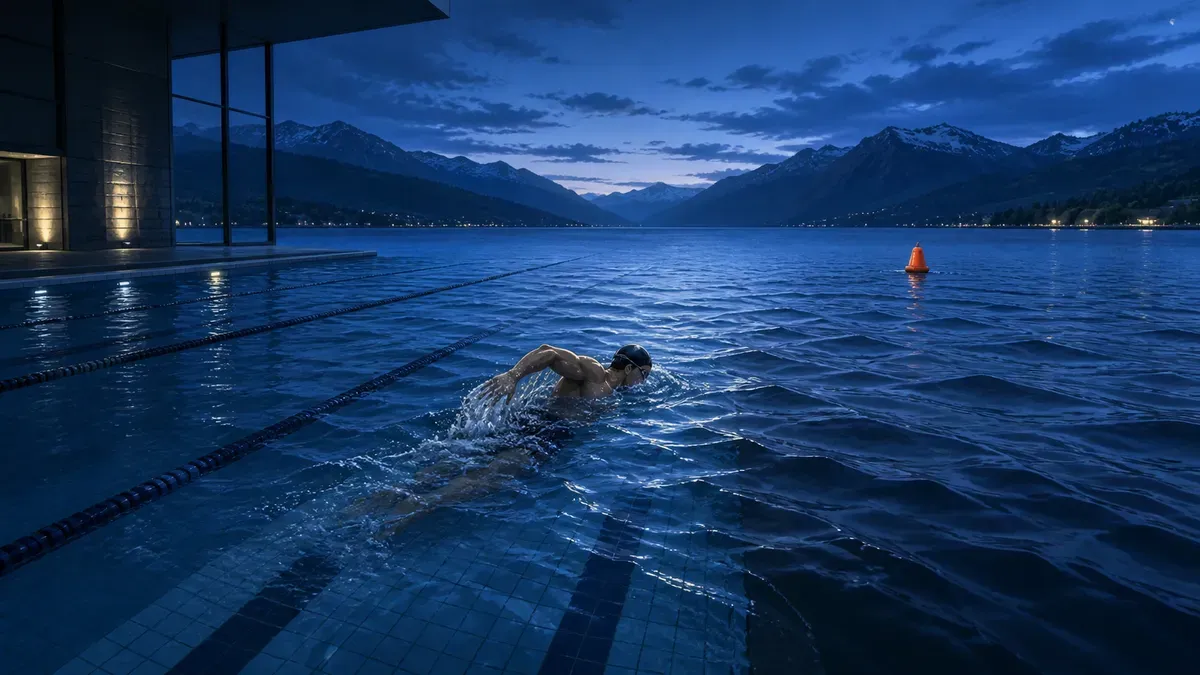
Pool swimming gives you lanes, clear water, measured distances, walls, turns, and usually stable conditions. Open water removes most of those reference points and adds navigation, waves or current, variable temperature, limited visibility, other users, and a site-specific exit plan. The stroke is still front crawl, but the decisions around it change.
A capable lap swimmer should not jump straight from a comfortable pool distance to the same distance offshore. First learn to sight without stopping, swim continuously without relying on walls, tolerate contact and reduced visibility, regulate effort without a pace clock, and make conservative safety decisions at a managed venue. Treat pool fitness as the engine; open-water judgment, orientation, and self-rescue skills are a separate layer.
Key facts
- Pool walls provide rest, speed, and distance feedback that open water does not.
- Open-water sighting interrupts normal head position and must be practiced before distance increases.
- Wind, current, and navigation errors change the distance and energy cost of an outdoor swim.
- Cold-water immersion triggers rapid breathing and cardiovascular strain even in skilled swimmers.
- A venue-specific safety plan defines the route, conditions, supervision, exits, and cancellation rules.
Swimming in both settings can build aerobic fitness, muscular endurance, and confidence in water. Our guide to swimming and cardiovascular aging covers those shared benefits. This article focuses on what changes when the lane line and pool wall disappear—and how to make that transition without confusing endurance with safety.
Pool vs open water at a glance
| Factor | Pool swimming | Open water swimming | What to train |
|---|---|---|---|
| Distance | Measured lengths | Route plus navigation error, drift, and conditions | Time-based effort and conservative range |
| Direction | Lane line and bottom markings | Shore features, buoys, sun, waves, or current | Sighting and course correction |
| Rhythm | Broken by turns and push-offs | Continuous until a buoy, stop, or exit | Long uninterrupted repeats |
| Water | Usually clear, treated, and still | Variable visibility, quality, depth, salinity, and movement | Calm response and site assessment |
| Temperature | Relatively stable | Can vary by site, depth, season, wind, and weather | Gradual, supervised exposure |
| Contact | Lane sharing is structured | Group contact, plants, wildlife, craft, or debris may occur | Space awareness and reset skills |
| Safety | Lifeguard and deck often close | Rescue and exit may be farther away | Buddy, safety cover, route, and exit plan |
| Pacing feedback | Clock, splits, wall count | Effort, time, landmarks, and imperfect devices | Perceived effort and technique cues |
Neither environment is universally harder. A technically demanding pool set can be much harder than a calm, short outdoor swim. Open water is less predictable, however, so equal distance does not mean equal demand or equal risk.
Six differences that change how you swim
1. Pool walls add speed—and micro-recovery
Every turn interrupts free swimming. A streamlined push-off can cover several meters quickly, while the wall gives a momentary change in muscle action and breathing. In open water, you keep producing propulsion without that reset. A swimmer who completes 2,000 yards (1,829 m) as short pool repeats may therefore be unprepared for 30 continuous minutes outdoors.
Prepare with longer pool blocks that reduce wall dependence. Do not deliberately make turns unsafe or inefficient; simply build sets in which the main outcome is sustained relaxed swimming rather than a fast split helped by push-offs.
2. Navigation becomes part of technique
Pool markings quietly solve direction for you. Outdoors, even a small repeated angle can add distance or move you toward a hazard. Sighting means lifting the eyes just enough to confirm a large fixed target, then returning the head to normal breathing position. Lifting the whole chest drives the legs down and increases drag.
Practice a compact sequence in the pool:
- Look forward briefly with the eyes near the surface.
- Record only one piece of information: target visible, left, or right.
- Rotate to the side for a normal breath if needed.
- Make a small correction over several strokes rather than a sharp turn.
Start by sighting every 6–10 strokes, then vary the frequency. Rough conditions or a crowded turn may require more frequent checks; a protected straight line may require fewer. The right interval is the one that keeps you on course without dismantling your stroke.
3. Water movement changes rhythm and route
Wind chop can shorten the useful time available for breathing. A current can carry you sideways even when your body points directly at the target. Waves may obscure a buoy for several strokes. Salt water and a wetsuit can increase buoyancy, while fresh water and an ordinary swimsuit may feel lower and less stable.
The practical response is adaptability, not force. Breathe away from oncoming chop when possible, keep the recovery relaxed, and use a slightly quicker controllable cadence if long gliding leaves the body exposed to disruption. Practice the underlying freestyle breathing technique in a controlled pool first. Do not fight a strong current toward a fixed point without understanding the local flow. At a managed site, follow the required course and safety instructions.
4. Outdoor pace is not a pool pace conversion
A 2020 study comparing 5 km pool and open-water trials found different speed and stroke-rate patterns between the two environments; the open-water measures fluctuated with velocity and stroke-rate changes (Zacca et al., 2020). That does not produce a universal conversion formula. Course accuracy, conditions, temperature, drafting, turns, and measurement error all change the result.
Use three layers of pacing:
- Effort: begin at a deliberately easy intensity at which breathing remains controlled.
- Technique: watch for a rising head, crossing hand entry, shortening stroke, or frantic kick.
- Route: confirm that the line is efficient before interpreting speed.
Our heart-rate zones by sport guide explains why sport-specific readings and conditions matter. In water, optical heart-rate data may be delayed or incomplete, so a simple rating of perceived exertion and repeatable stroke cues are useful backups.
5. Drafting can reduce effort, but it is not a beginner safety plan
Swimming behind or beside another swimmer can reduce drag. In a controlled study, oxygen use, heart rate, lactate, perceived exertion, and stroke rate were lower in drafting positions than in a non-drafting swim; the greatest measured drag reduction occurred close behind the lead swimmer (Chatard and Wilson, 2003). A later experiment also found less muscle fatigue and better efficiency behind a lead swimmer (Puce et al., 2022).
Those findings describe hydrodynamics, not permission to crowd an unfamiliar swimmer. Draft only in coached practice or an event where contact expectations are clear. Maintain enough space to protect hands, face, and the other swimmer’s feet. A first open-water session should prioritize a calm line, visibility, and communication—not tactical gains.
6. Temperature and visibility change the stress response
Sudden cold immersion can produce an involuntary gasp, rapid breathing, increased cardiovascular demand, and loss of fine control. In an experiment using 50°F (10°C) water, both skilled and less-skilled swimmers had a similar initial cold-shock response, and swimming distance fell compared with 81°F (27°C) water (Button et al., 2015). Skill did not make the first physiological response disappear.
Dark water, weeds, depth, or an unseen bottom can also provoke anxiety even when the swimmer is physically capable. Address one stressor at a time: short supervised exposure, easy breathing, a parallel-to-shore route, and an exit that remains close. If breathing does not settle promptly, leave the water rather than trying to “win” against panic or cold.
Build open-water technique in the pool
The pool is the safest place to rehearse most of the motor tasks.
Continuous swimming without wall dependence
Use relaxed turns and avoid treating every push-off as a sprint. Build from 5-minute continuous blocks to 10, 15, and 20 minutes while keeping the same easy stroke quality. Continuous swimming is not a breath-hold challenge; breathe normally and stop if you become dizzy or unwell.
Sighting without a full stop
During an easy 25-yard (23 m) or 50-yard (46 m) repeat, sight a large deck feature two or three times. Ask a coach or partner whether the legs sink or the hands cross the center line. Once the movement is compact, combine sighting with normal side breathing.
Breathing to either side
You do not need rigid bilateral breathing on every third stroke. You do need options when wind, glare, waves, or nearby swimmers make one side unpleasant. Practice several lengths breathing to the less familiar side, then return to your natural pattern.
Variable rhythm without panic
Alternate 20–30 strokes at easy rhythm with 10–15 strokes at a slightly quicker cadence, then settle again. This rehearses a controlled response to chop, a congested buoy, or a short course correction. The goal is to regain rhythm, not turn every disturbance into a sprint.
Group awareness
With lane rules and a coach’s approval, practice swimming beside another person, passing safely, and stopping without collision. Never create deliberate contact in a public lane. Close swimming belongs in a structured session with explicit consent.
Open-water safety is a separate competency
Natural water can contain currents, waves, rocks, vegetation, poor visibility, contamination, sudden depth changes, craft traffic, and limited exits. The CDC recommends swimming with a buddy, choosing lifeguarded areas when possible, checking weather, avoiding alcohol, and recognizing that natural water has hidden hazards. It also advises checking local monitoring, advisories, and closures before entering oceans, lakes, or rivers (CDC healthy swimming guidance).
A wind-powered foil adds wing handling, equipment retention, upwind return, water depth, and fall direction to that environmental judgment. Our beginner wing-foiling guide sets out the staged skills and safety system before a first flight.
Moving below the surface is a different progression: scuba adds breathing gas, active buoyancy control, and personal decompression information. Our scuba diving equipment guide explains why the core kit must be fitted, configured, and checked as one life-support system.
For a first session, choose a managed venue or a coached group with safety cover. The RNLI open-water guidance emphasizes acclimatizing, knowing your limits, using a bright cap, considering a tow float for visibility, and floating if tired or in difficulty.
At a shared beach, fishing lines and casting lanes are part of the site assessment. Our surfcasting safety guide explains how shore anglers should separate people, hooks, sinkers, and changing surf before a cast. Boat anglers also need to keep moving presentations away from swimmers: the beginner trolling guide makes route control and retrieving lines before shared-water hazards explicit.
Use this go/no-go checklist
Before entry, answer all of these:
- Is swimming permitted here today, and is the water-quality status acceptable?
- What are the wind, weather, tide, current, wave, and water-temperature conditions?
- Is the route appropriate for the least experienced swimmer?
- Who is the buddy or safety lead, and how will you communicate?
- Where are the normal exit and at least one earlier exit?
- What local hazards include boats, fishing lines, vegetation, rocks, surf, or poor visibility?
- What bright cap, thermal protection, and visibility aid are appropriate?
- What exact condition will cancel or shorten the swim?
A tow float improves visibility and can carry allowed small items, but it is not guaranteed rescue equipment and should not be used to justify a route beyond your ability. A wetsuit can improve insulation and buoyancy, yet fit, overheating, shoulder restriction, and local rules matter. A review of 17 studies found that wetsuits often improved performance through lower drag, lower energy cost, and greater buoyancy, with effects varying by swimmer and suit (Lepers et al., 2021). Practice in the exact suit before depending on it.
Leave immediately for warning signs
End the swim for uncontrolled breathing, chest pain or pressure, faintness, confusion, unusual weakness, loss of coordination, escalating panic, blue or very pale skin, severe shivering, or an inability to maintain direction. Call local emergency services for severe or persistent symptoms. People with unstable heart or lung disease, fainting, poorly controlled seizures, cold-triggered conditions, or other relevant medical risks should seek individualized medical advice before open-water swimming.
Do not hyperventilate or perform prolonged underwater breath-holds. The CDC warns that these practices can lead to loss of consciousness and drowning. Pool lifeguards, a buddy, a wetsuit, or strong fitness do not make breath-hold contests safe.
A four-week pool-to-open-water transition
This plan assumes you already swim front crawl comfortably for at least 20 minutes, can stop and float, and have access to a managed venue or qualified coach. It is a skill progression, not medical clearance or a guarantee of outdoor safety. Repeat a week when technique or anxiety is not stable.
| Week | Pool focus | Open-water focus | Progress only when |
|---|---|---|---|
| 1 | 3 × 6 minutes easy continuous; sight every 8–10 strokes in short repeats | Venue briefing from shore; identify route, hazards, and exits | Sighting causes only a small rhythm change |
| 2 | 2 × 10 minutes easy; practice either-side breathing and cadence changes | 10–15 minutes close to exit with coach or safety cover | Breathing settles and direction remains controlled |
| 3 | 20 minutes continuous; 6 short controlled surges followed by recovery | 15–25 minutes on a simple parallel-to-shore route | You can sight, correct, float, and signal calmly |
| 4 | Rehearse cap, goggles, and wetsuit if used; 25–30 minutes easy | Short planned route below your pool endurance limit | You finish with reserve and can explain the go/no-go decision |
Keep most swimming easy. Increase only one variable at a time: duration, distance from the exit, water movement, temperature exposure, or group complexity. Do not increase them together. If an outdoor session is cancelled, replace it with pool technique rather than searching for a riskier unmonitored location.
How SuperAge can support the training process
Use SuperAge to observe the health routine around swimming, not to certify open-water readiness. A wearable may help you review session duration, resting heart rate, sleep, and recovery trends. It cannot see a rip current, judge water quality, confirm a safe exit, or guarantee that an optical heart-rate reading is accurate underwater.
Log pool and open-water sessions separately. Add a short note for temperature, conditions, perceived effort, wetsuit use, anxiety, and any technique breakdown. Over several weeks, compare how your body responds instead of forcing pool pace onto an outdoor route. The broader exercise-for-longevity guide can help balance swimming with strength and other aerobic work, while heart-rate recovery offers one land-friendly way to follow cardiovascular adaptation.
The most useful signal is often behavioral: you finished with reserve, recovered normally, and made the conservative decision when conditions were wrong.
Common transition mistakes
Matching pool distance on day one
Distance is only one load variable. Start shorter than your continuous pool capacity because navigation, temperature, anxiety, and exits are new tasks.
Following a faster swimmer blindly
Their route, thermal tolerance, and risk acceptance may not match yours. Stay within the session plan and retain your own navigation awareness.
Testing new goggles and a new wetsuit outdoors
Leaks, fogging, neck chafing, and shoulder restriction are manageable in a pool and destabilizing far from an exit. Rehearse equipment before the first outdoor route.
Treating a tow float as a life jacket
Visibility aids can detach, leak, or be inappropriate in some conditions. Stay within your independent ability and the venue’s safety system.
Chasing device pace
Outdoor distance estimates can wander, and conditions change speed. Navigate first; then interpret effort, time, and the route as a whole.
Normalizing panic or cold symptoms
Discomfort is information. Exit early, warm appropriately, and identify the trigger before another attempt. More exposure is not automatically better.
FAQ
Is open water swimming harder than pool swimming?
It is usually less predictable, not automatically more intense. A pool workout can be physiologically harder, but open water adds navigation, continuous swimming, temperature, visibility, conditions, and a more complex safety system. The same distance can therefore demand different skills and effort.
How much slower should I expect to swim outdoors?
There is no reliable universal conversion. Wind, current, waves, water type, wetsuit use, drafting, route accuracy, and the absence of turns all affect speed. Begin by controlling effort and direction, then build your own comparison across similar sessions.
How far should my first open-water swim be?
Use time and proximity to a safe exit rather than chasing a distance. At a managed venue, 10–15 easy minutes close to the exit may teach more than a long crossing. Follow the coach or venue plan and finish with substantial reserve.
How often should I sight?
Every 6–10 strokes is a useful practice range, not a rule. Sight more often when the target disappears, the route changes, or conditions push you off line; sight less when a protected straight section and a large target make direction obvious.
Do I need a wetsuit for open water swimming?
It depends on water temperature, exposure, local rules, swimmer experience, and fit. A wetsuit can add insulation and buoyancy but can also restrict the shoulders or contribute to overheating. Practice with it before the intended session and follow local safety requirements.
Is a tow float enough to swim alone?
No. It may improve visibility but does not replace a buddy, safety cover, a suitable venue, route knowledge, or rescue capacity. Never use it to extend beyond your skill or thermal tolerance.
Can strong pool swimmers skip open-water lessons?
No. Pool fitness helps, but it does not teach site assessment, navigation, cold response, group contact, craft awareness, or outdoor exits. A coached introduction compresses those skills into a safer setting.
Should I use heart rate to pace an open-water swim?
Heart rate can be one input, but underwater readings may be imperfect and cardiovascular response changes with temperature and stress. Combine it with perceived effort, breathing control, technique quality, time, and the venue plan.
Key takeaways
- Pool fitness transfers to open water, but open-water competence requires additional skills and decisions.
- Practice continuous swimming, compact sighting, either-side breathing, rhythm changes, and calm floating before extending distance.
- Compare effort rather than applying a fixed pool-to-outdoor pace formula.
- Start at a managed venue with a buddy or safety cover, clear exits, and conservative cancellation rules.
- Add duration, exposure, conditions, or group complexity one at a time.
- Track training trends with SuperAge, but leave environmental safety decisions to real-time local assessment.
Review your swim training with SuperAge
Build the engine and respect the environment. Download SuperAge to follow the recovery and cardiovascular habits behind your swim training, and use qualified local safety systems for every open-water decision.
References
- Zacca R, et al. 5 km front crawl in pool and open water swimming: breath-by-breath energy expenditure and kinematic analysis. European Journal of Applied Physiology. 2020.
- Chatard JC, Wilson B. Drafting distance in swimming. Medicine & Science in Sports & Exercise. 2003.
- Puce L, et al. Muscle fatigue and swimming efficiency in behind and lateral drafting. Frontiers in Physiology. 2022.
- Button C, et al. Integrative physiological and behavioural responses to sudden cold-water immersion are similar in skilled and less-skilled swimmers. Physiology & Behavior. 2015.
- Lepers R, et al. Wetsuit use during open water swimming: does it suit everybody?. International Journal of Sports Physiology and Performance. 2021.
- Centers for Disease Control and Prevention. Preventing drowning. Updated 2025.
- Centers for Disease Control and Prevention. How to safely visit oceans, lakes, and rivers. 2024.
- Royal National Lifeboat Institution. Open water swimming guidelines. Accessed 2026.
Related Articles
Canoe vs kayak: differences, safety, and which is easier
Canoe vs kayak: compare paddles, stability, storage, rescue, fitness demands, and safety so you can confidently choose the right craft for your first trip.