Sea kayak touring: plan a safer multi-day coastal trip
Plan sea kayak touring trips with safer routes, weather and tide checks, rescue skills, packing systems, camping logistics, and fitness preparation.
Quick answer
Sea kayak touring means travelling along a coast or large body of water in a kayak, often carrying camping equipment for one or more nights. A safe plan begins with a conservative route, frequent landing options, a weather-and-tide window, practiced capsize recovery, immersion clothing, a continuously worn personal flotation device (PFD), navigation backups, and a float plan left with a reliable person ashore.
Do not turn a first coastal paddle into a self-supported expedition. Build from sheltered day trips to loaded-boat practice and an overnight route with straightforward landings. Local instruction matters because wind, swell, tidal current, cliffs, traffic, access rules, and rescue coverage vary by coast. Fitness helps you paddle efficiently, but it cannot make an exposed crossing or hostile landing safe.
Key facts
- Sea kayak touring combines paddling endurance with navigation, weather judgment, rescue skills, and camp logistics.
- Offshore wind increases the distance between a capsized paddler and a safe landing.
- Cold-water immersion triggers involuntary breathing changes before hypothermia becomes the main concern.
- A float plan gives rescuers a route, timetable, boat description, contacts, and overdue trigger.
- Conservative daily mileage preserves time and energy for changing conditions, awkward landings, and recovery.
What sea kayak touring is—and what it is not
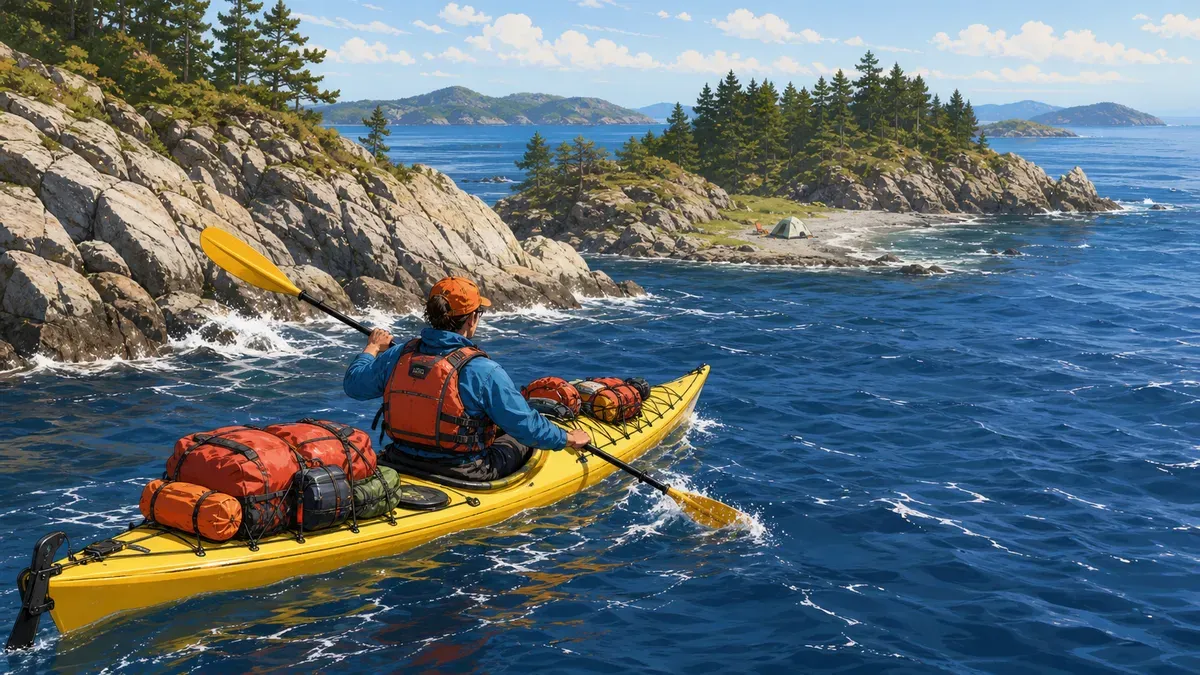
Sea kayak touring is a journey rather than a short loop from the same beach. The craft carries food, water, shelter, clothing, repair items, and emergency equipment in dry storage. The route may connect islands, coves, headlands, or legal coastal campsites. Even when the day’s distance looks modest on a map, wind, current, waves, surf, cold, and limited exits can multiply its difficulty.
That makes touring different from choosing between a canoe and a kayak for a first sheltered-water session. It is also different from racing. The goal is not to hold the highest possible speed; it is to keep the group, boat, route, and remaining daylight inside a controllable margin.
The sea is not a gym with a predictable exit. Treat any itinerary as provisional and every crossing as a decision that must still make sense when you reach it.
Build the route around exposure, not ambition
Start with the map and identify the consequences of being wrong. A useful route assessment considers three connected questions:
- Where can you land? Mark ordinary stops, emergency exits, beaches that disappear at high water, cliffs, reefs, harbor restrictions, private land, and protected habitat.
- What can move you? Plot prevailing and forecast wind, tidal streams, river outflow, swell direction, rebound from cliffs, and boat traffic.
- How long are you committed? Measure crossings, stretches without a landing, exposed headlands, and the time required to reverse the route.
Distance alone is a weak difficulty measure. A 6-mile (10 km) shoreline with frequent beaches may be more manageable than a 2-mile (3.2 km) open crossing with offshore wind and no intermediate exit.
Write a route card before packing
Create a compact route card that another person can understand without your phone. Include:
| Field | Record before departure | Why it matters |
|---|---|---|
| Launch and finish | Coordinates, access hours, parking constraints | Prevents an avoidable access failure |
| Route legs | Bearing, distance, expected time, safe landing | Makes progress and drift visible |
| Tidal gates | Local source, time zone, direction, uncertainty | Prevents a schedule built on the wrong tide |
| Weather limits | Personal wind, wave, visibility, and thunder limits | Turns cancellation into a pre-made decision |
| Escape options | Landing, walking access, pickup point | Keeps one problem from becoming an emergency |
| Communications | VHF channel where applicable, phone coverage, beacon details | Matches equipment to local rescue systems |
| Overdue action | Check-in time and who contacts rescue services | Makes the float plan operational |
Add margins instead of assuming perfect speed. A loaded kayak, a tired paddler, a navigation check, a rough landing, or a seasick teammate can consume the spare hour you thought you had.
Read weather, tide, current, and waves as one system
A city weather app is not a marine forecast. Use the official marine service for the area and check the same route repeatedly as departure approaches. The US National Weather Service explains that small-craft advisories depend on local wind and sea thresholds, while the RNLI advises paddlers to check weather, sea conditions, and tides and keep updating them on longer outings.
Translate the forecast into what it means at kayak height:
- Wind direction: offshore wind can make return to land progressively harder; onshore wind may create surf and difficult landings.
- Wind against current: opposing flows can steepen and shorten waves.
- Headlands and gaps: terrain can accelerate wind and current locally.
- Swell period and direction: distant storms can produce powerful surf on an otherwise sunny day.
- Visibility: fog removes visual references and makes traffic harder to detect.
- Thunder: open water offers no meaningful shelter.
Tide height and tidal current are related but not interchangeable. High tide does not necessarily mean slack current. Obtain predictions from an official hydrographic source, confirm the time zone and daylight-saving convention, and apply local corrections. A prediction is not a promise: atmospheric pressure, river flow, and wind can change observed water levels and currents.
Before launching, compare the forecast with the actual water. If the beach, whitecaps, cloud development, or wind direction contradicts the plan, trust the conditions in front of you.
If your coastal activity stays on the beach rather than launching a boat, our beginner surfcasting guide applies the same forecast-first discipline to beach reading, casting lanes, and shore-specific stop rules.
Define the no-go decision in advance
Good judgment is easier before the group is dressed, packed, and emotionally invested. Write down the conditions that trigger a shorter route, a delayed launch, or a cancellation.
Use the least capable relevant element—not the strongest paddler—as the limit:
- the least experienced person in those conditions;
- the least reliable rescue skill in the group;
- the coldest person after an unplanned swim;
- the weakest communication link;
- the most exposed unavoidable route leg;
- the landing that becomes dangerous when timing slips.
A “yellow” observation should make the route more conservative. Two independent yellow observations—such as a rising offshore wind and a teammate becoming cold—should normally trigger an exit while one is still easy. A “red” observation, including lightning, a failed essential safety item, conditions beyond the group’s practiced rescue envelope, or loss of a viable landing, ends the original plan.
Skills come before miles
Before a loaded overnight trip, every paddler should be able to exit a capsized kayak calmly and participate in a rescue while wearing the actual clothing and PFD intended for the trip. The American Canoe Association’s coastal curriculum includes trip risk assessment, rough-water rescues, towing, navigation, communication, and hypothermia equipment. Learn with a qualified local instructor, then practice in controlled water before adding exposure.
Readers moving from paddling to a wind-powered board need a different skill ladder. Our wing-foiling beginner guide separates wing control, upwind return, self-rescue, and low first flights before sustained foiling.
At minimum, practice:
- a wet exit without losing contact with kayak and paddle;
- an assisted re-entry with a loaded boat;
- a self-rescue appropriate to the kayak and paddler;
- emptying water and restoring a usable cockpit;
- towing a tired or unstable paddler;
- launching and landing in the conditions expected;
- group signals and what happens after separation;
- a navigation fix without relying on mobile data.
Rolling is valuable but not a substitute for the rest of the rescue system. A roll may fail, a shoulder may be injured, or another paddler may need help. Similarly, pool practice does not prove a rescue will work in wind, waves, cold water, and a fully loaded kayak.
Dress for immersion and keep flotation on your body
The relevant temperature is the water, not the sunny air. The National Weather Service notes that sudden cold-water immersion can cause gasping, rapid breathing, cardiovascular strain, impaired thinking, and loss of muscular control. A PFD helps keep the airway supported while the paddler controls breathing and attempts rescue.
Wear a correctly fitted paddling PFD continuously and choose thermal protection for the expected immersion, not merely for comfortable paddling. Depending on water temperature and conditions, that may mean a wetsuit or drysuit with suitable insulation. Test the complete system in controlled water: a drysuit without enough insulation can still leave a swimmer dangerously cold, and poorly fitted clothing can restrict movement.
Keep communication and signaling equipment attached to the person where it remains reachable after separation from the kayak. Local requirements differ, but an appropriate system may include a waterproof VHF marine radio, personal locator beacon, phone in a tested waterproof case, whistle, light, mirror, or flares. Know which device reaches the actual rescue service in the area, how to use it, and any licensing or registration rules.
Pack by function, access, and failure mode
A long gear list does not automatically create resilience. Organize equipment into systems and ask what happens when one container leaks, one hatch is inaccessible, or the group becomes separated.
On-body essentials
Keep the items needed during an immediate capsize or separation on the PFD or clothing: communication, signaling, cutting tool where appropriate, and a small amount of emergency energy. Do not attach loose lines that create an entanglement hazard.
Cockpit-accessible items
Sun protection, water, snacks, chart, compass, spare gloves, and a compact layer should be reachable without unpacking the kayak on unstable water. Secure everything so a capsize does not create debris.
Watertight compartments
Use multiple dry bags rather than one large bag. Separate sleeping insulation from wet clothing and duplicate critical fire-lighting, water-treatment, and navigation functions across different compartments. Pack dense items low and near the kayak’s center; test the loaded trim before departure.
Group repair and rescue system
Match repair materials to the actual hull, hatch, skeg or rudder, seat, and paddle. Carry a spare paddle where the group can deploy it on the water. First-aid contents should reflect evacuation time and the paddlers’ training, not an impressive but unfamiliar kit.
The US Coast Guard’s paddler checklist emphasizes pre-trip planning, a float plan, immersion clothing, and wearing the PFD. Equipment is strongest when every person knows where it is and has rehearsed using it.
Water, food, and pacing for a loaded day
Plan water from realistic use, reliable refill points, treatment capacity, and a reserve; never assume an unmapped coastal source is fresh or safe. Salt spray and cool wind can hide sweat, while sun reflected from the water increases heat load. Use regular drinking and eating opportunities before fatigue makes a landing or rescue harder. For a deeper explanation of fluid needs and individualized limits, see our hydration and biological aging guide.
Choose familiar, compact foods that can be eaten when the water is too active for a relaxed stop. Divide the day into sustainable legs rather than alternating hard efforts with long recoveries. A conversational aerobic intensity resembles the effort described in our Zone 2 training guide, but wind and sea state can raise effort abruptly even when speed falls.
Do not let a calorie estimate dictate the itinerary. Paddling efficiency, loaded-boat handling, thermal stress, anxiety, sleep, and repeated landings can matter more than a watch’s energy number.
Prepare the body without confusing fitness with seamanship
Sea kayaking can provide sustained aerobic work and repeated trunk and upper-body loading. A survey of 178 coastal kayakers found that joint, tendon, and muscle problems were the most commonly reported health impacts among those who had experienced problems. That is a reason to progress volume and technique deliberately, not a reason to avoid the activity.
Build three capacities:
- Easy endurance: start with continuous, relaxed paddling and gradually extend time. Other low-impact aerobic work can support the base.
- Strength and control: train pulling, pushing, trunk rotation control, hips, legs, and grip rather than isolating the arms. Our comparison of strength training and cardio after 40 explains why both belong in a durable program.
- Task-specific resilience: practice loaded launches, short carries, repeated re-entries, and paddling after a break—initially in sheltered, supervised conditions.
Keep the top hand below a position that forces the shoulder into a vulnerable high-elbow posture, learn torso-driven technique from a coach, and stop when pain changes the stroke. General benchmarks can help reveal a weak link, but they do not certify open-water competence; use our age-based fitness benchmarks as training context, not a sea-kayaking clearance test.
A six-week progression for an already competent day paddler
This is a preparation template, not a substitute for technical instruction:
| Weeks | Paddling focus | Land training | Safety focus |
|---|---|---|---|
| 1–2 | Two easy 45–75 minute sessions | Two full-body strength sessions | Controlled wet exit and assisted rescue |
| 3–4 | One easy session plus one 90–120 minute loaded paddle | Two strength sessions; carry practice | Self-rescue, tow setup, navigation |
| 5 | One easy session plus a back-to-back weekend | One lighter strength session | Loaded rescues and landing choices |
| 6 | Reduce volume; short technique paddle | Mobility and light activation | Gear rehearsal and written route card |
Increase only one major stressor at a time: duration, load, environmental complexity, or consecutive days. If shoulder, wrist, or back symptoms persist or worsen, reduce exposure and seek qualified medical assessment.
Use SuperAge for the training record, not the marine decision
SuperAge can help you observe whether aerobic work, strength sessions, sleep, and recovery are trending in a useful direction before a trip. It can also keep the preparation plan visible when the expedition is still weeks away.
It cannot measure local tidal races, landing surf, rescue competence, group communication, or the effect of a forecast wind on a specific headland. Use health data as one personal readiness input, then let official forecasts, local knowledge, practiced skills, and conservative route judgment govern the water decision. If paddling is one part of a broader routine, our guide to swimming and cardiovascular aging shows another low-impact aquatic option—but swimming fitness still does not replace kayak rescue training.
Download SuperAge to review training and recovery trends while you prepare, without treating an app score as marine-safety clearance.
Camp without damaging the narrow coastal edge
Coastal camps concentrate impact on a small strip of land. Confirm permits, private-property boundaries, fire restrictions, wildlife closures, sanitation rules, and freshwater availability before departure. Leave No Trace advises sea kayakers to use established durable sites, protect fragile vegetation, and know where camping is allowed.
Where a legal coastal camp also has steep slopes, drainage channels, exposed ground, or cold nights, use the same terrain and sleep-system screen described in our mountain tent camping safety guide; the hazard logic travels even when the shoreline setting differs.
Land and store boats on durable surfaces below fragile dune vegetation. Keep food secured according to local wildlife guidance, pack out rubbish and micro-trash, minimize light and noise, and avoid disturbing nesting or resting animals. Human-waste rules vary sharply by coast and protected area; follow the managing authority rather than applying a generic method everywhere.
Nature exposure may support wellbeing, but the coast is habitat before it is a wellness setting. Our review of nature exposure and biological aging describes the health evidence while keeping the experience in perspective.
Make the emergency plan specific
A float plan is not “we are kayaking north this weekend.” The US Coast Guard notes that a float plan is useful even for a 10-foot kayak because it preserves details that a friend may not remember during an emergency.
Give a reliable person:
- names, relevant medical information, and emergency contacts;
- boat colors, vehicle details, and a current photo;
- launch, route legs, camps, escape landings, and finish;
- communication and locator devices;
- planned check-in and a clear overdue time;
- the local rescue authority to contact and the information to provide.
Update that person when the route changes, and close the plan promptly after returning. Inside the group, agree who leads a call for help, what information they transmit, how the remaining paddlers stay together, and when an injury, lost paddle, damaged hatch, failed drysuit seal, or deteriorating weather ends the trip.
A retrospective analysis of 50 New Zealand incidents found that events were complex and that human factors contributed more often than physical events. Incidents were more severe when a capsized paddler became separated from the kayak and when a PFD was not worn. The practical lesson is not that one item guarantees safety; it is that several simple protections must work together.
A conservative first-overnight template
For a first overnight after proper instruction, choose a familiar sheltered area with reliable forecasts, legal camping, minimal boat traffic, multiple landings, and no mandatory open crossing. Paddle the fully loaded kayak on a separate test day first.
An example decision sequence:
- One week out: confirm access, permits, group skills, equipment, escape routes, and a backup land itinerary.
- Forty-eight hours out: compare marine forecasts, water temperature, tides, swell, and local notices.
- Departure morning: inspect actual wind and water, recheck the forecast, brief the group, and activate the float plan.
- On the water: regroup before commitments, compare progress with the route card, eat and drink early, and use the easiest safe landing before margin disappears.
- At camp: secure boats above the water line without harming vegetation, change into dry insulation, close the day’s float-plan check-in, and reassess the next leg.
- Next morning: treat the return as a new trip. Yesterday’s successful conditions do not approve today’s launch.
Success means everyone returns with unused safety margin. Reaching the planned campsite is optional.
Final pre-launch checklist
- Route, crossings, landings, escape points, and access rules checked
- Official marine forecast, tide, current, swell, and water temperature reviewed
- Personal no-go limits still satisfied by actual conditions
- PFD and immersion clothing worn and tested
- Loaded-boat rescues practiced within the group’s real conditions
- Navigation, communication, signaling, spare paddle, repair, and first aid ready
- Water, food, shelter, dry insulation, and reserve distributed safely
- Float plan delivered with an explicit overdue action
- Local camping, fire, sanitation, and wildlife rules confirmed
- Backup route accepted before launch
Key takeaways
- Plan coastal touring around exposure and landing options, not mileage alone.
- Treat marine weather, tides, currents, waves, and visibility as an interacting system.
- Practice loaded rescues and communication before adding distance or remote camps.
- Wear the PFD and dress for the water temperature throughout the trip.
- Use fitness and health data to guide preparation, never to override marine conditions.
- Leave a detailed float plan and protect the fragile coastal edge.
FAQ
Is sea kayak touring suitable for beginners?
A sheltered day trip with qualified instruction can be suitable for a beginner. A self-supported multi-day coast trip is not the starting point. First learn boat control, wet exits, assisted and self-rescues, group communication, and local route judgment.
How far can you sea kayak in a day?
There is no universal safe distance. Wind, current, waves, landings, boat load, group pace, daylight, and rescue capacity matter more than a generic mileage target. Plan conservative legs from recent practice and preserve time for an early exit.
Do I need a drysuit for sea kayaking?
It depends on water temperature, exposure, weather, and local guidance. Dress for an unplanned immersion rather than the air temperature. In cold water, a suitable drysuit with appropriate insulation may be necessary; get local instruction and test the system safely.
Can a phone replace a VHF radio or locator beacon?
Not reliably everywhere. Coverage, waterproofing, battery life, rescue monitoring, and local communication systems differ. Build a redundant system that matches the route and local regulations, and keep essential devices attached to your body.
Should I paddle alone?
Solo touring removes immediate assisted rescue and group decision support. It demands a much stronger skill, communication, and risk-management system. Beginners should paddle with appropriately skilled partners and seek local instruction.
How do I plan around tides?
Use an official local prediction, verify the date, time zone, and station or secondary-port corrections, then distinguish tide height from tidal-current timing. Add uncertainty and compare the prediction with actual conditions before committing.
What should go in a sea kayak first?
Pack dense items low and near the center, keep trim balanced, isolate sleeping insulation, and distribute critical systems across separate dry bags. On-body rescue essentials and cockpit-accessible water, food, chart, and layers should remain usable after a capsize.
Does sea kayaking improve fitness?
Regular paddling can support aerobic fitness and muscular endurance, but the training effect depends on intensity, duration, technique, and consistency. Progress gradually and combine paddling with full-body strength and recovery work.
References
- Bailey I. An analysis of sea kayaking incidents in New Zealand 1992–2005. Wilderness & Environmental Medicine. 2010.
- Powell C. Injuries and medical conditions among kayakers paddling in the sea environment. Wilderness & Environmental Medicine. 2009.
- Royal National Lifeboat Institution. Kayaking and canoeing safety guidance.
- US National Weather Service. Cold water hazards and safety.
- National Oceanic and Atmospheric Administration. Guide to marine weather watches, advisories, and warnings.
- US Coast Guard. Float plan guidance.
- American Canoe Association. Paddler’s safety checklist.
- American Canoe Association. Level 5 coastal kayaking skills.
- Leave No Trace. Sea kayaking minimum-impact guidance.
Related Articles

Canyoning in Italy: where to go and how to choose safely
Plan canyoning in Italy by matching routes to your skills, checking weather and water, choosing qualified guidance, and comparing seven standout regions.