Kitesurfing for beginners: lessons, safety, and progression
Start kitesurfing with a clear plan for lessons, wind, safety systems, fitness, and learning milestones. Prepare for your first session and progress with care.
Quick answer
Start kitesurfing with a qualified instructor, suitable school equipment, and conditions selected for learning. Learn to assess the site, control the kite, use its release systems, move through the water without a board, and recover from problems before concentrating on riding. A first successful water start is a milestone, not proof that you can kite independently.
You need swimming confidence, the ability to follow instructions in open water, and enough fitness to repeat practice without losing concentration. You do not need to arrive with advanced board skills. This guide helps you prepare for lessons; powered-kite handling, launching, landing, and self-rescue require practical instruction.
Key facts
- A kite transfers wind force through lines and a harness to the rider.
- Kite control enables board progression by making power delivery more predictable.
- Release-system practice builds familiarity with the equipment used in a lesson.
- Wind direction changes the consequences of drifting or losing control.
- Fatigue reduces the margin for attention, judgment, and repeated skill practice.
Understand what you are learning
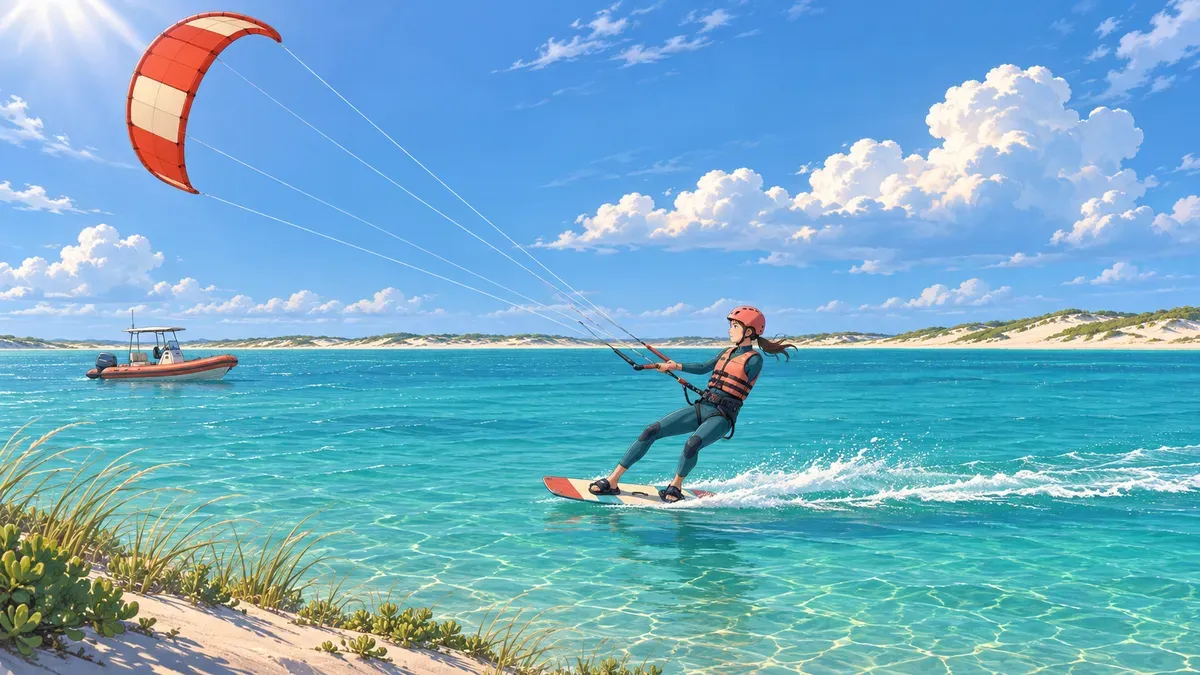
In beginner kiteboarding, a flying kite supplies propulsion while the rider stands on a board, commonly a twin tip that can travel in either direction. Steering the kite, managing its pull, and directing the board are connected tasks. Pulling harder with your arms is not a substitute for understanding that system.
The British Kitesports sport overview explains that the harness carries the kite’s load and that competent kite flying precedes introducing the board. This differs from wing foiling, where the rider holds a wing directly. Our wing foiling guide covers that separate learning pathway.
For your first course, define success as understanding the next decision. Can you explain why the instructor chose this equipment and teaching area? Can you identify the agreed signal to stop? Those questions are more useful than comparing your first ride with an experienced rider’s jumps.
Choose instruction around competence
Look for a school with appropriately qualified instructors, a clear teaching plan, equipment maintenance, and a rescue arrangement suited to its venue. Ask how many learners share the instructor, how communication works on the water, and what happens when the weather becomes unsuitable. A good booking policy should make it possible to postpone a poor learning day.
The British Kitesports learning scheme separates introductory kite handling and water skills from board starts and independent riding. This supports a staged approach. Published course durations are estimates, not a guarantee for a particular person or a promise that all safety skills fit into one weekend.
Before booking, ask for answers to four practical questions:
- What will I learn before using a powered kite?
- How will I practice the release systems and rescue skills?
- Which abilities must I demonstrate before moving to the next stage?
- What support is available after the introductory course?
Bring an honest description of your swimming ability, previous injuries, and relevant medical conditions. If exertion causes chest pain, fainting, or unexplained breathlessness, seek medical assessment before attempting a demanding water sport. Ongoing shoulder, back, knee, or ankle problems may also need an individual plan.
Read the learning area before the wind number
There is no single wind speed that makes a session appropriate for every beginner. Kite size, rider mass, gusts, current, water depth, available space, and rescue access change the decision. A forecast number without those details is an incomplete answer.
Ask the instructor to point out the wind direction, the expected drift path, obstacles, the teaching boundary, and the exit. Side-shore or side-onshore wind may be useful at a suitable site; neither label makes a hazardous shoreline safe. Offshore wind can carry a struggling learner away from land. Direct onshore wind can push someone toward beach obstacles.
The IKO intermediate handbook preview places wind direction, hazards, protective equipment, and instructor-led rescue preparation before water practice. Use that as a reason to ask better questions, rather than as permission to assess an unfamiliar venue alone.
Local access restrictions and right-of-way procedures still need to be checked with the school. Conditions also change during a lesson. If gusts increase, visibility falls, current strengthens, or the teaching space becomes crowded, reassess the plan. Thunderstorms require leaving exposed water and seeking appropriate shelter; see the National Weather Service lightning guidance.
Treat equipment as a working safety system
Use equipment selected and checked by the instructor while you learn. The question is whether the kite, bar, lines, harness, board, and protective clothing work together for your body and the actual conditions. Buying a supposedly advanced setup cannot solve missing skills.
| Part of the system | What to understand before practice | Question for the instructor |
|---|---|---|
| Kite, bar, and lines | The controls must match the kite and be inspected | How do you verify compatibility and damage? |
| Harness and releases | The fit must allow access to the safety controls | Can I locate and operate them in my lesson clothing? |
| Helmet and flotation | Fit and intended use matter | Does this flotation meet the site’s needs, rather than merely provide impact padding? |
| Thermal protection | Immersion matters even in warm air | Is this suitable for the water temperature and lesson duration? |
| Board | Size and setup must suit the teaching stage | What skill do I need before introducing it? |
Do not handle tensioned lines or wrap them around any part of your body. Keep other beach users outside the equipment and line area. Launching and landing assistance must come from someone who understands the procedure; an enthusiastic bystander is not automatically a safe helper.
An instructor should demonstrate the exact release system, supervise practice, and explain its limitations. Reducing power, activating a primary release, and fully disconnecting are different actions with different consequences. Do not assume that releasing the bar or one safety device always removes every pulling force. The ISO 21853 standard overview distinguishes reducing pull from disconnecting the user. This article cannot supply a universal operating sequence for different equipment.
Follow milestones rather than a countdown
Use the following as a discussion framework with your instructor, not a self-teaching program. Conditions may require revisiting an earlier stage, changing equipment, or ending the session.
| Learning stage | Useful evidence of progress | Reason to repeat the stage |
|---|---|---|
| Site assessment and equipment familiarization | You can explain the main hazards, signals, and stop plan | You cannot identify a safe exit or locate a release |
| Supervised kite control | You can manage the instructor’s tasks without persistent uncontrolled pull | You repeatedly lose orientation or react by gripping harder |
| Water movement without the board | You can practice directional movement and recovery tasks under supervision | Drifting, relaunching, or rescue procedures remain confusing |
| Water starts and short rides | Power, board position, and stopping become more repeatable | Standing up works only through a lucky burst of power |
| Supported transition toward independence | You demonstrate the school’s required return, traffic, and emergency competencies | You can ride but cannot return or manage foreseeable problems |
A learner who stands up quickly may still need substantial work on recovery. Another learner may take longer to stand but develop excellent control. Neither deserves pressure to skip a step. Ask the instructor to record both what you can do and what remains supervised.
Avoid turning the final minutes into an exhaustion challenge. When you stop processing instructions or repeat errors you had already corrected, take a break. A useful session can finish with a clear next task rather than one more attempt.
Prepare your body without rehearsing dangerous tasks
General conditioning can make lessons more comfortable. Build swimming confidence in a suitable supervised environment, maintain regular walking or cycling, and include basic strength work you can perform comfortably. The freestyle breathing guide provides a separate pool-based skill foundation. Practicing a controlled squat, hip hinge, row, and trunk stabilization on land is a general preparation option, not a validated kitesurfing injury-prevention program.
The WHO physical activity guidelines recommend 150–300 minutes of moderate aerobic activity weekly, or an equivalent vigorous combination, with muscle-strengthening work on at least two days. These are general health goals, not admission requirements for a course. Begin from your current capacity and build gradually; our exercise and longevity guide explains the wider training framework.
Do not exhaust your grip or shoulders the day before a lesson. Eat familiar meals, bring drinking water, and allow recovery between demanding days. The exercise hydration guide and rest-between-workouts guide address those supporting habits.
Know what the injury evidence can tell you
A 2020 prospective cohort study followed 194 kitesurfers across a season and recorded 177 injuries during 16,816 hours. Foot and ankle injuries were the most common anatomical group, and many injuries occurred during tricks or jumps. Most reported injuries were mild, but serious injuries also occurred.
Those findings describe a mixed group of participants, not the personal risk of a supervised beginner lesson. They do not prove that a particular warm-up, kite, or fitness score prevents injury. Likewise, a 2026 retrospective survey adds information about injury patterns but relies on recalled reports. Use research to take hazards seriously without converting population averages into a safety guarantee.
Thermal risk deserves separate attention. The National Weather Service cold-water guidance describes involuntary gasping, rapid breathing, and loss of control after sudden immersion. Water at 50–60°F (10–15°C) can still produce dangerous cold shock. Wear suitable flotation and thermal protection, and tell the instructor promptly if you become cold or struggle to use your hands. Pool swimming ability does not remove open-water hazards; our pool-to-open-water guide explains the distinction.
Keep a simple first-lesson plan
The evening before, confirm the school’s weather decision and meeting arrangements. Pack food, water, dry clothing, sun protection, and any personal items the school requests. Leave enough time to arrive without rushing.
At the briefing, repeat the communication and stop signals back to the instructor. After each practice block, name one thing that improved and one thing to repeat. At the end, ask for a specific next objective. This makes the session useful even when the weather limits riding time.
The RNLI kitesurfing guidance emphasizes appropriate conditions, capable company, a way to summon help, and telling someone your plan. Do not interpret being close to shore as a substitute for those precautions. Before future sessions, confirm the venue’s emergency contact method and rescue arrangements rather than assuming every beach has the same coverage.
Review your activity pattern with SuperAge
Keep a brief learning log: the conditions, skills practiced, what still needs supervision, and how you felt afterward. SuperAge can help place available Apple Health activity and recovery trends alongside that record. Sleep and recovery information may help you notice when a demanding week leaves less capacity for learning.
A wearable score cannot assess kite compatibility, judge the wind, verify rescue competence, or clear a session as safe. Better fitness supports participation; it does not replace instruction or environmental judgment. Look for a repeatable routine that leaves room for both enjoyment and recovery.
Frequently asked questions
Can I teach myself kitesurfing?
Practical lessons are the appropriate starting point. Reading and videos can prepare questions, but powered-kite control, releases, launching, landing, and self-rescue require supervised learning and feedback.
How many lessons do I need?
There is no universal number. Weather, water conditions, prior experience, instruction, and confidence affect progress. Use demonstrated competencies rather than a promised number of hours to judge readiness.
Do I need strong arms?
The harness carries much of the kite’s load, so this is not simply an arm-strength sport. General conditioning helps, but controlled kite handling and sound decisions matter more than gripping force.
Must I be able to swim?
You need suitable swimming ability and comfort in the water for the school’s program. Tell the instructor your actual ability. Flotation is important, but it does not replace swimming competence or rescue planning.
What wind speed is best for beginners?
A single number cannot answer this safely. The instructor must match equipment, gusts, wind direction, water conditions, rider size, and available rescue support to the lesson.
Should I buy equipment before taking lessons?
Using school equipment first lets the instructor adapt the setup and explain compatibility. Make purchase decisions after you understand your needs; this guide does not recommend particular products.
Can I start after 40 or 50?
Age alone does not decide readiness. Swimming confidence, health, mobility, recovery, and appropriate teaching matter. Discuss medical conditions or previous injuries before booking and progress at a sustainable pace.
Does riding in both directions mean I am independent?
No. Returning, stopping, managing traffic, recognizing unsuitable conditions, and responding to foreseeable problems also matter. Ask your instructor what remains to be demonstrated before practicing with less support.
Key takeaways
- Start with qualified instruction and equipment matched to the lesson.
- Learn control, releases, and recovery before chasing longer rides.
- Judge conditions as a whole rather than using one wind-speed threshold.
- Use competence milestones and stop before fatigue disrupts learning.
- Treat fitness and recovery information as context for participation.
Build a useful learning record
Write down the next skill your instructor wants you to practice. If you use Apple Health, download SuperAge on the App Store to review available activity and recovery trends alongside your lesson notes.
References
- British Kitesports. Kitesurf: skills, equipment, and control systems.
- British Kitesports. Learn: staged training scheme.
- International Kiteboarding Organization. Kiteboarder’s handbook: intermediate preview.
- British Standards Institution. BS EN ISO 21853:2020: kiteboarding release systems.
- World Health Organization. Guidelines on physical activity and sedentary behaviour: at a glance. 2020.
- Kitesurf injury trauma evaluation study: a prospective cohort study evaluating kitesurf injuries. World Journal of Orthopedics. 2020.
- Injuries in kitesurfing: a retrospective cross-sectional survey on injury patterns based on discipline and skill level. BMC Sports Science, Medicine and Rehabilitation. 2026.
- National Weather Service. Cold water hazards and safety.
- National Weather Service. Lightning safety outdoors.
- RNLI. Kitesurfing safety advice.
Related Articles
Canyoning in Italy: where to go and how to choose safely
Plan canyoning in Italy by matching routes to your skills, checking weather and water, choosing qualified guidance, and comparing seven standout regions.