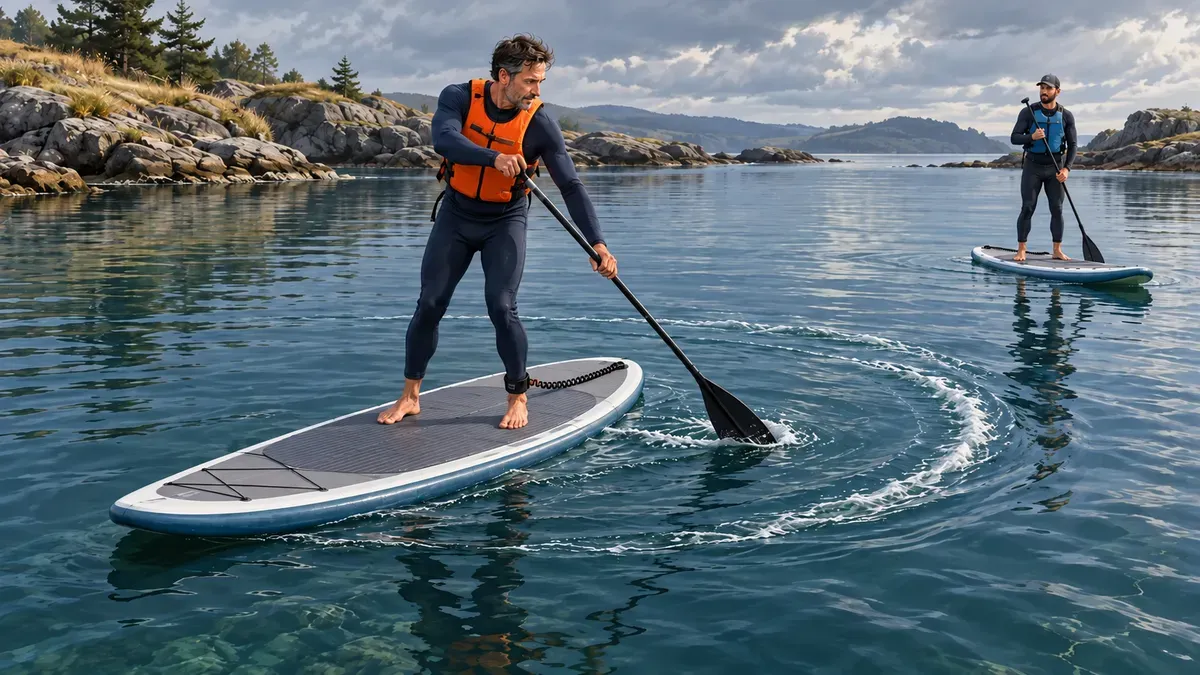
SUP paddling technique: how to stand, turn, and stop
Learn SUP paddling technique for standing, efficient strokes, turning, stopping, and remounting. Use practical drills to prepare for a supervised first lesson.
Quick answer
Good SUP paddling technique starts with control: stand near the board’s center with parallel feet and soft knees, place the blade fully in the water before pulling, and keep the forward stroke close to the board. Use a wider sweep to turn and short reverse strokes to slow down. Learn falling and remounting with a qualified instructor on sheltered flat water before traveling farther. Standing up is one skill; returning, stopping, and getting back aboard are equally important.
Key facts
- A centered stance distributes weight across the board rather than loading one edge.
- A planted blade transfers coordinated body movement into forward propulsion.
- A forward sweep turns the nose away from the side being paddled.
- Reverse strokes reduce forward momentum before a landing or obstacle.
- Remount practice tests whether a paddler can recover after falling in.
Set a useful goal for your first lesson
Aim to leave a small practice area, turn deliberately, stop, and return with enough energy to recover from a fall. Speed and distance can wait. This guide explains the movement tasks to discuss with an instructor; it does not establish that a particular venue or independent outing is safe.
The RNLI beginner guidance recommends booking a lesson. A teacher can see the blade, feet, board trim, and conditions together. That feedback is particularly useful when a movement feels correct but repeatedly sends the board in the wrong direction.
For the separate question of what paddling contributes to exercise, read our SUP benefits and beginner fitness guide. Here, success means acquiring reliable control rather than accumulating workout minutes.
Check the water and equipment before technique
Choose sheltered, still water with an accessible landing and an instructor or competent supervised group. Check wind, weather, water temperature, current, and other traffic. Offshore wind can carry a board away from land even when the surface looks inviting.
Wear a properly fitted personal flotation device, carry a means of calling for help on your body, and dress for possible immersion. Tell someone ashore the plan. These are central elements of RNLI SUP safety advice. Being able to swim does not remove the effects of cold, injury, fatigue, or separation from the board.
Have the instructor check board setup, paddle length, fin clearance, and leash choice. Paddle Cymru’s 2026 guidance explains why leash arrangements depend on the environment: an ankle or calf attachment suitable for still water without snag hazards is not a universal solution for moving water. Quick-release systems require suitable fitting and training; buying one does not qualify a beginner for rivers or white water.
Find balance before trying to travel
Start kneeling around the center carry handle, facing the nose. Ask the instructor to identify the board’s front: the shape alone can be misleading. Take gentle strokes while kneeling so you learn how the board responds before adding height.
When the practice area has appropriate depth and clearance, move from hands and knees into a low squat, then rise gradually. Keep the feet parallel on either side of the center line, approximately hip- to shoulder-width apart. Look ahead, keep the knees soft, and let the ankles and hips make small adjustments. Avoid a wide surf stance as the default beginner position.
Do not stare at every wobble or freeze the knees. A useful cue is to keep the upper body quiet while allowing small corrections underneath it. If standing becomes hurried or tense, return to kneeling with the instructor’s guidance. You can learn turning and braking from that lower position too.
Land-based balance practice can complement general fitness, but passing a balance exercise on land does not prove water competence. The board, flotation device, and remount task introduce different demands.
Make the paddle move the board, not just your arms
Check the blade and hand positions
With a conventional angled SUP blade, the blade’s offset points forward toward the nose when held for a forward stroke. The broad working face moves water backward. Unusual blade designs need individual explanation; ask the instructor to demonstrate rather than guessing from a logo.
Place one hand over the grip and the other on the shaft. Switch their roles when changing sides. Use a secure but relaxed hold and avoid locking the elbows. Paddle length and hand spacing should allow a comfortable plant without shrugging or reaching beyond control.
Practice a smooth plant, drive, and release
The PSUPA instruction manual describes the stroke as a sequence rather than one long arm pull. Think of four tasks:
- Reach within control. Bring the blade forward with coordinated hip and trunk movement, keeping your weight centered.
- Set the blade. Immerse the blade before applying pressure. Splashing at entry often means the pull started too soon.
- Move past the planted blade. Keep the shaft relatively upright and the path close to the side of the board. Share the movement through the body instead of repeatedly curling the lower arm.
- Release near the feet. Lift the blade clear without dragging a long stroke behind you, then return it forward with a light grip.
Start slowly enough to feel each transition. A hard pull cannot compensate for an incomplete blade plant. Equally, “use the body” is not an instruction to twist aggressively through the lower back.
A 2019 laboratory study compared seven experienced and 19 inexperienced paddlers on a SUP ergometer. The inexperienced group used more overall shoulder motion and less hip motion. That supports paying attention to whole-body coordination, but the observational study did not prove that a particular coaching cue prevents injury or establish universal joint-angle targets.
Keep a straighter course without fighting the board
Choose a stationary point ahead and notice the path over several gentle strokes. A paddle held far out to the side produces more turning influence. Try bringing the shaft more upright and aligning the stroke beside the board before adding force.
Switch sides before a small deviation becomes a large zigzag. There is no compulsory number of strokes per side: board shape, fin, wind, speed, and your technique change the response. Advanced correction strokes can come later.
| What you notice | What to check first | Useful next attempt |
|---|---|---|
| The board turns sharply after each stroke | Blade path too far from the side | Slow down and plant closer to the board |
| The blade splashes but little happens | Pressure starts before full immersion | Pause briefly after the plant, then apply pressure |
| Shoulders tire almost immediately | Tight grip, long pull, or excessive reach | Shorten the stroke and ask for a technique check |
| You wobble when switching hands | Rushed transfer or eyes fixed downward | Rehearse a slower transfer while kneeling |
If you must strain to hold position, conditions may exceed the purpose of a beginner lesson. Return or stop with the instructor rather than interpreting every difficulty as a fault in your body.
Turn and stop before approaching a landing
For a basic forward sweep, reach toward the nose and move the blade in a broad arc away from the board toward the tail. A sweep on the right turns the nose left; a sweep on the left turns it right. Keep the stance steady and watch the intended direction without throwing your weight toward the turn.
To slow forward travel, place the blade beside you and make short reverse strokes, moving it toward the nose. Alternate sides as needed to keep the board aligned. Begin gently: a sudden hard braking stroke can upset balance or turn the board. Ask the instructor to demonstrate the blade face used for reverse paddling.
Practice braking in clear space long before the shore, dock, people, or another board. Stopping distance varies; do not use an obstacle as the test. A beginner does not need a step-back pivot turn to control an ordinary lesson. Learn a stable sweep first, then develop more demanding maneuvers under instruction.
Rehearse falling and getting back aboard
Arrange this practice with the instructor in a clear area of suitable depth and temperature. Fall away from the board and paddle, protect the head, and never dive into unknown or shallow water. Locate the board and fin before resurfacing so you avoid striking them.
A common remount starts at the side near the board’s middle: reach across the deck, kick the legs toward the surface, and slide the chest onto the board before bringing the knees aboard. The instructor may teach another entry for your board or mobility. Practice with the same flotation device and clothing you actually wear.
If repeated attempts fail, stop the drill and ask for help. Difficulty remounting is a reason to change the activity, support, or conditions before going farther from an exit. It is not solved by promising to stay standing. Discuss a different craft through our canoe and kayak beginner guide when appropriate.
Organize a short skills practice
After the instructor’s safety briefing and equipment checks, the following 20-minute example can organize practice. It is an illustrative sequence, not a tested prescription or a requirement to finish every block.
| Block | Example time | What you are learning |
|---|---|---|
| Kneeling and easy strokes | 4 minutes | Centered position and response to the paddle |
| Standing transitions | 4 minutes | Controlled rise and return to kneeling |
| Short forward passes | 4 minutes | Full blade plant and relaxed recovery |
| Sweeps and gentle stops | 4 minutes | Intentional direction and speed changes |
| Supported fall and remount practice | 4 minutes | Recovery skills with help available |
An instructor may reorder, shorten, or replace any block. A whole lesson spent improving remounting can be useful progress. For the next session, change one learning task rather than adding distance, stronger wind, and faster strokes together.
Use comfortable breathing and perceived effort as context, keeping attention on instruction and surroundings. For a different low-position practice on a board, SUP yoga has separate movement demands and still requires water skills.
Keep comfort and recovery in the plan
Finish while you can still steer and recover confidently. Sharp pain, numbness, dizziness, shivering, deteriorating weather, or unusual exhaustion are reasons to stop and get assistance. Persistent shoulder or back symptoms need individual assessment rather than repeated attempts to “fix” them with a harder stroke.
General shoulder strength and mobility exercises can complement paddling, but they cannot establish readiness after injury. Discuss relevant medical or mobility limitations before participation. Keep SUP alongside the broader activity pattern described in our exercise and longevity guide; no single skill session demonstrates a change in biological age.
Review the learning pattern with SuperAge
After the lesson, record a few practical observations: conditions, skills practiced, comfort, perceived effort, and whether remounting was manageable. Compare similar sessions rather than judging learning by speed alone.
SuperAge can help you review available Apple Health activity and recovery trends alongside those notes. Use the information as context for your wider routine. A favorable recovery reading cannot evaluate wind, assess a leash, or certify that your next outing is safe.
Frequently asked questions
Which way should the SUP blade face?
On a conventional angled blade, the offset points toward the nose for forward paddling. Ask the instructor to identify the working face and demonstrate entry before setting off.
Why does my paddleboard keep zigzagging?
Check whether the blade travels too far from the board or the shaft leans outward. Slow down, use a closer stroke, and change sides earlier. Wind and board setup also affect direction.
Should I lock my knees to balance?
No. Keep a small, comfortable knee bend so the lower body can respond to movement. Look ahead and return to kneeling when control is slipping.
Which side do I paddle on to turn left?
For a basic forward sweep, use the right side: sweep from near the nose outward toward the tail. Other turning strokes behave differently, so learn one clearly demonstrated method first.
How do I stop a paddleboard?
Use gentle reverse strokes in clear water, alternating sides as needed to maintain alignment. Practice early, at low speed, rather than discovering your stopping distance beside a dock.
Is kneeling a bad habit?
No. Kneeling is useful for learning control and managing transitions under instruction. It does not make unsuitable wind, cold, current, or distance safe.
Do I need to practice falling?
Yes, with instruction and suitable conditions. A controlled drill helps you learn how to avoid the board and fin and determine whether you can get back aboard in your actual clothing and flotation device.
Can fitness replace a beginner lesson?
No. Strength and aerobic fitness do not automatically teach board control, rescue skills, or environmental judgment. Start with instruction even if you are confident in another sport.
Key takeaways
- Learn returning, turning, stopping, and remounting alongside standing.
- Set the blade before pulling and practice a short, coordinated stroke.
- Separate a close forward stroke from a wide turning sweep.
- Choose conditions and equipment with qualified guidance; no leash suits every environment.
- Measure progress by repeatable control and comfort before adding distance or effort.
Keep a simple practice record
If you use Apple Health, download SuperAge on the App Store to review your available activity and recovery trends alongside an honest skills log.
References
- RNLI. Paddleboarding for beginners: top tips.
- RNLI. Stand up paddleboarding safety.
- Paddle Cymru. SUP leash safety: understanding the guidance. September 2026.
- Professional Stand Up Paddle Association. Fundamentals 1 manual. 2019. Basic skills sections; consult current governing-body guidance for leash use.
- Schram B, et al. A biomechanical analysis of the stand-up paddle board stroke: a comparative study. PeerJ. 2019;7:e8006.
Related Articles
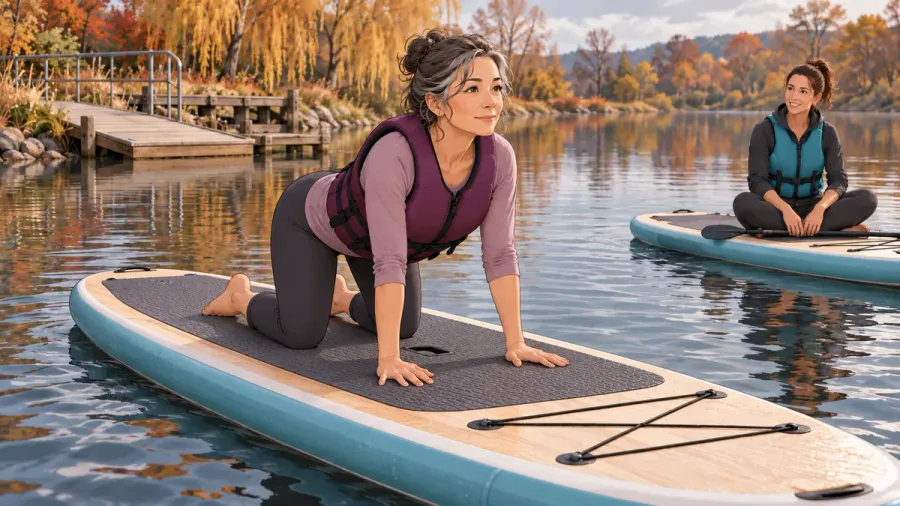
SUP yoga for beginners: poses, balance, and water safety
Try SUP yoga with stable beginner poses, realistic benefits, and a supervised first-session plan. Learn what to practice on land and what to check on water.