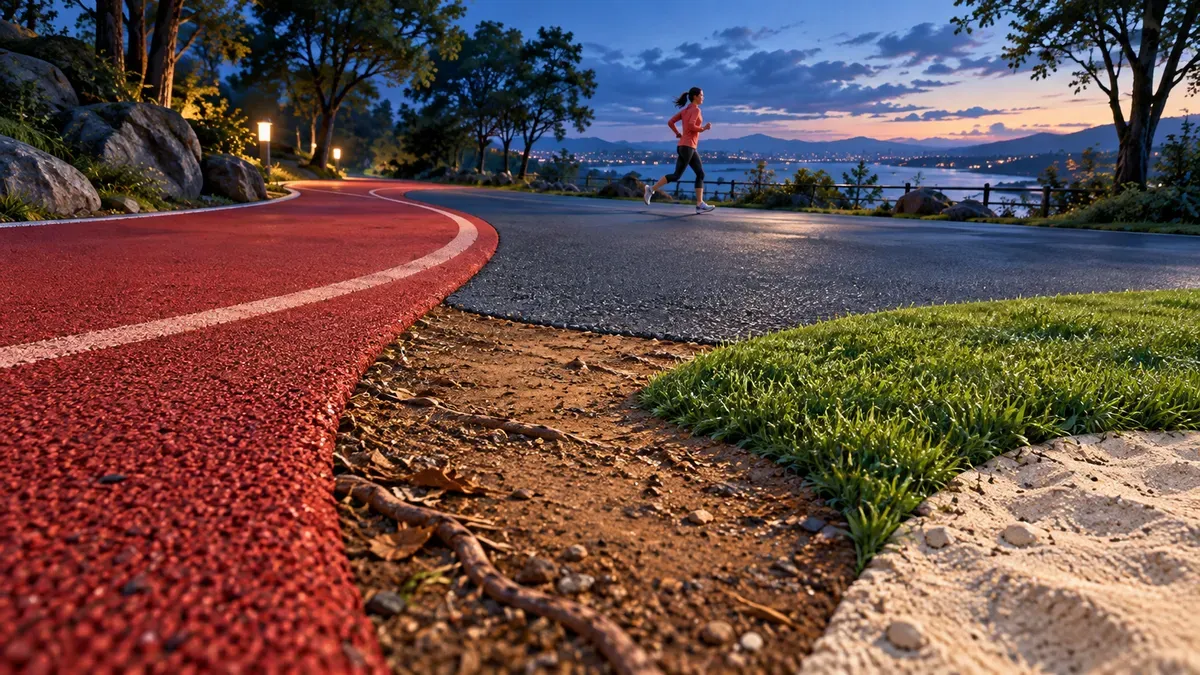
Running surfaces: how to choose road, trail, track, or sand
Compare running surfaces by grip, effort, and predictability. Learn how to choose road, trail, track, grass, or sand and adjust your next run with confidence.
Quick answer
The best running surface is the one that suits today’s session, offers reliable footing, and fits your current capacity. A level road or track makes pace easier to control; a maintained dirt path adds variety; uneven trails and loose sand can increase effort even when speed falls. No surface is universally safest, and softer ground does not automatically protect your knees.
For an easy run, start with familiar, predictable ground. When trying a new surface, replace a short part of an existing easy run rather than adding another workout. Keep effort comfortable, leave speed and footwear unchanged, and judge the next exposure by your symptoms and recovery. This guide compares surface choices; it does not prescribe a rehabilitation program.
Key facts
- Surface firmness changes the interaction between the runner’s leg and the ground.
- Uneven terrain increases the control demands of placing each foot.
- Loose sand dissipates energy that firmer ground can return.
- Grip and visibility determine usable footing beyond the surface’s material label.
- Laboratory impact measurements do not establish an injury ranking for everyday runners.
Judge the surface, not just its name
“Trail” can mean smooth packed dirt or loose rocks. “Grass” can mean an even sports field or long vegetation hiding holes. “Road” can mean a level traffic-free path or a steeply cambered shoulder. Before deciding where to run, check four properties:
- Predictability: Can you see where each foot will land?
- Grip: Will the shoe hold during push-off, braking, and a turn?
- Firmness and energy return: Does the ground stay stable, spring back, or shift beneath you?
- Slope and camber: Are you climbing, descending, or repeatedly landing with one foot higher?
Weather changes all four. Frozen dirt may be hard; wet leaves can cover slippery pavement; rain can turn a firm path into mud. A familiar route can therefore become an unfamiliar training demand overnight. Choose the actual conditions in front of you rather than a permanent label in your training log.
Why softer ground does not simply absorb every impact
The body responds to the ground. In controlled experiments, runners adjusted leg stiffness as surface stiffness changed, maintaining similar overall running mechanics (Ferris and colleagues, 1998). The leg and surface act together rather than as two independent shock absorbers.
That finding explains why the intuition “half as hard means half the load” is unreliable. It does not tell you which surface prevents injury. Different tissues, speeds, shoes, and terrain hazards can change the outcome. Treat comfort as useful personal feedback, while avoiding a universal medical claim about asphalt, concrete, or grass.
Compare road, track, grass, trail, and sand
| Surface | Useful qualities | Main tradeoff | Sensible first choice |
|---|---|---|---|
| Asphalt or concrete | Predictable support and repeatable routes | Traffic, camber, cracks, and exposed weather | Level, visible paths with safe separation from vehicles |
| Synthetic track | Consistent footing and measured distances | Repeated bends, other users, and slippery patches | Easy controlled running before faster repetitions |
| Short grass | Variety and sometimes lower measured impact acceleration | Hidden holes, wet grip, and uneven firmness | A maintained area inspected while walking |
| Packed dirt or fine gravel | A useful bridge between road and technical trail | Loose stones, erosion, and changing traction | Smooth, dry sections at comfortable effort |
| Rocky or rooted trail | Terrain-specific coordination and outdoor variety | Foot-placement demands, falls, slopes, and slower pace | Walk difficult sections and shorten the first outing |
| Firm or loose sand | A different support and energy-return challenge | Sinking, camber, debris, and lower-leg fatigue | A brief, level exposure with familiar footwear |
The table is a decision aid, not a safety league table. A smooth road with no traffic may be more manageable than a soft but rutted field. A dry packed path may suit a recovery run; that same path after heavy rain may demand constant braking and balance corrections.
Road and track: repeatability has practical value
Predictable ground helps you distinguish fitness changes from terrain changes. If you are learning a conversational pace or comparing a familiar workout, a level route reduces one source of variation. For people just starting, the beginner running plan explains how to manage running and walking before adding terrain complexity.
On a track, respect local lane conventions and other users. Do not reverse direction into traffic to balance the bends. If permitted and safe, vary direction on separate sessions; otherwise use straight sections or another route when repeated curves feel uncomfortable. A track is useful for control, but it does not require a hard session.
There is no reliable universal injury percentage separating asphalt from concrete. Material hardness alone cannot capture speed, exposure, footwear, and individual response. Choose the route that lets you run with stable footing and appropriate effort.
Grass and dirt: inspect what softness hides
Short, maintained grass can feel pleasant, but it is not automatically level. Walk the area first, looking for holes, irrigation equipment, debris, slippery patches, and abrupt edges. Long grass is a poor place to assume that the next landing will match the last.
A study of 35 people found lower tibial acceleration on a woodchip trail than on concrete or a synthetic track, and lower acceleration at slower speeds (surface-and-speed study, 2016). These measurements describe impact-related signals; the study did not demonstrate fewer injuries over a season. Lowering speed may be useful regardless of the surface you choose.
For packed dirt or gravel, take a little speed out before tight turns. Avoid an abrupt sideways push on loose stones. If the ground becomes deeply rutted or the available line narrows beside a drop, walking is an appropriate change of activity.
Technical trail and sand: pace stops being comparable
In a study of 12 participants, running on an uneven treadmill increased energy expenditure by about 5% compared with smooth terrain at the same speed (Voloshina and Ferris, 2015). Real trails add variable slopes, turns, and obstacles, so that laboratory percentage is not a route calculator. It supports a simpler lesson: a slower split can still represent substantial work.
Loose sand also absorbs work. A classic experiment reported an energy cost about 1.6 times that of hard-ground running at the same speed (Lejeune and colleagues, 1998). Do not apply that multiplier to every beach or calorie estimate. Moisture, compaction, and the pace you actually maintain change the comparison. Use the separate sand-running guide for detailed technique and progression.
On either surface, shorten the outing before fatigue makes placement unreliable. Slopes introduce another demand: consult the downhill-running guide before treating a technical descent as easy recovery.
Match the ground to the purpose of the run
An easy day should remain easy after you account for terrain. Use the rating of perceived exertion and your ability to speak comfortably. If the route requires continuous concentration, forceful braking, or repeated hard climbs, it may not serve today’s recovery goal even at a slow average pace.
For a pace-controlled session, choose a repeatable, unobstructed route with adequate grip. For trail preparation, build relevant terrain experience while separating technical difficulty from speed. For enjoyment, choose variety that you can manage without turning every outing into a test.
You do not need to rotate through every surface each week. Access, confidence, time, and consistency matter. The wider exercise and longevity guide puts running choices within a sustainable activity routine; no particular ground material is required for health benefits.
Introduce unfamiliar ground without changing everything
Use a small experiment rather than replacing the entire training week. For someone already comfortable with easy running, one option is a short section of smooth unfamiliar ground within a normal outing. There is no validated universal first dose for all runners or surfaces.
For example, during a usual 30-minute easy run, replace 5 minutes of level road with a maintained packed-dirt section. Keep the total at 30 minutes. This is an illustration of changing one variable, not a studied injury-prevention prescription. A beginner, someone returning from injury, or a runner facing technical terrain may need walking or a smaller exposure.
| Stage | What to do | What determines the next step |
|---|---|---|
| Before | Walk the new section and inspect footing | Visibility, grip, slope, and a clear exit |
| During | Keep conversational effort and familiar shoes | Stable movement without increasing discomfort |
| After | Note surface, minutes, effort, and symptoms | Normal walking and recovery before another exposure |
| Next visit | Repeat first; then change one demand | Comfortable recovery rather than a calendar deadline |
Surface transitions deserve attention themselves. A study of 18 runners found small increases in tibial acceleration during grass–concrete transitions compared with steady running, alongside higher acceleration on concrete (Sebastian and colleagues, 2026). It did not measure subsequent injury. Slow down before a visible edge and avoid repeatedly hopping between textures for an imagined cushioning benefit.
Keep unfamiliar footwear, barefoot running, extra distance, speed, and steep hills for separate decisions. Comfortable shoes with grip suited to the conditions are useful; a foot-shape label does not settle the choice. The pronation and running-shoe guide explains that distinction.
SuperAge: review the response
After choosing a manageable session, SuperAge can help you review available activity and recovery trends over time. Add your own note about the surface and conditions so slower pace has context. An app estimate cannot diagnose an injury, measure the load on a specific tendon, or certify that a route is safe.
When changing the surface is not enough
Do not use grass or sand as a way to keep running through pain. Stop if discomfort increases, changes your gait, or makes normal walking difficult. Persistent localized pain, swelling, or recurrent instability deserves assessment by a qualified clinician. Sudden severe pain or inability to bear weight needs prompt evaluation. The NHS running-injury guidance advises stopping for painful running rather than assuming a different surface will solve the cause.
Chest pain, fainting, severe unusual breathlessness, or confusion are reasons to stop and seek urgent help. Surface selection cannot make an alarming symptom acceptable. For a diagnosed injury, follow the rehabilitation plan you were given rather than this general comparison.
Key takeaways
- Choose ground by the session’s purpose, actual footing, and your present capacity.
- Distinguish firmness from grip, unevenness, slope, and visibility.
- Keep easy effort easy when pace falls on trails or sand.
- Replace a small familiar segment before adding more terrain exposure.
- Do not treat lower laboratory impact as proof of fewer injuries.
Plan your next run
Choose one familiar route and one manageable surface change, then note how the session and following day feel. Explore SuperAge if reviewing those activity patterns alongside longer-term health trends helps you keep running consistently.
FAQ
What is the best surface to run on?
There is no universal winner. Choose stable footing that suits the workout and your experience. A predictable road can suit controlled running, while a maintained path can add manageable variety.
Is grass better for knees than concrete?
Some experiments measure lower impact-related acceleration on grass or other softer surfaces. That does not prove less knee injury or establish treatment for knee pain. Unevenness, grip, speed, and symptoms also matter.
Is asphalt safer than concrete?
There is no dependable universal injury ranking between them. Both offer firm support. Traffic, camber, surface damage, total running load, and individual tolerance often provide more actionable reasons to choose a route.
Does a slower trail pace mean I am losing fitness?
No. Uneven terrain, hills, turns, and cautious foot placement can raise effort while reducing speed. Compare similar conditions and use breathing and perceived exertion to interpret the session.
Should I change surfaces every run?
You do not have to. Variety can be enjoyable and specific to a goal, but frequent changes are not a proven requirement for injury prevention. A repeatable routine on accessible ground can work well.
Can beginners start on a trail?
Yes, if it is smooth, predictable, and appropriate to their capacity. Technical roots, rocks, steep slopes, and poor visibility add demands. Begin with walking and easy run–walk sessions rather than a difficult route.
Is a track only for fast workouts?
No. Its consistent footing can help with easy controlled sessions too. Respect other users and lane rules, and consider repeated bends if they cause discomfort.
Should I keep running if a softer surface reduces pain?
Pain relief from a surface change does not identify the cause or show that continued running is safe. Stop for increasing pain or altered gait, and seek advice for persistent or localized symptoms.
References
- Ferris DP, Louie M, Farley CT. Running in the real world: adjusting leg stiffness for different surfaces. Proceedings of the Royal Society B. 1998. doi:10.1098/rspb.1998.0388.
- The effect of three surface conditions, speed and running experience on vertical acceleration of the tibia during running. 2016.
- Voloshina AS, Ferris DP. Biomechanics and energetics of running on uneven terrain. Journal of Experimental Biology. 2015;218:711–719.
- Lejeune TM, Willems PA, Heglund NC. Mechanics and energetics of human locomotion on sand. Journal of Experimental Biology. 1998;201:2071–2080.
- Sebastian N, et al. The influence of transitioning between grass and concrete surfaces on resultant tibial accelerations while running. Sports Biomechanics. 2026;25:610–619. Published online 2025.
- NHS. Knee pain and other running injuries. Accessed October 25, 2026.
Related Articles

How to calculate running pace and set realistic targets
Calculate running pace, convert minutes per mile and kilometer, plan splits, and check realistic training targets. Use the numbers with effort and recovery.