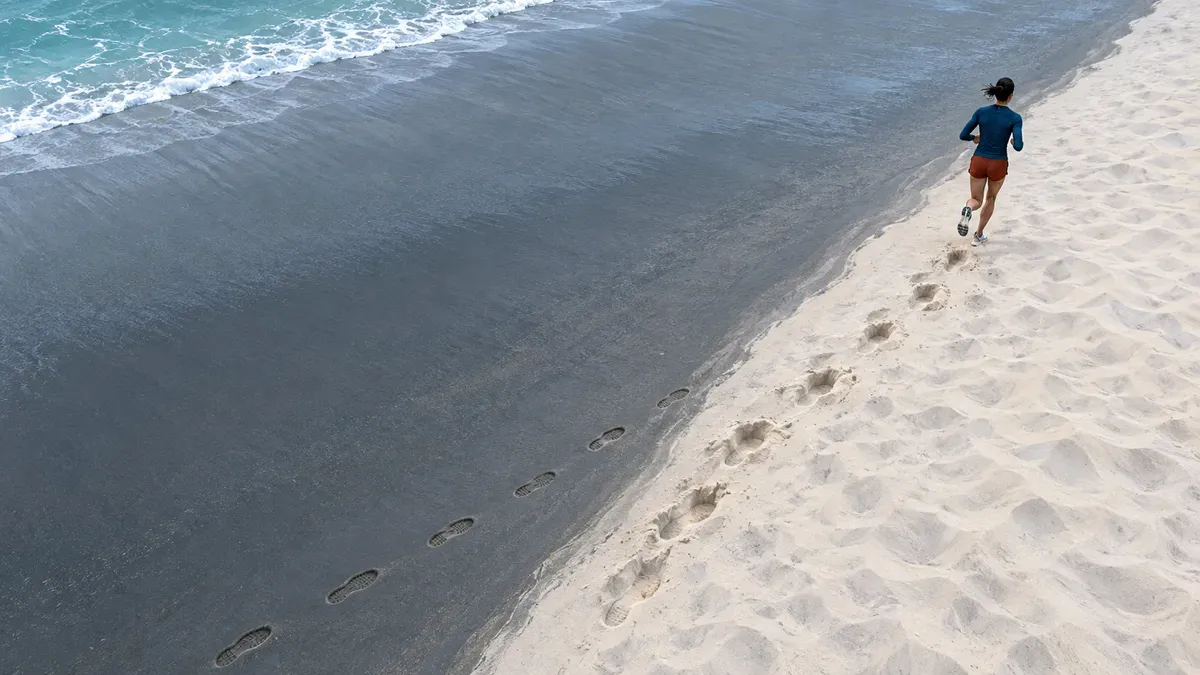
Running on sand: technique, benefits, risks, and progression
Running on sand raises effort and changes lower-leg loading. Learn firm-versus-soft technique, footwear choices, safety, and a gradual training plan.
Quick answer
Running on sand is harder than running at the same speed on a firm surface because the ground deforms and returns less useful energy. Begin on level, compact sand, run by effort rather than road pace, keep the first exposure to 5–10 easy minutes inside a normal session, and leave at least a day before repeating it. Shorten the step naturally, stay tall and relaxed, and turn around regularly if the shoreline slopes.
Soft, dry sand is a different training surface, not merely a prettier road. It usually demands more muscular work and control, so introduce it only after firm sand feels predictable. Shoes protect the soles and preserve a familiar footwear setup; barefoot running adds a second adaptation at the same time. Neither option is universally safer, and lower measured impact on soft sand does not prove lower injury risk.
Key facts
- Yielding sand increases the energy cost of locomotion.
- Loose grains absorb mechanical work and reduce useful elastic return.
- Soft sand lengthens ground contact and increases lower-leg muscle activity.
- Compacted wet sand transmits more impact than loose dry sand.
- Gradual exposure protects training consistency better than chasing road pace.
What running on sand changes
Sand changes the contract between runner and ground. On a road or track, the surface barely deforms, so the body can store and return part of each step’s energy through muscles and tendons. On loose sand, the foot pushes grains down and backward. Some work moves the surface instead of moving the runner forward.
In a classic laboratory comparison, running on sand required about 1.6 times the energy expenditure of running on a hard surface at the same speed. The authors attributed the difference to work done on the sand and less efficient positive work by muscles and tendons (Lejeune et al., 1998). Another small study found a more modest average increase of about 20% compared with compact terrain (Zamparo et al., 1992). Different sand depth, moisture, speed, protocol, and participants help explain why there is no single multiplier that predicts every beach run.
The practical translation is more reliable than any percentage: the same pace can cost much more on sand. If you insist on matching road splits, an intended easy run may become a hard session before breathing or technique warns you clearly. Use the rating of perceived exertion and the talk test, and let pace fall as much as the surface requires.
Soft sand changes timing and muscle work
In eight well-trained men running barefoot at controlled speeds, soft dry sand increased hip and knee range of motion, contact time, and activation of several lower-limb muscles compared with a firm floor (Pinnington et al., 2005). That is a specific laboratory finding, not proof that every stabilizing muscle becomes stronger or that sand corrects a runner’s form.
Longer contact and a less stable push-off usually make the stride feel shorter and less springy. Allow that adaptation rather than manufacturing an exaggerated high-knee action or forcing the foot onto the toes. The useful cues are simple: run quietly, place the foot where you can support it, and stop while coordination still feels ordinary. If you want to practise selected mechanics on predictable ground, use a separate running-form drill routine.
Lower peak impact is not the same as lower injury risk
Loose sand can reduce measured peak impact forces. Mechanical testing found wet compacted beach sand was roughly six times stiffer and produced about four times the mean and peak impact forces of dry uncompacted sand under the study’s drop-test conditions (Barrett et al., 1998). Sprint research in professional soccer players also found lower speed, acceleration, flight time, stiffness, and mechanical power on soft sand, alongside longer contact time and higher estimated energy cost (Gaudino et al., 2013).
Those results describe forces and performance in controlled tasks. They do not show that beach runners sustain fewer injuries. A yielding surface may reduce one impact measure while increasing work at the foot, ankle, calf, Achilles tendon, hip, or stabilizing muscles. Holes, shells, debris, abrupt changes in firmness, fatigue, barefoot exposure, and a sloping shoreline add risks that a force plate cannot summarize.
Treat “low impact” as a biomechanical observation, not a medical guarantee. Previous injury, symptoms, total weekly training, strength, sleep, footwear changes, and the size of the new sand dose all matter.
Firm wet sand versus soft dry sand
The labels “wet” and “dry” are useful shortcuts, but the property that matters is how much the surface compacts, shifts, slopes, and changes from one step to the next. A firm strip near the water may feel almost road-like; saturated or uneven patches can still be slippery. Dry sand higher on the beach may be deep and yielding; a well-packed sand trail may not be.
| Surface | What the runner usually feels | Best use | Main caution |
|---|---|---|---|
| Level, compact sand | More predictable push-off and less sinking | First exposure and easy continuous running | Can still be hard, wet, sloped, or interrupted |
| Soft, dry sand | More sinking, slower pace, greater control demand | Short intervals after adaptation | Calf, foot, and Achilles fatigue can rise quickly |
| Sloped shoreline | One foot repeatedly lands higher than the other | Brief unavoidable sections | Repeated asymmetry and changing water line |
| Dunes or very deep sand | Large speed loss and unstable footing | Walking or advanced sport-specific work | Steep grades, hidden holes, vegetation, heat, and access rules |
For a beginner, choose the most level continuous strip rather than the softest possible surface. Turn around before one side accumulates a long exposure to the camber. If the route forces you beside surf, on a steep bank, or across repeatedly changing textures, shorten the session or choose another place.
Technique for running on sand
1. Run by effort, not by road pace
Start at an intensity that permits complete sentences. A familiar easy-road pace may be unsustainable on yielding sand, while heart rate can lag behind the sudden muscular demand. Use breathing, perceived exertion, and stable coordination together. If the run feels like a race against the surface, slow to a shuffle or walk.
Do not compare pace from two beaches as though the surface were standardized. Grain size, depth, moisture, slope, wind, tide, turns, and foot traffic change the cost. Compare repeat visits only when the route and conditions are reasonably similar, and treat the result as context rather than a fitness test.
2. Let the step shorten naturally
Keep the feet landing close enough to the body that you do not reach forward and brake into the surface. Use a compact step, relaxed arms, and a slight whole-body lean that comes from the ankles rather than bending at the waist. Avoid trying to claw the sand with the toes or driving forcefully backward; both can add tension without making the surface firm.
There is no universal beach-running cadence. Research on ordinary running economy finds most isolated biomechanical variables explain only a small share of the differences among runners (Van Hooren et al., 2024). Let rhythm adjust to speed, firmness, and your own body instead of chasing a prescribed number.
3. Keep the ankle responsive, not rigid
The foot and ankle must adapt to small changes in the ground. Allow normal motion while keeping the knee tracking comfortably over the foot. Do not lock the ankle, hold the heel permanently off the ground, or force a forefoot strike because sand “should” be run one way. A sudden strike-pattern change shifts load; it does not erase it.
Basic calf strengthening can build useful capacity, but a gym exercise does not automatically prepare the skin, foot, tendon, balance, and repeated contacts for barefoot soft sand. Specific exposure still needs its own progression.
4. Look farther ahead and choose the line early
Scan for holes, rocks, shells, glass, fishing gear, driftwood, sea life, vehicles, dogs, children, and sudden changes in surface. Do not stare directly at the feet for the entire run. Pick a clean line several steps ahead, then use peripheral vision for immediate placement.
Avoid weaving repeatedly between wet and dry strips just to maintain pace. Each transition changes grip and stiffness. If the safe line disappears, walk until the surface becomes predictable again.
5. Turn before fatigue changes the movement
Calf tightness, foot gripping, a noisy collapsing step, repeated ankle wobble, or rapidly rising effort are reasons to finish the sand dose. They are not challenges to overcome with more speed. Continue the session on a familiar firm surface only if walking and easy running feel normal.
Shoes or barefoot? Treat them as separate choices
Running on sand and running barefoot are two different changes. Combining them means the surface and footwear exposure both become unfamiliar, which makes it harder to identify what caused soreness or altered technique.
Shoes can protect against sharp objects, hot sand, rough shells, and abrasion. They also preserve a familiar heel-to-toe geometry and upper structure. Their disadvantages are practical: sand can rub, wet socks can blister, and some outsoles feel unstable on steep or loose sections. Use shoes that already fit well, tighten them only enough to prevent sliding, and stop to remove trapped debris rather than tolerating a hot spot.
Bare feet provide direct surface feedback but expose the skin and sole to heat, cuts, punctures, friction, and unfamiliar loading. A systematic review found biomechanical differences between barefoot and shod running, but all 18 included studies were rated low quality and clear injury-prevention guidance was not established (Hall et al., 2013). In a later randomized study, eight weeks of barefoot habituation changed foot placement but also increased average vertical loading rates, challenging the idea that acute barefoot measurements reliably predict long-term adaptation (Hollander et al., 2019).
If you normally run in shoes, keep them on for the first sand sessions. If barefoot running is a separate goal, begin with short walks on a visually inspected, temperature-safe surface and progress it independently. Diabetes, reduced foot sensation, circulation problems, an active wound, recent foot or ankle injury, or clinician-imposed footwear needs make unsupervised barefoot running a poor experiment.
A four-week beginner progression
This template assumes you already run comfortably on firm ground and have no current pain. It is a conservative starting example, not a rehabilitation plan or a promise of injury prevention. Keep normal weekly volume stable, replace part of an easy run rather than adding a new hard session, and place at least 48 hours between the first sand exposures when possible.
| Week | Sand dose within an easy session | Surface | Progress only if |
|---|---|---|---|
| 1 | 5 × 1 minute easy, 1 minute firm-ground walk or jog between | Level compact sand | Technique stays relaxed and next-day symptoms are ordinary |
| 2 | 4 × 2 minutes easy, 1–2 minutes off sand between | Level compact sand | Feet, calves, and Achilles feel normal during daily activity |
| 3 | 10–15 minutes continuous easy | Mostly compact sand | Effort remains conversational without foot gripping or wobble |
| 4 | 15–20 minutes easy, optionally 3 × 30 seconds on softer sand | Compact sand with brief soft exposure | The softer intervals do not change gait or create delayed pain |
Repeat a week when the surface was unusually soft, the weather raised effort, or recovery was poor. Reduce the next dose when soreness lasts longer than your normal response to an easy run. Do not add duration, soft-sand depth, speed, barefoot exposure, and hills in the same week.
The widely repeated “10% rule” is not a proven universal injury threshold. A systematic review found very limited evidence connecting specific week-to-week load changes with running injury (Damsted et al., 2018). The useful principle is not a magic percentage: avoid abrupt spikes, monitor the response, and individualize the next exposure. The training-load guide explains how to separate purposeful progression from extra work added only because a surface feels novel.
Three sand workouts after adaptation
Easy firm-sand run
Run 15–30 minutes on a level compact strip at conversational effort. This is the most specific option for someone who wants to enjoy a beach route without turning it into a power session. Use time rather than distance, because the same mile can cost very different amounts as the surface changes.
Soft-sand aerobic intervals
After several comfortable firm-sand sessions, alternate 1–3 minutes on soft sand with 2–3 minutes of easy movement on compact sand. Keep the soft repetitions controlled and submaximal. The goal is exposure to yielding ground, not exhaustion.
Short sand accelerations for experienced runners
Experienced, pain-free runners or field-sport athletes may use four to six relaxed accelerations of 8–12 seconds on a clean, level stretch, with full walking recovery. Stop well before maximal speed. A 2026 systematic review found sand-based programs can improve sprint performance in competitive athletes, but the studies used structured multiweek programs and the authors called for more standardized methods and broader populations (Meng et al., 2026). That evidence does not turn beach sprints into a necessary workout for recreational runners.
Do not combine all three sessions in the same week at first. One sand session is enough to learn how your body responds; ordinary running still provides the most specific preparation for ordinary road or track performance.
Put sand running in the larger training picture
A beach pace is a poor standalone fitness score because the surface can change between steps. The useful record is broader: duration, perceived effort, route, approximate surface, heat, wind, footwear, symptoms, and recovery over the next day.
SuperAge can help you review activity, heart-rate trends, sleep, and recovery when those data are available through Apple Health. Use those trends to ask whether a sand session fits a sustainable week—not to certify that a beach is safe, diagnose an injury, or compare two unstandardized surfaces. You can explore more evidence-led movement and recovery topics in the SuperAge health library.
Beach hazards that can cancel the run
Tide, waves, and route access
Check the official local tide, surf, and weather information before leaving. A low-tide strip can narrow or disappear on the return. Waves can cover holes, move debris, and cut off a route around rocks or structures. Tide prediction is not a complete surf forecast, so keep a dry exit and turn back early when the water line changes.
Stay out of the surf while running. Rip currents are a water hazard, but avoiding water entry also reduces exposure to shorebreak, hidden drop-offs, and unstable footing. The National Weather Service beach-hazard guidance highlights dangerous currents, heat, ultraviolet exposure, and lightning among beach risks.
Heat, sun, and wind
Sand and water reflect ultraviolet radiation, while an exposed shore may offer little shade. Run earlier or later when heat is lower, use suitable clothing and sunscreen, and carry enough fluid for the conditions without forcing excessive intake. The CDC guidance for athletes in heat advises starting slowly, pacing activity, drinking more water than usual, and stopping if faint or weak.
Wind can raise effort dramatically and blow sand into the eyes. Use effort rather than pace, protect the eyes when blowing sand is a problem, and shorten the outing when the return will face a strong headwind. The running-in-wind guide explains how to adjust effort and route without racing the forecast.
Thunder ends the run. Move to a substantial enclosed building or hard-topped vehicle; a beach shelter or umbrella is not lightning protection. Darkness, fog, extreme heat, contaminated water warnings, severe weather, or poor visibility are also reasons to choose a safer surface.
People, animals, and local rules
Use beaches where running is permitted and give other people a wide margin. Slow to a walk near children, dogs, fishing lines, vehicles, wildlife, nesting areas, or crowded access points. Do not run across protected dunes or vegetation. Local closures and wildlife rules outrank a planned workout.
When soreness is feedback—and when to stop
Mild, symmetrical muscle soreness after a new surface can occur, especially in the calves and feet. It should trend toward improvement and should not change normal walking. Do not repeat the sand session while you are compensating, limping, or avoiding stairs.
Stop during the run for sharp or escalating pain, focal Achilles or bone tenderness, an ankle that repeatedly gives way, numbness, dizziness, unusual weakness, chest pain, severe shortness of breath, confusion, or loss of coordination. A cut or puncture needs cleaning and assessment appropriate to its depth, contamination, retained material, and tetanus history.
Seek urgent medical help for severe symptoms, a suspected fracture, inability to bear weight, a deep contaminated wound, heat-stroke signs, chest pain, or neurological symptoms. Persistent localized pain deserves evaluation by a qualified clinician. Do not use softer ground to train through an injury on the assumption that lower impact makes the session therapeutic.
Common mistakes
- Matching road pace. The runner turns higher surface cost into an unintended hard workout.
- Starting on the deepest sand. Instability and muscular demand rise before the runner has learned the surface.
- Going barefoot and increasing duration together. Two adaptations become impossible to separate.
- Running one direction on a cambered shore. The same leg repeatedly works from the higher or lower side.
- Assuming soft means injury-proof. Lower peak impact does not measure total tissue demand or hazards.
- Watching only the feet. Obstacles, people, surf, and route changes arrive before the next footprint.
- Adding the beach run on top of the week. Novel work becomes a load spike instead of replacing familiar work.
- Using pace as proof of progress. Moisture, depth, slope, wind, and tide make the comparison unstable.
Key takeaways
- Begin on level compact sand with 5–10 easy minutes inside an existing run.
- Judge effort by breathing, perceived exertion, and control—not road pace.
- Let the stride shorten naturally; do not force a forefoot strike or high cadence.
- Treat soft sand, speed, hills, and barefoot running as separate progressions.
- Lower impact measurements do not prove lower injury risk.
- Turn around on sloped shorelines and stop when foot, calf, or Achilles control changes.
- Check official tide, surf, heat, UV, lightning, access, and wildlife information.
- Record surface and conditions so a sand session has context inside the training week.
Before choosing your next route, compare road, trail, track, grass, and sand by footing, effort, and familiarity. Softer ground alone does not establish a lower injury risk.
FAQ
Is running on sand better than running on pavement?
Neither surface is universally better. Sand can raise energy cost at a slower speed and provide a useful variety of movement, while pavement is predictable and specific to road running. The right choice depends on the session goal, experience, symptoms, access, and total training load.
Does running on sand burn more calories?
At the same speed, controlled studies generally find a higher energy cost on sand than on firm ground. Real-world calorie difference cannot be predicted by one multiplier because runners usually slow down and because sand firmness, depth, slope, wind, duration, and body size vary. Our running calorie and energy-cost calculator shows how to start from distance or METs while keeping terrain as an uncertainty rather than false precision.
Is wet or dry sand better for running?
Level compact sand is usually easier for a first exposure because it shifts less. Soft dry sand demands more control and muscular work, so use it in short intervals after adaptation. Wet sand can be firm and transmit more impact; “wet” does not automatically mean soft or safe.
Is running on sand good for the knees?
Soft sand can reduce selected peak impact measures, but studies do not prove that it prevents knee injury or treats knee pain. The surface changes where and how the body works. A runner with ongoing knee symptoms should seek an individualized assessment rather than self-prescribing beach running.
Is running barefoot on the beach safe?
Barefoot running removes protection and changes familiar loading. It may be reasonable for an adapted runner on a carefully inspected, temperature-safe surface, but it is not automatically safer or more natural for everyone. Keep shoes on initially if you normally run in them, and progress barefoot exposure separately.
How long should a first sand run be?
For someone already comfortable with firm-ground running, 5–10 easy minutes divided into short intervals is a conservative first dose. Stop sooner if technique changes or symptoms appear. A new runner should first build consistent walk-run capacity on a predictable surface.
Can sand running improve speed?
Structured sand training can improve sprint performance in competitive athletes, according to recent pooled evidence. That does not mean an occasional beach jog will make every distance runner faster. Road, track, or field performance still requires specific training on the target surface.
What should I do if my calves or Achilles tendon hurt after sand running?
Stop the new exposure and avoid repeating it while walking or easy running is altered. Mild diffuse soreness should improve; focal tenderness, swelling, weakness, limping, or pain that persists or worsens deserves professional assessment. Do not stretch or run through sharp tendon pain to “loosen it.”
References
- Lejeune TM, Willems PA, Heglund NC. Mechanics and energetics of human locomotion on sand. Journal of Experimental Biology. 1998;201:2071–2080. doi:10.1242/jeb.201.13.2071.
- Zamparo P, Perini R, Orizio C, Sacher M, Ferretti G. The energy cost of walking or running on sand. European Journal of Applied Physiology. 1992;65(2):183–187. doi:10.1007/BF00705078.
- Pinnington HC, Dawson B. The energy cost of running on grass compared to soft dry beach sand. Journal of Science and Medicine in Sport. 2001;4(4):416–430. doi:10.1016/S1440-2440(01)80051-7.
- Pinnington HC, Lloyd DG, Besier TF, Dawson B. Kinematic and electromyography analysis of submaximal running on firm and soft dry sand surfaces. European Journal of Applied Physiology. 2005;94(3):242–253. doi:10.1007/s00421-005-1323-6.
- Barrett RS, Neal RJ, Roberts LJ. The dynamic loading response of surfaces encountered in beach running. Journal of Science and Medicine in Sport. 1998;1(1):1–11.
- Binnie MJ, Dawson B, Pinnington H, Landers G, Peeling P. Sand training: a review of current research and practical applications. Journal of Sports Sciences. 2014;32(1):8–15. doi:10.1080/02640414.2013.805239.
- Gaudino P, Gaudino C, Alberti G, Minetti AE. Biomechanics and predicted energetics of sprinting on sand. Journal of Science and Medicine in Sport. 2013;16(3):271–275. doi:10.1016/j.jsams.2012.07.003.
- Van Hooren B, Fuller JT, Buckley JD, et al. The relationship between running biomechanics and running economy. Sports Medicine. 2024;54:1267–1288.
- Hall JPL, Barton C, Jones PR, Morrissey D. The biomechanical differences between barefoot and shod distance running. Sports Medicine. 2013;43(12):1335–1353. doi:10.1007/s40279-013-0084-3.
- Hollander K, Liebl D, Meining S, Mattes K, Willwacher S, Zech A. Adaptation of running biomechanics to repeated barefoot running. American Journal of Sports Medicine. 2019;47(8):1975–1983. doi:10.1177/0363546519849920.
- Damsted C, Glad S, Nielsen RO, Sørensen H, Malisoux L. Is there evidence for an association between changes in training load and running-related injuries?. International Journal of Sports Physical Therapy. 2018;13(6):931–942.
- Meng K, Chen Y, Xiang X, Jiang G, Liu Y, Yi Q. Effect of sand-based training on sprint performance: a systematic review and meta-analysis. Frontiers in Physiology. 2026;17:1665495. doi:10.3389/fphys.2026.1665495.
- Centers for Disease Control and Prevention. Heat and athletes. Updated June 25, 2024.
- National Weather Service. Beach hazards and safety. Accessed September 8, 2026.
Related Articles

Running with weights: benefits, risks, and safer ways to add load
Running with weights raises energy cost but changes mechanics. Learn which loads add risk, when a weighted vest may fit, and safer training alternatives.