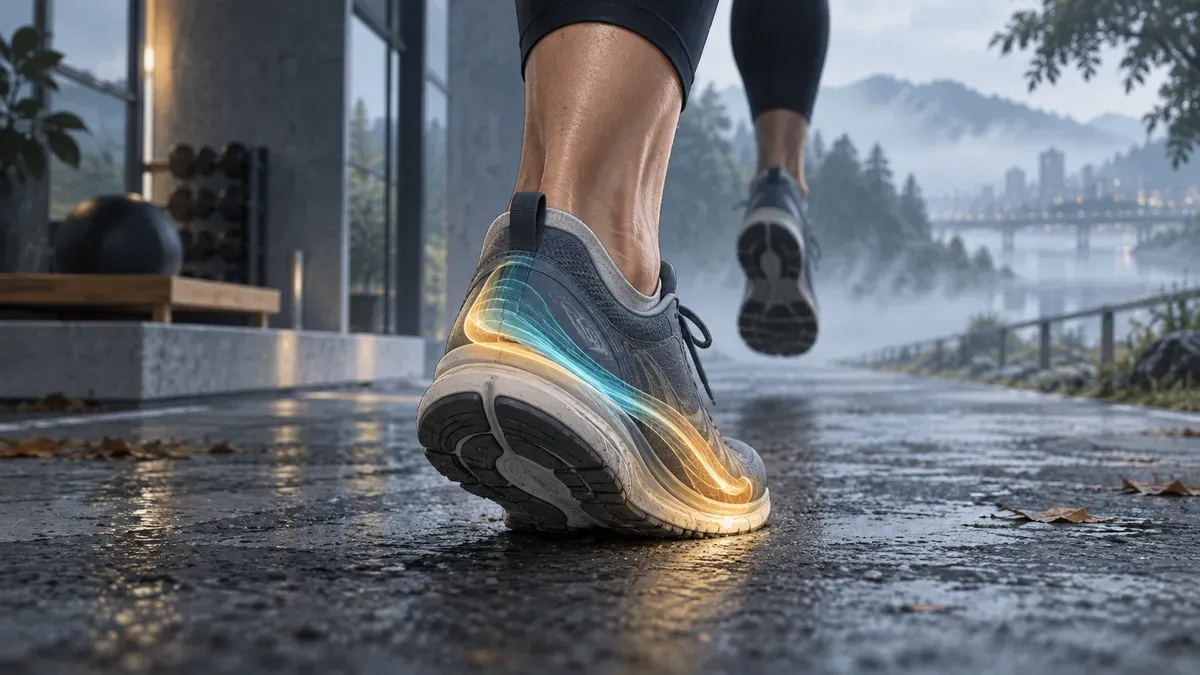
Pronation in running: what it means for shoes and injury risk
Learn what pronation in running means, why overpronation is not a diagnosis, and how to choose shoes or seek help when pain changes your stride.
Pronation in running is the normal inward rolling and flattening motion that helps the foot adapt to the ground after contact. Every healthy runner pronates to some degree. Seeing the ankle move inward, finding more wear on one side of a shoe, or having a low arch does not by itself prove that anything is wrong.
The useful question is not “Do I pronate?” but “Does my foot motion occur without pain, loss of function, or a repeated injury pattern?” Static arch shape, a treadmill video, and shoe wear each reveal only one piece of that answer. Training load, previous injury, strength, recovery, terrain, and shoe comfort can matter as much as foot posture.
Quick answer
Pronation is a normal part of walking and running. “Overpronation” is a descriptive label, not a complete diagnosis and not an automatic reason to buy motion-control shoes or orthotics. If you run comfortably, do not change your gait just because a store scan or wet footprint labels your foot as pronated.
If pain is persistent, one-sided, worsening, or changing how you run, reduce the aggravating load and get an assessment that combines symptoms, training history, strength, footwear, and dynamic movement. Some runners with pronated feet may benefit from a comfortable stability shoe or an orthosis, but the evidence does not support prescribing shoes from arch shape alone.
Key facts
- Foot pronation absorbs and redistributes load as the foot adapts during stance.
- Static foot posture predicts dynamic running mechanics only imperfectly, so a standing arch test cannot describe the whole stride.
- Pronated posture adds only a small injury-risk signal for selected conditions and does not explain most running injuries.
- Foot-shape shoe assignment does not reliably prevent injury, while comfort and symptom response remain practical selection filters.
- Pain plus function guides treatment decisions more usefully than the appearance of pronation alone.
What pronation actually is
Pronation is a three-dimensional combination of movements rather than one ankle angle. As the foot accepts weight, the heel can evert, the talus and lower leg can rotate, and the medial arch can lower. These coupled motions help the foot become adaptable enough to meet the surface. Later in stance, the foot becomes relatively stiffer so force can travel forward for push-off.
Supination describes the opposite combination: the heel moves toward inversion, the arch rises, and the foot becomes more rigid. Both patterns occur within a normal stride. They are phases, not moral categories, and neither word means injured.
The amount and timing differ among runners. Speed, fatigue, surface, anatomy, shoes, and the task all affect what a camera sees. A 2019 systematic review found only small associations between foot posture and selected subtalar mechanics and leg stiffness, with limited or very limited evidence for many other biomechanical outcomes (Hollander et al., 2019). That is why a low arch at rest cannot tell you exactly how a foot will behave at mile six.
Pronation is also different from foot strike. A rearfoot, midfoot, or forefoot strike describes which region contacts first; pronation describes motion through stance. A runner can land on the heel and pronate modestly, or land farther forward and still show substantial inward motion. The running form drills guide explains why changing one visible feature rarely creates a universally “correct” stride.
What “overpronation” can and cannot tell you
There is no single universally accepted angle that divides healthy pronation from harmful overpronation in every runner. In practice, clinicians may use the term when inward motion appears large, rapid, prolonged, or relevant to a runner’s symptoms. A retail shoe label may use it much more broadly.
That difference matters. A description becomes clinically useful only when it connects to a real problem:
- pain appears during or after running;
- the same tissue is repeatedly irritated as load rises;
- the runner has lost strength, control, or tolerance;
- footwear changes symptoms consistently;
- a clinician can reproduce the problem and test a plausible intervention.
Without those links, “overpronator” can turn ordinary variation into a defect. In a systematic review of prospective studies, pronated static posture showed a small association with medial tibial stress syndrome and very limited evidence of a small association with patellofemoral pain. The review did not find a relationship with several other injury categories (Neal et al., 2014). Foot posture can be one variable in a risk profile; it is not a verdict.
Broader evidence points the same way. A 2022 review of 30 prospective studies tested more than 100 biomechanical and musculoskeletal factors in non-elite runners. Most pooled variables were not significantly related to future injury (Peterson et al., 2022). The body does not reduce to one alignment screen.
How to check your feet without diagnosing yourself
Home checks can organize observations, but they cannot establish why something hurts. Use them to create a better history for a sports clinician, not to assign yourself a permanent foot type.
1. Start with symptoms and function
Record where discomfort occurs, when it begins, and what changes it. Note the first painful minute or mile, whether it settles during the run, and how it feels the next morning. Compare this with recent changes in distance, hills, speed, surfaces, strength work, and shoes.
A rapid increase in load often deserves attention before a subtle foot angle. The training-load guide shows how to separate total weekly work from a single unusually long or hard session.
2. Look at standing posture cautiously
A clinician may use the six-item Foot Posture Index to describe several parts of standing foot posture. The tool was designed and validated as a multi-segment clinical measure, not as a consumer diagnosis from one photograph (Redmond et al., 2006).
The wet-foot test is cruder. A broad print can reflect a lower arch, but body mass, soft tissue, pressure, and how you stand influence the mark. It does not show movement timing or tissue capacity. The “too many toes” sign, heel position, and arch height can add context, yet none should be interpreted alone.
3. Film movement from more than one view
If you use a phone, record several seconds at an easy, familiar pace from behind and from the side. Keep the camera stable around lower-leg height, include both feet, and repeat only if the first view is obscured. Compare left and right, but expect some asymmetry.
Two-dimensional video can be reliable when the same observer repeats a measure, but its validity against three-dimensional motion analysis is poor to moderate for many joint angles, especially in frontal and transverse planes (Mousavi et al., 2023). A slow-motion clip is therefore a conversation starter, not a lab result.
4. Read shoe wear as history, not diagnosis
Outsole wear shows where rubber repeatedly met the ground. It is affected by foot strike, surface, turning, shoe geometry, and how long the pair has been used. More wear on the outer heel followed by wear toward the big toe can occur with normal rearfoot running. Collapsed foam, a tilted upper, or a new irritation tells you the shoe may be worn or mismatched; it does not identify the sole cause of an injury.
Does pronation cause running injuries?
Pronation can change how forces move through the foot and leg, but a biomechanical difference is not the same as an injury mechanism. Tissues adapt to repeated load. Problems emerge when the load exceeds current capacity, recovery is insufficient, or a vulnerable tissue is repeatedly stressed.
Think in layers:
| Layer | Useful question | Example |
|---|---|---|
| Symptoms | What hurts, and when? | Medial shin pain begins after 25 minutes |
| Exposure | What changed recently? | Long run rose from 4 mi (6.4 km) to 7 mi (11.3 km) |
| Capacity | What can the tissue tolerate? | Calf endurance drops quickly on one side |
| Mechanics | What motion may influence load? | Foot motion is faster when fatigue appears |
| Context | What else affects recovery? | Previous injury, poor sleep, hard surfaces |
This model prevents two opposite mistakes: blaming every pain on pronation, or pretending mechanics never matter. If a runner has recurring medial shin symptoms, a pronated posture may be relevant alongside bone-loading history, calf capacity, recovery, and nutrition. If the runner is pain-free, the same posture may simply be their normal solution.
Red flags need medical attention rather than a shoe experiment. Stop running and seek prompt assessment for an inability to bear weight, major swelling, deformity, numbness or progressive weakness, pain after a traumatic twist or fall, or highly localized bone pain. Night pain, fever, a hot red joint, or symptoms that do not improve with reduced load also warrant evaluation.
Neutral, stability, and motion-control shoes
Shoe categories are not standardized diagnoses. A neutral shoe generally has less deliberately added medial support. Stability shoes use geometry, foams, sidewalls, or guidance features intended to influence motion. Motion-control shoes usually apply stronger versions of those features. Modern designs often blur the boundaries.
The old prescription model was simple: high arch equals cushioned shoe, normal arch equals stability shoe, low arch equals motion control. Trials have not validated that formula as a general injury-prevention rule. In a randomized study of military recruits, assigning shoes according to plantar shape produced little difference in injury risk compared with giving everyone a stability shoe (Knapik et al., 2010). A Cochrane review likewise concluded that evidence for matching shoes to foot posture was uncertain and often low quality (Relph et al., 2022).
That does not mean support features never help. In a six-month randomized trial of 372 recreational runners, the motion-control version of one shoe was associated with lower overall injury risk, with the strongest signal in runners classified as pronated (Malisoux et al., 2016). A secondary analysis found fewer injuries classified as pronation-related, but only 25 such injuries occurred, so the estimate was imprecise (Willems et al., 2021). One design in one population cannot prove that every pronated runner needs maximum control.
Use these results as permission to test support, not as a command to buy it. If a stability feature feels comfortable, preserves your normal rhythm, and reduces a recurring symptom, it may be useful. If it creates pressure, stiffness, or new pain, the label on the box is not a reason to persist.
A practical shoe-selection test
Choose shoes around the running you actually do and the response you can observe.
- Bring your history. Know what worked, what caused pressure, and where old shoes failed.
- Check fit before category. Leave roughly a thumb’s width in front of the longest toe, secure the heel, and avoid pressure across the forefoot. Feet often swell during longer runs.
- Compare two or three models. Include a familiar option and, if symptoms or assessment suggest it, a modestly more supportive option.
- Run, do not only stand. A brief treadmill or shop run can reveal heel slip, arch pressure, instability, and whether the transition feels smooth.
- Prefer immediate comfort. Do not expect a painful arch or rigid pressure point to “correct” you after a break-in period.
- Change one variable at a time. Introduce the new pair on short easy runs before a long run, speed session, or race.
Comfort is not a magic injury shield, but it is actionable feedback. A focused review found limited support for every single footwear paradigm and recommended emphasizing a lightweight, comfortable shoe rather than rigidly prescribing from pronation alone (Malisoux and Esculier, 2022). More recent prospective evidence also linked greater perceived cushioning and overall shoe appreciation with lower injury risk, though an association cannot prove that comfort itself caused protection (Malisoux et al., 2025).
If you are new to running, build the habit before optimizing small equipment details. The beginner running guide after 40 provides an eight-week run-walk progression that keeps impact exposure manageable.
When orthotics may help
An orthosis changes the interface between foot and shoe. It can redistribute pressure, alter comfort, or modify selected motion and moments. It does not permanently rebuild an arch, and its benefit does not require visibly eliminating pronation.
Research suggests potential benefits, but context is essential. A 2022 meta-analysis reported fewer lower-limb injuries among runners using foot orthoses, with moderate-quality evidence across seven prevention studies; the included populations and devices varied (Neves et al., 2022). A 2024 biomechanical review found that orthoses changed plantar pressure and selected ankle or tibial variables, while some custom devices slightly worsened running economy and perceived exertion (Jor et al., 2024). Changing a lab variable is not automatically a clinical success.
Consider a professional orthotic trial when:
- a specific running-related condition has not settled with sensible load modification;
- a clinician identifies a plausible foot-related contribution;
- taping or a temporary insert produces a meaningful short-term improvement;
- the device fits the shoe, feels tolerable, and supports a return-to-run plan;
- progress is measured through pain, function, and running exposure, not arch appearance.
Prefabricated devices are often a reasonable first trial. Custom orthoses may be appropriate for unusual anatomy, difficult fit, or a clinician-defined need, but cost and complexity do not guarantee a better outcome. Any insert should be introduced gradually.
Strength and gait changes: target the problem, not the label
Foot and calf strength can improve capacity even if the arch still moves. A simple program can include straight-knee calf raises, bent-knee calf raises, controlled single-leg balance, and progressive foot-intrinsic work. The calf-strengthening guide provides regressions and loading targets.
Do not expect generic “arch exercises” to correct every pain. The dose should match the tissue and goal. Two or three sessions per week may be enough at first, with repetitions stopping before form collapses. Running volume should stay stable while a new strength load is introduced.
Gait retraining deserves the same restraint. A clinician may test a small cadence increase, a quieter landing cue, or a change in step width when a specific symptom and loading pattern justify it. These interventions redistribute load; they do not delete it. Forcing the knees outward, holding the arch rigid, or switching abruptly to a forefoot strike can create new stress at the calf, Achilles tendon, or metatarsals.
Use the smallest change that improves the target outcome. If no pain or functional limitation exists, there is rarely a reason to retrain a stride solely to make a rear-view video look straighter.
Use SuperAge to track the response, not a perfect-looking foot
For two to four weeks, record a small set of variables: minutes or miles run, session intensity, shoe used, pain during the run, symptoms the next morning, and any strength work. This makes it possible to see whether a change improves tolerance or merely changes appearance.
SuperAge can help place the experiment inside the larger recovery picture by tracking workouts, cardiovascular trends, sleep, and readiness over time. It cannot diagnose overpronation or certify a shoe, but it can help you notice whether the same foot symptom follows hard sessions, low-recovery days, or sudden changes in volume. If that broader context would make your training notes more useful, download SuperAge from the App Store.
Keep the decision rule simple: maintain a change when comfort and function improve without a new problem; reconsider it when pain rises, movement becomes guarded, or running tolerance falls. Biological age and healthspan improve through sustainable activity, not through chasing a visually perfect foot.
A runner’s decision guide
| Situation | Best next step |
|---|---|
| Pain-free, comfortable, consistent running | Keep training; no correction is required |
| Store scan says “overpronation,” but no symptoms | Treat it as descriptive information, not a diagnosis |
| New mild ache after a load or shoe change | Reduce the aggravating exposure and reverse the newest variable |
| Recurring pain in the same area | Seek a sports clinician or podiatry assessment that includes training history and dynamic function |
| Stability shoe feels clearly better | Introduce it gradually and track symptoms and tolerance |
| Insert or shoe causes new pressure, numbness, or pain | Stop using it and reassess fit or prescription |
| Focal bone pain, major swelling, weakness, or inability to bear weight | Stop running and obtain prompt medical assessment |
Key takeaways
- Pronation is a necessary movement, not an injury.
- “Overpronation” needs symptoms and context before it becomes clinically meaningful.
- Static arch tests, wet footprints, shoe wear, and 2D video cannot diagnose injury risk by themselves.
- Foot posture has small associations with selected injuries, while overall risk remains multifactorial.
- Matching shoes to arch shape alone has not reliably prevented injuries.
- A comfortable stability shoe or orthosis can help some runners, but the response should be tested rather than assumed.
- Persistent or focal pain deserves a complete assessment, not a more aggressive attempt to hold the foot rigid.
FAQ
Is pronation normal when running?
Yes. Pronation helps the foot adapt and distribute load after contact. The amount varies. It becomes a clinical concern only when it plausibly contributes to pain, repeated injury, or loss of function.
How do I know if I overpronate?
A wet footprint or rear-view video may suggest a pronated posture, but neither establishes harmful overpronation. A useful assessment combines symptoms, standing posture, dynamic movement, strength, training load, footwear, and response to test changes.
Does wear on the inside of my running shoe prove overpronation?
No. Wear reflects repeated contact plus shoe design, terrain, turning, and mileage. It can show that a shoe is aging or that loading is asymmetric, but it cannot diagnose the cause or predict an injury alone.
Do overpronators need stability shoes?
Not automatically. Some pronated runners may benefit from support features, especially when the shoe is comfortable or reduces a recurring symptom. Pain-free runners do not need to switch solely because of an arch label.
Can neutral shoes cause injury if I pronate?
There is no general rule that neutral shoes cause injury in pronated runners. Shoe response varies by person, design, training exposure, and injury history. Fit, comfort, and gradual introduction are more informative than category alone.
Can exercises stop pronation?
Exercises can improve foot, calf, hip, and balance capacity, but normal pronation does not need to be stopped. The goal is better tolerance and function, not freezing the arch in one position.
Are custom orthotics better than store-bought inserts?
Not for everyone. A prefabricated insert can be a practical first trial. Custom devices may help when anatomy, fit, or a specific clinical problem requires them, but they should still be judged by comfort, symptoms, and function.
When should foot pain stop me from running?
Stop and seek prompt assessment for inability to bear weight, major swelling, deformity, numbness, weakness, traumatic pain, or focal bone tenderness. Reduce running and arrange evaluation when pain worsens, changes your gait, persists despite rest, or repeatedly returns.
References
- Hollander K, et al. The relationship between static and dynamic foot posture and running biomechanics: a systematic review and meta-analysis. Gait & Posture. 2019.
- Neal BS, et al. Foot posture as a risk factor for lower limb overuse injury: a systematic review and meta-analysis. Journal of Foot and Ankle Research. 2014.
- Peterson B, et al. Biomechanical and musculoskeletal measurements as risk factors for running-related injury in non-elite runners. Sports Medicine - Open. 2022.
- Redmond AC, et al. Development and validation of the Foot Posture Index. Clinical Biomechanics. 2006.
- Mousavi SH, et al. Validity and reliability of two-dimensional video-based assessment to measure joint angles during running. Journal of Biomechanics. 2023.
- Knapik JJ, et al. Injury reduction effectiveness of assigning running shoes based on plantar shape in Marine Corps basic training. American Journal of Sports Medicine. 2010.
- Relph N, et al. Running shoes for preventing lower limb running injuries in adults. Cochrane Database of Systematic Reviews. 2022.
- Malisoux L, et al. Injury risk in runners using standard or motion-control shoes. British Journal of Sports Medicine. 2016.
- Willems TM, et al. Motion-control shoes reduce the risk of pronation-related pathologies in recreational runners. Journal of Orthopaedic & Sports Physical Therapy. 2021.
- Malisoux L, Esculier JF. Running injury paradigms and their influence on footwear design features and runner assessment methods. Frontiers in Sports and Active Living. 2022.
- Malisoux L, et al. Association of shoe cushioning perception and comfort with injury risk in leisure-time runners. European Journal of Sport Science. 2025.
- Neves MP, et al. Effects of foot orthoses on pain and prevention of lower-limb injuries in runners. Journal of Sport Rehabilitation. 2022.
- Jor A, et al. Effects of foot orthoses on running kinetics and kinematics. Gait & Posture. 2024.
Related Articles

Can nail changes signal diabetes? What they mean and when to test
Can nail changes signal diabetes? Learn why color, thickness, and growth are nonspecific, which blood tests diagnose high glucose, and when to seek care.