SUP yoga for beginners: poses, balance, and water safety
Try SUP yoga with stable beginner poses, realistic benefits, and a supervised first-session plan. Learn what to practice on land and what to check on water.
Quick answer
SUP yoga is yoga practiced on a stand up paddleboard. For beginners, the useful starting point is a supervised session on sheltered, still water, with low positions such as seated breathing, tabletop, and small cat-cow movements. Learn how to fall and remount before adding poses. Wear a fitted flotation device, and let a qualified instructor assess conditions and equipment. Standing balances are optional; staying low can provide a complete first practice.
Key facts
- A moving board changes the balance demands of familiar yoga positions.
- Low positions reduce the height of the body’s center of mass above the board.
- Controlled transitions preserve more options than reaching the deepest possible pose.
- Paddling studies do not establish the specific health benefits of paddleboard yoga.
- Supervised remount practice tests an essential skill before a yoga sequence begins.
What changes when the mat becomes a board?
A floor stays still while you move. A floating board tilts and responds to changes in where you place your weight. Moving one hand, turning your head, or shifting a knee can therefore change the task even when the pose looks simple.
The aim is to organize a comfortable position while retaining the ability to return to a stable base. You do not need to eliminate every wobble. You do need to notice when breathing, joint comfort, or control is deteriorating and simplify before that happens.
This makes SUP yoga a different skill from both a daily yoga routine on land and paddling for fitness. Experience in either helps with familiarity, but does not automatically supply the other skill. A flexible yoga practitioner may still need a basic board lesson; an experienced paddler may need simpler wrist and knee positions.
Set realistic expectations about benefits
SUP yoga offers movement practice, attention to breathing, and a different setting for an activity you may enjoy. Whether it feels relaxing depends on the person and conditions. Feeling anxious on water is a reason to reduce the challenge, not evidence that the practice is working harder.
The National Center for Complementary and Integrative Health describes possible benefits of yoga for general wellbeing and several health outcomes, with results varying by program and population. Those findings concern yoga broadly. They do not establish that moving the practice onto water adds a medical benefit.
Similarly, a small SUP training study followed 13 previously untrained participants through six weeks of paddling training. Fitness, trunk-endurance measures, and self-rated quality of life improved, but static and dynamic balance tests did not improve significantly. It was a small study with participants serving as their own controls, and it did not test a SUP yoga program.
Use the distinction when choosing a goal:
| Your goal | A useful way to judge the session | What a session cannot demonstrate |
|---|---|---|
| Learn board yoga | More comfortable low positions and transitions | A guaranteed change in balance on land |
| Enjoy movement | Willingness to return and a manageable effort | Treatment of an anxiety disorder |
| Practice mobility | Comfortable movement you can control | That a deeper stretch is healthier |
| Build long-term activity | A sustainable addition to your week | Reversal of biological aging |
If reducing falls is the priority, keep a structured land-based balance and strength program. Water practice is an optional recreation choice, not a necessary upgrade.
Choose the lesson before choosing the poses
Ask whether the instructor can teach both board handling and beginner yoga adaptations, and how rescue is organized. A class should explain what happens if someone falls, cannot remount, becomes cold, or needs to finish early. A nearby shore is useful only when there is an accessible, appropriate exit.
The RNLI paddleboarding guidance recommends flotation, a means of calling for help carried on your body, an appropriate leash, and avoiding offshore winds. The instructor should match the equipment to the actual environment. A leash does not replace flotation; flowing water introduces entanglement risks that require specific assessment.
For a first class, sheltered still water or a supervised pool session keeps the environmental task simpler. A pool still needs suitable space, rescue arrangements, and the facility’s permission. Do not improvise anchors, tie boards together, or wrap a tether around your body. Leave any station-keeping arrangement and its release procedure to a competent provider.
Before committing to the lesson, ask:
- Can I remain seated or kneeling throughout?
- Will we practice falling and getting back aboard before yoga?
- What happens if I cannot remount independently?
- Which positions are compatible with the fitted flotation device?
- What conditions cause the class to move indoors or be cancelled?
The RNLI beginner guide supports instruction, remount practice, and learning to stay near the board’s middle. Treat these as entry skills. Holding a pose for a photograph is not a substitute for them.
If board control is new to you, the SUP paddling technique guide explains steering, stopping, and getting back aboard. Practice those skills with instruction before adding yoga positions.
Practice these low positions first
The following is an illustrative teaching sequence to discuss with an instructor, not a tested exercise prescription or a substitute for a lesson. Rehearse the movements on land first. On the board, change one contact point at a time and pause between positions. Keep your eyes open and breathe normally.
1. Supported sitting and easy breathing
Sit near the center with the legs in a comfortable position. Hands can rest on the board rather than reaching overhead. Let your gaze settle on a stationary point ahead. Take three to five comfortable breaths without making them unusually deep or slow.
If cross-legged sitting pinches the hips or knees, choose another supported seat approved by the instructor. You are testing a usable position, not demonstrating flexibility. Keep the flotation device on and fitted.
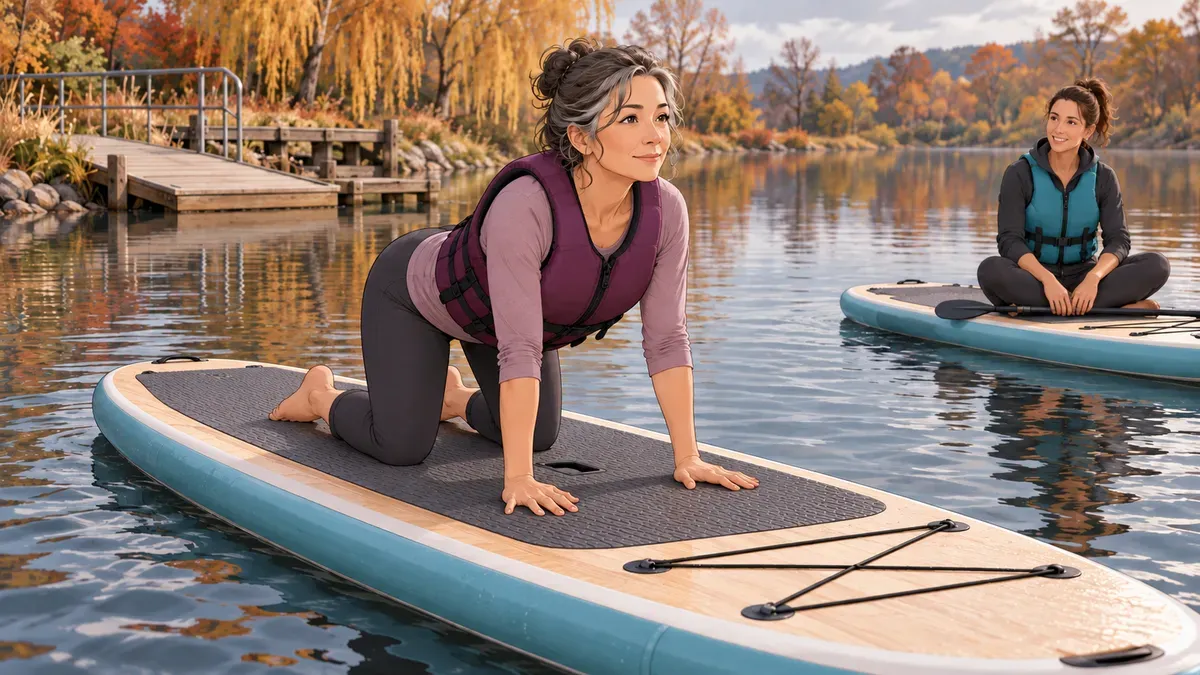
2. Tabletop with four points of contact
Move onto hands and knees around the center of the board. Spread the hands comfortably and keep the knees at a width that permits control. Stay still for a few breaths before adding movement.
If the wrists or knees hurt, return to sitting or use the instructor’s adaptation. Do not solve discomfort by balancing on a loose cushion or unsecured object. A stable land alternative is preferable to forcing the position on water.
3. Small cat-cow movements
From tabletop, gently round the back, then return through neutral into a small comfortable extension. Start with three slow cycles. A cycle means one rounding movement and one extension, not a long hold at either extreme.
Make the movement smaller than you would on a mat. Keep the hands and knees connected to the board and avoid throwing the head back. The test is whether you can reverse the movement smoothly while continuing to breathe.
4. A short rock-back
From tabletop, move the hips a little toward the heels and return. The hips do not need to reach the heels. Stop before knee pressure, hip pinching, or loss of hand support changes the task.
Repeat two or three times, then pause. If this is uncomfortable, remain in tabletop or sitting. The pose has no special benefit that makes joint pain worth accepting.
5. A brief seated finish
Return to the starting seat one movement at a time. Notice whether you can look ahead, relax the grip in your hands, and speak comfortably. End the sequence while you still have attention and energy for returning to the exit.
Avoid headstands, shoulder stands, forceful breathwork, and eyes-closed balances as beginner experiments. NCCIH advises new yoga practitioners to avoid extreme practices. On a floating surface, removing visual information or rushing a transition adds another challenge without being necessary for a useful first session.
Organize a short first practice
Separate teaching time from pose time. A 45-minute class might contain substantial fitting, explanation, rescue practice, and pauses; it is not automatically 45 minutes of moderate exercise.
After the instructor has completed the safety and board-skills portion, this 12-minute example can organize an easy practice:
| Block | Approximate time | Main decision |
|---|---|---|
| Seated orientation | 2 minutes | Can I breathe comfortably and follow instructions? |
| Tabletop and pauses | 3 minutes | Are wrists, knees, and board position comfortable? |
| Small cat-cow and rock-backs | 4 minutes | Can I control every reversal without rushing? |
| Seated finish | 3 minutes | Do I retain enough energy for the exit? |
These times are options, not targets to complete despite discomfort. An instructor may shorten the practice, replace a position, or finish before the sequence starts. A lesson spent learning remounting can still be a successful first lesson.
For later sessions, add either a little practice time or one modest movement change. Avoid combining a new pose, longer holds, and more challenging water conditions. You can explore a larger comfortable range on land using the flexibility and mobility guide, where support is easier to control.
Keep the rest of your fitness week
Board yoga can sit beside walking, cycling, swimming, or strength work. It does not need to replace them. The WHO activity guidelines recommend 150–300 minutes of moderate aerobic activity weekly, or the equivalent vigorous activity, and muscle-strengthening work. A gentle yoga class may not provide a sustained aerobic stimulus.
The broader goal is a repeatable mix of movement, strength, and recovery. Our exercise and longevity guide explains that larger pattern. There is no evidence here that a pose, a wobble, or an afternoon on water directly lowers biological age.
Review the habit with SuperAge
SuperAge can help you review available Apple Health activity and recovery trends alongside a simple session note: positions used, comfort, perceived effort, and how you felt afterward. Compare the experience across several sessions rather than treating one heart-rate reading as a result.
Use those trends as context. A favorable recovery reading cannot assess a lake, decide whether you can remount, or clear a painful wrist. The most useful outcome may be finding an activity you enjoy repeating at an appropriate level.
Know when to adapt or stop
Discuss pregnancy, recent surgery, an unstable medical condition, recurrent fainting, seizures, significant dizziness, or substantial mobility limitations with the relevant clinician and instructor before water participation. A suitable land yoga adaptation may be a better starting point. Being comfortable on a mat does not resolve water-specific risks.
Sharp or increasing pain, numbness, dizziness, shivering, deteriorating conditions, or difficulty following instructions are reasons to stop and get help from the instructor. Chest pressure, fainting, or severe unusual breathlessness require urgent medical assessment.
Dress for potential immersion. The RNLI cold-water guidance explains that sudden cold immersion can disrupt breathing and movement. Warm air and sunshine do not establish that water is safe for an unexpected fall. An instructor should assess water temperature and appropriate clothing before launching.
Frequently asked questions
Do I need to be good at yoga before trying SUP yoga?
No advanced poses are necessary. A beginner class should offer low, adaptable positions. Tell the instructor about both your yoga experience and your comfort around water.
Must I stand up during the class?
No. Sitting, kneeling, and tabletop can provide a complete first practice. Standing is a later option when the instructor judges it appropriate, not a graduation requirement.
Is SUP yoga harder than yoga on a mat?
The moving surface adds a balance task, so a familiar pose may require more attention. Harder does not automatically mean more useful. Shorter holds and smaller movements can be the right dose.
Can I do SUP yoga if I cannot swim?
Do not start independently. Tell the provider before booking and ask whether the class is suitable for your water competence and rescue needs. A flotation device alone does not establish suitability.
Will it strengthen my core or improve balance?
Maintaining positions involves muscular work and board-control practice. The size of any training effect depends on the program. Paddling research cannot establish the specific effects of SUP yoga or guarantee transfer to balance on land.
Should I remove my flotation device for easier poses?
Keep it on. Ask the instructor to choose movements compatible with its fit. Change the pose rather than removing a safety measure to reproduce a photograph.
Is SUP yoga a weight-loss workout?
It uses energy, but no reliable universal calorie figure applies to every class. Choose it for a sustainable movement practice; do not extend a session to chase an uncertain calorie estimate.
How often should a beginner practice?
Start with one supervised lesson and assess comfort and recovery before scheduling more. Land practice can build familiarity between classes. There is no established universal SUP yoga frequency prescription.
Key takeaways
- Start with instruction, appropriate water conditions, and remount practice.
- Keep beginner positions low and transitions deliberate.
- Judge progress by comfort and control rather than pose depth or time standing.
- Distinguish evidence about yoga or paddling from claims about SUP yoga.
- Keep the practice optional within a complete activity and recovery routine.
Make the first session useful
Before booking, write down three questions: how rescue works, whether you can stay low, and what conditions cancel the class. If you use Apple Health, download SuperAge on the App Store to review available activity trends alongside your own notes about comfort and consistency.
References
- National Center for Complementary and Integrative Health. Yoga: effectiveness and safety.
- Schram B, Hing W, Climstein M. The physiological, musculoskeletal and psychological effects of stand up paddle boarding. BMC Sports Science, Medicine and Rehabilitation. 2016.
- RNLI. Stand up paddleboarding safety.
- RNLI. Paddleboarding for beginners: top tips.
- RNLI. Cold water shock.
- World Health Organization. WHO guidelines on physical activity and sedentary behaviour: at a glance.
Related Articles

Kitesurfing for beginners: lessons, safety, and progression
Start kitesurfing with a clear plan for lessons, wind, safety systems, fitness, and learning milestones. Prepare for your first session and progress with care.