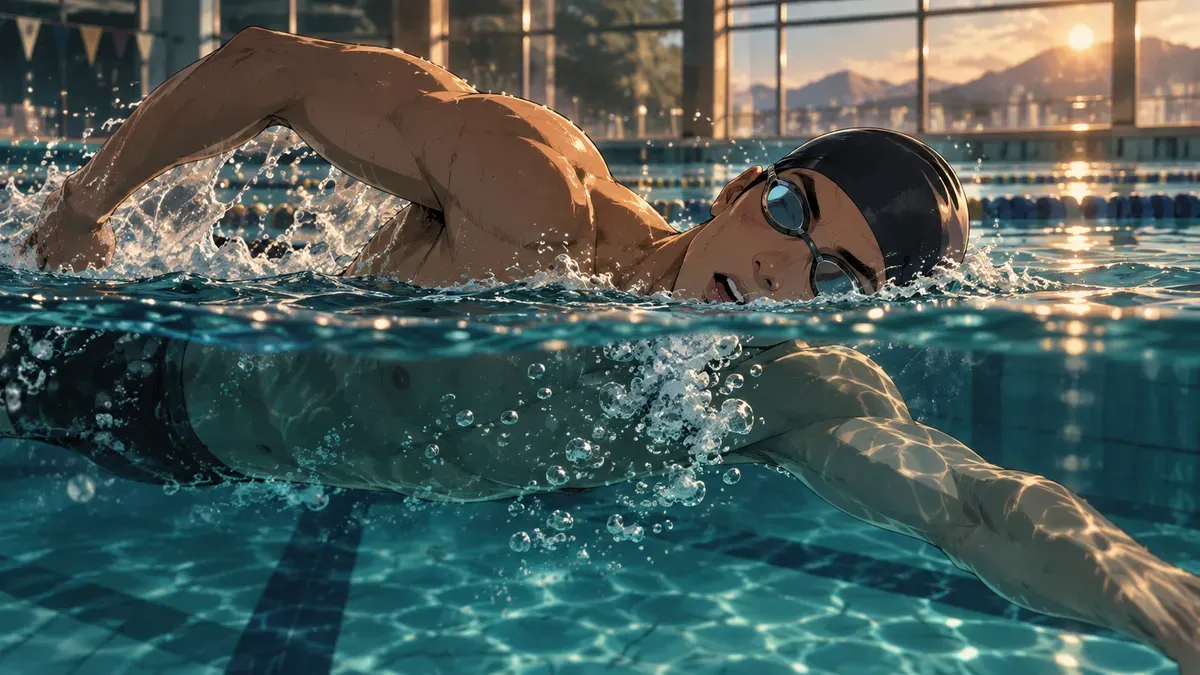
How to breathe while swimming freestyle: timing, rhythm, and drills
Learn how to breathe while swimming freestyle: exhale in the water, rotate for a calm inhale, choose a sustainable rhythm, and practice safely.
To breathe while swimming freestyle, let air out while your face is in the water, turn with your body’s natural roll, take a short comfortable breath to the side, and return your face before the next pull. You do not need to save all your air for the end of the stroke or force a three-stroke pattern. Start with a rhythm that gives you enough air to keep swimming calmly.
Quick answer
Practice a gentle, ongoing exhale into the water. When your torso rolls toward your breathing side, turn your head just enough to bring your mouth to air; avoid lifting your whole head forward. Inhale normally, then look back down and begin exhaling again. If you feel desperate for air, slow down, breathe more often, or stop at the wall. Breathing skill develops more reliably through short, relaxed repetitions than through long breath-holding challenges.
Key facts
- Underwater exhalation frees the short above-water window for an inhale.
- Body rotation carries the head toward air with less disruption to freestyle alignment.
- Breathing frequency should provide enough air for the swimmer’s effort, not satisfy a universal stroke count.
- Short pool drills let beginners practice one movement before combining breathing with a full stroke.
- Prolonged breath holding and pre-swim hyperventilation increase the risk of underwater blackout.
What a complete freestyle breath looks like
Freestyle asks you to share one narrow window between forward motion and an inhale. The simplest solution is to separate the jobs. Do most of the exhale while your face is submerged. Use the side turn for the inhale. A beginner who holds their breath underwater must then rush both exhalation and inhalation during the same short turn; that can feel like the water is stealing the breath.
You can exhale through your nose, mouth, or both. Aim for a comfortable stream of bubbles, not a maximal blast from the moment your face enters the water. Finish the exhale before or as your mouth reaches air, then take a normal breath. Swim England’s front-crawl guidance describes underwater exhalation and a side turn with the body’s rotation. U.S. Masters Swimming similarly identifies breath holding between turns as a common reason swimmers feel rushed.
The inhale is brief, but it should not be a frantic gulp. Think of bringing the mouth to an available pocket of air beside the head, rather than pulling the whole head out of the pool. If water repeatedly enters your mouth, reduce speed, reset at the wall, and practice the turn with support. A few calm breaths are more useful than forcing another length with a failing pattern.
Turn with the torso instead of lifting the head
As you swim front crawl, your trunk already rotates around its long axis. Let the head turn with that roll. Keep the neck relatively easy, look mostly down between breaths, and avoid looking straight ahead to find air. Lifting the head can make the hips sink and disturb the timing of the arms and kick. It also turns a small side movement into a larger balancing task.
A useful visual cue is to keep one goggle lens near the water when you breathe. It is a coaching cue, not a rigid rule for every face, wave, or skill level. The point is to make the turn small enough that you can return to a streamlined position without jerking the head. The forward arm should continue supporting the stroke rather than collapse beneath you as you turn. If your leading arm drops every time you breathe, slow the movement down before you try to swim farther.
Breathing inevitably changes the stroke somewhat. In a small laboratory study of ten competitive swimmers, breathing changed several arm-motion measures compared with breath holding at a fixed speed. That result does not prescribe a single ideal head angle for recreational swimmers. It supports the practical idea that breath timing and arm timing interact: observe the whole stroke, not just the mouth.
How often should you breathe?
Breathing every two arm strokes lets many learners use a consistent side and get frequent air. Breathing every three alternates sides, which can be useful for practicing symmetry. Neither count is a badge of skill. If a three-stroke pattern leaves you gasping, breathe every two for now. If you are comfortable on one side, you can practice the other side in easy, short lengths without insisting on bilateral breathing throughout a hard session.
Effort changes the answer. A gentle technique length gives more time to coordinate a breath than a faster interval. People also differ in pace, stroke rate, comfort, and respiratory needs. Swim England suggests beginning with a comfortable two-stroke pattern before experimenting with a three-stroke pattern in its front-crawl breathing tips. That is a practice sequence, not proof that every swimmer should eventually use three strokes.
| If you notice… | Try this at the next easy length | Why it may help |
|---|---|---|
| A rushed, noisy inhale | Begin a gentle exhale soon after your face returns underwater | The turn no longer has to fit both exhale and inhale |
| Hips dropping when you breathe | Roll the torso and turn the head sideways rather than looking forward | A smaller head movement disturbs balance less |
| Air hunger every third stroke | Breathe every two strokes and slow the pace | More frequent air may restore a repeatable rhythm |
| One side feels awkward | Practice that side for a few short lengths with rest | Skill work is easier before fatigue changes the stroke |
| Coughing or swallowing water | Stop, reset, and practice supported side turns | A calm drill is safer than forcing the next length |
A beginner progression for pool breathing
Start where you can stand comfortably and where supervision is available. Each step should feel controlled before you make it longer. If you are still learning basic water comfort or flotation, a qualified swim instructor can adjust the progression to you.
- Bubbles at the wall. Hold the edge, inhale above water, place your face in, and exhale gently. Come back up for a normal breath. Repeat a few times without trying to stay underwater longer each round.
- Supported side turn. With one hand on the wall or a stable flotation aid, put your face in, exhale, and rotate the head and upper body toward the side for air. Return your face to the water smoothly. Practice both sides separately.
- Short push and glide. Push lightly from the wall in shallow water, exhale while your face is down, and stand up when you need air. The goal is comfort and timing, not distance or a breath-holding record.
- Easy freestyle with one cue. Swim a short length or partial length at conversational effort. Focus only on exhaling in the water and turning with the torso. Rest fully, then repeat.
- Add a rhythm only after comfort. Try breathing every two strokes. When that is calm, test a few easy lengths to the other side or every three strokes. Keep whichever pattern lets you maintain control.
The short repetitions are an illustrative teaching sequence, not a medical protocol or a claim that every learner progresses in five steps. Swim England’s teaching framework treats breathing pattern and timing as parts of a broader stroke that also includes body position, arms, and legs. A coach may return to flotation or basic submersion work before adding arm strokes.
Fix the common problems without forcing a breath
I run out of air halfway across the pool. First check the pace: it may simply be too hard. Then notice whether you are holding air until the turn. Exhale in the water, breathe more often, and use shorter lengths with full recovery. Do not try to solve air hunger by repeatedly sprinting to the wall.
I breathe in water. You may be turning late, lifting forward, or letting the lead arm collapse. Slow down and practice a supported side turn so the mouth reaches air as the torso rolls. Some splashing is normal while learning, but repeated coughing is a reason to stop and reset.
I can breathe only to one side. That is common and does not prevent a useful easy swim. Practice your less comfortable side in short, relaxed repetitions. You can keep a preferred side during longer swimming while the other side develops. Bilateral breathing is a skill option, not a requirement to restrict oxygen.
My neck feels strained. Avoid craning forward or twisting the head separately from the torso. Shorten the turn and let the shoulder and rib cage roll. Persistent pain deserves assessment from a clinician or qualified instructor rather than more forced laps.
I panic when my face enters the water. Return to standing-depth, supported breathing work. A swim instructor can help build water confidence step by step. There is no advantage in using long underwater holds as exposure practice.
Safety: never turn breathing practice into breath-hold training
Freestyle breathing drills should teach an easy exchange of air. They are not tests of how long you can stay submerged. The CDC advises against hyperventilating before swimming underwater or trying to hold your breath for long periods, because these behaviors can lead to loss of consciousness and drowning. The CDC also recommends swimming with a buddy and choosing lifeguarded areas when possible. Do not practice extended underwater lengths, repeated breath holds, or deliberate oxygen restriction to improve your freestyle.
If you feel dizzy, faint, unusually short of breath, or develop chest pain, stop swimming and seek appropriate medical care. People with conditions that increase drowning risk should discuss water safety and supervision with their clinician. Technique advice cannot replace an in-person assessment when symptoms or water fear are significant.
Pool breathing and open-water breathing share the same basic exchange of air, but open water adds waves, navigation, temperature, and rescue planning. Build the skill in a controlled pool first. Our pool versus open-water swimming guide addresses that separate transition. This article stays focused on a repeatable freestyle breath, not open-water route choice or race preparation.
For pregnancy-specific pool pacing, stroke comfort, and access, see our swimming during pregnancy guide.
How swimming fits a sustainable training week
Once breathing feels easier, you can judge the swim by effort and repeatability rather than by how far you managed to go without air. An easy session can alternate short freestyle lengths with rests or a different comfortable stroke. If the stroke falls apart whenever you increase distance, return to shorter lengths and rebuild. Fitness improves through sessions you can repeat, not a single desperate lap.
Swimming is one option for aerobic activity; it does not require a particular breathing ratio to count. Our swimming and cardiovascular fitness guide covers the broader training question. If pool visits are difficult to maintain, our exercise consistency guide offers a way to design a routine around actual life rather than an ideal schedule. For a separate land-based breathing problem, see breathing while running; the mechanics differ because runners do not have a submerged exhale.
How SuperAge can add context
After you have a comfortable swim routine, SuperAge can help you view workouts alongside broader fitness and recovery trends recorded in Apple Health. Compare similar weeks while paying attention to how calmly you can complete the same pool session. A wearable cannot tell whether your head turn or exhalation timing is correct; an instructor and your own control in the water remain more direct feedback.
Try SuperAge if you want one place to review the training pattern after the breathing skill itself is under control.
Key takeaways
- Exhale into the water; reserve the side turn mainly for a comfortable inhale.
- Rotate with the torso and avoid lifting the head forward to chase air.
- Breathe as often as you need; two or three strokes are practice options, not a hierarchy.
- Build the skill with short, easy, supervised pool repetitions and rest when the pattern breaks down.
- Avoid hyperventilation, prolonged underwater breath holding, and drills that deliberately restrict air.
FAQ
Should I breathe through my nose or mouth while swimming?
You can exhale underwater through your nose, mouth, or both, whichever lets you stay relaxed and keep water out comfortably. Take the above-water inhale through the mouth. The timing and steadiness of the exchange matter more than insisting on one exhalation route.
Should I hold my breath between freestyle strokes?
Usually no. Holding air until the head turns leaves too much work for the short above-water window. Let air out while your face is submerged and take a normal breath on the side. Do not convert this advice into a long underwater breath-holding drill.
Is breathing every three strokes better than every two?
No universal rule makes three better. Every three strokes alternates sides; every two can offer more frequent air. Choose a pattern that fits your effort and keeps the stroke controlled, and practice the less familiar side in easy lengths if useful.
Why do I get out of breath after one pool length?
The pace may be too high, you may be holding your breath underwater, or the turn may be so rushed that you never inhale comfortably. Slow down, exhale in the water, breathe more often, and rest between short repetitions. Persistent or unusual breathlessness needs medical assessment.
Should my head lift out of the water to breathe?
For ordinary freestyle, aim to turn to the side with your torso rather than lifting the head forward. A small side turn can preserve balance and arm timing. A coach can adapt the cue to your body, mobility, and the water conditions.
Can I practice breathing by swimming underwater farther each time?
No. Extended underwater breath holding and hyperventilation can cause blackout. Practice the normal breath cycle in shallow, supervised pool conditions and stop for air whenever needed.
What if I can breathe on only one side?
Use your comfortable side for longer easy swimming and practice the other side in short lengths with ample rest. A one-sided pattern can still support a safe, useful swim. Seek instruction if the turn consistently causes pain or loss of control.
References
- Swim England. Improving your breathing in front crawl.
- U.S. Masters Swimming. A simple fix to improve your breathing in freestyle.
- Swim England. Three tips to improve front crawl breathing.
- Swim England. Teaching the four strokes.
- Lerda R, Cardelli C. Underwater stroke kinematics during breathing and breath-holding front crawl swimming. Journal of Human Kinetics. 2003.
- CDC. Preventing drowning.
Related Articles

Canoe vs kayak: differences, safety, and which is easier
Canoe vs kayak: compare paddles, stability, storage, rescue, fitness demands, and safety so you can confidently choose the right craft for your first trip.