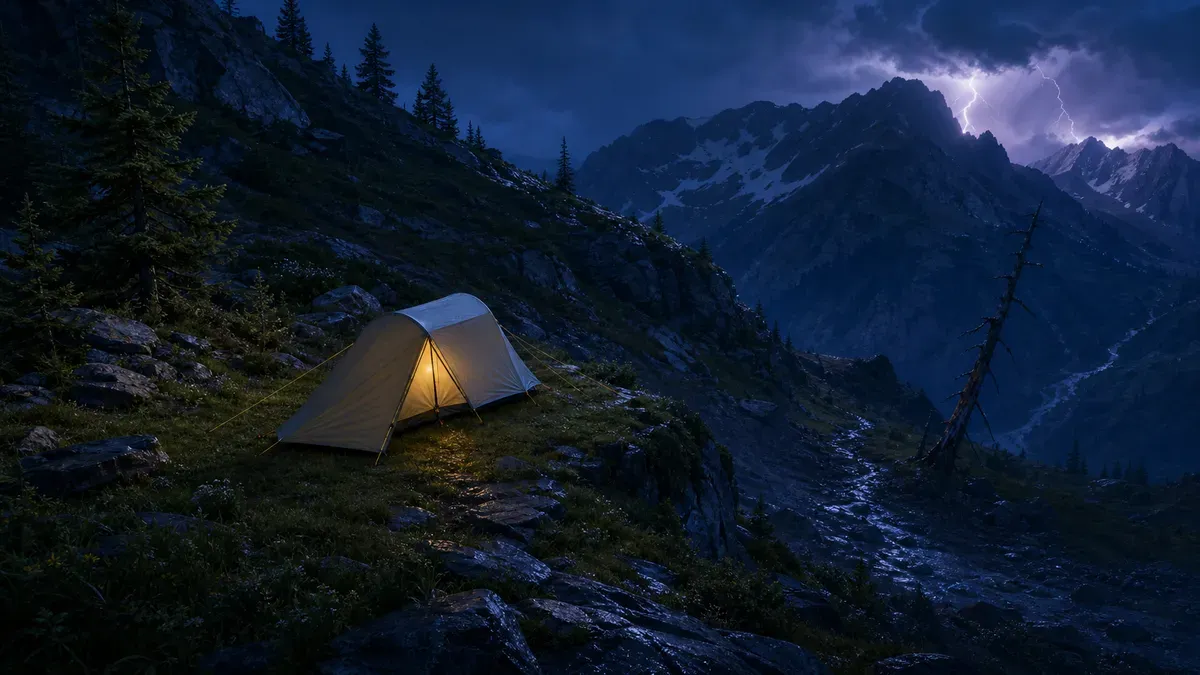
Mountain tent camping: choose a safer site and sleep system
Plan mountain tent camping safely: choose a lower-risk site, match your sleep system to the forecast, and manage water, wildlife, and emergencies well.
Mountain tent camping turns a day hike into an overnight exposure to falling temperatures, wind, water, wildlife, and terrain that may be easy to miss in daylight. A good tent helps, but it cannot make a flood channel, lightning-exposed ridge, dead tree, inadequate sleeping pad, or illegal site safe.
The practical goal is not to find a perfectly flat view. It is to build layers of margin: confirm that overnight use is allowed, check the mountain forecast, choose a site without an obvious terrain trap, match both the sleeping bag and the ground insulation to the expected low, keep food and water systems separate from sleep, and retain a realistic exit plan.
If the objective ends before nightfall, the winter hiking safety guide covers the day-hike boundary: adjustable layers, surface-specific traction, independent light and navigation, emergency insulation, and a precommitted turnaround time.
Quick answer
For safer mountain tent camping, arrive with enough daylight to inspect the whole site. Use a designated or already durable site when required or available. Avoid ridges, summits, exposed fields, cliff edges, drainage channels, depressions, avalanche paths, rockfall zones, and dead or damaged trees. Pitch on firm, level ground that is not the lowest point nearby, then orient and anchor the tent for the forecast wind.
Treat the sleeping bag, sleeping pad, dry clothing, shelter, and ventilation as one sleep system. Select standardized temperature and thermal-resistance ratings for conditions colder than the most likely forecast, then adjust for your own cold sensitivity, altitude, wind, humidity, fatigue, and the cost of being wrong. A tent is not lightning protection, and an emergency messenger is not a substitute for a conservative weather and turnaround decision.
Key facts
- Terrain concentrates mountain hazards: gullies and low spots collect water, while ridges and isolated high points increase exposure to wind and lightning.
- A sleeping pad resists ground heat loss: its thermal resistance matters even when the sleeping bag appears warm enough.
- A sleeping-bag rating enables comparison: it is a standardized laboratory result, not a personal guarantee in every field condition.
- Clear stream water can still contain pathogens: uncertain water needs an appropriate treatment plan before drinking, cooking, or brushing teeth.
- A tent blocks weather, not every hazard: it does not provide a safe place during lightning and should not contain food where wildlife rules require separate storage.
This guide addresses planning and early field decisions for healthy adults. It does not replace a local land manager, mountain guide, weather service, medical professional, or rescue authority. Conditions, permits, fire restrictions, food-storage rules, and emergency systems vary by place and season; verify them for the exact route immediately before departure.
Start with permission, weather, and an exit
Mountain camping begins before packing. The same patch of ground can be an authorized designated campsite, a fragile restoration area, a seasonal wildlife closure, private land, or a location where overnight use requires a permit. Do not infer permission from old trip reports, an existing fire ring, a map icon, or another tent.
Check the current land-manager page for:
- whether camping is allowed and whether a reservation or permit is required;
- designated-site, group-size, fire, sanitation, and food-storage rules;
- seasonal closures, protected habitat, and water-source restrictions;
- current trail, bridge, snow, avalanche, rockfall, and wildfire conditions; and
- the local emergency number, coverage limits, rescue expectations, and practical evacuation routes.
Then compare a point forecast for the camp elevation with a broader mountain forecast. Valley weather is weak evidence for a site thousands of feet higher. Record expected low temperature, precipitation timing, freezing level, wind speed and direction, thunderstorm probability, and the time between sunset and sunrise. Recheck before leaving signal range.
Write down decision points instead of promising yourself that you will “see how it goes.” Examples include: no departure if thunderstorms overlap the exposed approach; no camp if the only legal sites are occupied; turn around if the group reaches the site-selection zone after the daylight cutoff; descend if sleep-elevation symptoms appear; and use the known lower shelter if wind exceeds the tent or group’s practiced capability.
Fitness does not neutralize poor terrain or weather. If the approach involves sustained climbing, our uphill walking guide explains why grade raises cardiovascular and muscular demand. A heavier overnight pack changes that demand again; use our rucking guide for gradual load carriage rather than making the trip itself the first test. If the overnight is above roughly 8,200 ft (2,500 m), use our altitude-sickness guide to plan sleeping elevation and recognize symptoms; do not assume that a night in a tent accelerates acclimatization safely.
Use a five-zone campsite scan
Arrive early enough to walk beyond the exact rectangle where the tent might sit. A flat footprint can look safe while the slope above it, the drainage beside it, or the dead branch overhead says otherwise. The U.S. National Park Service advises campers to screen for flash flooding, lightning, wind, dead trees and branches, cliff edges, and low ground before pitching (NPS campsite guidance).
Use five zones, from broadest to smallest:
| Zone | Question | Reject or relocate when |
|---|---|---|
| Landscape | What can arrive from above or upstream? | The site lies below unstable rock, snow, a burn scar, a steep gully, or a watershed that can flood after distant rain |
| Exposure | How will wind, lightning, and falling objects reach camp? | The site is on a ridge, summit, open high point, cliff edge, or beneath dead, leaning, cracked, or heavily loaded trees |
| Water | Where would rain and runoff travel? | The footprint is in a depression, dry creek, narrow ravine, lake-edge fluctuation zone, or the lowest ground nearby |
| Wildlife and people | Is this an animal route or crowded travel corridor? | Tracks, scat, nests, burrows, food scraps, a trail junction, or required food-storage separation make the site unsuitable |
| Tent footprint | Can the shelter stand without damage? | The ground is fragile, sharply sloped, puncture-prone, or cannot hold the required anchors |
The scan is a rejection tool, not a promise that an accepted site is hazard-free. Recent fire can weaken roots and branches. Rain can fall upstream while camp remains dry. Snow conditions and rock stability can change within hours. When uncertainty is high, move to a designated, lower, more sheltered site or abandon the overnight.
Favor durable ground without rebuilding the mountain
Use established tent pads where provided. In dispersed-use areas, follow the exact land-manager rules and prefer durable surfaces that can tolerate a night without trenching, clearing vegetation, moving rocks, or creating a new fire ring. Leave No Trace frames campsite selection around minimizing new impact, especially in high-use areas where concentrating use on existing durable sites can prevent a wider scar (Leave No Trace).
Do not cut live vegetation or engineer drainage around the tent. Digging a trench transfers water and erosion elsewhere. If the ground requires major modification, it is the wrong footprint. Remove only loose objects that could puncture the floor if local rules allow, then restore anything you displaced before leaving.
Avoid the false shelter of one large tree
A lone tall tree, shallow cave, rock overhang, or narrow gully can feel protected while adding lightning, falling-object, rockfall, or flood risk. During a thunderstorm, a substantial enclosed building or hard-topped metal vehicle is the safer destination when one is reachable. The U.S. National Weather Service is explicit that a tent offers no lightning protection and that no outdoor location is safe during a thunderstorm (NWS lightning guidance).
Plan the trip to avoid being committed above tree line or at an exposed camp when storms are likely. Hearing thunder is not the moment to solve an itinerary problem that the forecast already revealed.
For storm-specific turnaround and shelter decisions, see our guide to hiking thunderstorm safety.
Pitch for the conditions you actually have
Practice the complete shelter at home, including unfamiliar pole clips, rainfly orientation, guylines, vents, and repairs. In the field, assemble deliberately before darkness or precipitation removes options.
- Confirm the final footprint. Lie down or place the uninflated pad inside the empty footprint to detect slope, roots, sharp points, and water flow.
- Protect the floor. Use the intended groundsheet without letting it extend beyond the fly, where it can collect rain beneath the tent.
- Orient to wind. Follow the shelter maker’s geometry rather than assuming that a broad side should face the gusts. Keep the entrance away from the worst driven rain when the design permits.
- Anchor every required point. Seat stakes for the soil, snow, or rock conditions, tension the fly, and use structural guylines before the storm arrives. Do not attach guylines to loose rocks or damaged vegetation.
- Keep vents functional. Maintain the designed gap between fly and inner wall. Move wet gear away from sleeping insulation and avoid pressing the bag against condensation-covered fabric.
- Recheck after settling. Soil softens, temperature changes tension, and gusts expose weak anchors. Inspect before sleep and after a major weather change.
Never run a stove, flame, grill, or fuel-burning heater inside a backpacking tent or closed vestibule. Fire, burns, oxygen depletion, and carbon monoxide can become lethal before a sleeping person understands the warning signs. Cook only where local rules and equipment instructions allow, with stable placement and ventilation, well separated from shelter fabric and dry vegetation.
Build a sleep system, not a single warm item
The nighttime system has four interacting parts: insulation above and around you, insulation below you, dry sleep clothing, and shelter from wind and precipitation. A thick sleeping bag can still feel cold when an under-insulated pad conducts heat into the ground or when damp clothing drives evaporative heat loss.
Read sleeping-bag labels as test results
ISO 23537-1:2022 specifies testing and labeling for adult recreational sleeping bags intended for limit temperatures of -4°F (-20°C) and higher (ISO 23537-1). Standardized values help compare bags under defined steady-state conditions; they do not predict the exact temperature at which every person will sleep comfortably.
When a compliant label provides several values, base a conservative comfort decision on the value appropriate to you rather than treating an extreme or survival value as a normal operating target. Add margin for:
- being a naturally cold sleeper or having little field experience;
- forecast uncertainty, radiative cooling, altitude, wind-driven shelter heat loss, and humidity;
- a bag that is dirty, damp, compressed, aging, or too narrow for its insulation to loft;
- fatigue, inadequate food, illness, medication, alcohol, or reduced circulation; and
- clothing and pad assumptions used in the laboratory test that differ from your system.
Do not promise a universal safety buffer in degrees. Instead, test the complete system in controlled conditions with an easy retreat, record the actual overnight low, and change one variable at a time. A bag rating should guide comparison and planning, not pressure you to endure worsening cold.
Treat the pad as thermal equipment
A sleeping pad is not only cushioning. ASTM F3340-22 defines a repeatable method for measuring the thermal resistance of camping mattresses; a higher measured R-value means greater resistance to heat transfer through the pad (ASTM F3340). The standard also notes that laboratory results may differ from field performance because of edges, posture, compression, and other heat-loss paths.
Select a pad with a standardized rating suited to the ground and season, then confirm that it stays inflated and supports your whole body. Carry the repair materials that match its construction and know how to locate a leak. A thin emergency foam pad can add redundancy if an inflatable pad fails, but stacking rules and seasonal targets should come from validated manufacturer data rather than an improvised internet chart.
Keep the insulation dry from both sides
Pack the sleeping bag and dry sleep layers inside a waterproof liner or sealed bag even when the backpack has a rain cover. Change out of sweaty layers before bed. Vent the shelter enough to limit condensation without defeating its weather protection, and keep wet rainwear and footwear away from insulation.
Moist breath, damp ground, wet clothing, and cooking steam all add water to the system. Down and synthetic fills respond differently when wet, but neither makes moisture irrelevant. If insulation becomes wet and the forecast is cold, the safest response may be to descend or use a known shelter before night rather than hoping body heat will solve it.
Separate sleep, water, food, and wildlife systems
Layout is part of safety. Keep the sleeping area, cooking area, water collection, sanitation, and food storage arranged according to current local rules. Generic fixed distances do not override a park that mandates a specific canister, locker, cable, designated cooking area, or campsite geometry.
Treat uncertain water
Clear mountain water can contain bacteria, viruses, or parasites. The CDC recommends boiling uncertain water as the most reliable way to kill germs; when boiling is not possible, filtering followed by disinfection is the next-best general approach, with device instructions determining what a particular method removes (CDC backcountry water treatment). Chemical contamination and toxins require a different source because ordinary boiling or disinfection does not remove them.
Carry enough capacity to reach the next reliable source, plus treatment redundancy appropriate to the route. Protect the clean side of filters and bottles from dirty hands and threads. If prolonged exertion is part of the approach, our hydration guide explains why both dehydration and forced overdrinking can create problems; water treatment and drinking volume are separate decisions.
Keep scented items out of the tent
Food rules are wildlife- and place-specific. Follow the current requirement even if another region allows a different method. Food, trash, toiletries, cooking residue, and other scented items may all count. The NPS emphasizes that proper food storage protects both campers and animals and may require lockers, cables, hangs, or bear-resistant containers depending on the location (NPS camp cooking and food storage).
Do not eat or store scented items in the tent where rules require separation. Keep a clean cooking area, pack out scraps, and never assume that a zippered fabric wall is wildlife-resistant. If a dog joins the trip, food storage is only one additional constraint; use our hiking-with-dog safety guide for conditioning, water, heat, wildlife, and evacuation planning. After any camp in tick habitat, inspect skin and clothing; our tick-bite warning-sign guide explains when later fever or rash needs medical attention.
Know the difference between discomfort and deterioration
Feeling cool at bedtime is a system warning. Act before dexterity, coordination, or judgment decline: add dry insulation, stop wind and moisture ingress, eat and drink if the person is alert and can swallow normally, repair the pad or shelter, and move to a safer location while movement remains controlled.
Persistent or violent shivering, fumbling, slurred speech, poor decisions, apathy, stumbling, confusion, or reduced consciousness can indicate hypothermia and require urgent action. The Wilderness Medical Society’s field guidance emphasizes preventing further heat loss, insulating the patient, handling more severe cases gently, and arranging evacuation according to clinical condition (WMS hypothermia guideline summary).
Do not rely on a watch temperature, phone app, hot drink, or the person’s reassurance to rule out deterioration. A confused person may not judge their condition accurately. Remove wet clothing only when you can immediately replace it with dry insulation and protect the patient from the environment. Do not apply intense direct heat to numb skin or give food or drink to someone who cannot swallow safely.
Altitude adds a separate decision tree. Headache with nausea, dizziness, or unusual fatigue after ascent should stop further gain in sleeping elevation. Confusion, loss of coordination, or breathlessness at rest calls for descent and urgent help, not simply a warmer sleeping bag.
Use SuperAge before the trip, not as wilderness clearance
Mountain tent camping combines load carriage, climbing, temperature exposure, disturbed sleep, and next-day movement. SuperAge can help you review the personal context before departure: recent sleep, resting heart rate, HRV, activity load, and recovery trends. It can also help you notice that a familiar approach is arriving after illness, accumulated fatigue, or poor sleep.
Use those signals to make the plan more conservative, never to certify the route or campsite. SuperAge cannot see a dead branch, forecast a local drainage, test a sleeping pad, authorize a camp, diagnose hypothermia or altitude illness, or call off a thunderstorm.
Download SuperAge to keep your health and recovery trends in one private view, then let official conditions, practiced skills, and the weakest margin in the group govern the outdoor decision.
A two-minute camp decision card
Before unpacking, answer each question with observable evidence:
- Is camping allowed on this exact site tonight, and are all permit and storage conditions met?
- Can we identify a lower-risk exit or shelter if the forecast worsens?
- What lies uphill, upstream, overhead, and upwind of the footprint?
- Is the site outside obvious flood, lightning, falling-tree, rockfall, avalanche, cliff, and animal-travel hazards?
- Will the tent remain anchored and ventilated in the forecast wind and precipitation?
- Are the bag, pad, dry layers, and shelter appropriate as one tested system?
- Can we keep cooking, scented items, water collection, and sanitation where current rules require?
- Does every person know the symptoms and exact trigger for descent, evacuation, or an emergency call?
- Is there enough daylight and functional capacity to relocate now?
If a critical answer is “probably,” keep looking or retreat. The cost of moving before the tent is pitched is small; the cost rises after darkness, wet gear, fatigue, and worsening weather arrive.
FAQ
Is it safe to pitch a mountain tent beside a stream?
Proximity to water is convenient but can add flood, condensation, cold-air pooling, wildlife, sanitation, and environmental-impact risks. Never pitch in a dry channel, narrow ravine, floodplain, or low bank. Follow the land manager’s required setback and ask what rainfall upstream could do, not only what the stream looks like now.
Should the warmest sleeping-bag number determine my choice?
No. Use a standardized rating that corresponds to a realistic comfort decision for you, not an extreme or survival figure. Pair it with an adequately insulated pad and add margin for forecast error, personal cold sensitivity, moisture, altitude, fatigue, and the consequences of an unexpectedly cold night.
Does a tent make lightning safe?
No. A normal tent provides no lightning protection. When thunder threatens, a substantial enclosed building or hard-topped metal vehicle is safer if reachable. Design the itinerary around the forecast so that an exposed mountain camp is not the only option when storms are likely.
How do I stop condensation inside a mountain tent?
Use the shelter’s vents, preserve the designed fly-to-inner gap, avoid bringing wet gear into the sleep area, and do not cook inside. Site humidity, clear-sky cooling, breath, wet ground, and limited airflow can still create condensation, so protect sleeping insulation even in a well-pitched tent.
Can I drink from a clear mountain stream?
Appearance does not prove microbiological or chemical safety. Use an appropriate treatment method for the likely hazards and follow its instructions. Carry a second method or enough reserve for failure, and choose another source if chemical pollution or toxins are possible.
What food can stay inside the tent?
Follow the exact local rule. In many wildlife areas, no food, trash, toiletries, or scented item belongs in the tent. A bear-resistant container, locker, cable, or another approved method may be mandatory. A fabric tent is not secure food storage.
When should cold make me abandon camp?
Relocate or descend while everyone can still move safely if the sleep system is wet, damaged, losing insulation, or clearly inadequate for the developing conditions. Treat persistent shivering, loss of dexterity, stumbling, slurred speech, confusion, or reduced consciousness as urgent deterioration and activate the emergency plan.
Is solo mountain tent camping appropriate for a first overnight?
A first trip has less margin because shelter setup, site screening, water treatment, food storage, and cold response are untested. Rehearse close to an easy exit, use benign weather and a legal designated site, or go with an experienced partner or qualified guide before committing to a remote solo camp.
Key takeaways
- Confirm permission, current rules, a mountain forecast, and an exit before carrying the overnight load uphill.
- Scan the landscape, exposure, water paths, wildlife context, and exact footprint before pitching.
- Treat shelter, sleeping bag, sleeping pad, dry layers, and ventilation as one system with failure margin.
- Keep water treatment, cooking, food storage, sanitation, and sleep physically and procedurally separated.
- A tent is not protection from lightning, flooding, falling trees, altitude illness, wildlife, or worsening hypothermia.
- Move or descend while the group still has daylight, dexterity, coordination, and judgment.
References
- National Park Service — Finding and setting up a campsite
- Leave No Trace — Selecting a campsite
- National Weather Service — Lightning safety outdoors
- ISO 23537-1:2022 — Requirements for sleeping bags
- ASTM F3340-22 — Thermal resistance of camping mattresses
- CDC — Water treatment when hiking, camping, or traveling
- National Park Service — Cooking in camp and food storage
- Wilderness Medical Society — Clinical practice guideline summaries
Related Articles
Hiking thunderstorm safety: lightning, shelter, and when to turn back
Learn hiking thunderstorm safety: plan an early exit, recognize real lightning shelter, avoid dangerous myths, and know when to seek emergency help outdoors.