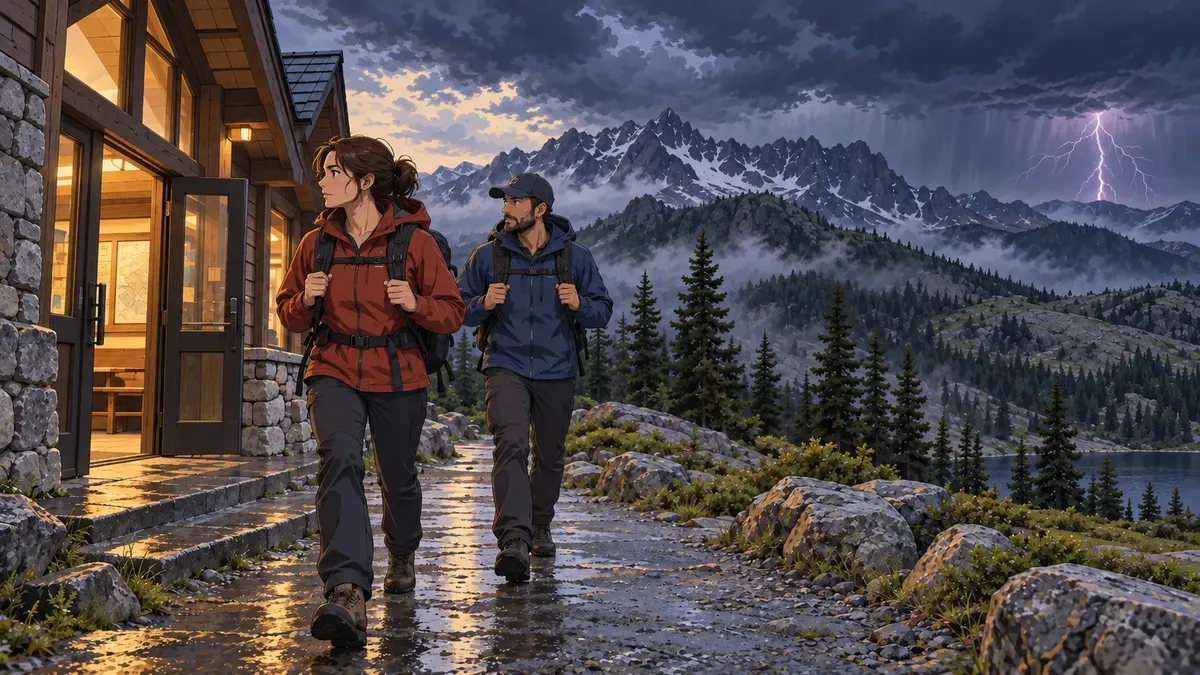
Hiking thunderstorm safety: lightning, shelter, and when to turn back
Learn hiking thunderstorm safety: plan an early exit, recognize real lightning shelter, avoid dangerous myths, and know when to seek emergency help outdoors.
Hiking thunderstorm safety starts with deciding how to avoid being exposed when a storm develops. The important question is not whether you can tolerate rain. It is whether your route leaves enough time to reach genuine lightning shelter before the weather removes that option.
A waterproof jacket, strong legs, and a familiar trail are useful hiking resources. None makes an exposed ridge an acceptable place to wait for lightning. Treat a shortened walk or an abandoned summit as a successful use of the plan.
Quick answer
If you hear thunder while hiking, stop the objective and move toward a substantial enclosed building or an enclosed hard-topped metal vehicle. No outdoor location is safe during a thunderstorm. A tent, isolated tree, shallow cave, rock overhang, or open-sided shelter does not solve the problem. If safe shelter is unreachable, reduce exposure without creating a fall, flood, or navigation emergency; the remaining risk is real. Wait at least 30 minutes after the last thunder before resuming outdoor activity (NWS outdoor guidance, NWS sports guidance).
Key facts
- Thunder signals lightning danger: a dry trail does not establish a safe storm distance.
- Route planning preserves escape options: an early turnaround can prevent commitment to exposed terrain.
- Enclosed buildings and hard-topped vehicles provide protection: rain shelters and tents are not equivalents.
- A lightning casualty needs urgent care: the person does not retain an electrical charge.
- Outdoor risk reduction leaves residual risk: lower terrain is not a lightning-safe destination.
This guide supports hiking decisions, not technical rescue instruction. Use current official forecasts and local emergency guidance for the actual route. A qualified mountain professional is appropriate when terrain or conditions exceed the group’s practiced skills.
Build the hike around shelter access
Before choosing distance or elevation gain, identify the exposed parts of the route and the actual shelter options. A line on a map marked “hut” may represent a locked building, an open refuge, or a structure whose lightning protection you cannot verify. Do not let an unverified symbol become the basis of the day’s safety plan.
Write down three decisions:
- Departure: Which forecast or warning would make you postpone or choose a shorter, lower route?
- Commitment: Where is the final easy turnaround before a long ridge, plateau, summit section, or difficult descent?
- Exit: Where can the slowest member reach genuine shelter, and what could delay that movement?
This is a planning exercise, not a universal cutoff formula. If your only exit depends on everyone moving at their best pace over dry rock, it has little margin when someone becomes tired or the trail gets wet.
For example, imagine two possible walks. One stays close to a verified enclosed trailhead building; the other enters a long ridge with no shelter. With uncertain storm timing, choosing the first preserves options. Reaching the ridge earlier does not turn it into the same type of route.
Use the mountain navigation guide to identify the exit before departure. Navigation should help execute a weather decision, rather than become an improvised task after visibility deteriorates.
Read a mountain forecast as a route decision
Read the forecast for the mountain area and elevation, not just the nearby town. Check thunderstorm timing, wind and gusts, precipitation, temperature, cloud and visibility, and official warnings. The Met Office explanation of mountain forecasts illustrates why mountain-specific information matters to walkers.
Then connect the information to your itinerary. “Storms possible later” is not yet a decision. “We will not enter the ridge if the storm window overlaps our descent” is an action everyone can understand. Recheck the official forecast on the day and before losing connectivity; an old screenshot is a record, not a live update.
Some mountain areas frequently develop summer storms later in the day. An early start can help, but noon is not a universal safety deadline. Storms can arrive earlier, form locally, or continue at other times. Follow the current forecast and observations rather than borrowing a schedule from another mountain range.
Discuss delays explicitly. A missed departure time, slower-than-expected ascent, or lengthy navigation stop should change the objective when it consumes the planned weather margin. Avoid “making up time” by rushing a hazardous descent.
Use a simple decision sequence on the trail
The following table is an editorial planning aid, not a validated prediction model. It helps a group connect changing information to an action without debating the summit repeatedly.
| Situation | Decision to make | Common trap to avoid |
|---|---|---|
| Storms overlap the exposed route in the forecast | Postpone or select a route with realistic shelter access | Assuming fitness will compensate |
| Progress is slower than the plan | Turn back before the commitment point | Treating the original schedule as unchanged |
| Clouds and conditions deteriorate | Reassess immediately and leave exposed terrain early | Waiting for rain as confirmation |
| Thunder is audible | End the objective and seek real shelter | Counting seconds to justify continuing |
| Shelter is not reachable | Reduce exposure along a known, safe route and seek help if necessary | Calling a lower outdoor spot safe |
| The last thunder has passed | Remain sheltered for at least 30 minutes and reassess the whole route | Restarting because sunlight returns |
Assign someone to watch weather, but give every participant permission to call the turnaround. That person should not have to persuade the group that a summit is unimportant. Agree on the rule at the trailhead, where everyone has more attention and less emotional investment.
Cloud observations supplement the forecast; they cannot prove that a route is safe. Wind, terrain, and distance can also limit what you hear or see. The NWS lightning safety guidance for outdoor activities emphasizes leaving when threatening conditions develop rather than finishing the activity first.
Know what counts as lightning shelter
A substantial enclosed building or enclosed hard-topped metal vehicle is the destination. In a vehicle, close the windows and avoid contact with conductive parts. Inside a building, stay away from plumbing, plugged-in electrical equipment, windows, and doors during the storm (CDC lightning safety).
Shelter from rain is a different property. An open pavilion may keep clothing dry while leaving you exposed to lightning. A tent is not upgraded by a thicker groundsheet or a better sleeping mat. A lone tree and a rock overhang are poor alternatives, even when they look comfortable.
For overnight plans, the mountain tent camping guide covers site selection and insulation separately. Choose the itinerary so that pitching a tent is not your storm-response plan.
Do not assume a closed mountain building is available. Confirm access when planning, and retain an alternative. If you reach a locked door, you need a new decision immediately; waiting outside it does not inherit the protection of being indoors.
If you are caught without safe shelter
This is a risk-reduction problem with no safe outdoor solution. Leave peaks, ridges, and open high ground using a known route that the group can negotiate. Avoid isolated tall trees, water, conductive fences or cables, cliff edges, and shallow overhangs. In forested terrain, lower trees are preferable to an isolated tall tree, but the forest is not lightning shelter (CDC outdoor precautions).
Keep group members separated where terrain and communication allow, without losing contact or sending anyone alone into unknown ground. Do not lie flat. Do not stop moving toward reachable shelter because you have adopted a supposedly protective crouch: the NWS myths guidance explicitly rejects crouching as a way to make being outdoors safe.
Avoid trading one hazard for another. A direct downhill shortcut may end at a cliff. A narrow drainage can become a flood route. Wet rock can turn a hurried scramble into a fall. The lower place you choose must be reachable by a sensible route, not merely lower on a map.
Rain protection and spare insulation remain useful for preventing cold exposure during an interrupted hike. Keep them accessible. The winter hiking safety guide explains the broader clothing and emergency-insulation system; storms can create cold, wet conditions outside winter too.
If the group cannot establish a safe way to move, someone is injured, or worsening conditions close the remaining margin, contact the local emergency service and follow its instructions. Give coordinates, group size, injuries, weather, and the known route. Emergency communication supports a response; it cannot remove the lightning hazard while you wait.
Prepare the group without turning the walk into a drill
A short trailhead conversation is more useful than a long argument halfway up. Ask each person to explain the turnaround rule and shelter destination in their own words. Check that the group is using the same place names on the map and understands which structures are only rain cover.
Distribute essential supplies so that one separated pack does not remove every map, insulating layer, light, or communication option. Keep the route and emergency contact information available offline. Learn first aid and CPR before a remote trip, rather than relying on an internet search during an emergency.
The slowest sustainable pace belongs in the itinerary. The uphill hiking guide helps with pacing and preparation, but training should expand your comfort on an appropriate route, not justify staying out in threatening weather.
Use readiness to keep more margin
Before a demanding hike, SuperAge can help you review sleep, recent activity, and recovery trends. Use that context to choose a shorter day, an earlier return, or a route with simpler exits when your usual capacity feels reduced.
Personal readiness does not forecast lightning or certify a trail. No recovery value can overrule thunder, a weather warning, a closed shelter, or a participant who cannot continue safely. Make the weather decision first, then use personal trends to keep the itinerary within your capacity.
Respond to a lightning casualty
Call the local emergency number immediately. A person struck by lightning does not retain electricity and can be touched. Check the scene for continuing danger before approaching. Follow the dispatcher’s guidance; move the person only when needed for immediate safety or essential care, especially if a fall or spinal injury is possible.
If the person is unresponsive and not breathing normally, start CPR according to your training and dispatcher instructions, and use an AED if available. Provide rescue breaths if trained and able; do not delay help while searching for visible burns. Keep monitoring breathing and responsiveness, protect against cold, and arrange emergency assessment even if the person appears to recover (Red Cross lightning first aid).
The Wilderness Medical Society guideline provides an evidence-graded clinical framework for prevention and treatment. It is a 2014 guideline, not a newly published trial, and much lightning-injury evidence comes from observational reports. This article does not turn that clinical document into instructions for untrained rescue procedures.
Frequently asked questions
Can I keep hiking if the storm is far away?
Hearing thunder is enough to end the objective and seek shelter. A distant-looking cloud, dry ground, or a flash-to-thunder count does not establish permission to continue. Do not use a distance estimate to delay an exit that is already long.
Is a tent safe during a thunderstorm?
No. A tent is weather cover, not lightning protection. Plan around access to a substantial enclosed building or enclosed hard-topped metal vehicle rather than around the tent’s waterproof rating.
Should I remove my watch or other small metal items?
Do not delay shelter-seeking to remove small items. Metal conducts electricity, but height and isolation matter to strike exposure. Avoid conductive infrastructure and follow the shelter plan; removing a watch is not a substitute (NWS myths).
Does crouching on a sleeping mat make me safe?
No. Do not treat a crouch, backpack, mat, or rubber-soled boots as lightning protection. Continue toward reachable shelter by a safe route. If none is reachable, you still face residual risk outdoors.
Can I restart as soon as the rain stops?
Remain in shelter for at least 30 minutes after the last thunder. Then reassess daylight, route condition, official information, and whether another storm could develop. The waiting period does not repair a washed-out trail or restore the original schedule.
Is hiking below the tree line safe?
It may reduce some exposure compared with a summit or ridge, but it is still outdoors. Avoid isolated tall trees and do not confuse lower-risk terrain with genuine shelter. The plan should aim to avoid being caught there.
What if someone looks well after a lightning strike?
Call emergency services and arrange assessment. Apparent recovery does not establish that there is no injury. Keep watching responsiveness and breathing, and follow professional instructions rather than restarting the walk.
Key takeaways
- Select the route with storm timing and real shelter access in mind.
- Turn back before delays consume the planned exit margin.
- Treat thunder as an action trigger, not a debate about distance.
- Use outdoor risk reduction only as a fallback with remaining danger.
- Learn first aid before remote hiking and seek urgent help after a strike.
Keep preparation practical
Explore SuperAge to review personal fitness and recovery trends before your next hike. Pair that preparation with a current forecast, practiced navigation, and a conservative route decision.
References
- National Weather Service. Lightning safety outdoors.
- National Weather Service. Lightning safety and outdoor sports activities.
- National Weather Service. Lightning myths and facts.
- Centers for Disease Control and Prevention. Safety guidelines: lightning. Updated June 2026.
- Met Office. Understanding the mountain forecast.
- American Red Cross. Lightning strike injury first aid.
- Davis C, et al. Wilderness Medical Society practice guidelines for the prevention and treatment of lightning injuries: 2014 update. Wilderness Environ Med. 2014;25:S86–S95. DOI: 10.1016/j.wem.2014.08.011.
Related Articles

How to start skateboarding: balance, push, turn, and stop
Learn how to start skateboarding with a safe first-session plan for stance, balance, pushing, turning, and stopping before you try tricks or speed.