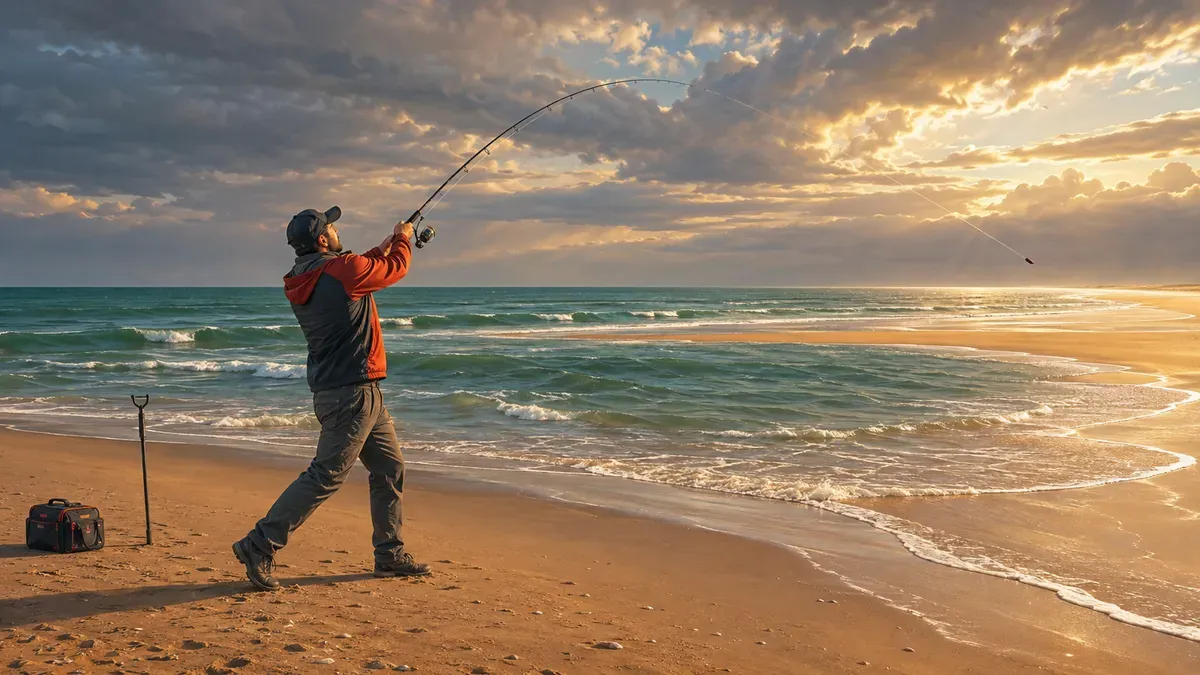
Surfcasting for beginners: technique, gear, and shore safety
Learn surfcasting for beginners: choose simple gear, read the beach, cast safely, plan around tides and weather, and handle your catch responsibly.
Quick answer
Surfcasting is shore-based fishing in which you cast a baited rig or lure into the surf zone and fish from the beach. A beginner does not need maximum distance or the heaviest possible tackle. Start on an open, gently sloping beach in manageable weather, use a rod and reel you can control, match the line, leader, hook, and sinker to local conditions, and practice an overhead cast with a hookless training weight before fishing near anyone.
The safe sequence is forecast -> beach inspection -> clear casting lane -> accurate cast -> stable rod position -> controlled retrieve -> responsible landing. Check the local marine forecast, tide and current information, surf warnings, lightning risk, fishing license, seasons, size and bag limits, protected species, bait rules, and access restrictions. If waves are washing over your position, thunder is audible, the beach is crowded, or you would need to wade beyond stable footing, choose another place or another day.
Key facts
- Rod loading stores energy during a smooth cast and transfers it to the rig as the rod straightens.
- Beach structure redirects waves and currents around bars, troughs, points, cuts, rocks, and jetties.
- Tide and wind change water depth, access, wave shape, line control, and the safe space behind an angler.
- A clear casting lane prevents hooks and sinkers from crossing people, animals, lines, or overhead hazards.
- Prepared release tools reduce handling time, air exposure, and damage to fish intended for release.
Surfcasting rewards observation more than brute force. Distance can help on a particular beach, but fish may travel in a nearshore trough or along a current seam that is much closer than a beginner expects. Accuracy, repeatability, a rig that holds without being excessively heavy, and the discipline to stop when conditions deteriorate are more useful than one spectacular cast.
What surfcasting is
Surfcasting—often called surf fishing—is fishing from a beach or comparable open shoreline where breaking waves influence the water. The angler may present natural bait on a bottom rig, retrieve an artificial lure, or use another locally legal method. The defining problem is not simply casting far. It is placing and controlling a presentation in moving water while managing sand, salt, wind, waves, other beach users, and changing access.
The saltwater fishing bait guide covers the separate choice between natural bait and artificial lures by target, depth, current, hook fit, and presentation.
That makes surfcasting different from several nearby activities:
| Activity | Primary setting | Main beginner problem |
|---|---|---|
| Surfcasting | Open beach and breaking surf | Safe casting, rig control, changing water, and shore hazards |
| Pier fishing | Fixed elevated structure | Shared space, vertical landing, rail and drop hazards |
| Rock fishing | Exposed rocks or platforms | Wave run-up, slippery footing, limited escape routes |
| Wade fishing | Angler enters the water | Depth, current, bottom changes, and loss of footing |
| Boat trolling | Mobile vessel | Vessel safety, navigation, weather, and onboard organization |
| Deep-drop fishing | Boat-based near-vertical rig in deep water | Line angle, bottom contact, heavy terminal gear, and release at depth |
This guide stays with an ordinary beach start. Rock ledges, jetties, deep wading, powerful storm surf, night sessions, sharks, and large species introduce consequences that deserve local instruction, specialized systems, and much more conservative decisions.
Make the first decision on land
The best beginner session is not the one with the most dramatic forecast. It is the one that leaves enough margin to learn. Choose a legal access point with a wide casting lane, a predictable route back, firm enough sand to stand and walk safely, phone coverage or another realistic communication plan, and no need to cross water as the tide rises.
Before leaving home, check:
- the official local marine and beach forecast, including wind, swell, thunderstorms, extreme heat, cold, and surf warnings;
- predicted tides and, where available, current information for the exact area;
- license or registration requirements, open seasons, size and bag limits, allowed hooks and bait, protected areas, and species-identification rules;
- beach hours, parking, gates, nesting closures, dog rules, and any restriction on fishing or lead tackle;
- who knows where you are, when you expect to return, and what should happen if you do not check in.
NOAA Tides and Currents provides official U.S. tide predictions and coastal-condition products; other countries operate their own hydrographic and meteorological services. Use the authority for the beach you will actually visit. A tide table is not a complete safety forecast: wind, swell, storm surge, local bathymetry, and recent beach changes can make the observed water very different from a memorized pattern.
Local rules are not optional details. Saltwater fisheries are managed through area- and species-specific permits, seasons, catch limits, gear rules, and protected-species requirements. The NOAA recreational fishing portal illustrates how federal and state responsibilities can overlap in the United States. Verify the equivalent current rules where you fish rather than copying a setup from a video recorded somewhere else.
Read the beach without pretending to predict it
Surfcasters often look for changes rather than a single perfect feature. On a calm, safe observation day, watch several sets of waves before unpacking:
- Sandbars are shallower zones where waves may steepen or break.
- Troughs are deeper lanes between the beach and a bar, or between bars.
- Cuts and gaps interrupt a bar and may concentrate water moving seaward.
- Points and pockets alter wave angle and create edges between faster and slower water.
- Foam, discolored water, birds, or bait activity may reveal movement, depth changes, or food, but none guarantees fish.
These features migrate. A productive trough yesterday can fill, a cut can move, and a rising tide can erase the dry route behind you. Tides are the rise and fall of water level; currents are horizontal water movement influenced by tides, wind, coastline shape, and other factors. NOAA’s tides and currents overview explains why the two are related but not interchangeable.
There is no universal rule that surfcasting is always best at high tide, low tide, dawn, or a particular moon phase. Species, bottom shape, water clarity, season, temperature, prey, pressure, and local regulations all change the answer. For a beginner, first use tide information to protect access and understand depth. Treat catch timing as a local experiment: record conditions, make one change at a time, and compare several sessions instead of turning one catch into a law.
Never stand in a channel, on a bar, or beside a structure simply because it looks fishy. Rip currents commonly form near gaps, piers, jetties, rocks, and changing sandbars. The National Weather Service rip-current guidance emphasizes checking the local forecast and staying out of hazardous surf; shallow water can still remove stable footing. If you are caught, do not fight straight against the flow—signal for help, float if needed, and move parallel to shore or toward breaking waves when able.
Build a simple, matched tackle system
The beginner’s equipment should solve one local problem at a time. Ask an experienced local angler, fisheries educator, or reputable tackle shop what size of fish, bottom, casting space, legal tackle, and surf conditions are normal. Then choose a system whose components work together.
| Component | Beginner purpose | What to avoid |
|---|---|---|
| Surf rod | Cast the intended rig and keep line above small breakers | A rod too powerful or long to control |
| Reel | Hold adequate line and provide a smooth adjustable drag | An overfilled spool or corroded mechanism |
| Main line | Carry the cast and retrieve through the surf | Strength or diameter chosen without the rod and rig |
| Shock leader | Tolerate the acceleration of a heavier sinker when locally appropriate | Knots or materials not matched to the load |
| Terminal rig | Present the bait or lure and separate hook from sinker as designed | Excess hooks, loose clips, weak knots, or illegal tackle |
| Sinker | Hold or move in the bottom current as intended | More weight than the rod rating or conditions require |
| Rod rest | Keep the rod stable and away from sand and waves | Placement inside a walking or vehicle lane |
| Landing and release tools | Control hooks and shorten handling | Searching for pliers after the fish is already ashore |
Many general-purpose beach setups use rods around 9–12 ft (2.7–3.7 m), but that range is not a prescription. A shorter, lighter combination can be easier in calm water and for smaller targets; a longer rod may help line clearance and casting but increases leverage on the shoulders and makes crowded-space errors more consequential. Stay within the rod’s marked lure or casting-weight range and follow the manufacturer’s assembly and line guidance.
For the first sessions, simplicity wins. One hook, one presentation, and a rig you can inspect quickly make tangles, damaged leaders, and bite detection easier to understand. Circle hooks, barbless hooks, or crimped barbs may be required or useful for release in some fisheries; rules and species response differ. Carry a dehooker or long-nose pliers, line cutters capable of cutting every material in the rig, a tape or measuring board, wet-safe gloves for appropriate non-gill handling, and the current identification and regulation resource.
Sand and salt shorten equipment life. Keep the reel out of loose sand, avoid blasting it with high-pressure water, follow the maker’s care instructions, inspect guides for cracks, and replace abraded line or leaders. Store hooks secured, dry tools before packing, and dispose of clipped line where wildlife cannot reach it.
Learn a controlled overhead cast
Casting is a timed acceleration, not a test of maximal shoulder strength. The rod bends under the moving load, then straightens and transfers energy to the rig. A sudden hit, an overpowered rod, an incorrect weight, loose line, or a poorly timed release makes direction less predictable and increases breakage risk.
Practice first in a large open area with a hookless casting plug or training weight. The Texas Parks and Wildlife casting guide recommends prioritizing safe, accurate casting and checking behind, overhead, and around the angler. Distance is secondary.
For a basic two-handed overhead cast:
- Inspect the system. Check the rod sections, guides, line path, knot, clip, leader, and training weight. Confirm that the load is within the rod rating.
- Create a sterile lane. Look behind, overhead, to both sides, and toward the target. Say that you are casting. Do not begin until people and animals are clear.
- Set a manageable drop. Let the practice weight hang far enough below the tip to load the rod smoothly without swinging into the ground or a person. Follow local coaching for the exact tackle.
- Use a stable stance. Put the feet comfortably apart with one foot slightly forward. Keep knees soft and the trunk controlled rather than twisting violently.
- Move smoothly. Bring the rod back under control, pause only as needed to organize the load, and accelerate forward toward the target.
- Stop and release. A firm stop allows the rod to straighten. Release timing sets the trajectory; forcing harder does not correct poor timing.
- Finish balanced. Let the rod point along the line without stepping into the surf. Watch the rig land and close or engage the reel as appropriate.
Use protective casting aids where appropriate for the line and tackle. Never wrap line around a bare finger to manage a heavy cast. A cut-resistant finger guard does not authorize an overweight rig or a crowded lane. If casts repeatedly pull left or right, shorten the effort and work on the same target with a training plug. Consistency before distance protects both technique and people.
More advanced ground casts, pendulum casts, power casts, and very heavy rigs create larger danger zones and loads. Learn them from a qualified local instructor in controlled space, not from a text description on an occupied beach.
Place the rig, manage the line, and recognize a bite
Choose a visible feature—an edge of breaking water, a trough, or a calm pocket—and make an accurate cast that you can repeat. Fish can be near, so test more than one practical distance instead of throwing every cast as far as possible.
After the rig lands:
- engage the reel and retrieve slack without dragging the rig far from the intended position;
- set the rod securely above normal wash, with the tip high enough to manage small waves but not where wind alone dominates it;
- adjust drag so a strong pull can take line without uncontrolled spool movement or immediate breakage;
- keep the rod within reach and continue watching the sea, other people, and changing access—not only the tip;
- inspect bait, hook point, knots, leader abrasion, and accumulated weed at sensible intervals.
Wave rhythm may bow the line and move the tip repeatedly. A bite can look different depending on the rig and species: a sharper pull, sustained weight, slack line, or movement that breaks the wave pattern. Do not respond to every twitch with a violent strike. With circle hooks, an aggressive jerk can work against the hook’s intended function; follow the hook guidance and use steady pressure when appropriate.
If the sinker continually rolls, weed loads the line, or waves bury the setup, do not automatically add more weight. A different sinker style, cast angle, presentation, or beach may solve the problem with less load. Stop when conditions exceed the equipment or your control.
Land and handle fish responsibly
Decide before the cast what you will keep, what must be released, how you will identify and measure the catch, and where the required tools are. If you cannot identify a fish or confirm legality, keep it in the water when possible and seek current local guidance.
For fish intended for release, the latest NOAA catch-and-release practices recommend tackle strong enough to avoid unnecessary exhaustion, wet hands or a wet soft net, minimal handling and air exposure, avoiding eyes and gills, supporting the body horizontally, and preparing dehooking tools in advance. New York’s saltwater best practices add a surf-specific point: do not drag fish across dry sand.
Use a smooth retrieve and the wash only when it can help move a fish without slamming it onto the beach. Keep fingers away from teeth, spines, gill covers, and the line under tension. If a hook is deeply swallowed, near an eye, or unsafe to remove, cutting the leader close may cause less damage than prolonged digging, subject to local species guidance. Release the fish head-first into clean moving water only when you can do so without wading into unsafe surf.
If keeping a legal fish, dispatch, bleed, cool, clean, and transport it according to species-specific food-safety guidance and local law. A warm bucket in the sun is not a preservation system. Never keep a catch merely because release tools were forgotten.
Pack out line, bait containers, hooks, sinkers, and every other item. Abandoned monofilament and terminal tackle can entangle birds, marine mammals, fish, pets, and people long after the session ends.
Prepare your body for sand, casting, and carrying
Surfcasting can include walking on soft sand, carrying awkward equipment, standing for long periods, repeated casting, and controlling a loaded rod. The workload varies enormously. A relaxed session beside easy access may be light activity; a long approach with deep sand and repeated powerful casts can be demanding. Do not count fishing time as a guaranteed substitute for aerobic and strength training.
Two observational studies reported associations between recreational angling and better perceived well-being or lower stress, but they cannot prove that fishing caused the difference. One marine recreational fishing survey used a convenience sample, while a UK angling survey was cross-sectional and included a declared industry conflict for one author. Blue space, routine, social contact, and activity may all contribute; selection and self-report can also shape the results.
For more reliable physical capacity, keep ordinary weekly movement and strength work. The WHO physical activity guidance recommends 150–300 minutes of moderate aerobic activity per week for adults, or the vigorous equivalent, plus muscle-strengthening work. Surfcasting can add movement, but it should not be treated as automatically meeting those targets.
A simple preparation plan can include:
- brisk walking, gradually adding short sections on sand;
- split squats or step-ups for uneven-ground control;
- calf raises and balance practice for stable stance and beach walking;
- rows and presses for general upper-body strength;
- controlled trunk work and the progressions in our lower-back strength guide;
- light, pain-free external rotation and scapular work from the shoulder exercise guide.
Before casting, walk for a few minutes, move the shoulders through comfortable ranges, rehearse slow casts without a hook, and build effort over several attempts. Stop if pain changes your mechanics, grip fades, or accuracy deteriorates. Persistent shoulder, elbow, wrist, hand, neck, or back symptoms deserve assessment rather than a heavier rod or harder cast.
Use SuperAge as a training log, not a fishing forecast
Surfcasting blends a sport skill with an outdoor environment that no health app can certify as safe. SuperAge can help you review the broader pattern—walking, exercise, heart-rate trends, sleep, and recovery—when those data are available through Apple Health. That can help you notice whether repeated casting sessions sit inside a balanced week or arrive on top of poor sleep and accumulated training load.
The app cannot identify species, validate a license, read a rip current, approve a beach, set drag, diagnose pain, or replace local weather and marine authorities. Use it for the long-term health record after the technique and safety decisions have been made in the real world. The training-load guide can help separate productive consistency from effort added only because one session felt easy. You can explore related evidence-led training and recovery guides in the SuperAge health library.
Beach hazards that override the fishing plan
Waves, run-up, and rip currents
Stay above the observed reach of wave run-up and keep a retreat path. NOAA’s beach-hazard overview notes that shorebreak can injure the extremities and cervical spine, while rip currents account for most surf-beach lifeguard rescues. Do not turn your back on the sea while baiting, photographing a catch, or untangling line. Pool competence is useful but does not reproduce surf entry, visibility, temperature, or current; the pool-to-open-water guide explains that boundary.
Avoid climbing onto wet rocks, jetties, groins, or steep banks for a better angle. If a fish or rig is lost, let it go rather than entering rough water. A personal flotation device appropriate to the setting may add a survival layer where local experts recommend it, but it does not make unsafe wading or exposed rocks acceptable. If you are also planning coastal paddling, our sea-kayak touring guide explains why weather, communication, escape options, and route decisions must be treated as one system.
Lightning and changing weather
The National Weather Service beach-safety page identifies fishing as a leading activity among lightning fatalities. Long rods, open sand, water, isolated rocks, and distance from shelter create a poor combination. If thunder is audible or storms approach, stop early and reach a substantial enclosed building or hard-topped vehicle. A beach shelter, umbrella, isolated tree, or open pavilion is not adequate lightning protection.
Wind changes casting direction and can push a hook outside the expected lane. Fog and darkness hide people, obstacles, incoming water, and the route out. Beginners should learn in daylight and conservative conditions.
Sun, heat, cold, and hydration
Use clothing, a brimmed hat, broad-spectrum sunscreen, eye protection, drinking water, food, and thermal layers suited to the forecast. Water and sand reflect ultraviolet radiation. Heat illness can begin with heavy sweating, headache, nausea, dizziness, weakness, or confusion; cold wind and wet clothing can also reduce hand function and judgment. The heat-symptom safety guide explains why overheating and anxiety can overlap without making confusion or collapse safe to self-diagnose. Leave before symptoms impair balance or casting.
Hooks, line, and first aid
Wear eye protection when casting, tying under tension, or freeing a snag. Cut the line before a dangerous pull transfers force to a hook. Never put a hand near a taut leader or between a moving sinker and the rod. Keep hooks covered during transport and use a rigid container for used or damaged hooks.
A hook embedded near the eye, face, joint, tendon, bone, major vessel, or deeply under the skin needs professional medical care. Do not push it through blindly or rely on a generic online removal trick. Control bleeding with direct pressure when appropriate, protect the hook from moving, and seek urgent help for severe bleeding, eye injury, loss of sensation or movement, or signs of a serious allergic reaction. The CDC wound-management guidance treats puncture wounds as higher-risk wounds and bases tetanus vaccination or immune-globulin decisions on wound type and vaccination history. A clinician should make that assessment.
A conservative first-session plan
Keep the first outing short enough that attention, daylight, and the tide margin remain generous.
Before the beach
- Verify forecast, tide, regulations, access, and the return plan.
- Assemble and inspect the rod, reel, line, simple rig, tools, measuring device, first-aid kit, water, sun protection, and secure waste container.
- Practice 15–20 hookless casts toward a target in an open area.
- Tell a contact the exact beach and return time.
On arrival
- Watch several wave sets before entering the casting area.
- Identify the highest recent wash, retreat route, other users, animals, vehicles, overhead wires, rocks, structures, and current signs.
- Choose one legal presentation and one visible target.
- Put release tools where they can be reached with one hand.
During 60–90 minutes of fishing
- Begin with controlled casts at an easy distance.
- Try the near trough before assuming distance is necessary.
- Check knots, abrasion, bait, hooks, weed, and drag regularly.
- Record time, tide stage, wind, wave character, water appearance, presentation, distance band, and any catch.
- Stop immediately if thunder, wave run-up, crowding, fatigue, or access changes erase the margin.
After the session
- Account for every hook, sinker, lure, bait container, and length of line.
- Rinse and maintain equipment according to manufacturer guidance.
- Note one setup change and one technique cue for next time.
- Check hands and feet for cuts, punctures, blisters, or retained foreign material.
This structure turns the first session into deliberate practice. Catching nothing can still teach beach reading, safe setup, repeatable casting, line management, and the wisdom to leave on time.
Common beginner mistakes
- Chasing distance immediately. The cast becomes unpredictable before the angler can repeat a target.
- Adding sinker weight to every problem. Excess load can exceed the rod, leader, technique, or safe lane.
- Watching only the rod tip. Waves, people, dogs, vehicles, and the retreat route continue to change.
- Using one universal tide rule. A local observation becomes a false promise on a different beach.
- Wading to rescue a rig. Replaceable tackle is treated as more valuable than stable footing.
- Unhooking without tools ready. Fish handling becomes longer and more hazardous.
- Ignoring local law and identification. A generic technique guide is mistaken for current legal advice.
- Calling every beach session exercise. Standing beside a rod is assumed to replace planned aerobic and strength work.
Key takeaways
- Start with an open legal beach, manageable conditions, and a clear route away from the water.
- Match every component to the rod rating, target, bottom, current, regulations, and your ability to control it.
- Practice a hookless overhead cast for accuracy and repeatability before adding distance.
- Use tides first to understand access and water level; do not treat one tide stage as a universal catch guarantee.
- Prepare landing, measuring, dehooking, release, and waste tools before the first cast.
- Stop for thunder, unstable footing, rising run-up, crowding, fatigue, pain, or uncertainty about the catch.
- Treat surfcasting as an outdoor skill that can add movement and well-being, not as a guaranteed workout or therapy.
FAQ
What is the difference between surfcasting and surf fishing?
The terms are often used interchangeably. “Surfcasting” sometimes emphasizes longer rods and casting a rig from shore, while “surf fishing” can include bait or lure fishing at many distances. The practical beginner requirements—legal access, safe casting space, suitable tackle, beach awareness, and responsible handling—are the same.
How far does a beginner need to cast when surfcasting?
There is no universal distance. Fish may use a trough close to shore, a bar edge, a cut, or deeper water farther out. Begin at a distance you can hit accurately and repeat safely. Test a few distance bands rather than turning every cast into a maximum effort.
What length surf rod should a beginner use?
Many surf rods are about 9–12 ft (2.7–3.7 m), but the correct length depends on the beach, rig weight, target, transport, casting space, and the angler’s size and control. A local instructor or tackle professional can help match rod, reel, line, leader, and sinker as one system.
Is high tide or low tide better for surfcasting?
Neither is always better. Tide stage changes depth, beach access, current, and where waves break, but local bottom shape, target species, season, wind, swell, and regulations determine how useful that stage is. Use official predictions and keep a session log to learn the beach without sacrificing a safe exit.
Do I need to wade when surfcasting?
No. Beginners can fish from dry sand, and entering the surf adds current, depth, wave, bottom, and entanglement hazards. Never wade merely to gain casting distance or retrieve tackle. Seek local instruction before considering any water entry.
How heavy should a surfcasting sinker be?
Use the lightest legal sinker and appropriate design that presents the rig as intended in the actual conditions, while remaining within the rod’s casting rating and the leader’s capacity. If the rig will not hold, changing location, angle, timing, or sinker style may be safer than simply adding weight.
Is surfcasting good exercise?
It can include walking on sand, carrying equipment, standing, and repeated casting, but intensity varies too much to assume a health dose. Keep dedicated aerobic, strength, and balance work, and treat active fishing as additional movement. Observational well-being studies show association, not proof of a therapeutic effect.
What should I do if a fishhook enters my skin?
Stop the line and stabilize the hook so it cannot move. Seek professional care for deep or difficult hooks and any hook near the eye, face, joint, tendon, bone, or major vessel. Get urgent help for serious bleeding, impaired movement or sensation, eye injury, or a severe allergic reaction. A clinician should assess wound cleaning, retained material, infection risk, and tetanus protection.
References
- National Oceanic and Atmospheric Administration. Tides and Currents. Accessed September 6, 2026.
- NOAA Center for Operational Oceanographic Products and Services. NOAA Tides and Currents. Accessed September 6, 2026.
- National Weather Service. Rip current safety. Accessed September 6, 2026.
- National Weather Service. Beach hazards and safety. Accessed September 6, 2026.
- NOAA Ocean Service. Dangers at the beach. Accessed September 6, 2026.
- NOAA Fisheries. Catch and release fishing best practices. Updated August 4, 2026.
- New York State Department of Environmental Conservation. Best practices for saltwater fishing. Accessed September 6, 2026.
- Texas Parks and Wildlife Department. Teaching casting safety and accuracy. Accessed September 6, 2026.
- Pita P, Gribble MO, Antelo M, et al. Recreational fishing, health and well-being: findings from a cross-sectional survey. Ecosystems and People. 2022;18(1):530–546. doi:10.1080/26395916.2022.2112291.
- Wilson JJ, Trott M, Tully MA, et al. Mental health and recreational angling in UK adult males: a cross-sectional study. Epidemiologia. 2023;4(3):298–308. doi:10.3390/epidemiologia4030030.
- World Health Organization. WHO guidelines on physical activity and sedentary behaviour: at a glance. 2021.
- Centers for Disease Control and Prevention. Clinical guidance for wound management to prevent tetanus. Updated June 10, 2025.
Related Articles

Hiking thunderstorm safety: lightning, shelter, and when to turn back
Learn hiking thunderstorm safety: plan an early exit, recognize real lightning shelter, avoid dangerous myths, and know when to seek emergency help outdoors.