Deep-drop fishing for beginners: rigs, depth control, and safety
Learn deep-drop fishing for beginners: choose a safe rig, control line angle, detect bottom and bites, retrieve steadily, and release fish responsibly.
Quick answer
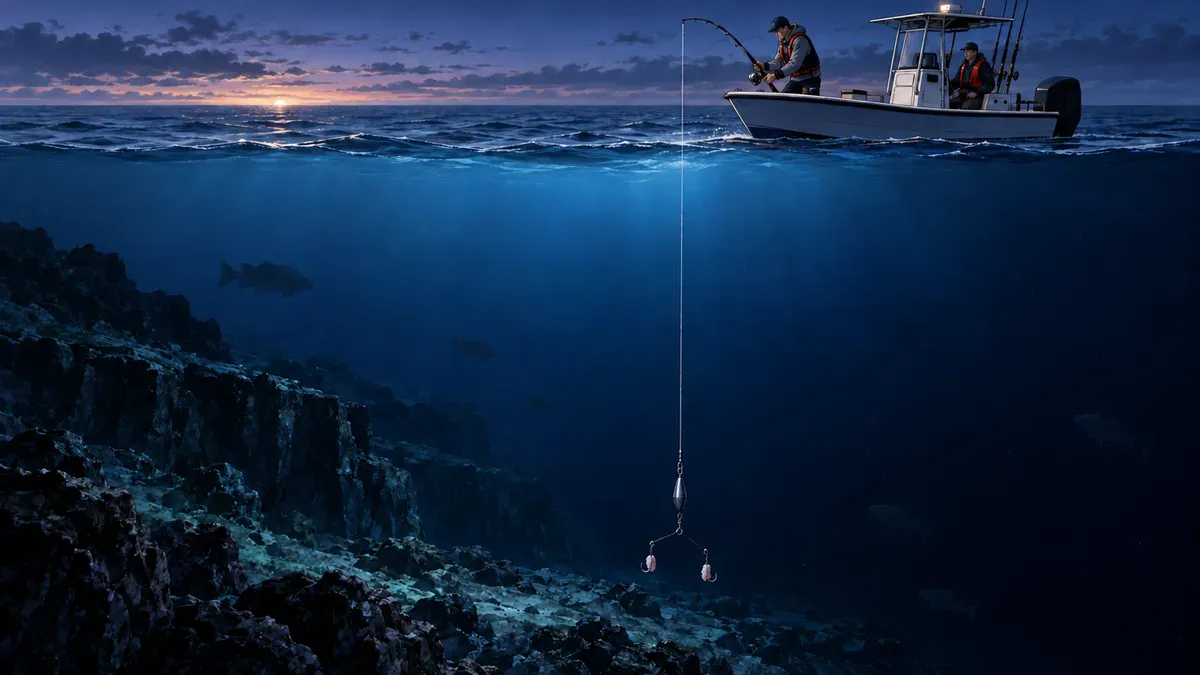
Deep-drop fishing is vertical or near-vertical bottom fishing in deep water. A weighted rig carries one or more locally legal hooks toward the seabed while the crew uses boat position, line angle, sinker mass, and short controlled movements to keep the presentation near the target depth. It is not simply “drop until something bites.” Depth magnifies every mistake: excess line creates poor bite detection, a snag loads the whole system, a heavy sinker becomes a swinging hazard, and a released fish may be unable to return below the surface without rapid recompression.
For a first session, go with an experienced skipper, use the smallest simple rig that can hold depth, start with one active line, and prepare landing and release tools before the first drop. The working sequence is rules -> target -> chart and forecast -> drift test -> rig check -> controlled descent -> bottom contact -> measured lift -> bite -> steady retrieval -> keep or release. Stop when boat control, identification, safe handling, or legal release can no longer be completed promptly.
Key facts
- Current pushes line sideways and separates the rig from the point directly below the boat.
- Sinker mass counters drift only when rod, reel, line, knots, and crew can safely manage the added load.
- A brief bottom contact confirms depth; repeatedly dragging the seabed increases snags and habitat contact.
- A smooth retrieval limits sudden shock loads and gives the crew time to organize a safe landing.
- Rapid release at depth recompresses many buoyant deep-caught fish affected by barotrauma.
The beginner goal is not maximum depth or the largest possible catch. It is a repeatable drop in which the crew can explain where the rig is, why its components are compatible, what will happen if it snags, and how every fish will be identified, retained, or released.
What deep-drop fishing is
“Deep drop” is a practical label, not one universal depth or rig. The water may be deep enough that ordinary bottom-fishing tackle, visual line cues, and casual boat positioning become unreliable. Depending on the fishery, the target may live on a slope, ledge, reef edge, soft bottom, or other deep structure. Rules, species, pressure effects, current, line capacity, and distance from shelter all change with location.
The presentation is normally vertical or close to vertical. A sinker takes baited or artificial presentations down; the angler then maintains controlled proximity to the target depth. That makes it distinct from trolling fishing, where a moving boat pulls a lure through the water column. It also differs from active vertical jigging: a deep-drop rig may be worked gently or held comparatively still rather than accelerated through repeated large strokes.
Choose the presentation before adding depth and retrieval complexity: the saltwater fishing bait guide compares natural bait and artificial lures by target, feeding zone, rigging, and release consequences.
| Method | What moves the presentation | Main control problem |
|---|---|---|
| Deep drop | Weight descends while boat and water move | Line angle, bottom proximity, drift, long retrieval |
| Trolling | Boat pulls bait or lure | Route, speed, lure action, running depth |
| Drifting bottom rig | Wind and current carry boat and rig | Drift lane and bottom contact |
| Vertical jigging | Angler repeatedly moves a weighted lure | Cadence, fatigue, depth, line control |
| Surfcasting | Cast and waves move a shore-based rig | Casting lane, surf, bottom hold, shore hazards |
Our surfcasting guide addresses the shore-based problem. Deep water adds a different chain of consequences: a long length of loaded line, a less visible terminal rig, longer time between decisions, pressure injury in some fish, and greater dependence on a capable vessel and crew.
Begin with the legal target and a release plan
Choose the target fishery before assembling tackle. A generic “bottom fish” plan cannot answer the questions that matter: whether the area is open, which species are protected, what hooks and bait are legal, whether a descending device must be ready, how many hooks or lines are permitted, which fish may be kept, and which similar-looking fish must be released.
Verify current rules from the responsible authority for the exact water and date. Check:
- license, vessel, operator, reporting, and protected-area requirements;
- open seasons, depth restrictions, size and possession limits, and species closures;
- permitted hooks, bait, sinkers, line count, and release equipment;
- reliable identification for likely target and non-target species;
- any consumption advice for the species and water;
- the procedure for reporting tagged, protected, entangled, or injured wildlife.
Some fisheries require non-offset circle hooks with natural bait; others regulate weights, hook count, or where bottom contact is allowed. The Maryland Department of Natural Resources terminology guide illustrates a high-low bottom rig with hooks above the weight, while its circle-hook guidance shows how a rule can be tied to target, bait, and jurisdiction. These are examples of concepts, not worldwide permission. Copy neither a local regulation nor a rig diagram into another fishery without checking.
Decide the likely keep-or-release outcome before the drop. Put the measuring tool, species guide, cutters, dehooker, wet-safe support, and descending device where the crew can use them immediately. A release method buried beneath a cooler is not ready.
Plan depth, current, and drift as one system
The charted bottom depth is only the start. The rig’s working position depends on water movement, vessel drift, line diameter and stretch, sinker shape and mass, terminal drag, and how much line is paid out. Even with an electronic depth display, the hook is not necessarily beneath the transducer.
Imagine a right triangle. Depth is the vertical side; horizontal separation between boat and rig is the other side; deployed line is the diagonal. As current increases, the line bows and the diagonal grows. A reel may show 600 ft (183 m) of line out over 400 ft (122 m) of water without proving that the rig is on the bottom or at the desired point. Line counters, color changes, or marked line are useful observations, but stretch, bow, spool fill, and calibration create uncertainty.
Use a conservative process:
- Read the official forecast, chart, tides, and current information. In the United States, NOAA Tides and Currents and NOAA nautical charts are planning inputs; use the competent authorities for your water.
- Choose a wide test area. Stay clear of traffic, cables, wreck restrictions, protected habitat, steep danger contours, and other gear.
- Observe the boat before dropping. Note wind, surface current, waves, heading, drift speed, and how quickly the vessel crosses the intended depth band.
- Make one controlled test drop. Use one rig and stop if the line streams far astern, the boat cannot maintain the lane, or bottom cannot be distinguished safely.
- Change one variable. Reposition the boat, adjust drift strategy, use a lower-drag rig, or select a compatible sinker—not all at once.
More weight is not an unlimited solution. It increases stored energy, rod load, hand injury risk, retrieval demand, and the consequence of a snag. If the required mass exceeds the ratings or the crew’s controlled handling capacity, change conditions, location, or day.
Build a compatible tackle system
Every component must tolerate the working load and the plausible shock load. The weakest part should not be an accidental knot, corroded clip, cracked guide, damaged line, or improvised attachment. Follow documented ratings and instruction from a qualified local skipper or tackle professional who understands the target fishery.
| Component | Purpose | Pre-drop check |
|---|---|---|
| Rod | Supports sinker, detects load changes, controls retrieval | Rated for the intended load; guides and holder intact |
| Reel | Stores sufficient line and provides controlled drag | Capacity, drag, mounting, handle, power source if applicable |
| Main line | Connects the full system with manageable diameter | No abrasion, unexplained damage, buried loops, or weak splice |
| Leader or branch rig | Separates hooks and resists local abrasion | Legal layout, sound knots, branches clear of main line |
| Hooks | Present bait and retain a legal catch | Legal type and count; points protected until deployment |
| Sinker | Reaches and helps hold target depth | Secure attachment; shape and mass manageable by crew |
| Breakaway strategy | Defines what should yield in a severe snag | Deliberate, documented, and compatible with local rules |
| Landing/release tools | Shorten the highest-risk handling phase | Reachable, functional, and assigned to a crew member |
Thin low-stretch line can reduce water drag and make subtle load changes easier to feel, but it can cut skin, bury into a spool, fail at damaged points, and transmit abrupt shocks. Never wrap any fishing line around a hand, wrist, glove, rail, cleat, or tool. Heavy gloves do not make a tensioned line safe to grab.
A simple beginner terminal layout often keeps the weight below one or two legal hook branches. That arrangement can help the sinker reach bottom first and may reduce hook contact with some seabed features, but it is not universally appropriate. Fewer hooks simplify baiting, tangles, species identification, landing, and release. Start with one presentation if local instruction permits it.
Manual and powered retrieval
A manual reel keeps the system mechanically simple but can turn a deep retrieve into a long bout of repeated gripping and cranking. A powered reel can reduce that repetitive work, yet it adds battery demand, cables, connectors, control settings, line-speed hazards, and the possibility of applying force faster than the crew can interpret it. It does not make an overrated rig safe or remove the need to monitor the rod, drag, line path, catch, and boat.
Before using powered retrieval, learn the stop control, safe speed range, drag interaction, manual override, power isolation, and what happens during a snag or electrical failure. Route cables away from feet, wet working areas, hot surfaces, steering, and emergency access. Stop power before touching the line or terminal rig.
Rig and lower without creating a pendulum
A deep-drop sinker and loaded hooks can swing across a deck with enough energy to puncture skin, damage the boat, or pull someone off balance. Rig with the weight supported low and the hooks secured. Do not lift the assembled system above shoulder level or let it hang freely while the boat rolls.
Before the first descent:
- confirm that the boat is in a safe position and the skipper is ready;
- brief who controls the reel, terminal rig, boat, net, and release device;
- move bystanders away from the deployment side;
- put the reel in the correct controlled-release mode;
- ensure the line path is outside rails, propellers, ladders, antennas, and other rods;
- verify that bait, hooks, clips, and sinker are attached correctly;
- name the stop command that any crew member may use.
Lower the terminal rig into the water under control. Do not throw a heavy assembly; slack line can wrap hardware or a person before the load comes tight. Let the line leave at a rate that preserves slight control without braking so hard that the rig pendulums or the bait spins. Watch the spool for loose coils, buried line, or an unexpected stop.
Pause immediately if the vessel changes course, another boat approaches, the line crosses a propeller lane, a person loses balance, or gear behaves differently from the briefing. A clean reset is faster than clearing a loaded tangle offshore.
Find bottom, then stop dragging it
Bottom contact often appears as a brief reduction or change in rod and line load. In calm conditions with a near-vertical line it may feel distinct; in waves, strong current, soft substrate, or a long bowed line it can be ambiguous. Do not respond by continuously paying out line. That creates a long belly, weakens bite detection, and increases snag risk.
Use this cycle:
- descend under control while watching line behavior and estimated depth;
- detect the first credible bottom contact;
- stop payout and recover slack;
- lift the terminal rig a small, deliberate distance above the bottom;
- hold or work the presentation as locally taught;
- recheck after the boat moves across changing depth;
- retrieve and reset before line angle or bottom uncertainty becomes excessive.
The safest clearance is fishery-specific. A rig for flat soft substrate behaves differently from one near rock, coral, wreckage, cables, or sharp ledges. Avoid dragging a sinker to “map” an unknown bottom. Charts, competent electronics use, local instruction, and conservative positioning should do the finding; the tackle is not a survey tool.
When a snag occurs, keep everyone away from the loaded line and rod arc. Do not point the rod directly at another person, lock the drag reflexively, or reverse the boat without the skipper understanding the line direction. Reduce load in a controlled way, change boat position only when navigation remains safe, and use the planned breakaway or line-cutting method if recovery would endanger people or habitat.
Detect a bite through load changes
At depth, line stretch, current, waves, vessel heave, weight movement, and contact with structure can all imitate a bite. Learn the baseline first: observe the rod tip and reel load for several cycles before changing the presentation. A bite is a deviation from that repeatable pattern, not every twitch.
With a circle hook and bait, local guidance may call for steady loading rather than a dramatic upward strike. Other legal hooks or artificial presentations may require a different response. Use the method appropriate to the hook, species, and rig instead of applying one universal hook-set.
When the load changes:
- keep the boat controlled and call the event clearly;
- take up slack without a violent sweep;
- establish a smooth, appropriate drag load;
- retrieve at a steady rate while watching for crossed lines or a changing boat lane;
- prepare identification, landing, and release tools before the rig reaches the surface;
- slow the final approach so the terminal weight and hooks do not launch over the gunwale.
Do not accelerate a powered reel merely because the catch seems small. A second fish, snag, branch tangle, or changing line angle can suddenly increase load. As the sinker approaches the boat, reduce speed and have one person control the terminal assembly low over the water.
Treat barotrauma as a predictable release problem
Some deep-dwelling fish have gas-filled swim bladders. As a fish rises and surrounding pressure falls, internal gas expands. Signs of barotrauma may include a distended body, bulging eyes, an everted stomach, abnormal scales, poor equilibrium, or inability to swim down. Vulnerability varies by species and capture depth, so a fish that looks less dramatic may still be impaired.
NOAA Fisheries catch-and-release guidance recommends minimal handling and air exposure, wet hands or suitable wet support, and rapid release. For a fish unable to descend, a descending device, release weight, or basket can return it toward capture depth so pressure recompresses the gas. NOAA’s rockfish recompression research summary reports that tested device types were largely effective at returning rockfish toward depth, while survival still varied by species and injury.
Prepare the device before fishing, select it for the likely fish and depth, and practice its operation without a live fish. Follow the current local rule: some fisheries specify that a device be rigged and ready; others regulate release depth or allow a trained venting procedure. Do not pierce a fish with a knife, solid spike, or improvised object. Venting is invasive and species-sensitive; use it only when legal, appropriate, and taught by a competent authority.
Release decisions should be fast but not careless:
- identify the fish before removing it from the water when possible;
- cut the leader rather than performing a damaging hook removal when guidance supports that choice;
- keep the fish horizontal and supported if it must be lifted;
- avoid eyes and gills;
- attach the descending system securely without adding injury;
- send the fish down promptly to the instructed depth;
- record species, capture depth, release method, and outcome if required or useful.
If the crew cannot release non-target fish promptly at depth, stop deep dropping. Catch rate cannot justify predictable discard mortality.
Reduce habitat and wildlife impact
Deep structure can be biologically rich and slow to recover. A heavy sinker, lost rig, repeated dragging, and anchored or drifting vessel can affect more than the target fish. Stay outside closed areas and respect gear restrictions. Use accurate positioning to limit repeated exploratory contact, retrieve before the rig crosses hazardous structure, and carry a plan for every length of damaged line.
Birds may attack bait during deployment or retrieval. Keep bait and hooks controlled at the surface, avoid feeding wildlife, and stop the set when birds or protected animals enter the line path. The Australian Fisheries Management Authority description of demersal line weighting explains that rapid sinking can move baited hooks beyond some seabirds’ diving range in regulated commercial settings. A recreational angler should treat that as a mechanism to discuss with the local authority—not as permission to copy commercial tackle or add unsafe mass.
Account for hooks, sinkers, clips, and line after every retrieval. Secure waste line in a closed container; loose loops can entangle wildlife on the boat, at the dock, or after disposal. If a large animal is entangled, contact trained responders rather than attempting a close rescue with loaded fishing gear.
Boat safety outranks the drop
Deep-drop sites may be offshore, exposed, or far from a quick landing. Fishing adds distraction precisely when navigation, forecast changes, traffic, propulsion, and crew condition demand attention. The skipper must be able to abandon the fishing task instantly.
Before leaving
Use a seaworthy vessel appropriate to the water and trip. Complete required checks for propulsion, steering, fuel or battery reserve, bilge, lights, sound signals, distress equipment, fire protection, first aid, navigation, communications, and life jackets. File a float plan with a reliable person. The U.S. Coast Guard float-plan guidance emphasizes that rescuers need accurate trip, boat, passenger, communication, and emergency details.
Wear a correctly fitted life jacket appropriate to the person and conditions. Use the installed engine cut-off link as required and appropriate; the Coast Guard’s explanation describes its role in stopping propulsion if the operator is displaced. Local laws differ, but a working safety layer should not be ignored merely because the boat is moving slowly while fishing.
Weather, water, and distance
Check the official marine forecast before departure and continue monitoring it. The National Weather Service warns that thunderstorms can rapidly bring gusty shifts, steep waves, lightning, waterspouts, and poor visibility. A deep rig takes time to retrieve, so the return trigger must occur earlier than it would beside the dock. If conditions require an immediate exit, cut or abandon tackle rather than delaying safety.
Dress for the water temperature, not only the air. NWS cold-water guidance describes involuntary gasping, rapid breathing, cardiovascular strain, and loss of useful function after sudden immersion. A life jacket provides flotation time; it does not prevent cold shock. Thermal protection, communication, crew competence, and a realistic rescue plan must match the exposure.
No person enters the water near a running engine or loaded fishing line. Stop and isolate propulsion before clearing a propeller or working in its hazard zone. Keep sinkers low, hooks covered, knives and cutters accessible, deck lanes clear, and footwear secure. A fish or rig is replaceable; a hand, eye, or person overboard is not.
Prepare your body for the real task
Deep-drop fishing is not automatically a workout. A powered reel and long periods of sitting may create little sustained activity, while manual retrieval, boat loading, balance, repeated rig handling, and a large catch can demand substantial grip, shoulder, trunk, and leg endurance. Count the work actually performed, not the hours offshore.
Useful preparation includes:
- regular aerobic activity for general capacity;
- leg and trunk strength for a stable stance on a moving deck;
- progressive pulling and shoulder endurance;
- grip training without maximal testing every session;
- shoulder strength and mobility that remains pain-free;
- sleep, hydration, sun protection, and food appropriate to the trip.
Keep the rod supported by a rated holder or fighting system rather than twisting under a load that exceeds your technique. Switch roles before fatigue degrades balance or hook control. Persistent hand, wrist, elbow, shoulder, neck, or back pain needs assessment; locking the drag or buying heavier equipment is not rehabilitation.
Use SuperAge after the safety system is complete
Once rules, vessel, rig, retrieval, and release are covered, the health connection is modest but useful. An outdoor skill can support purpose, time in nature, and social connection, yet a fishing trip can also bring long sitting, sun exposure, disrupted sleep, motion sickness, and physical bursts that are easy to misclassify.
SuperAge can help you review exercise, walking, heart-rate, sleep, and recovery trends available through Apple Health. That record can show whether fishing sits inside a balanced movement week. It cannot read a chart, predict current, identify a fish, set drag, inspect a knot, judge seaworthiness, or authorize a release method.
Use the training-load guide to separate purposeful training from incidental effort, and the sea-kayak trip-planning guide for the transferable relationship among route, weather, communication, thermal protection, and escape options. Real-world decisions remain with the skipper, current authorities, and qualified local instruction.
A conservative first-session plan
Before departure
- Confirm the target, identification, rules, forecast, chart, current, depth, and return threshold.
- Use an experienced skipper and a vessel suited to the water.
- Inspect the complete tackle system and choose one simple legal rig.
- Prepare cutters, dehooker, measuring tool, species guide, and descending device.
- File a float plan and brief roles, stop commands, communications, and emergencies.
- Decide the maximum conditions, depth, line angle, sinker load, and fatigue the crew will accept.
On the water
- Observe drift before deploying gear.
- Begin with one active line and a clear deck.
- Lower the rig under control; never throw it.
- Detect bottom once, recover slack, and hold a small instructed clearance.
- Reset when line angle, depth, traffic, or vessel control becomes uncertain.
- Retrieve smoothly and slow before the terminal rig reaches the surface.
- Identify, measure, retain, or release without delay.
Stop conditions
Stop fishing when weather approaches the return limit; communications, propulsion, steering, or essential safety equipment fails; the line repeatedly crosses a hazard; species identification is uncertain; release capacity is overwhelmed; barotrauma tools are unavailable; hooks or sinkers cannot be controlled; anyone becomes cold, sick, dehydrated, impaired, or exhausted; or the skipper needs undivided attention.
Troubleshooting the first drops
| Observation | Likely possibilities | Conservative response |
|---|---|---|
| Much more line out than charted depth | Current, line bow, vessel drift, missed bottom | Stop payout, recover, reassess drift and position |
| Repeated snagging | Too much bottom contact, poor lane, unsuitable rig | Retrieve, move, reduce contact; do not add force blindly |
| Baits return spun or tangled | Descent too fast, branch tangles, current, rig mismatch | Simplify rig, control descent, inspect every branch |
| Rod loads rhythmically with no bite | Boat heave, sinker lift, bottom contact | Learn baseline before reacting |
| Load vanishes during retrieval | Fish swims upward, weight lost, break or slack | Recover steadily while preserving control |
| Fish floats after release | Possible barotrauma or exhaustion | Use the prepared lawful release-at-depth procedure |
| Crew cannot manage terminal rig | Excess mass, speed, hooks, or poor role assignment | Stop and simplify before another drop |
| Boat leaves the planned lane | Wind/current change or divided helm attention | Retrieve immediately and restore navigation control |
Key takeaways
- Deep-drop fishing is a system of boat position, current, line geometry, bottom control, retrieval, and release—not a depth contest.
- Use one simple compatible rig and the least sinker mass that safely holds the intended presentation under local instruction.
- Confirm bottom briefly, recover slack, and avoid dragging habitat or paying out uncontrolled line.
- Prepare for barotrauma before the first drop; rapid lawful release at depth may be essential for non-target fish.
- Slow the final retrieval so heavy weights and hooks remain controlled at the gunwale.
- Stop fishing whenever safe navigation, identification, handling, or release cannot remain the crew’s first priority.
FAQ
How deep is deep-drop fishing?
There is no universal threshold. The practical transition occurs when depth, current, line capacity, retrieval time, pressure effects, and distance from shelter require a specialized plan. Use the definition and restrictions of the local fishery rather than a number from another region.
What is the simplest deep-drop rig for a beginner?
A locally legal bottom rig with a sinker below one or two presentations is often easier to control than a many-hook assembly, but the correct hook, leader, weight, and layout depend on the target and rules. Learn from a qualified local skipper and begin with one active line.
How much weight should I use?
Use the least compatible mass that holds the intended depth and line angle in the conditions. If more weight exceeds tackle ratings, becomes hard to control, or creates an unsafe pendulum, do not keep increasing it—change the drift, rig, location, conditions, or day.
How do I know when the rig reaches bottom?
Watch for a distinct reduction or change in load, then stop payout and recover slack. Compare line out with charted depth while allowing for bow and drift. If contact remains ambiguous, retrieve and reassess instead of feeding out uncontrolled line.
Do I need an electric reel?
No universal rule requires one. Powered retrieval can reduce repetitive cranking but adds cables, controls, battery demand, and line-speed hazards. Manual or powered equipment must match the depth, load, crew, rules, and emergency plan.
Why can a deep-caught fish float at the surface?
Pressure falls during ascent, allowing internal gas to expand in vulnerable species. The resulting barotrauma can impair buoyancy and organs. Follow species- and jurisdiction-specific guidance and use a prepared descending device when appropriate and legal.
Should I vent a fish with a needle?
Do not improvise. Venting is invasive, requires the correct hollow tool and anatomical training, and may be restricted or unsuitable. Many authorities prefer rapid release with a descending device. Follow the current rule and competent instruction for the species and water.
Does deep-drop fishing count as exercise?
It depends on the work performed. Manual retrieval, balance, loading, and rig handling can be demanding, while long seated periods may be light activity. Treat physical preparation as support for safe participation rather than assuming every fishing hour meets exercise targets.
References
- NOAA Fisheries — Catch and release fishing best practices
- NOAA Fisheries — Rockfish barotrauma and recompression
- NOAA Fisheries — Recreational saltwater fishing and barotrauma
- NOAA Tides and Currents
- NOAA Office of Coast Survey — Nautical charts
- U.S. Coast Guard — Float plan
- U.S. Coast Guard — Engine and propulsion cut-off devices
- National Weather Service — Safe boating and thunderstorms
- National Weather Service — Cold water hazards and safety
- Maryland Department of Natural Resources — Recreational fishing terminology
- Maryland Department of Natural Resources — Circle hooks
- Australian Fisheries Management Authority — Demersal line weighting
Related Articles

Running surfaces: how to choose road, trail, track, or sand
Compare running surfaces by grip, effort, and predictability. Learn how to choose road, trail, track, grass, or sand and adjust your next run with confidence.