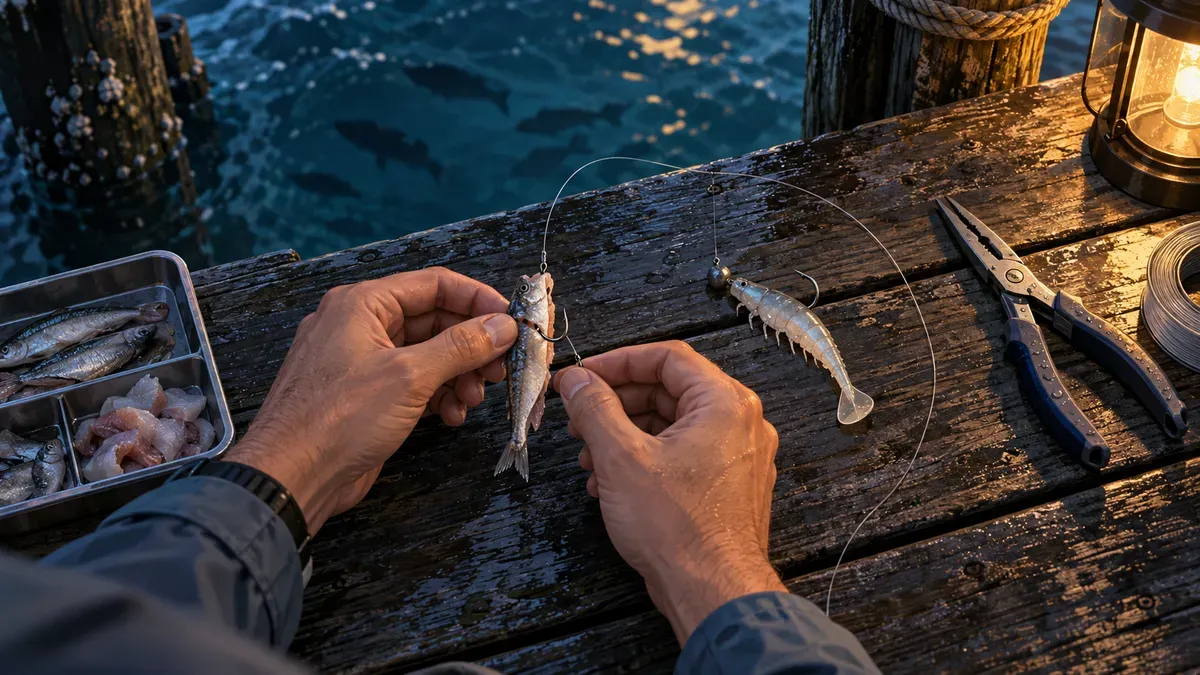
Best bait for saltwater fishing: selection, rigging, and presentation
Choose the best bait for saltwater fishing by target, depth, current, and method. Compare natural bait and lures, rig safely, and improve each session.
Quick answer
The best bait for saltwater fishing is not one universal species, color, or lure. It is a legal presentation that resembles food your target can detect in the part of the water column where it is feeding. Start with the target species and local rules, identify the likely prey size and depth, then choose natural bait when scent and a slower presentation matter or an artificial lure when you need to search water, control depth, and repeat casts efficiently.
Use this sequence: target -> legal bait and hook -> feeding zone -> prey profile -> presentation speed -> one measured adjustment. A fresh natural bait presented badly is still a poor choice. A realistic lure outside the feeding zone is equally unconvincing. Keep the rig simple enough to cast, lower, retrieve, and unhook safely, and never let a hoped-for catch overrule weather, navigation, protected wildlife, or handling limits.
Key facts
- Target species determine the legal hook, bait, size, and retention rules you must check first.
- Water depth and current place the presentation where fish can encounter it.
- Natural bait releases odor and taste cues but requires careful storage, legal sourcing, and timely bite detection.
- Artificial lures create repeatable movement, flash, vibration, silhouette, or scent while covering water efficiently.
- Single-variable testing turns each cast or drift into useful evidence instead of guesswork.
What “best bait” actually means
“Best” should mean fit for one fishing problem, not most famous or most expensive. The useful question is: what legal presentation can this target detect, intercept, and take under today’s depth, current, light, and method?
That question has five parts:
- Target: species or small group of legally distinguishable species.
- Zone: surface, midwater, structure edge, seabed, or another defined layer.
- Food signal: size, silhouette, scent, movement, vibration, or combination.
- Delivery: cast, drift, retrieve, vertical drop, or controlled troll.
- Consequence: bycatch, deep hooking, snags, protected wildlife, and safe handling.
Fish do not all perceive prey in the same way. A review of the teleost olfactory system describes how dissolved amino acids and other compounds can contribute to food-search behavior, while sensory research in marine predators shows that vision, odor, water movement, and other signals can converge during prey detection. This does not prove that adding more scent, flash, noise, or color always catches more fish. It explains why bait choice must be matched to species, visibility, distance, and presentation rather than reduced to one magic cue.
Decide the target and rules before opening the bait box
A generic plan to “catch whatever is there” cannot answer whether the bait is legal, whether live bait may be transported, which hook is required, which similar-looking species is protected, or whether a fish may be kept. Rules can change by jurisdiction, season, location, species, and fishing method.
Before choosing bait, confirm from the current fishery authority:
- license or registration requirements;
- open areas and seasons;
- minimum, maximum, and slot sizes;
- bag limits and protected look-alikes;
- allowed bait species, collection methods, and transport rules;
- hook type, hook count, lure, weight, or lead restrictions;
- mandatory release tools or reporting requirements.
NOAA’s directory of state recreational fishing websites illustrates why the correct authority is local to the water. A rule found in a video, old screenshot, forum post, or another country is not permission. If you cannot identify the fish or verify the rule, do not plan around keeping it.
Natural bait or artificial lure?
Natural bait and artificial lures solve different problems. Neither category is automatically more sporting, humane, selective, or effective in every fishery.
| Choice | Main signal | Best use case | Main tradeoff |
|---|---|---|---|
| Live natural bait | Movement plus natural odor and texture | Fish are responding to a recognizable local prey and the bait can be kept healthy and legal | Storage, transport, welfare, bycatch, and deep-hooking risk require control |
| Cut or dead natural bait | Strong odor plus a stationary or drifting food profile | Low visibility, slower bottom or drift presentation, or scavenging targets | Can spin, wash out, attract small non-target fish, or hide the hook point |
| Soft artificial lure | Shape, movement, texture, and sometimes scent | Repeated casting, adaptable retrieve, weed or structure edges | Tail action and rig alignment fail when the lure is mounted crooked |
| Hard lure or metal | Flash, vibration, silhouette, depth, and repeatable action | Searching water, imitating moving prey, or controlling a specific retrieve layer | Hooks, speed, and running depth must match the situation |
| Jig or weighted lure | Vertical or diagonal fall, pulse, and bottom proximity | Current, deeper water, or fish holding below the surface | Excess weight increases fatigue, snags, impact, and handling consequences |
The Florida Fish and Wildlife Conservation Commission field guide presents both natural and artificial options and emphasizes that choice depends on target, availability, and preference. Treat its species examples as regional illustrations, not a universal shopping list.
Choose natural bait when the food signal matters
Natural bait can be useful when fish are locating food through dissolved chemical cues, when the presentation must remain in a small zone, or when the target naturally takes slow or stationary prey. Common functional groups include baitfish, crustaceans, worms, mollusks, and cut pieces of legal fish. The species and collection rules vary too much for a global list to be safe.
Quality means more than “fresh.” A useful bait must remain on the hook, present naturally at the chosen speed, fit the target and hook, and survive handling if used live. Discolored, mushy, rancid, repeatedly thawed, or poorly stored bait may lose texture and create a hygiene problem. Keep edible supplies separate, use a dedicated sealed container, keep hands away from the face, cover cuts, and clean tools and surfaces after the session.
Do not assume that a large bait selects only large fish. Hook size, bait dimensions, target behavior, soak time, and location all interact. Passive bait left unattended may give a fish more time to swallow it. Watch the line or rod, use a legal hook pattern suited to the target and bait, and respond according to that hook’s correct technique.
Choose an artificial lure when control and coverage matter
Artificial lures make it easier to repeat a cast, change retrieve speed, search different depths, and test shape or movement without continually replacing bait. They are often useful when predators are chasing mobile prey, when you need to cover water, or when natural bait is difficult to store or legally source.
Choose by function before color:
- Surface lure: stays high and creates a wake, splash, or silhouette.
- Shallow swimmer: runs just under the surface or over shallow structure.
- Suspending or sinking lure: pauses or descends into a chosen layer.
- Soft lure on a weighted head: combines a flexible body with adjustable depth and fall.
- Metal lure or jig: casts efficiently and reaches moving or deep water.
Color is only one part of contrast. Water clarity, ambient light, background, depth, lure movement, and the visual system of the target all matter. Begin with a silhouette or contrast that you can see and control, then test alternatives. Avoid claiming that one color works in all cloudy water, all clear water, or all depths.
Match the bait to prey profile, not folklore
The principle often called “match the hatch” is broader than copying one animal exactly. Match the functional prey profile:
- approximate length and body depth;
- swimming, crawling, drifting, or injured movement;
- position in the water column;
- speed relative to current;
- solitary prey or compact group;
- visible contrast, vibration, and scent;
- how the prey behaves when threatened.
Use direct observations cautiously. Small fish scattering, birds working, surface disturbances, shells, or prey in a legal retained fish may suggest a food source, but a single sign does not prove the target, depth, or best lure. Do not chase birds into unsafe water, disturb protected animals, or use an unverified bait species because it appears abundant.
Start close to the likely prey size rather than automatically upsizing. If short strikes occur, the problem may be target size, hook exposure, retrieve speed, tail alignment, or non-target fish—not proof that the bait must be larger. If nothing happens, first confirm that the presentation is actually in the target zone and working correctly.
Put the presentation in the feeding zone
Bait selection and depth control are one system. A surface lure cannot imitate a bottom prey item while it remains ten feet above it, and a bottom rig cannot search active surface feeders without leaving the seabed.
Surface and near-surface
Use a floating or shallow presentation when fish or prey are visibly active high in the water, when structure is too shallow for a deeper-running lure, or when the method requires keeping hooks above habitat. Pause before the bait reaches a bird, marine mammal, swimmer, boat, or floating debris. Surface commotion can attract a target, but more noise is not always better.
Midwater
Control midwater depth with lure design, retrieve angle, line out, a float, or legal added weight. Current may bow the line and lift or displace the bait. Count-down methods can make a sinking lure repeatable, but the count is only a relative setting; wind, current, line diameter, lure weight, and retrieve speed can change the actual depth.
Near the seabed
Use only enough legal weight to reach and monitor the intended zone. Repeated dragging increases snags and can damage sensitive habitat. A vertical or near-vertical deep presentation creates a different safety and release problem; the deep-drop fishing guide explains line angle, heavy terminal gear, bottom contact, and barotrauma-aware release in that specific method.
If the bait never reaches the zone, change one depth variable: weight, lure design, casting angle, line out, drift angle, or retrieve speed. Do not change all of them at once.
Rig natural bait so it can still work
The goal is a secure, legal bait with an exposed hook point and a believable orientation. The exact hooking location varies by bait species, target, hook, and whether the bait is cast, drifted, lowered, or trolled.
Use this rigging check:
- Match hook and bait. The bait should not fill the hook gap or conceal the point.
- Preserve function. A live bait must still move and ventilate; a strip bait should not fold into a spinning lump.
- Control the cast. A bait that tears off under acceleration needs a gentler cast, different attachment, or different delivery method.
- Test beside you. Watch the bait in the water before sending it away. Reject spinning, tumbling, dead alignment, or a fouled hook.
- Inspect after contact. Weed, a missed bite, bottom contact, and long soaks can move the bait or cover the point.
Circle hooks are useful in some natural-bait fisheries, but they are not a universal instruction. Regulations and correct technique differ. NOAA describes how barbless circle hooks can reduce harm in its Pacific Islands context. Experimental research in a northern Gulf of Mexico reef fishery found lower traumatic hooking with circle hooks under the tested conditions, yet a recent striped bass field study found no significant mortality difference between its tested circle and J hooks. The honest rule is to use the legal hook designed for your bait, target, and method, then learn its correct strike or steady-loading technique.
Make an artificial lure behave deliberately
An artificial lure is only a shape until speed, line angle, water flow, and rod movement animate it. Test it at your feet or beside the boat where safe. Confirm that it tracks rather than spins, rolls, fouls, or collects weed.
A simple retrieve has four controllable parts:
- depth: how long it sinks or how the design runs;
- speed: average forward movement through the water;
- cadence: steady, pulsed, swept, twitched, or paused;
- contact: what you can feel without dragging or snagging continuously.
Change one part for several casts before judging it. If the lure rises too high, a slower retrieve is not always the solution; some designs need speed to work correctly. Choose a lure or weight built for the desired depth rather than forcing one design outside its stable range.
For boat-based moving presentations, use the trolling guide because boat path, speed through water, line out, and lure action must be managed together. From shore, the surfcasting guide covers casting lanes, moving water, sinker control, and wave hazards that bait choice alone cannot solve.
Use a small decision matrix
This matrix provides starting hypotheses, not guaranteed catches.
| Observation | Sensible first test | What to hold constant |
|---|---|---|
| Visible feeding near the surface | Similar-size shallow lure or legally sourced bait near the activity | Casting distance and retrieve cadence |
| Turbid water with little visual activity | Natural bait or a lure with a clear vibration or silhouette | Depth and drift line |
| Fish believed to be near the bottom | Compact bait or weighted lure that reaches the zone without excessive drag | Weight and contact time |
| Strong current bows the line | More hydrodynamic bait or the smallest safe weight increase | Target zone and hook setup |
| Frequent small non-target catches | Adjust bait size, hook fit, location, or presentation selectivity | One variable per test |
| Bait returns twisted or washed out | Re-rig for straight tracking or shorten inspection interval | Delivery method |
| Lure follows without strikes | Change pause, speed, depth, or profile—one at a time | Route and water layer |
| Deep hooking becomes frequent | Stop, review bite detection, hook choice, bait method, and local guidance | Do not continue the harmful pattern |
A 2019 study in the western Baltic recreational cod fishery found that bait and artificial lures differed in fish size, bycatch, hooking location, and injury under that study’s conditions. That is evidence that terminal choice can affect selectivity—not proof that the same effect size applies to every species or coast.
Turn fishing into a controlled learning loop
Memory favors the dramatic catch and forgets the unproductive casts. A small log protects against that bias. Record only variables you can use:
- target and method;
- date and legal water;
- approximate depth or presentation layer;
- tide or current phase when relevant;
- water clarity and weather observation;
- bait or lure functional profile;
- rig, weight, hook, and retrieve;
- strikes, landed fish, bycatch, snags, and release problems;
- the single change made next.
Use blocks of several comparable casts, drifts, or drops. A strike after changing color, depth, and speed simultaneously does not reveal which change mattered. Replication is more useful than a lucky result.
Do not turn a private log into false precision. Phone location, sonar, tide apps, or catch records are observations with error, not guarantees. Conditions and fish behavior change, and sharing exact locations can create safety, access, or conservation consequences.
Reduce bycatch, deep hooking, and bait waste
Bait choice affects more than catch rate. Natural bait may attract a wider range of animals, and an unattended bait may be swallowed deeply. Artificial lures may carry multiple exposed hooks and can injure fish, birds, mammals, and people. Selectivity is a design goal, not an inherent property of either category.
Before fishing, prepare pliers or a dehooker, cutters, a suitable wet-safe net, a measuring tool, current identification guidance, and any required descending device. If a pattern repeatedly catches undersized or non-target fish, move, change depth, adjust the presentation, or stop.
NOAA’s sustainable recreational fishing guidance recommends identifying species correctly, using tackle that shortens the fight, and moving when protected animals show interest in bait or catch. Do not feed wildlife with leftover bait or fish remains. Recover line and hooks when it is safe; never risk a person or vessel to retrieve replaceable tackle.
Unused live bait must not be released casually. NOAA lists the release of excess live bait as a pathway for non-native species introductions. Follow local disposal and transport rules, keep packing material out of the water, and never move organisms between waters unless the authority explicitly permits it.
For a fish that will be released, minimize fight and air-exposure time, wet hands, support the body, and avoid squeezing. Government catch-and-release guidance also advises cutting the line close to a deeply embedded hook when removal would cause more damage; species-specific local guidance takes precedence.
Safety outranks bait optimization
The “best” bait becomes irrelevant when the casting lane, boat, weather, or hook handling is unsafe.
- Keep hooks covered until use and control them during every cast and transfer.
- Wear eye protection where hooks, sinkers, or lures can rebound.
- Separate bait knives from hands, unstable decks, and loose tackle.
- Stop casting when people, animals, boats, or overhead obstructions enter the lane.
- Check an official marine forecast and actual conditions before leaving and throughout the session.
- On a boat, use properly fitted life jackets, a float plan, navigation lights, communication, and required safety equipment.
- Shut down propulsion before working where accidental engagement or a taut line near the propeller could cause injury.
- Leave before deteriorating weather, waves, visibility, cold, heat, or fatigue removes your margin.
The U.S. Coast Guard’s recreational boating guide is one jurisdiction’s safety reference, not a substitute for the legal requirements where you launch. Shore anglers should plan a retreat from waves and tides; boat anglers should assign the helm as a continuous responsibility rather than letting every person focus on a fish.
Prepare the body for casting and handling
Saltwater fishing may include carrying loads over sand, repeated casting, prolonged standing, balancing on a moving deck, gripping a rod under tension, and working in sun, wind, cold, or heat. It can be active, but catch count and time outdoors do not prove training intensity.
Before a long session, build capacity with ordinary walking, pulling, rowing, trunk, shoulder, and grip work. Our shoulder strength and mobility guide can help you prepare for repeated casting without treating pain as a technique problem. The grip-strength guide explains how to measure hand strength separately from sport skill.
Change hands where safe, keep the wrist near neutral, use the rod and drag rather than squeezing continuously, and take short breaks before technique deteriorates. Hydration needs vary with heat, clothing, wind, duration, and exertion; the hydration guide explains why thirst, urine, weather, and individual risk matter more than a universal volume rule.
Pain, numbness, dizziness, confusion, chest discomfort, severe shortness of breath, or loss of coordination is a stop signal. Fishing is not a reason to continue through a medical warning sign.
Use SuperAge as the activity record, not the fishing answer
After the informational and safety plan is complete, SuperAge can help place a fishing session inside the rest of your activity history. Record duration, general exertion, walking or paddling, environmental strain, sleep, and next-day recovery if those observations are useful to you.
Do not use a health score to choose bait, identify a species, interpret marine weather, navigate, certify fitness for sea conditions, or replace local instruction. The practical value is longitudinal: you can see whether long sessions coincide with shoulder discomfort, unusually high effort, poor sleep, or slow recovery and adjust workload before the pattern becomes routine.
Browse the fitness library for conditioning that supports outdoor sport. It remains separate from fishing rules, seamanship, animal handling, and on-water judgment.
Download SuperAge to review activity and recovery trends after the session while keeping bait, safety, and fishery decisions grounded in local evidence.
A conservative 90-minute practice session
Before leaving
- Choose one target and verify current rules.
- Select one legal natural bait or artificial lure plus one backup profile.
- Match the hook, line, leader, and rod to the target and expected load.
- Pack identification, cutters, pliers, measuring and release tools, water, sun or cold protection, and required safety equipment.
- Set stop rules for weather, crowding, fatigue, bycatch, and gear failure.
First 20 minutes
- Inspect the water and casting or deployment lane.
- Test the bait or lure action where you can see it safely.
- Fish one defined zone with one repeatable presentation.
- Check the hook point, bait alignment, knots, leader, and weed frequently.
Next 40 minutes
- Keep the target, rig, and route constant.
- Change one variable: depth, speed, cadence, profile, or bait condition.
- Give each change enough comparable attempts to learn from it.
- Stop and reassess if protected wildlife, repeated bycatch, deep hooking, or unsafe conditions appear.
Final 30 minutes
- Test the better of the first two presentations again.
- Leave time to return before light, tide, weather, or fatigue becomes a problem.
- Account for every hook, lure, line fragment, bait container, and tool.
- Record the simplest useful lesson for the next session.
Troubleshooting
| Problem | Likely checks | Next safe action |
|---|---|---|
| Natural bait spins | Hooking position, shape, current, towing speed | Re-rig straight and test beside you |
| Bait falls off | Texture, cast force, attachment, small-fish activity | Shorten the cast or inspection interval; change delivery |
| Hook point stays covered | Bait too large or threaded around the gap | Reduce or reposition bait without exposing unsafe tackle |
| Lure rolls or tracks sideways | Fouled hook, damaged hardware, knot position, excess speed | Retrieve and correct before another cast |
| No contact with the target zone | Weight, sink rate, current bow, line angle | Change one depth-control variable |
| Constant snags | Too much bottom contact, unsuitable hook or route | Lift the presentation, change angle, or move |
| Many non-target fish | Bait size, hook fit, zone, location, soak time | Increase selectivity or stop the pattern |
| Missed takes | Hook exposure, timing, drag, target size, lure speed | Inspect first; do not automatically strike harder |
| Shoulder or forearm fatigue | Excess tackle load, gripping, casting volume, poor breaks | Stop, reduce load, and recover before technique fails |
Common mistakes
- Buying by reputation instead of defining the target. A famous bait outside the feeding zone is not a plan.
- Copying a local bait list globally. Availability, legality, prey, and protected species differ.
- Choosing color before depth and action. Fish cannot respond to a lure they do not encounter.
- Burying the hook point in natural bait. More bait can reduce hook function.
- Letting bait soak unattended. Delayed detection can increase deep-hooking risk.
- Changing everything after two casts. The result teaches nothing reproducible.
- Ignoring bait transport and disposal. Releasing leftovers can move invasive organisms or pathogens.
- Treating a catch as proof of safety. A bite does not validate weather, navigation, identification, or handling.
Key takeaways
- Define the target, legal water, and feeding zone before choosing bait.
- Use natural bait for a controlled food signal and artificial lures for repeatable coverage and movement.
- Match prey size, depth, action, and scent rather than chasing one universal color or species.
- Rig so the bait works and the legal hook point remains clear.
- Test one variable at a time and log comparable attempts.
- Stop patterns that produce deep hooking, unsafe bycatch, habitat damage, or protected-wildlife interactions.
- Build enough shoulder, grip, balance, and environmental capacity for the actual session.
FAQ
What is the best all-around bait for saltwater fishing?
There is no universal best bait. A small locally legal natural bait or a simple artificial lure that resembles common prey can be a practical starting point, but the target species, depth, current, method, hook rules, and bait-transport rules decide whether it is appropriate. Define those variables before choosing.
Is live bait better than artificial lures?
Live bait can provide natural movement, odor, and texture. Artificial lures are easier to repeat, search with, and control across depths. Either can outperform the other on a given day, and either can create bycatch or handling problems. Choose by target, zone, rules, and the consequence of an unwanted catch.
How should I choose lure color in saltwater?
Start with visibility and contrast in the actual light, depth, and water clarity, then test. Shape, action, depth, speed, and target prey often matter as much as color. Avoid universal claims such as one color always working in murky water; species and visual environments differ.
How do I keep natural bait on the hook?
Use bait with sound texture, match its size to the hook, pierce firm tissue without filling the hook gap, and reduce casting force when needed. Test it in the water for straight tracking. If it repeatedly tears or spins, change the attachment or delivery method rather than adding a larger mass blindly.
Should the hook point be exposed?
In many bait presentations, a clear point and gap are necessary for the hook to function. The safe and legal rig depends on the bait, target, hook pattern, and method. Keep fingers clear, cover hooks during transport, and follow current local guidance rather than copying a generic diagram.
Do circle hooks prevent deep hooking?
They can reduce traumatic or deep hooking in some natural-bait fisheries, but results vary with species, hook design and size, bait, technique, and study conditions. Use them when required or locally recommended, learn the correct steady-loading technique, and do not apply one fishery’s result as a universal guarantee.
What should I do with unused live bait?
Do not release it unless the current local authority explicitly permits that action. Excess live bait can introduce non-native organisms or pathogens. Follow local rules for use, transport, and disposal, and keep water, seaweed, soil, and packing material out of another water body.
How often should I change bait or lure?
Inspect natural bait after a bite, bottom contact, weed, or a long soak and replace it when it no longer holds or presents correctly. Change an artificial lure after you have tested a repeatable depth and retrieve, not after random casts. Change one variable at a time so the result is interpretable.
References
- Florida Fish and Wildlife Conservation Commission. Fishing Lines field guide.
- Olivares J, Schmachtenberg O. An update on anatomy and function of the teleost olfactory system. PeerJ. 2019.
- Jordan LK, Mandelman JW, McComb DM, et al. Linking sensory biology and fisheries bycatch reduction in elasmobranch fishes. Philosophical Transactions of the Royal Society B. 2013.
- NOAA Fisheries. Barbless circle hooks.
- Garner SB, Patterson WF III, Porch CE, Tarnecki JH. Experimental assessment of circle vs. J hook performance and selectivity. ICES Journal of Marine Science. 2017.
- Dean MJ, Hoffman WS, Armstrong MP, et al. Evaluating the conservation benefit of circle hooks for the Atlantic striped bass recreational fishery. Marine and Coastal Fisheries. 2024.
- Weltersbach MS, Strehlow HV, Ferter K, et al. Effect of lure and bait type on catch, size, hooking location, injury and bycatch. Fisheries Research. 2019.
- NOAA Fisheries. Practicing sustainable recreational fishing on the West Coast.
- NOAA Fisheries. Invasive and exotic marine species.
- U.S. Coast Guard. A boater’s guide to the federal requirements for recreational boats. 2023.
- Northern Ireland Direct. Catch and release fishing guidelines.
Related Articles
Surfcasting for beginners: technique, gear, and shore safety
Learn surfcasting for beginners: choose simple gear, read the beach, cast safely, plan around tides and weather, and handle your catch responsibly.