Trolling fishing for beginners: setup, speed, depth, and safety
Learn trolling fishing for beginners: build a simple setup, control lure speed and depth, avoid tangles, read strikes, and operate the boat safely.
Quick answer
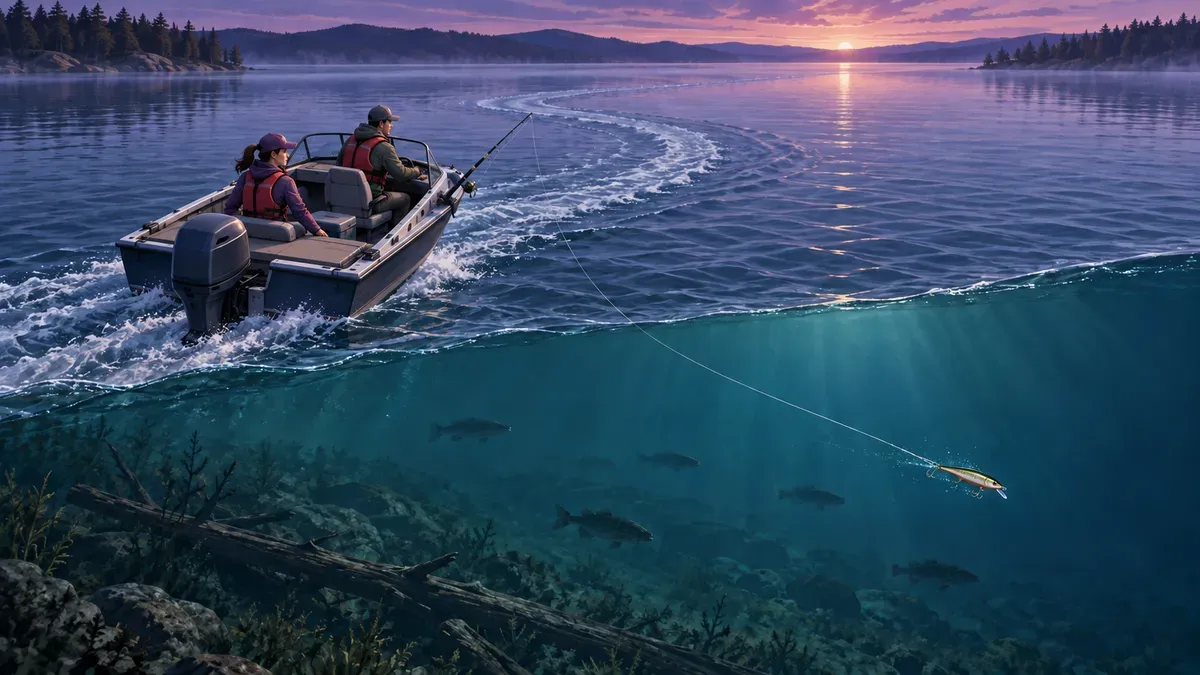
Trolling fishing means pulling one or more baited hooks or artificial lures behind a moving boat at a controlled speed and depth. For a first session, use one rod in a secure holder, one locally appropriate lure, and a route with generous space. Confirm that the lure swims correctly beside the boat, let out a measured amount of line, settle at a species- and lure-appropriate speed, and change only one variable at a time.
The beginner sequence is target -> route -> lure action -> line out -> depth -> strike -> safe landing. Speed is not a universal number: it changes lure action, drag, line angle, and running depth, while current and turns change the lure’s speed through the water. Boat handling remains the first job. A fish, snag, tangled spread, or expensive lure never outranks weather, traffic, shallow hazards, a person in the water, or the skipper’s attention.
Key facts
- A moving boat pulls bait or a lure through a chosen part of the water column.
- Speed and line geometry control lure action, drag, and approximate running depth.
- Turns create a faster outside presentation and a slower inside presentation.
- A simple spread prevents crossed lines, hidden hooks, and overloaded attention.
- Prepared release tools shorten handling time and improve the chance of a responsible release.
Trolling is a search method, not an automatic catching system. It helps an angler cover water and repeat a productive combination of route, depth, speed, and presentation. The useful skill is not collecting the most hardware. It is building a controlled experiment that can be stopped safely, repeated accurately, and adjusted without guessing.
What trolling fishing is—and what it is not
The defining feature of trolling is continuous movement: a powered or human-propelled craft draws a presentation through the water. The U.S. National Park Service overview describes flatline trolling near the surface and downrigger trolling for more deliberate depth control. The method can be adapted to freshwater and saltwater, but the target species, legal tackle, boat, weather, current, and local habitat determine the actual setup.
Trolling sits beside, but is not interchangeable with, other fishing methods:
If the boat instead holds a weighted presentation almost vertically over deep bottom, our deep-drop fishing guide covers the separate problems of line angle, bottom contact, long retrieval, heavy terminal gear, and barotrauma-aware release.
| Method | How the presentation moves | Main control problem |
|---|---|---|
| Trolling | Boat pulls bait or lure | Boat path, speed, depth, line separation |
| Drifting | Wind or current moves boat and rig | Drift direction, sink rate, bottom contact |
| Casting | Angler casts and retrieves | Placement, retrieve, structure, casting safety |
| Surfcasting | Angler fishes from shore through surf | Casting lane, waves, bottom hold, shore access |
| Vertical jigging | Angler works a lure below the boat | Depth, vertical action, boat drift |
Before setting speed and line out, use the saltwater fishing bait guide to decide whether a natural bait or artificial lure fits the target, feeding zone, and release plan.
Our surfcasting guide covers the separate problem of fishing from a beach. Moving the same tackle onto a boat does not make it a trolling system. Rod power, reel capacity, leader, terminal gear, drag, holder, and line must suit the expected load and the way the presentation will run.
Start with the target and the legal water
Choose the target before choosing the lure. “Anything that bites” gives a beginner no defensible answer for hook type, line strength, lure depth, safe landing tools, minimum size, closed season, or protected look-alikes. Use the current rules and identification resources for the exact water—not a screenshot, old video, or rule from another jurisdiction.
Before departure, verify:
- fishing license or registration requirements;
- open area, season, size, bag, possession, and protected-species rules;
- legal hooks, bait, lure count, lead restrictions, and number of lines;
- vessel, operator, life-jacket, lighting, sound-signal, and safety-equipment requirements;
- marine or lake forecast, water temperature, navigation notices, launch access, and realistic return options.
Local law can change the entire plan. Trolling may be prohibited in a waterway, motor use may be restricted, multiple hooks may be illegal, or a fishery may require a particular hook or release tool. The National Park Service explicitly tells anglers to check both fishing and boating rules before trolling. Treat every rig diagram in this guide as a concept, never a permit.
Build the smallest useful trolling setup
A beginner can learn more from one visible, repeatable presentation than from a crowded rack of lines. Start with a rod and reel rated for the target and lure load, a line and leader compatible with that system, one secure rod holder, one lure or bait rig, cutters, long-nose pliers or a dehooker, a wet-safe landing net when appropriate, a measuring tool, and protected storage for hooks.
| Component | Job | Beginner check |
|---|---|---|
| Rod | Absorb lure drag, strike, and fish movement | Rated for the line and intended load; guides undamaged |
| Reel | Store line and apply adjustable drag | Spools and retrieves smoothly; enough capacity remains |
| Main line | Connect reel to terminal system | Diameter and strength suit the target, reel, and depth method |
| Leader | Provide abrasion or visibility properties when needed | Knots are sound; length is manageable at the boat |
| Lure or bait rig | Create the target presentation | Legal, correctly rigged, and stable at the chosen speed |
| Rod holder | Keep the rod controlled while the boat moves | Mechanically secure and reachable without leaning overboard |
| Landing and release tools | Control the final, highest-risk minute | Ready before lines enter the water |
Use the manufacturer’s ratings and locally qualified advice to match components. There is no honest universal rod length, line strength, leader material, hook size, or lure color for all trolling. Small freshwater fish, large pelagic fish, cold deep lakes, shallow estuaries, and paddle craft impose different loads and consequences.
Avoid beginning with wire line, heavy downrigger weights, outriggers, planers, multiple divers, or a large multi-line spread unless an experienced skipper is teaching the system. These tools can solve real depth and separation problems, but they add stored energy, sharp hardware, cables, pinch points, snags, and recovery tasks. Complexity should earn its place after one-line control is reliable.
Make the lure swim before sending it away
Every trolling pass starts beside the boat. At the intended slow operating speed, put the lure in clear water where you can see it without reaching toward the propeller or placing hands near a taut line. Confirm that it tracks and vibrates as designed rather than spinning, rolling onto its side, fouling, or running erratically.
If the lure does not run cleanly, do not hide the problem 150 ft (46 m) behind the boat. Stop propulsion when safe, retrieve it, and inspect for tangled hooks, weed, damaged hardware, an off-center connection, rigging error, or a speed outside its usable range. Some lures are speed-sensitive; some natural baits must be rigged carefully to avoid rotating. Follow the relevant rigging instructions and local practice.
This short check separates two variables:
- Boat speed over ground is how fast the craft moves relative to the earth.
- Lure speed through water is influenced by boat movement, current, waves, turns, and the lure’s position in the spread.
A following current can make the boat’s ground speed look high while the lure moves more slowly through the water; an opposing current can do the reverse. If available, use instruments as observations rather than guarantees. The practical test remains clean lure action plus repeatable records.
Control speed without worshipping one number
Official guidance shows why a single trolling speed is misleading. The National Park Service describes slow flatline and downrigger examples below 5 mph (8 km/h), while the Massachusetts recreational angling guide notes a much wider saltwater range driven by target species and presentation. Idaho Fish and Game specialists describe very slow kokanee examples and recommend varying direction and speed. These are context examples, not universal settings.
Use this process instead:
- Choose a starting range from the lure maker, fisheries authority, local instructor, or an experienced skipper targeting the same species.
- Watch the lure beside the boat. Reject a setting that destroys the intended action.
- Stabilize the pass. Hold a safe heading and speed long enough to learn what that setup does.
- Change one thing. Adjust speed, depth, lure, route, or line out—not all five.
- Record the result. Note direction, speed, depth method, line out, lure, weather, current, and strike.
Small S-curves can test two relative lure speeds during one controlled pass. The outside line travels farther and usually speeds up; the inside line travels a shorter path and usually slows. A strike during the turn is useful evidence, but it does not prove that speed alone caused it. The lure may also have changed depth, angle, flash, or position relative to fish.
Rapid throttle changes create loose line, crossed presentations, unstable lure action, and an attention spike at the helm. Make deliberate changes only when the route, traffic, crew, and gear are controlled.
Understand depth as a system
The lure does not run at a depth simply because a display says the water is deep. Its position depends on the lure design, line diameter and material, amount of line out, added weight or diving device, trolling speed, current, turns, waves, and line angle. Idaho Fish and Game summarizes this interaction clearly: without a downrigger, weight, line out, line diameter, and speed all affect running depth.
Four common approaches are:
Flatline
The lure trails directly from the rod with no separate depth-control device. A floating or shallow-running lure may stay near the surface; a diving lure uses its lip or shape to pull deeper. More line out may allow some lures to reach farther from the boat and deeper, but the relationship is not linear or identical across lines and speeds.
Inline or clip-on weight
Added weight can take a presentation deeper. It also adds load, changes the fight and landing sequence, and can become dangerous if swung aboard. Use a documented setup whose weight, attachment, line, rod, and target are compatible.
Diver or planer
A diving device uses water pressure to pull the presentation down or sideways. It can increase coverage and separation, but release behavior, dive curves, line tension, and retrieval require practice.
Downrigger
A downrigger lowers a separate heavy weight on cable or strong line. The fishing line clips to a release; a strike frees it so the fish can be fought without the downrigger weight. Washington’s marine salmon basics explains weights, divers, and downriggers as different ways to reach a chosen depth. The downrigger offers precise control, but the weight, cable, boom, pinch points, bottom clearance, and retrieval sequence make instruction valuable.
For a first flatline session, measure line out using reel-counter data, marked line, or a repeatable count. Then log the setting. A statement such as “long line” cannot be reproduced. Use a lure’s trustworthy dive information as a starting estimate and confirm that the route has enough clearance. Never deliberately “find bottom” where snagging could damage habitat, foul a propeller, or create a collision risk while the skipper is distracted.
Choose a route the skipper can actually manage
The most productive-looking contour is useless if the boat cannot follow it safely. Before setting a line, identify the navigation channel, shoals, rocks, submerged timber, swimming areas, restricted zones, other vessels, fixed gear, ferry paths, and a wide recovery area for turns. Decide who is driving and who is handling tackle. On a small boat, those jobs may belong to one person, which is a strong reason to use one line.
A good beginner pass has:
- enough water and lateral room for a gentle turn;
- a heading that does not force repeated conflict with traffic;
- a clear plan for retrieving gear before docking, crossing a channel, or entering hazards;
- a visible waypoint or contour that can be repeated legally and safely;
- a stop condition for weather, visibility, fatigue, mechanical trouble, or crew illness.
The sea-kayak trip-planning guide explains a transferable principle: route, weather, communication, thermal protection, and escape options are one system. Trolling from a kayak or canoe adds paddle control, balance, entanglement, and self-rescue demands. Learn basic craft handling first; our canoe and kayak comparison is a starting point, not an authorization for offshore fishing.
Set one line without creating a hook trap
Put the boat on the intended safe heading and slow speed before touching the lure. Confirm that the propeller area is clear and that nobody is swimming or working over the stern. Keep the lure and hooks controlled until they enter the water.
For a simple flatline:
- place the lure in the wake where you can observe its action;
- with the reel in controlled free spool or with drag released as appropriate, let line leave gradually;
- keep light tension so line does not pile loosely or wrap hardware;
- stop at the planned, measured line-out setting;
- engage the reel and verify the drag is appropriate for the system;
- place the rod in the secured holder and confirm it cannot lift or twist free;
- scan traffic, heading, depth, weather, crew, and the line—then continue the pass.
Never hold loops of line around a hand, wrist, clothing, or boat fitting. Keep hair, loose clothing, fingers, and feet away from reels, downrigger cables, cleats, and line under tension. A snagged lure can load the rod and line like a spring. Reduce speed and approach the recovery deliberately; cut the line if the alternative is unsafe boat position, excessive force, or a person reaching into danger.
Add a second line only after the first is boring
A trolling “spread” is the arrangement of presentations behind and beside the boat. Separation can come from different distances, depths, rod positions, planers, or outriggers. Beginners should earn each extra line by demonstrating that the existing one can be deployed, monitored, retrieved, and cleared during a turn or strike.
When adding a second legal line:
- use clearly different, recorded line-out settings;
- place rods so lines leave the boat with separation;
- keep compatible lure speeds;
- make broad, slow turns and watch both rod angles;
- retrieve immediately if the lines cross or one lure fouls;
- brief the crew on which rod is cleared first after a strike.
More lines do not automatically create more useful fishing time. They also multiply hooks, drag, tangles, release work, and the chance that the skipper looks backward at the wrong moment. If the crew cannot name and execute the clearing sequence, return to one line.
Read a strike and land the fish without chaos
A healthy trolling lure creates a repeatable rod-tip rhythm and steady load. Weed, a plastic bag, bottom contact, a turn, or a small fish may change that rhythm. A fish strike may bend the rod sharply, trigger a release device, produce repeated pulses, or create unexpected slack.
When the rod changes:
- keep the boat on a safe heading and communicate clearly;
- reduce speed only as the presentation and conditions require—do not abandon steerage blindly;
- take the rod from the holder with control and maintain appropriate tension;
- clear other lines if the fish, route, or spread makes crossing likely;
- adjust drag smoothly rather than clamping it down to end the fight;
- prepare the net, dehooker, measuring tool, and release plan before the fish reaches the boat.
Match tackle strength to the target so the fish is not fought to exhaustion. Keep hands away from a taut leader and never wrap it around the hand. Large fish, toothy fish, billfish, sharks, heavy leaders, gaffing, and offshore conditions demand species-specific instruction and equipment. This guide does not turn a first-time crew into a big-game team.
For fish intended for release, NOAA’s current best practices recommend strong enough tackle, wet hands or a soft wet net, minimal handling and air exposure, support along the body, and release tools ready in advance. Deep-caught fish may show barotrauma and may require an appropriate descending device under local rules and species guidance. Do not improvise invasive treatment from a generic article.
Protect non-target wildlife and the water
Trolling covers water, so it can also carry hooks and line into non-target animals. Inspect the route ahead and retrieve or change course when turtles, marine mammals, diving birds, swimmers, or dense floating debris enter the fishing area. NOAA advises anglers to move when protected animals show interest in bait or catch, to inspect gear, recycle line, and never abandon hooks or line. An entangled large animal should be reported to trained responders; attempting a close, improvised rescue can injure both the animal and crew.
Decide the keep-or-release threshold before a strike. Have current species identification, measuring tools, and catch rules immediately available. If identification or legality is uncertain, minimize handling and follow local authority guidance. Dispose of old line in a secure recycling or waste system, cut closed loops before disposal, and account for every hook and lure at the end of the day.
Responsible fishing also means not treating a legal limit as a target that must be filled. Stop when the crew cannot release fish promptly, when protected wildlife becomes active around the spread, or when fatigue makes hook handling and boat control less reliable.
Boat safety overrides the fishing plan
Life jackets, float plan, and helm discipline
Wear a correctly fitted life jacket appropriate to the person, craft, and conditions, and meet the local carriage rules. The U.S. Coast Guard boating guidance emphasizes boater education, life-jacket wear, safety equipment, and leaving a float plan. Tell a reliable person who is aboard, where the boat is going, what it looks like, when it should return, and when to call for help.
Use the installed engine cut-off system as required and appropriate. The Coast Guard explains that it stops propulsion when the operator is displaced from the helm, helping prevent a runaway boat and propeller hazard. Trolling exemptions and legal details vary, so follow the rules for the boat and jurisdiction; do not use an exemption as a reason to ignore a working safety layer.
No one enters the water near a running engine. Confirm neutral and shut down propulsion before clearing line from the propeller or working where accidental engagement would be catastrophic. A snag, lure, or catch is replaceable.
Forecast, cold water, and lightning
Check the official marine or lake forecast immediately before departure and keep monitoring it. Thunderstorms can develop rapidly, with gust fronts, steep waves, lightning, reduced visibility, and waterspouts. The National Weather Service boating guidance states that safety begins ashore with planning and training. Leave early enough that reaching shelter is realistic; hearing thunder is not the moment to set another line.
Dress for the water temperature, not only the air. NWS cold-water guidance warns that sudden immersion can trigger gasping, rapid breathing, cardiovascular stress, and rapid loss of useful function. A life jacket buys flotation time; it does not cancel cold shock. Shorten the plan, use suitable thermal protection, and avoid solo exposure when conditions exceed training or equipment.
Carbon monoxide, fuel, and motion sickness
Gasoline engines and generators produce carbon monoxide, an odorless gas that can accumulate around cabins, cockpits, bridges, aft decks, and swim platforms—especially during slow running or idling. The CDC boating guidance lists headache, dizziness, weakness, nausea, vomiting, chest pain, and confusion as possible symptoms. Move an exposed person to fresh air, shut down the source when safe, and contact emergency services. Maintain engines and marine-rated alarms as specified; never dismiss several sick passengers as ordinary seasickness.
Motion sickness can also impair attention, balance, hydration, and willingness to follow instructions. The CDC Yellow Book explains the sensory conflict behind it and notes that habituation is the most effective countermeasure, though slow to develop. A person with a medical condition, pregnancy, or medication interactions should ask a clinician or pharmacist about prevention rather than self-prescribing at the dock. Give a symptomatic crew member fresh air, a stable safe position, hydration as tolerated, and a shorter route home.
Prepare the body without calling trolling a workout
Trolling may involve loading a boat, balancing on a moving deck, repeated setup and retrieval, holding a loaded rod, cranking, landing fish, and cleaning gear. The demand varies from light sitting to sustained whole-body work, but time on the water is not automatically moderate exercise.
Support the activity with:
- regular aerobic movement outside the boat;
- leg and trunk strength for stable stance and controlled transfers;
- pulling strength and shoulder endurance for rod control;
- grip training that develops capacity without testing maximal force every session;
- shoulder strength and mobility progressed without pain;
- sleep, hydration, sun protection, and food appropriate to the trip.
The World Health Organization recommends 150–300 minutes of moderate aerobic activity per week for adults, or 75–150 minutes vigorous, plus muscle-strengthening work on at least two days. A quiet trolling day may contain very little sustained movement. Count actual activity, not the duration printed on a fishing log.
Persistent shoulder, elbow, wrist, hand, neck, or back pain deserves assessment. Technique, boat motion, tackle load, and fatigue interact; buying a stiffer rod or locking the drag is not a rehabilitation plan.
Use SuperAge for the health record, not navigation
Once the search intent is satisfied—safe setup, speed, depth, boat control, strike response, and release—the longevity connection is simple: an outdoor skill can enrich a life, but it should sit inside a broader pattern of movement, strength, recovery, and risk management.
SuperAge can help you review exercise, walking, heart-rate, sleep, and recovery trends that are available through Apple Health. That record may show whether fishing trips accompany regular training or mostly add long seated periods and disrupted sleep. The app cannot identify fish, interpret sonar, set drag, predict local weather, certify a vessel, judge seasickness, or approve a route.
Use the training-load guide to distinguish planned exercise from incidental effort, and browse the SuperAge health library for evidence-led training and recovery context. The boat’s skipper and current local authorities remain responsible for real-world decisions.
A conservative first trolling session
Before launch
- Verify target species, rules, forecast, water temperature, route, fuel or battery margin, and daylight.
- Inspect the boat, propulsion, steering, bilge, communication equipment, safety gear, life jackets, and engine cut-off system.
- File a float plan with a reliable person.
- Rig one rod, secure every hook, and place cutters, dehooker, net, measuring tool, and first aid where they are reachable.
- Mark one wide, obstruction-free practice route and a clear return threshold.
On the water
- Complete ordinary boat checks before fishing distracts the crew.
- Confirm the lure action beside the boat at low speed.
- Let out one measured line and secure the rod.
- Hold one speed and depth setting through a clean pass.
- Make a broad turn only when traffic and depth allow.
- If nothing happens, change one variable and record it.
After a strike
- Maintain a safe heading and communicate.
- Clear the line or spread in a known sequence.
- Land, identify, measure, keep, or release the fish according to current rules.
- Re-rig only after hooks, people, boat position, and route are controlled.
Before returning
- Retrieve all lines well before the launch, dock, channel, swimmers, or shallow hazards.
- Count rods, hooks, weights, lures, tools, and line waste.
- Note the productive or failed speed, direction, depth method, line out, and lure action.
- Clean and inspect gear according to manufacturer guidance.
The first session succeeds when the crew returns with a repeatable process and no uncontrolled event. A catch is useful feedback, not the definition of safety or learning.
Troubleshooting matrix
| Signal | Likely possibilities | Controlled response |
|---|---|---|
| Lure spins or rolls | Speed mismatch, fouling, rigging error, damage | Retrieve, inspect, and retest beside boat |
| Lure runs too shallow | Speed, line, lure design, insufficient weight or device | Change one documented depth variable |
| Repeated bottom snags | Route too shallow, depth estimate wrong, turn changes | Retrieve, move, increase clearance; do not drag habitat |
| Lines cross | Turn too tight, poor separation, incompatible depths | Slow the process, retrieve, return to one line |
| Rod pulses differently | Strike, weed, debris, bottom, turn | Maintain heading, inspect load, retrieve if uncertain |
| Fish lost beside boat | Drag, tension, net timing, leader handling | Review one step; do not clamp drag or wrap leader |
| Crew feels dizzy or nauseated | Motion sickness, heat, dehydration, CO, other illness | Stop fishing, assess hazards, ventilate, return or seek help |
| Skipper keeps looking backward | Spread exceeds attention capacity | Retrieve lines and simplify immediately |
Common beginner mistakes
- Buying a complex spread before learning one line. Hardware multiplies tasks faster than skill.
- Using speed over ground as the whole answer. Current, turns, waves, and lure position change speed through water.
- Sending out a fouled lure. A visible rigging problem becomes a long, unproductive pass.
- Changing lure, depth, speed, and route together. The next result cannot teach which variable mattered.
- Guessing line out. A productive presentation cannot be repeated.
- Turning sharply with several lines. The inside and outside paths compress, change speed, and cross.
- Landing before tools are ready. Hooks, fish, line, and people converge in the smallest space.
- Looking at the rods instead of driving. Fishing attention replaces navigation attention.
- Copying another region’s rules or speed. Species, water, gear, and law make the example non-portable.
- Calling the day exercise by default. Long sitting is mistaken for structured aerobic or strength work.
Key takeaways
- Trolling pulls bait or lures behind a moving craft at controlled speed and depth.
- Choose the target, legal water, safe route, and simple matched tackle before choosing extra hardware.
- Test lure action beside the boat and measure line out so the presentation can be repeated.
- Treat speed, line, lure, weight, current, and turns as one depth-control system.
- Begin with one rod; add lines only when deployment, turns, strikes, clearing, and landing are routine.
- Prepare release tools, protect non-target wildlife, and never abandon line or tackle.
- Weather, cold water, carbon monoxide, crew illness, traffic, and helm attention override the fishing plan.
- Trolling can add outdoor engagement, but it does not automatically meet exercise guidelines.
FAQ
What is trolling fishing?
Trolling is fishing from a moving boat or other craft while bait or artificial lures trail behind at a selected speed and depth. It differs from drifting because propulsion or paddling deliberately moves the presentation, and from casting because the boat provides most of the horizontal travel.
What trolling speed should a beginner use?
There is no universal speed. Start with guidance for the exact lure, target species, water, and depth method, then watch the lure swim beside the boat. Hold one repeatable setting and adjust in small steps. Record whether the value is speed over ground and remember that current changes speed through water.
How far behind the boat should a trolling lure be?
The correct distance depends on lure design, target, depth, line, boat disturbance, water clarity, and any downrigger or diver. Use a documented starting point and measure the amount of line out. More line is not always better, and excessive distance makes turns, depth estimates, strikes, and clearing harder.
How do I make a trolling lure run deeper?
Depth can change with lure design, line diameter, line out, speed, added weight, divers, planers, or a downrigger. Change only one documented variable at a time and maintain bottom clearance. Advanced devices add load and handling risks, so learn them with experienced instruction.
Do I need a fish finder or downrigger to troll?
No. A beginner can flatline a suitable lure in safe water without either. A depth sounder can improve situational awareness and a downrigger can place a lure at a deliberate depth, but neither replaces navigation, local knowledge, legal compliance, or basic one-line control.
How many rods should a beginner troll with?
One. It makes lure action, line out, depth, turns, strikes, clearing, and landing easier to understand. Add a second only when local rules allow it and the crew can manage both lines without distracting the skipper or creating tangles.
What should I do when a fish strikes while trolling?
Keep the boat on a safe heading, communicate, take the rod under control, and clear other lines if needed. Maintain appropriate tension and drag rather than jerking or locking the reel. Prepare identification, landing, measuring, dehooking, and release tools before the fish reaches the boat.
Is trolling fishing good exercise?
It can involve lifting, balancing, cranking, landing, and gear handling, but many hours may be seated or low-intensity. Treat active work as extra movement, not proof that aerobic and strength targets were met. Keep regular training and adjust the trip if fatigue or pain affects boat or hook safety.
References
- U.S. National Park Service. Trolling. Accessed September 11, 2026.
- Massachusetts Division of Marine Fisheries. Recreational angler techniques. Accessed September 11, 2026.
- Idaho Department of Fish and Game. Kokanee fishing tips: depth, speed, and distance. Accessed September 11, 2026.
- Washington Department of Fish and Wildlife. Salmon fishing in marine areas. Accessed September 11, 2026.
- NOAA Fisheries. Catch and release fishing best practices. Updated August 4, 2026.
- NOAA Fisheries. Fishing tips to protect sea turtles and marine mammals. Updated September 3, 2025.
- U.S. Coast Guard Boating Safety Division. Recreational boaters. Accessed September 11, 2026.
- U.S. Coast Guard Boating Safety Division. Engine and propulsion cut-off devices. Accessed September 11, 2026.
- National Weather Service. Safe boating and thunderstorms. Accessed September 11, 2026.
- National Weather Service. Cold water hazards and safety. Accessed September 11, 2026.
- Centers for Disease Control and Prevention. About carbon monoxide poisoning on your boat. Reviewed August 21, 2026.
- Centers for Disease Control and Prevention. Motion sickness. CDC Yellow Book. Accessed September 11, 2026.
- World Health Organization. WHO guidelines on physical activity and sedentary behaviour: at a glance. 2020.
Related Articles
Surfcasting for beginners: technique, gear, and shore safety
Learn surfcasting for beginners: choose simple gear, read the beach, cast safely, plan around tides and weather, and handle your catch responsibly.