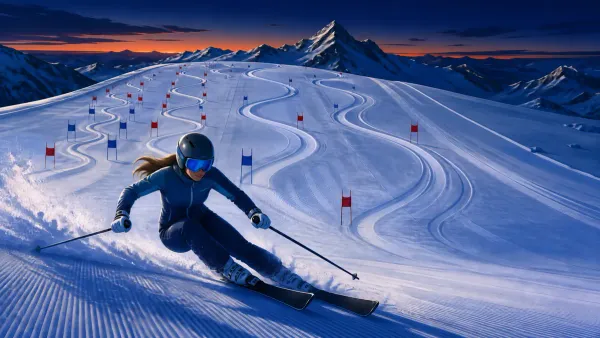
Calories burned skiing: estimate your active time accurately
Estimate calories burned skiing with current MET values, body weight, and active time. Separate downhill runs from lift rides and use the figures sensibly.
Quick answer
A 154 lb (70 kg) adult might use roughly 460 total kcal during 60 minutes of moderate downhill skiing, or roughly 625 total kcal during 60 minutes of moderate cross-country skiing. These are calculations from standardized activity values, not measurements of an individual. For downhill skiing, the clock must count active skiing: an hour that includes chairlifts, queues, and a lunch stop is a different session.
A useful estimate needs three inputs: body mass, an appropriate activity intensity, and the minutes actually spent doing that activity. Keep the result rounded, distinguish total from active calories, and use it to understand a day rather than to set a target that competes with safe skiing.
Key facts
- Active skiing time limits the calculation because lift rides and breaks do not share the energy demand of a descent.
- Body mass scales a MET estimate because the formula multiplies standardized intensity by the skier’s mass.
- Skiing discipline changes physical demand because self-propelled Nordic skiing and lift-served downhill skiing involve different movement patterns.
- Total calories include resting energy while active calories approximate the extra expenditure above rest.
- Calorie estimates guide interpretation without measuring food requirements, fat loss, or skiing quality directly.
Choose a skiing activity before choosing a calorie number
The 2024 Adult Compendium winter-activity table assigns metabolic equivalents, or METs, to defined skiing activities. A MET compares an activity with a standardized resting energy demand. The downhill entries explicitly apply to active time.
The following totals are our calculations for a 154 lb (70 kg) adult doing the selected activity for 60 active minutes. They include energy that would also have been used at rest and are rounded estimates.
| Skiing activity | MET | Approximate total kcal in 60 active minutes |
|---|---|---|
| Downhill skiing, light effort | 4.3 | 315 |
| Downhill skiing, moderate effort | 6.3 | 460 |
| Downhill skiing, vigorous effort | 8.0 | 590 |
| Cross-country skiing, slow effort around 2.5 mph (4 km/h) | 6.8 | 500 |
| Cross-country skiing, moderate effort around 4.0–4.9 mph (6.4–7.9 km/h) | 8.5 | 625 |
| Cross-country skiing, vigorous effort around 5.0–7.9 mph (8.0–12.7 km/h) | 11.3 | 830 |
These labels describe absolute metabolic demand. “Moderate effort” within a sport’s activity description does not necessarily mean the public-health category of moderate-intensity exercise, and the same outing may feel very different to two people.
Do not choose the highest row because a run looked steep or because your legs burned. Match the actual activity and effort as honestly as possible. Competition, touring uphill, and specialist training have other entries; they should not supply a default value for an ordinary resort day.
For differences in movement and trail demands, see our classic versus skate skiing guide. Choosing a technique and estimating its energy cost answer related but separate questions.
Calculate skiing calories from mass and active minutes
Use this standard approximation:
Total kcal = MET × 3.5 × body mass in kg ÷ 200 × active minutes
If your weight is in pounds, divide by 2.205 to obtain kilograms before using the formula. The standardized resting oxygen-consumption assumption is 3.5 mL/kg/min; the conversion also assumes approximately 5 kcal per liter of oxygen. Actual metabolic cost varies.
For a 154 lb (70 kg) person doing 60 active minutes at 6.3 METs:
6.3 × 3.5 × 70 ÷ 200 × 60 = 463 kcal, reported as approximately 460 total kcal.
Doubling the active minutes doubles this estimate. Changing the mass from 154 lb (70 kg) to 176 lb (80 kg), with identical activity and time, increases it to approximately 530 total kcal. That difference reflects the formula; it does not establish who worked harder relative to personal fitness.
The Compendium methods paper explains how activity values are assembled and why population comparisons need consistent definitions. The adult dataset covers ages 19–59. Applying these examples outside that population, or when illness, disability, medication, or unusual physiology affects energy cost, adds uncertainty. Even within that age range, a table does not replace individual testing.
Total calories versus active calories
The calculation above estimates gross energy during skiing. To approximate the extra energy above standardized rest, subtract one MET:
Active kcal = (MET − 1) × 3.5 × body mass in kg ÷ 200 × active minutes
For the same 60-minute example, this gives approximately 390 active kcal, compared with approximately 460 total kcal. The difference is roughly 74 kcal of standardized resting expenditure over that hour.
Subtracting one MET is still a model. A person’s measured resting metabolic rate may differ from the standard assumption, and device manufacturers can define active energy differently. Our active versus total calories explainer helps identify which quantity a record actually reports.
Why a four-hour ski outing is not four hours of skiing
A lift-served day is an alternating sequence: ski, stop, queue, ride, walk, ski again. Applying the downhill MET to every minute silently assumes that all those segments have the demand of skiing.
Consider a four-hour outing with 60 accumulated minutes of moderate downhill skiing. At 154 lb (70 kg), the downhill portion estimates about 460 total kcal. Applying the same 6.3 MET value to all 240 minutes would produce about 1,850 kcal. The larger number comes from an incorrect time input, not from a different body.
The remaining three hours still use energy. To estimate the entire outing, model sitting, standing, walking, and other activities separately using appropriate values. Do not call the downhill subtotal the full day’s energy expenditure, and do not add a second resting allowance to a gross estimate that already includes it.
Four examples with clearly defined clocks
| Scenario for a 154 lb (70 kg) adult | Minutes counted at the selected skiing MET | Approximate total skiing kcal |
|---|---|---|
| Easy downhill practice, accumulated descents | 30 at 4.3 METs | 160 |
| Moderate downhill skiing, excluding lifts and breaks | 60 at 6.3 METs | 460 |
| Longer moderate downhill session, excluding lifts and breaks | 120 at 6.3 METs | 925 |
| Moderate Nordic session without prolonged stops | 60 at 8.5 METs | 625 |
These are worked examples, not prescriptions. A lesson can contain valuable instruction and very little continuous skiing. A busy day can offer substantial enjoyment while accumulating fewer active minutes than expected. Neither situation needs to be corrected by taking unnecessary risks.
For mixed effort, calculate each block separately and add the block totals. If you cannot distinguish the blocks reliably, report an approximate range and describe the assumptions rather than producing an elaborate number from uncertain inputs.
What changes skiing energy demand?
Terrain and speed change workload
Turns, braking, snow resistance, slope, and speed alter muscular work. A study of 38 recreational alpine skiers found that grade and speed affected physiological responses. Its controlled slope conditions do not provide a universal calorie multiplier for every run, but they support recording how you skied as well as how long you skied.
Distance is therefore a weak standalone input for downhill skiing. Gravity can carry a skier a long way while the muscular demands depend on turning, controlling speed, and maintaining posture. A running calorie-per-mile calculation should not be transferred to a downhill ski track.
Technique changes the meaning of effort
An inexperienced skier may maintain tense muscles, brake repeatedly, and expend effort while traveling slowly. A skilled skier can move faster with more organized technique. Difficulty ratings describe terrain and local classification, not a measured MET value for a particular skier.
If you are learning, prioritize instruction, stopping, and control. Our adult beginner skiing guide explains practical learning milestones. Increasing speed to raise a calorie estimate undermines the skills that make a session repeatable.
Cold and altitude add uncertainty
Cold exposure, clothing, wind, and altitude can affect comfort, physiology, and perceived effort. They do not justify a universal “winter bonus” percentage on a calorie calculator. Shivering is a reason to warm up and address exposure; it is not a useful workout strategy.
Similarly, breathlessness at altitude does not translate into a simple extra-calorie factor. Choose an effort you can control, take breaks, and treat symptoms and safety as separate decisions from the estimate.
Interpret a wearable record without treating it as calorimetry
A consumer device may combine heart rate, motion, location, duration, and personal profile information. It infers energy use; it does not measure metabolic heat or oxygen consumption directly.
The INTERLIVE expert statement emphasizes that validation depends on the population, reference method, testing conditions, processing, and analysis. A device that performs well during laboratory walking is not automatically validated for repeated downhill descents, pole use, or lift rides. Our heart-rate zones by sport guide explains why a familiar heart-rate number also needs activity context.
When a device and your calculation disagree, inspect the definitions first:
- Did the record count elapsed time, moving time, or detected runs?
- Does it report total energy or active energy?
- Is the body mass in the profile current?
- Does the chosen activity mode match downhill or Nordic skiing?
- Are heart-rate gaps or implausible traces present?
- Did the app pause during lifts, and what happened to those minutes?
Compare similar sessions with the same recording method while preserving uncertainty. A repeatable estimate can help organize training records, but stable numbers can also carry a stable bias. Agreement between two calculators is not independent validation if both use similar assumptions.
Use energy estimates to support a sustainable ski day
Plan normal meals, accessible food, fluids, and breaks around the length and demands of the outing. A long Nordic session and a short downhill lesson do not create identical fueling needs. Avoid turning an uncertain calorie total into a rigid food allowance or a reason to skip recovery nutrition.
The 2023 IOC consensus on relative energy deficiency in sport describes health and performance problems that can occur when energy intake remains inadequate relative to exercise demands. One low intake day or a calorie estimate cannot diagnose this condition. Persistent fatigue, recurrent injury, deteriorating performance, or concerning changes in health deserve professional assessment.
If body-weight management is a goal, look at patterns over time and your overall intake and activity. A skiing subtotal does not predict fat loss after a trip. Enjoyment, skill development, strength, and consistency remain useful outcomes even when the calorie number is modest.
For general health, WHO physical-activity guidance recommends 150–300 minutes of moderate aerobic activity or 75–150 minutes of vigorous activity each week, plus muscle-strengthening activity on two or more days. Skiing can contribute when the actual activity reaches the relevant intensity. Chairlift time should not be counted as aerobic exercise simply because it belongs to a ski outing. Our exercise and longevity guide places a seasonal sport within a broader, sustainable activity pattern.
Stop skiing if fatigue compromises turning or stopping. Chest pain, fainting, or severe unexplained breathlessness require urgent help rather than another run. People with relevant cardiovascular disease or health concerns should discuss unfamiliar strenuous activity with their clinician.
Use SuperAge for context around the skiing record
SuperAge reads available Apple Health data, with permission, to help review biological-age estimates and everyday health signals over time. It can provide context around activity and recovery where the underlying data exists. It does not turn a skiing energy estimate into a laboratory measurement or certify readiness for a difficult slope.
After a ski trip, review how activity fits with sleep, recovery, and your usual routine. Compare like with like: the same type of session, similar recording settings, and consistent definitions of energy. A missing metric must reach Apple Health before SuperAge can use it.
Keep a brief session note alongside your preferred recording method: discipline, active minutes, overall effort, breaks, and how you felt afterward. That context can explain more than a calorie total alone. Explore SuperAge if you want to review available health signals together.
Frequently asked questions
How many calories does one hour of downhill skiing burn?
For a 154 lb (70 kg) adult, the examples here estimate roughly 315–590 total kcal for 60 active minutes across light to vigorous effort. Moderate effort estimates about 460 total kcal. An hour including lift rides and stops does not qualify as 60 active minutes.
Does cross-country skiing burn more calories than downhill skiing?
At the example intensities, moderate Nordic skiing has a higher MET value than moderate downhill skiing. Nordic outings may also contain more continuous self-propelled movement. Actual totals still depend on mass, effort, active time, and technique; the sport label alone cannot settle the comparison.
Should I include chairlift time in skiing calories?
Exclude it when applying the downhill skiing MET. Chairlift time has its own energy cost and can be modeled separately for a whole-outing estimate. Check how your device handles elapsed time and automatic pauses before comparing its number with the skiing-only calculation.
Why are my watch calories lower than an online estimate?
The calculator may report total calories while the watch reports active calories, or they may count different minutes and intensities. Sensor data and model assumptions also differ. A higher result is not automatically more accurate.
Does feeling cold mean I burned many more calories?
Cold can change physiological demand, but there is no universal correction for a clothed skier. Do not add a fixed percentage or stay cold to increase energy use. Shivering, numbness, and deteriorating coordination call for warmth and appropriate help.
Can skiing help with weight management?
Skiing adds physical activity, but weight change depends on longer-term energy balance and many behavioral and health factors. A single trip’s estimated calories cannot predict fat loss. Choose safe, enjoyable activity and adequate recovery rather than a calorie target for each run.
Is the MET formula accurate for older adults?
The adult values used here were assembled for ages 19–59 and do not guarantee an individual estimate at any age. Older-adult activity values and individualized assessment may be more appropriate. Fitness, resting metabolism, medications, and health status all affect interpretation.
How can I make my estimate more useful next time?
Record discipline, body mass, active minutes, and a realistic effort description. Separate lifts and breaks, identify total versus active energy, and round the result. Consistent assumptions improve comparison while leaving the underlying uncertainty visible.
Key takeaways
- Start with skiing type, body mass, effort, and actual active minutes.
- Apply downhill METs to skiing segments; model other parts of the outing separately.
- Distinguish gross totals from approximate energy above rest.
- Treat calculations and wearable records as estimates with defined assumptions.
- Protect technique, fueling, recovery, and enjoyment before pursuing a larger calorie number.
References
- 2024 Adult Compendium of Physical Activities: winter activities and current skiing MET values.
- Herrmann SD, et al. 2024 Adult Compendium of Physical Activities: a third update of the energy costs of human activities. Journal of Sport and Health Science. 2024;13:6–12.
- Seifert J, et al. Grade and speed have greater influence on HR and RPE than ability, sex, and age in alpine skiing. Journal of Sports Sciences. 2017;35:419–425.
- INTERLIVE Network. Recommendations for determining the validity of consumer wearables and smartphones for the estimation of energy expenditure. Sports Medicine. 2022.
- Mountjoy M, et al. 2023 International Olympic Committee consensus statement on relative energy deficiency in sport. British Journal of Sports Medicine. 2023;57:1073–1097.
- World Health Organization. Physical activity: recommendations and health benefits.
Related Articles
What is biathlon? Rules, race formats, shooting, and training
Learn how biathlon works, from skiing and shooting rules to race formats, penalties, physical demands, safety, and a practical beginner training plan.