Bobsleigh vs skeleton vs luge: the complete differences guide
Bobsleigh vs skeleton vs luge: compare starts, steering, sleds, race formats, physical demands, safety, and the right way for beginners to start.
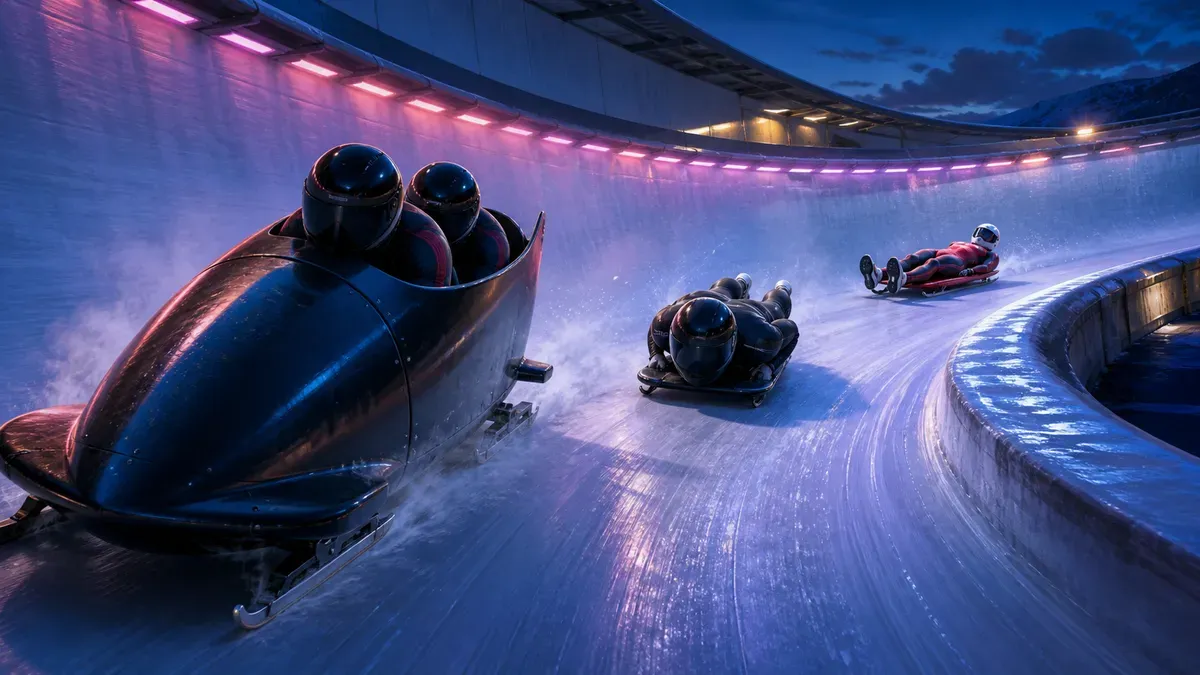
Bobsleigh, skeleton, and luge share a banked ice track, gravity, steel runners, and races decided by fractions of a second. They are not three versions of the same ride. Bobsleigh places a seated crew inside a steered sled, skeleton sends one athlete head-first and face-down, and luge places one or two athletes feet-first and face-up.
Those positions change almost everything: how the start creates speed, how the athlete steers, what equipment carries the load, which physical qualities matter most, and how a mistake develops. This guide explains the differences for spectators and prospective athletes without treating elite sliding as a recreational activity.
Quick answer
What is the difference between bobsleigh, skeleton, and luge? Bobsleigh crews sprint while pushing an enclosed sled, load into it, and let a pilot steer through a mechanical system. A skeleton athlete sprints beside a small open sled, dives on head-first, and steers with subtle shoulder, knee, and toe pressure. A luger begins seated, paddles with spiked gloves, lies back feet-first, and steers by combining leg pressure, shoulder movement, and changes in body tension. All three race on time, but their starts, body positions, controls, event formats, and physical demands are distinct.
Key facts
- Bobsleigh crews accelerate the heaviest sled with a synchronized running push before loading in sequence.
- Skeleton athletes descend face-down and head-first on an open sled with no mechanical steering or brake.
- Luge athletes start seated, use their hands to paddle for acceleration, and descend face-up and feet-first.
- Ice track performance combines start speed, a clean load, precise steering, aerodynamics, and knowledge of the racing line.
- Safe participation requires a homologated track, federation pathway, qualified coaching, inspected equipment, and progressive instruction.
Bobsleigh vs skeleton vs luge at a glance
| Feature | Bobsleigh | Skeleton | Luge |
|---|---|---|---|
| Athlete position | Seated inside a partially enclosed sled | Prone, face-down, head-first | Supine, face-up, feet-first |
| Typical crew | One, two, or four depending on event | One athlete; mixed team combines separate runs | Singles, doubles, team relay, and mixed formats |
| Start | Running push, then rapid loading | Running push, then a head-first dive onto the sled | Seated rocking launch, hand paddles, then lie-back transition |
| Steering | Pilot uses steering rings linked to the front runners | Shoulder, knee, and toe pressure subtly alters runner contact | Leg pressure through the steels plus shoulder and body inputs |
| Brake | Operated after the finish in crew events; monobob combines roles | No onboard brake | No onboard brake |
| Main physical emphasis | Sprint power, synchronized pushing, loading, driving, and crew roles | Sprint acceleration, push mechanics, precise loading, and fine control | Explosive upper-body start, low-profile control, neck and trunk endurance |
| Result | Combined time across competition runs | Combined time across competition runs | Combined time across competition runs or relay time |
These are the dominant international forms. Event programs, heat counts, eligibility, equipment limits, and start orders can change by competition and season. The current federation rulebook and event bulletin always take precedence over a general guide.
One ice track, three control systems
A modern artificial sliding track is a refrigerated, banked chute designed around gravity-driven acceleration. It contains straights, transitions, and curves that create large changes in direction and loading. Bobsleigh and skeleton are governed internationally by the International Bobsleigh and Skeleton Federation; artificial-track luge is governed by the International Luge Federation.
Sharing a venue does not mean sharing an identical start point or line. Luge can use discipline-specific start heights, while equipment dimensions and athlete-sled systems differ. The line through a curve must suit the sled, speed, entry position, ice, and next transition. An athlete is not simply leaning toward the desired direction: small control inputs alter how the runners interact with the ice, and excessive steering can create drag or a skid.
The result is a common performance equation with different weights:
- create as much controlled start velocity as the event allows;
- transfer onto or into the sled without destabilizing it;
- keep aerodynamic and runner drag low;
- steer early enough to hold an efficient line;
- preserve control as speed and force rise through the track.
How bobsleigh works
Bobsleigh uses the largest and heaviest sled of the three sports. In a two-person crew, the pilot drives and the second athlete performs the brake role after the timed section. In a four-person crew, the pilot loads first, two push athletes follow, and the brake athlete enters last. Monobob makes one athlete responsible for pushing, driving, and stopping the sled.
The bobsleigh start
The crew begins beside or behind the sled, accelerates it with folding push handles, and loads in a rehearsed order. A powerful push is not enough on its own. Teammates must match cadence, keep the sled straight, reach useful speed, and enter without striking each other or upsetting the runners.
The IBSF bobsleigh overview describes the pilot entering first and the brake athlete last in four-person racing. Once everyone is inside, the handles retract and the pilot takes control. A poor load can surrender the benefit of a fast sprint through extra drag, lateral movement, or a compromised entry to the first curve.
How a bobsleigh steers
The pilot holds steering rings connected to the front runner assemblies. Small movements change their angle. The rear runners remain fixed, so the pilot must manage the sled’s path without asking the front runners to correct too much too late. The crew stays compact and responsive to the forces of the track rather than actively steering as separate passengers.
The brake is for the outrun after the finish, not for regulating speed through the timed course. Driving therefore depends on track knowledge, visual references, feel, and a planned sequence of inputs. The official page notes racing speeds that can reach roughly 93 mph (150 km/h), but peak speed varies with the track, event, ice, weather, load, and line.
What bobsleigh rewards
Bobsleigh recruits sprint-capable athletes because the crew must overcome the inertia of a substantial sled. Lower-body power, horizontal force production, coordination, and the ability to load at speed all matter. A small study comparing Korean national-team athletes found that Olympic medalists differed from non-medalists in several strength measures, including squat and leg-curl performance (Min et al., 2022). That association does not turn one gym score into a selection test; it supports the broader role of strength and posterior-chain capacity in an elite population.
Roles matter too. A pilot needs repeatable line judgment under high force. Push athletes need speed-power qualities and precise loading. A brake athlete must contribute to the start, enter last cleanly, and stop the sled safely after timing ends. The best crew is an integrated system, not four isolated sprint tests.
How skeleton works
Skeleton uses one athlete and a compact open sled. The athlete starts upright, sprints while pushing the sled, launches onto it, and descends prone with the head facing down the track. The chin sits close to the ice, the arms remain alongside the body, and the feet trail behind.
The skeleton start and load
The IBSF skeleton overview describes the start as a standing acceleration followed by a quick load onto the sled. Unlike bobsleigh, there is no cabin to enter. The athlete must place the torso onto the saddle and settle the legs without bouncing, dragging, or producing a steering error.
Biomechanical research helps explain why skeleton recruits strong sprinters. A markerless-motion study found that pushing the sled reduced centre-of-mass velocity compared with free sprinting, while step characteristics remained broadly comparable when aligned for speed (Colyer et al., 2021). A newer analysis describes the start as a hybrid of sprint acceleration and a diving take-off, with regular sprinting, specific push practice, core stability, and lower-body power as relevant training themes (Wang et al., 2026). Both studies concern trained athletes; neither is a do-it-yourself initiation plan.
How skeleton steers
A skeleton sled has no steering wheel, mechanical linkage, or brake. The athlete guides it with small pressures from the shoulders, knees, and toes, changing runner contact while trying to preserve a narrow aerodynamic profile. The official IBSF explanation emphasizes that too much steering can skid the sled, while too little can leave the athlete off line.
Head-first does not mean the athlete has a better view in every curve. Vibration, force, helmet position, and the need to keep the head low can limit visual information. Elite steering integrates memorized timing, feel through the sled, and selected visual references. Dramatic body movement usually signals a correction, not an efficient default technique.
What skeleton rewards
Skeleton combines acceleration with unusually fine control. Athletes need enough strength and speed to create a competitive start, but then must become quiet on the sled. The transition from maximal intent to minimal disturbance is a defining skill.
The single-athlete format also removes the separation between push and drive roles. One person owns the start, load, line, aerodynamics, and finish. This makes skeleton different from bobsleigh even when both recruit from sprint and power backgrounds.
How luge works
Luge reverses skeleton’s body orientation. The athlete lies face-up and travels feet-first, with the head raised only enough to see and manage the run. Singles and doubles use an open sled with two runners, steels, bridges, and a seat structure. Current artificial-track programs also include team relay and mixed events; the FIL rules summary is the authoritative starting point for the active disciplines and equipment framework.
The luge start
A luger begins seated at a pair of start handles. The athlete rocks to generate momentum, releases into the start ramp, and uses spiked gloves to paddle against the ice. The hands then return to the sled as the athlete lowers into the aerodynamic position.
That makes the luge start mechanically distinct. Bobsleigh and skeleton emphasize running acceleration; luge places greater early demand on the upper body and trunk. A poor transition after the paddles can erase start gains through misalignment or unnecessary steering.
How luge steers
Luge steering blends several inputs. The athlete applies pressure through the legs to influence the runner steels, changes shoulder pressure against the sled, and manages body tension. The movements are subtle because a large correction increases friction and may destabilize the sled.
In doubles, two athletes share the sled in a stacked position and must coordinate the start, posture, and control strategy. The format is not merely singles with extra mass: communication, timing, and combined aerodynamics become part of the performance problem.
What luge rewards
Luge requires explosive start work, shoulder and arm capacity, trunk control, neck endurance, tactile steering, and the ability to maintain a low-drag position under vibration and force. The start may look brief, but it is one of the only chances to add propulsion before gravity and line management take over.
A 46-week prospective study of 40 elite lugers found that health burdens extended beyond dramatic crashes: shoulder and lumbar-spine regions were prominent in overuse problems, while strains and contusions were common acute diagnoses (Raschner et al., 2024). That evidence supports sport-specific prevention and monitoring rather than fear-based claims about one run.
Race formats, timing, and what decides the winner
All three sports use electronic timing and combine results across prescribed runs in their standard individual or crew competitions. The lowest total time wins. Because margins are small, a modest start deficit, a late steering correction, or extra runner friction can compound over the full descent.
The exact competition structure depends on the event:
- Bobsleigh can include monobob, two-person, and four-person races under the applicable program.
- Skeleton uses individual races, while mixed-team competition combines designated individual runs rather than placing two athletes on one sled.
- Luge includes singles, doubles, and relay or mixed structures defined by the active rules.
Heat counts should never be memorized as universal. World Championships, Olympic events, World Cups, youth categories, development races, and qualification rounds can use different procedures. For example, the 2026 Olympic men’s skeleton event used four runs over two days under its published procedure (IBSF, 2026), while the current FIL regulations specify the relevant run and ranking rules for each luge competition class.
For spectators, the useful split times are the start clock and intermediate track times. A fast start with worsening splits suggests that loading, aerodynamics, or driving cost time. A merely competitive start followed by improving relative splits can signal an efficient line. Track conditions and start order complicate comparisons, so a single sector should be interpreted in context.
Physical demands: acceleration first, then precision under force
Once an athlete finishes pushing or paddling, there is little opportunity to add energy. Start velocity is therefore important, but the relationship between start and finish depends on the track and the quality of the descent. A 2026 review of Olympic ice sports describes horizontal sprint force as central to bobsleigh and skeleton starts and notes that the glide phase still depends on minimizing drag and finding the right line (Lucey et al., 2026).
The three events emphasize different training qualities:
| Training quality | Bobsleigh | Skeleton | Luge |
|---|---|---|---|
| Acceleration | Team sprint against a heavy sled | Individual sprint while controlling a lighter sled | Seated launch and rapid hand paddles |
| Maximal strength and power | High priority for pushing and loading | Supports acceleration and stable loading | Supports start force and whole-body control |
| Coordination | Crew cadence and entry order | Push-to-dive transition | Rocking, release, paddles, and lie-back transition |
| Isometric endurance | Bracing through the run | Low-profile head, neck, trunk, and leg control | Neck, trunk, shoulder, and leg control |
| Perceptual skill | Pilot reads line and force | Athlete integrates feel and limited visual cues | Athlete integrates feel, timing, and visual cues |
General strength work can build capacity, but it cannot teach an ice line. Our strength-training frequency guide explains how to distribute gym exposure without assuming that more sessions always produce more adaptation. The reaction-time guide is useful for general context, but a consumer reaction test does not measure driving skill on a sliding track.
The closest SuperAge comparison article is our guide to alpine skiing disciplines, where event geometry also changes the performance problem. The boundary is important: alpine skiers create and manage turns on snow with edged skis, while sliding athletes ride runner-based sleds inside a banked ice track.
Safety: elite sliding is not recreational sledding
Bobsleigh, skeleton, and luge belong on approved tracks with professional operations. A public hill, ski run, improvised chute, or frozen road is not a substitute. The federations specify equipment, track, training, medical, and competition requirements because high speed, walls, forces, and limited stopping options make uncontrolled experimentation unacceptable.
Protective equipment reduces specific risks but does not eliminate them. Helmets, suits, footwear, gloves, sled components, runner preparation, and inspections are discipline-specific. The current IBSF bobsleigh rules, IBSF skeleton rules, and FIL artificial-track regulations define the governing requirements; rental or borrowed equipment is not automatically competition-safe.
Research also cautions against judging risk only by visible crashes. A systematic review found that concussion and concussion-like symptoms in competitive sliding sports have been under-studied, with substantial variation by event and track (McCradden and Cusimano, 2018). Instrumented research during a World Cup bobsleigh season recorded frequent head-acceleration events even though only one diagnosed sport-related concussion occurred in that cohort (Smirl et al., 2024). Exposure data do not diagnose brain injury, but they support proper symptom reporting and medical oversight.
After any suspected concussion, the athlete should stop participation and receive appropriate medical assessment. The Amsterdam consensus recommends removal when concussion is suspected and a supervised, graduated return-to-sport process rather than same-day self-clearance (Patricios et al., 2023). Emergency symptoms such as deteriorating consciousness, repeated vomiting, seizure, weakness, severe or worsening headache, or neck pain require urgent care.
How beginners actually enter the sports
Watching a race may create the impression that courage is the entry requirement. Access and instruction come first. A responsible pathway normally begins through a national federation, recognized club, development school, or sanctioned tryout connected to an operating track.
1. Find the legitimate pathway
Contact the national body for the discipline and ask which tracks, clubs, age groups, medical forms, insurance, and introductory programs are recognized. Do not buy specialized equipment before learning what the program supplies and what the active rules require.
2. Build transferable qualities off ice
Running mechanics, general strength, jumping and landing competence, trunk capacity, shoulder resilience, and aerobic fitness can support later sport learning. They do not make someone track-ready. Use the fitness library for general conditioning, and treat coached sliding as a separate technical curriculum.
The same boundary applies to ski jumping technique and scoring: physical preparation supports learning, but only a qualified coach and a progressive hill pathway make takeoff, flight, and telemark practice appropriate.
3. Learn in stages
Programs may use dry-land push tracks, shortened starts, lower start points, controlled speeds, and progressive track exposure. The coach—not the athlete’s appetite for speed—sets progression. Equipment checks, track walks, line instruction, communication procedures, and emergency planning belong to the session.
4. Recover between technical exposures
New athletes can underestimate the cost of sprint work, cold conditions, isometric bracing, and repeated vibration. Our guide to recovery between workouts explains why adaptation needs spacing. Pain, neurological symptoms, or declining control are not challenges to push through.
For a more accessible ice sport based on precision and team strategy, compare our curling rules guide. It still requires club instruction, but it does not share the high-speed track environment.
Sliding sports, fitness, and long-term health
Elite sliding combines power, coordination, skill acquisition, and team practice, but it should not be sold as a uniquely superior longevity intervention. Participation opportunities are scarce, training is specialized, and risk management is inseparable from the sport.
The durable health value comes from the broader habits around the discipline: consistent strength and power training, aerobic conditioning, recovery, social connection, and continued learning. Those elements also exist in more accessible sports. Our review of the best sports for longevity explains why adherence, fitness, and injury-adjusted consistency matter more than choosing a sport for its spectacle.
For masters athletes or adults entering a development program, health screening should reflect individual history, symptoms, medications, prior concussion, cardiovascular risk, bone and joint health, and the demands of the specific role. A qualified clinician and the program’s medical staff can decide what is relevant; a blog cannot clear anyone for a high-speed track.
Use recovery data without overriding the coach
Once an athlete has a sanctioned program, SuperAge can organize sleep, resting trends, activity, and recovery context around training. Add notes for sprint volume, push sessions, strength work, track runs, soreness, travel, and any technical deterioration. Over time, the pattern can help a coach and athlete ask better questions about workload.
A favorable readiness or recovery value cannot certify a sled, judge an ice line, exclude concussion, or authorize another run. Symptoms, equipment checks, track procedures, and the qualified coach’s decision always override an app score.
Download SuperAge to follow your fitness and recovery patterns alongside—not in place of—professional sliding-sport support.
Frequently asked questions
Which is faster: bobsleigh, skeleton, or luge?
There is no universal winner across every track and condition. All three can approach very high speeds, while the exact peak depends on start height, track geometry, ice, weather, sled, mass, line, and event. Official bobsleigh and skeleton material cites speeds around 87–93 mph (140–150 km/h) in elite settings. Comparing one broadcast’s peak numbers can be misleading.
Why is skeleton head-first but luge feet-first?
They developed as separate sports with different sled designs, starts, body positions, and steering techniques. Skeleton athletes sprint and dive prone onto the sled; lugers launch seated, paddle, and recline supine. The orientation is part of each discipline’s complete technical system, not a single safety choice that can be swapped.
How do skeleton athletes steer without a steering wheel?
They use subtle pressure from the shoulders, knees, and toes to alter contact between the runners and ice. Timing and restraint matter: excessive input can produce a skid and lose speed, while insufficient input can miss the intended line.
How do lugers steer?
Lugers coordinate leg pressure through the sled, shoulder pressure, and body tension. The inputs are small and track-specific. Turning the head or making a large visible lean is not a complete description of elite steering.
Who steers a bobsleigh?
The pilot steers using rings connected to the front runners. In crew events, the brake athlete operates the brake after the finish. Push athletes contribute to start acceleration and loading, then remain compact during the descent.
Do bobsleigh, skeleton, and luge use the same track?
They can share a combined artificial track, but may use different start locations, equipment specifications, and sport-specific procedures. A track must be approved for the relevant use, and the racing line is not automatically identical across sleds and conditions.
Is skeleton safer because the sled is simpler?
Sled simplicity does not establish overall safety. Risk depends on exposure, track, speed, experience, equipment, crashes, overuse, reporting, and medical systems. Research estimates vary by sport and event, so claims that one discipline is categorically safe should be treated cautiously.
Can an adult beginner try bobsleigh, skeleton, or luge?
Possibly, if an authorized federation or track program offers an age-appropriate introduction and accepts the person’s health and experience profile. The correct first step is contacting that program. Never improvise the sport on an unsanctioned slope or attempt to copy an elite start without qualified instruction.
Key takeaways
- Bobsleigh uses a seated crew, a running push, and mechanical steering controlled by a pilot.
- Skeleton uses one head-first athlete, a sprint-and-dive start, and subtle body-pressure steering.
- Luge uses a feet-first reclined position, seated launch and hand paddles, plus coordinated leg and shoulder steering.
- Start speed matters in every discipline, but loading, aerodynamics, line choice, and precise control decide how much of it survives to the finish.
- These are specialized high-speed sports that require homologated tracks, inspected equipment, federation pathways, professional coaching, and medical oversight.
- Fitness data can add recovery context, but it cannot replace symptoms, safety procedures, or expert decisions.
References
- International Bobsleigh and Skeleton Federation. International rules and quotas. Accessed August 13, 2026.
- International Bobsleigh and Skeleton Federation. Bobsleigh at a glance. Accessed August 13, 2026.
- International Bobsleigh and Skeleton Federation. Skeleton at a glance. Accessed August 13, 2026.
- International Bobsleigh and Skeleton Federation. International bobsleigh rules 2025. 2025.
- International Bobsleigh and Skeleton Federation. International skeleton rules 2025. 2025.
- International Luge Federation. International luge regulations for artificial track. Accessed August 13, 2026.
- Min S-K, et al. Differences in body composition and physical fitness of Korean national bobsleigh and skeleton athletes. Journal of Sports Medicine and Physical Fitness. 2022.
- Colyer SL, et al. Development, evaluation and application of a novel markerless motion analysis system to understand push-start technique in elite skeleton athletes. Journal of Applied Biomechanics. 2021.
- Wang L, et al. Biomechanics-based analysis of technical characteristics in skeleton start and specific physical training strategies. 2026.
- Raschner C, et al. Types, frequencies and burden of health problems in elite luge athletes. BMJ Open Sport & Exercise Medicine. 2024.
- Lucey A, et al. Olympic ice sports: a narrative review and perspectives toward Milano-Cortina 2026. 2026.
- McCradden MD, Cusimano MD. Concussions in sledding sports and the unrecognized sled head. Frontiers in Neurology. 2018.
- Smirl JD, et al. Head kinematics and injury analysis in elite bobsleigh athletes throughout a World Cup tour. Orthopaedic Journal of Sports Medicine. 2024.
- Patricios JS, et al. Consensus statement on concussion in sport: Amsterdam 2022. British Journal of Sports Medicine. 2023.
Related Articles
Ski jumping rules, technique, scoring, and beginner pathway
Learn ski jumping rules, K-point scoring, flight and telemark technique, hill anatomy, safety, and a coached beginner pathway from first drills.