Bike touring nutrition: meals, snacks, and next-day refueling
Plan bike touring nutrition with everyday meals, portable snacks, safe food storage, and next-day refueling. Build a practical eating plan before your trip.
Quick answer
For bike touring, build each day around breakfast, regular carbohydrate-containing snacks, a real meal during or after the ride, and an evening meal with carbohydrate and protein. Carry enough usable food to reach the next confirmed resupply plus a delay margin. Test the routine on loaded training rides, and choose foods you can store safely in the actual weather.
You do not need to turn a recreational tour into a race-fueling experiment. The important questions are whether you can eat comfortably, stay alert, recover overnight, and repeat the ride tomorrow. This guide covers food and refueling; the bike touring gear guide covers luggage, repairs, and the loaded bicycle.
Key facts
- Carbohydrate supplies fuel for sustained riding and repeated climbing.
- Protein provides amino acids for repair between riding days.
- Reliable resupply prevents gaps between planned meals and food actually available.
- Temperature control limits bacterial growth in perishable food.
- Consecutive riding days increase the importance of adequate food and recovery across the whole day.
Plan the eating opportunities before the menu
Start with the longest stretch between dependable food stops, not the total mileage. A 30-mile (48-km) day with frequent shops can be easier to feed than a shorter remote section where everything is closed. Hills, headwind, luggage, road conditions, and the group’s pace change how long the food must last.
Write down breakfast access, the first reliable shop, the longest riding block, drinking-water access, and the evening cooking or restaurant arrangement. Confirm opening hours and a backup. A map symbol is a lead to verify, not a meal reservation.
Then divide the food into three jobs: snacks for riding, food for proper stops, and an emergency reserve that does not depend on cooking. Keep the reserve separate enough that you notice when you start using it. If it becomes lunch, update the route or resupply plan rather than silently losing your margin.
These are planning suggestions, not a universal calorie prescription. A small rider on an easy supported tour and a large rider hauling camping equipment over hills have different needs. Avoid copying a dramatic daily calorie total from somebody else’s expedition.
Start with a breakfast you have already tested
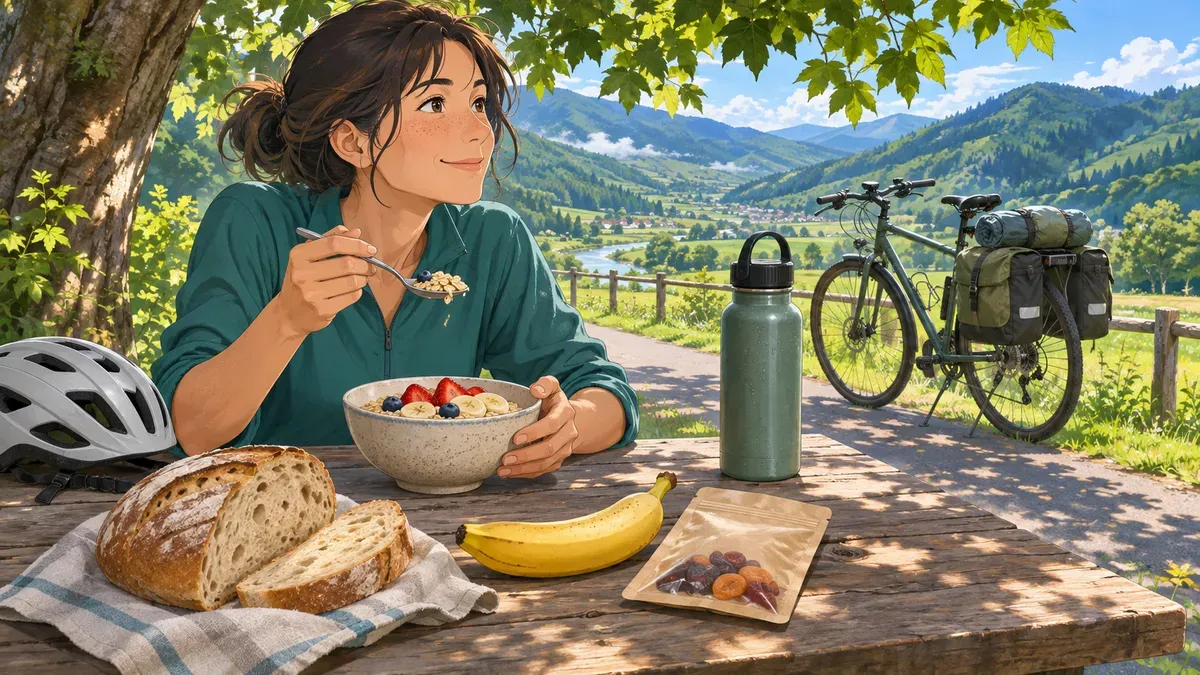
Choose a familiar carbohydrate base such as oats, bread, rice, or cereal. Add a protein source and fluid in amounts you tolerate. Examples include porridge with milk or fortified soy drink, bread with eggs, or rice with tofu. Prepare perishable ingredients immediately before eating unless reliable refrigeration is available.
Leave the digestion time you know works from training. A large meal immediately before a steep climb can be uncomfortable; a small breakfast followed by a planned early snack may fit an early departure better. The before-and-after workout food guide explains the separate issue of meal size and timing around a single session.
Before leaving, check that the first snack is accessible at a safe stop. Food buried under a sleeping bag is less likely to be eaten when the day gets busy. Do not eat while negotiating traffic, descending, or handling difficult terrain; stop somewhere safe to unwrap and chew.
Use carbohydrate guidance in the right context
The ISSN nutrient-timing position stand uses roughly 30–60 g of carbohydrate per hour for prolonged, demanding exercise. That is useful context for a hard, sustained riding block. It is not a requirement for every hour between leaving accommodation and arriving at camp, including long sightseeing or meal stops.
For a relaxed tour, start with normal meals and regular snacks, then adjust from rehearsals. When several hours of purposeful riding are planned, consider how much carbohydrate those snacks actually supply. A handful of nuts provides energy but is not interchangeable with a carbohydrate-rich snack. Nuts can still be useful elsewhere in the day’s menu.
Use package information where available and count drinks as well as food. For example, two portions labeled 20 g carbohydrate each supply 40 g in total. That arithmetic describes those portions; it does not establish that 40 g is your personal hourly requirement. Food sizes and recipes vary.
Increase amounts gradually during training if needed. A new high intake, several unfamiliar foods, heat, and a faster pace introduced together make digestive problems difficult to interpret. Riders with diabetes, glucose-lowering medication, kidney disease, or prescribed dietary restrictions need an individual plan from their clinician or dietitian.
Choose foods by function, tolerance, and storage
Ordinary food can supply exercise carbohydrate. In a randomized crossover study of 12 cyclists, potato purée and a carbohydrate gel supported similar cycling time-trial performance when carbohydrate delivery was matched, and both outperformed water alone (Salvador et al., 2019). Potato purée caused more digestive discomfort. This was a controlled exercise experiment, not evidence that every homemade snack is equally effective or safe to carry all day.
The practical lesson is flexibility. Choose food you enjoy, can digest, can obtain, and can keep safe. A portable option that remains uneaten because it tastes unpleasant after several hours does not solve the fueling problem.
| Food role | Everyday options | Limitation to check |
|---|---|---|
| Convenient carbohydrate | Bread, crackers, dried fruit, or a whole banana | Portion size, fiber tolerance, crushing, and packaging |
| Longer-stop meal | Rice, potatoes, pasta, or bread with a protein source | Safe preparation and storage; time to digest before harder riding |
| Compact extra energy | Nuts, seeds, or nut butter when tolerated | Allergies; these do not replace carbohydrate gram for gram |
| Recovery protein | Milk, yogurt, eggs, tofu, beans, fish, or meat | Actual protein amount, refrigeration, and preparation requirements |
| No-cook reserve | Unopened shelf-stable food suitable for your diet | Label instructions, edible portion, opening method, and water needed |
Fiber and fat belong in the overall diet. If large amounts feel uncomfortable during riding, shift more of them to meals after the demanding block. Do not turn one difficult afternoon into a permanent ban on vegetables, pulses, or whole grains.
Protect food from heat and contamination
A pannier is not a refrigerator. Meat, dairy, cut fruit, cooked rice, cooked potatoes, and other leftovers can require temperature control. Freshly cooked food does not become shelf-stable because it is homemade or wrapped tightly.
The CDC food-safety guidance says to refrigerate perishable food within 2 hours, or 1 hour when exposed to temperatures above 90°F (32°C), and keep refrigerated food at 40°F (4°C) or below. These are maximum handling limits, not a suggestion to spend the entire allowance before a long warm ride. An insulated bag only helps when it actually maintains the required temperature.
Without a reliable cold chain, choose foods labeled for ambient storage, prepare only what you will eat promptly, or buy perishable meals at the stop. Follow instructions after opening. Do not carry a cooked-rice lunch from breakfast to late afternoon in a warm bag and assume that smell will reveal whether it is safe.
Clean hands and utensils, protect ready-to-eat food from raw ingredients, and use safe water for food preparation. The USDA outdoor-food guidance emphasizes a cold source for perishable foods and warns against assuming clear stream water is safe. Keep stove fuel and cleaning chemicals away from food.
Keep fluid and sodium decisions individual
Make safe drinking water part of the route plan. Start normally hydrated and use thirst, conditions, and experience from similar rides to guide drinking. Long hot days or heavy sweating may justify a more deliberate plan, including sodium from food or drink.
The NATA fluid-replacement statement warns about both inadequate drinking and excessive intake. Do not force fluid to meet somebody else’s bottle schedule, and do not assume salt can make overdrinking safe. Our exercise hydration guide explains sweat-rate estimation and its limits.
Headache, nausea, and weakness have several possible causes. Confusion, collapse, severe headache, or repeated vomiting require stopping and urgent medical help; do not keep riding while experimenting with more water or food. A touring partner should know the emergency plan and location-sharing arrangements.
Refuel for tomorrow before the evening disappears
After a long day, eat a meal with a substantial carbohydrate source and protein, plus produce and fluid as available. Rice with lentils and yogurt, pasta with beans, or potatoes with fish are adaptable patterns. Portions must match the rider and workload; these examples are not nutritionally identical menus.
If dinner is delayed, have a practical snack rather than waiting hungry through camp setup and chores. Milk or a suitable soy drink with bread, or another familiar carbohydrate-and-protein combination, can bridge the gap when stored safely. Use a shelf-stable alternative when refrigeration is unavailable.
The NIH sports-nutrition fact sheet summarizes athlete protein guidance of approximately 0.55–0.9 g per pound (1.2–2.0 g per kilogram) daily. This broad range is context, not a requirement to reach its upper end. Include useful protein portions across meals rather than relying on a small amount at dinner; our protein-timing guide develops that separate question.
Food cannot compensate for an itinerary that exceeds your current capacity. When fatigue accumulates, reduce distance or intensity, improve sleep opportunities, and consider an easier day. The cycling training after 50 guide explains progressive preparation, while the recovery guide addresses the broader load-and-rest decision.
Rehearse a complete day, including the backup
Use this example as a sequence to adapt, not a fixed serving plan. Test it during a loaded practice ride with an overnight recovery period. Notice what you ate as well as what you packed.
| Stage | Practical action | Evidence that the plan needs adjusting |
|---|---|---|
| Before departure | Eat a familiar breakfast and pack accessible snacks | You start hungry or the meal repeatedly causes discomfort |
| First riding block | Use small familiar carbohydrate portions at safe stops | You postpone eating because access or packaging is awkward |
| Main stop | Eat a real meal and check the next resupply | The shop is closed or the next food gap is longer than expected |
| Arrival | Eat a bridging snack if dinner is delayed | Camp chores repeatedly replace the first recovery meal |
| Evening | Eat dinner, prepare safe food for tomorrow, and review the route | You cannot face the packed foods or have no breakfast option |
Write one fallback for a missed shop and one for a failed stove. Check whether the reserve requires water, heating, a can opener, or refrigeration after opening. The best backup is one you can actually use while tired in the conditions you expect.
Watch the pattern with SuperAge
After the food and route plan are workable, use SuperAge to view activity, sleep, and recovery patterns alongside brief notes about meals, digestive comfort, and next-morning energy. Compare similar riding days before changing several habits at once.
The 2023 IOC REDs consensus describes health and performance problems from problematic low energy availability in women and men. Persistent fatigue, recurrent injuries, menstrual changes, or an unexplained performance decline deserve professional assessment. One bad day cannot diagnose REDs, and a wearable calorie estimate or biological-age score cannot determine exactly how much you should eat.
Download SuperAge on the App Store to review your activity and recovery context while building a repeatable touring routine.
Frequently asked questions
What should I eat on a bike tour?
Use carbohydrate-containing meals and snacks, protein across the day, varied produce, and enough total food for the actual riding. Adapt portions and storage to the route, weather, appetite, and dietary needs.
Do I need 60 g of carbohydrate every hour?
No universal hourly target applies to all touring. The 30–60 g range is guidance for prolonged demanding exercise. Rehearse a plan for your riding blocks, and include normal meals and any carbohydrate-containing drinks in the overall picture.
Can I tour using ordinary food instead of sports products?
Yes. Ordinary foods can supply carbohydrate and other nutrients. Consider digestion, portion size, portability, preparation, and food safety rather than assuming a product label is necessary for effective fueling.
Is trail mix enough for a long riding day?
It can add compact energy, but its carbohydrate content varies and it may contain substantial fat and fiber. Combine it with appropriate carbohydrate foods and meals instead of treating every handful as a complete fueling plan.
Can I carry cooked rice or potatoes all day?
Only with appropriate safe storage. Cooked food can require refrigeration. Without temperature control, prepare it for prompt eating or choose an unopened shelf-stable option designed for ambient storage.
Should I use a bike tour to lose weight?
Avoid deliberately combining a demanding unfamiliar itinerary with aggressive restriction. Arrive adequately fed, support riding and recovery, and discuss weight goals separately with a qualified professional when needed.
What if I feel sick and cannot keep food down?
Stop riding and reassess. Persistent or repeated vomiting, confusion, collapse, or severe headache need urgent medical help. Do not assume every symptom is a simple lack of sugar or water.
What if I follow a plant-based diet?
Use familiar carbohydrate foods plus practical protein sources such as beans, lentils, tofu, or suitable soy foods, with safe storage. Check food availability before departure and keep a backup that fits your diet and allergies.
Key takeaways
- Plan food access and a delay reserve before deciding the menu.
- Match meals and riding snacks to the actual workload and your tested tolerance.
- Keep perishable food cold or choose genuinely shelf-stable alternatives.
- Eat after riding early enough to support the next day.
- Change the itinerary when food access, symptoms, or fatigue remove your margin.
References
- Kerksick CM et al. International society of sports nutrition position stand: nutrient timing. Professional position statement. 2017.
- Salvador AF et al. Potato ingestion is as effective as carbohydrate gels to support prolonged cycling performance. Randomized crossover trial. 2019.
- Centers for Disease Control and Prevention. Preventing food poisoning. Accessed November 2026.
- USDA Food Safety and Inspection Service. Keeping food safe during outdoor activities. Accessed November 2026.
- McDermott BP et al. National Athletic Trainers’ Association position statement: fluid replacement for the physically active. 2017.
- NIH Office of Dietary Supplements. Dietary supplements for exercise and athletic performance: health professional fact sheet. Accessed November 2026.
- Mountjoy M et al. 2023 International Olympic Committee consensus statement on Relative Energy Deficiency in Sport. 2023.
Related Articles

Return-to-work stress after vacation: a practical reentry plan
Ease return-to-work stress after vacation with a realistic first-week plan for sleep, workload, movement and recovery. Learn when to seek extra support.