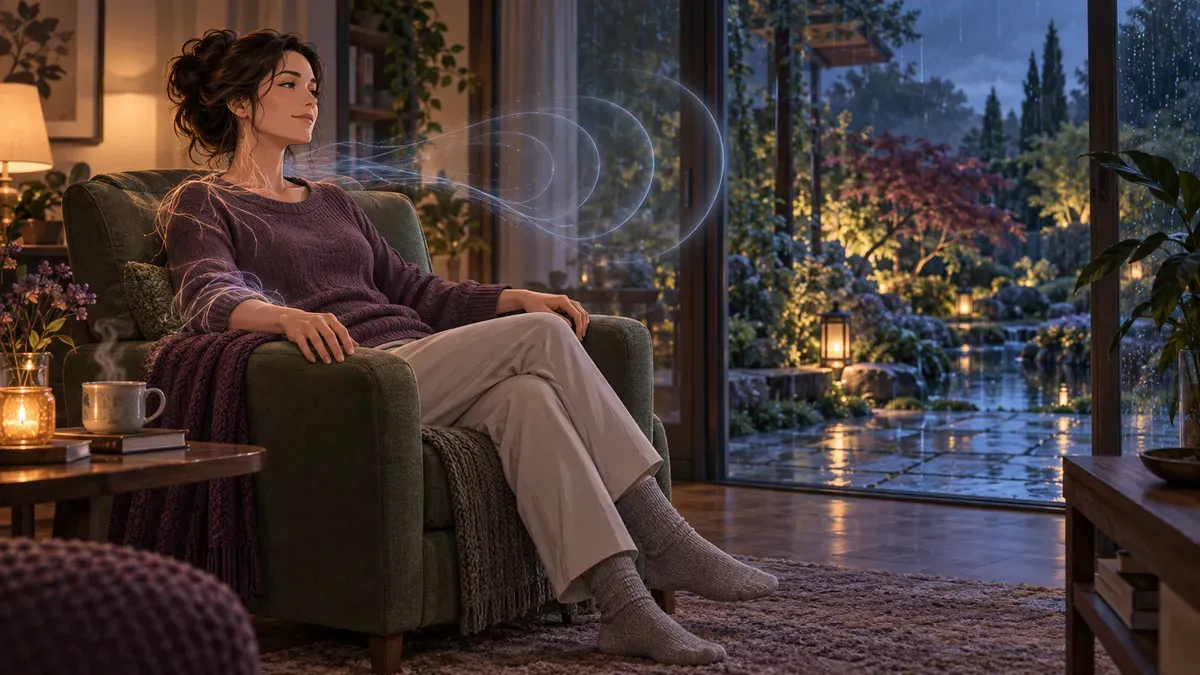
Relaxation techniques for stress: how to choose and practise them
Compare relaxation techniques for stress, anxiety, and sleep, with practical breathing, muscle relaxation, imagery, and clear safety guidance for daily use.
Relaxation techniques are deliberate skills that help reduce physical arousal and make attention less captive to stress. They do not erase a problem, switch off every anxious thought, or treat an underlying disorder on their own. What they can do is give your nervous system a repeatable route from activation toward recovery.
The most useful method is not necessarily the most fashionable one. Slow diaphragmatic breathing is discreet and fast. Progressive muscle relaxation works well when stress feels like a clenched jaw or raised shoulders. Guided imagery can occupy a mind that keeps rehearsing tomorrow. Grounding is often easier than closing your eyes when inward focus feels uncomfortable.
This guide compares those options, shows exactly how to practise them, and explains when persistent anxiety, panic, trauma symptoms, or insomnia need more than self-help.
Quick answer
For immediate stress, start with two to five minutes of comfortable, slower breathing with a slightly longer exhale. If your body stays tense, use a 10-minute progressive muscle relaxation sequence. If repetitive thoughts are the main problem, try guided imagery or a sensory grounding exercise. Practise one method when you are relatively calm for seven days before judging it. Relaxation can support anxiety and sleep care, but it should not replace professional treatment when symptoms are severe, persistent, or impair daily life.
Key facts
- Slow diaphragmatic breathing reduces breathing pace and short-term physiological arousal.
- Progressive muscle relaxation alternates gentle tension and release to make hidden muscular tension easier to recognise.
- Guided imagery directs attention toward a detailed, calming scene rather than trying to force the mind blank.
- Regular practice builds a faster association between a familiar routine and settling down.
- Persistent anxiety or insomnia requires assessment when relaxation alone does not restore normal function.
What relaxation techniques actually do
Stress prepares the body to respond. Breathing may become faster or shallower, muscles brace, attention narrows, and the heart beats more forcefully. A relaxation technique deliberately changes one or more of those inputs: respiration, muscle tone, sensory attention, or self-directed imagery.
The US National Center for Complementary and Integrative Health describes the relaxation response as a state associated with slower breathing, a lower heart rate, and lower blood pressure. That does not mean every session produces all three changes, or that feeling calm proves a medical condition has improved. It means the techniques train behaviours that are incompatible with constantly escalating arousal.
This distinction matters:
- Distraction temporarily pulls attention away from discomfort.
- Relaxation practises a shift in bodily or attentional state.
- Grounding reconnects attention to the present environment.
- Mindfulness notices experience without needing to change it.
- Therapy addresses patterns, diagnoses, and functional impairment with a qualified professional.
These approaches can overlap. A five-minute breathing practice may be mindful and relaxing; guided imagery may also be grounding. The label is less important than whether the method is safe, repeatable, and matched to what you notice.
If you want to train noticing and returning attention rather than change arousal directly, our beginner meditation guide compares focused attention, body scan, loving-kindness, and walking practice.
Choose a technique by the signal you notice first
| Your first signal | Technique to try | Starting dose | Why it may fit |
|---|---|---|---|
| Fast, shallow breathing | Diaphragmatic breathing | 2–5 minutes | Gives respiration a slower, steadier rhythm |
| Jaw, shoulder, hand, or back tension | Progressive muscle relaxation | 10 minutes | Makes tension and release easier to distinguish |
| Repetitive mental rehearsal | Guided imagery | 5–10 minutes | Gives attention a structured sensory task |
| Feeling scattered or unreal | Sensory grounding | 1–3 minutes | Reorients attention to the current place and time |
| General tension with no clear focus | Autogenic training | 5–10 minutes | Pairs simple phrases with sensations of warmth and heaviness |
| Bedtime arousal | PMR or slow breathing | 10–20 minutes | Reduces effort and physical activation without chasing sleep |
Treat this table as a starting experiment, not a diagnosis. A method that helps one person may irritate another. The useful question is: after practising, can I return to the next sensible action with less effort?
Technique 1: diaphragmatic breathing for a fast reset
Diaphragmatic breathing lets the abdomen expand as the diaphragm descends, rather than lifting the upper chest with every breath. A 2019 systematic review found promising reductions in psychological or physiological stress across the three eligible studies, while also emphasising the small and heterogeneous evidence base. A 2023 randomised study of 108 adults found that five minutes per day of structured breathing improved mood and reduced state anxiety over 28 days; cyclic sighing produced the largest increase in positive affect and the largest fall in respiratory rate relative to mindfulness meditation.
Those findings support a brief practice. They do not prove that one exact breathing count treats anxiety disorders or extends life.
A comfortable two-minute protocol
- Sit with your back supported and both feet resting on the floor, or lie down if that is comfortable.
- Place one hand lightly over the lower ribs or abdomen.
- Inhale through the nose without trying to fill the lungs maximally.
- Let the abdomen and lower ribs expand while the shoulders stay quiet.
- Exhale gently for a little longer than you inhaled.
- Repeat for 10 to 15 easy breaths, then return to normal breathing.
Do not force a very deep breath. Overbreathing can lower carbon dioxide and cause tingling, lightheadedness, chest tightness, or a sense of air hunger. If that happens, stop controlling the breath and let it settle naturally. For a fuller comparison of slow breathing, cyclic sighing, box breathing, and more intense methods, use our evidence-based breathwork guide.
Technique 2: progressive muscle relaxation for a tense body
Progressive muscle relaxation, or PMR, alternates a mild contraction with a longer release in a sequence of muscle groups. The contrast teaches you to detect tension that may otherwise feel normal. A 2024 systematic review included 46 publications and more than 3,400 adults, with generally favourable findings for stress, anxiety, and depression, although protocols and populations varied. A 2026 meta-analysis of 31 randomised trials found improvements in sleep quality and anxiety, but the high statistical heterogeneity means the large pooled effects should not be promised to every individual.
A 10-minute PMR sequence
Choose a quiet place where falling asleep would be safe. For each area, tense gently for about five seconds, release, and notice the contrast for 10 to 15 seconds.
- Make soft fists, then open the hands.
- Bend the elbows slightly, then let the arms rest heavily.
- Lift the shoulders toward the ears, then allow them to drop.
- Press the lips together and tighten the jaw very lightly, then leave space between the teeth.
- Draw the shoulder blades back without arching hard, then release.
- Tighten the abdomen mildly, then let it soften with the exhale.
- Press the thighs together, then release.
- Point the toes away or gently tighten the calves, then let the feet become still.
- Scan from forehead to feet and relax any area that re-tightened.
Use only enough effort to feel a contrast. Skip an injured, painful, recently operated, cramped, or spastic muscle group. You can also use progressive relaxation without tensing: move attention through the body and invite each area to soften. That version may suit chronic pain, injury, pregnancy, or anyone who finds contraction uncomfortable, with individual medical guidance when needed.
Technique 3: guided imagery for a busy mind
Guided imagery builds a detailed mental scene associated with safety or ease. It is not positive thinking and it does not require a vivid internal picture. Sound, temperature, texture, movement, and spatial detail can carry the exercise even if visual imagery is faint.
Research is condition-specific. Reviews have found potential benefit for anxiety in perioperative and cancer settings, but protocols differ and many studies combine imagery with PMR or other care. It is more accurate to say guided imagery may support short-term calm in some contexts than to call it a universal treatment.
A five-minute imagery practice
- Choose a real or imagined setting that feels neutral-to-pleasant, not emotionally loaded.
- Notice three visual details: distance, shape, and colour.
- Add two sounds, such as leaves moving or low rain.
- Add physical detail: the support under your body, air temperature, or a steady surface beneath your feet.
- Let breathing remain natural while you explore the scene rather than trying to “achieve” calm.
- End by noticing the actual room, moving the hands and feet, and opening the eyes.
If a beach, forest, or closed-eye scene feels unsafe, do not force it. Keep your eyes open and describe an ordinary object in the room in precise detail instead.
Technique 4: sensory grounding when inward focus backfires
Some people become more anxious when asked to monitor the breath, heartbeat, or internal sensations. Grounding moves attention outward. The World Health Organization’s stress guide uses grounding as one of several practical skills for coping with adversity and recommends brief, repeated practice rather than waiting for a crisis.
The 5-4-3-2-1 grounding exercise
Name, silently or aloud:
- five things you can see;
- four things you can physically feel;
- three things you can hear;
- two things you can smell or remember smelling;
- one thing you can taste, or one slow sip of water.
Accuracy matters less than orientation. State your name, the date, where you are, and the next safe action if that helps. Grounding aims to restore contact with the present; it is not a challenge to eliminate every symptom.
Technique 5: autogenic training for repeatable self-cues
Autogenic training uses brief phrases that direct attention toward sensations such as heaviness, warmth, calm breathing, or a steady heartbeat. A 2019 systematic review and meta-analysis reported improvements in several stress-related outcomes, but sample sizes for some comparisons were small and an older systematic review judged the trial quality insufficient for firm conclusions. It is a reasonable option when repetition feels easier than imagery, provided the claims remain modest.
Try this for five minutes:
- Sit or lie comfortably.
- Repeat slowly: “My hands feel comfortably heavy.”
- After several repetitions, use: “My hands feel comfortably warm.”
- Continue with: “My breathing is easy and unforced.”
- Finish by opening the eyes, stretching gently, and standing only when fully alert.
Treat the phrases as attentional cues, not commands. There is no need to manufacture warmth, slow the heart, or persist if focusing on internal sensations feels alarming.
How to practise without turning relaxation into another test
A common mistake is to try a technique only at the peak of distress, decide it “failed” after 30 seconds, and switch to something new the next day. Skills become easier to retrieve when rehearsed under lower pressure.
A seven-day experiment
| Day | Practice | What to record |
|---|---|---|
| 1–2 | One method for 3–5 minutes | Tension before and after, 0–10 |
| 3–4 | Same method at the same cue | Ease of starting and finishing |
| 5 | Use it after a mild everyday stressor | Time needed to return to the task |
| 6 | Try a second method once | Which signal it matched better |
| 7 | Choose the simpler repeatable routine | Whether it helped function, not perfection |
Attach practice to a cue you already have: after closing a laptop, before entering the house, following a warm shower, or once the phone is charging outside the bedroom. Consistency works better than waiting to feel motivated. The same behavioural principle underlies building exercise consistency: make the first step small, obvious, and easy to repeat.
Measure success by recovery, not sedation. You may still have a difficult thought, elevated heart rate, or unfinished problem. A useful session can simply create enough space to send one email, eat a meal, begin a wind-down routine, or ask for help.
Relaxation for anxiety: support, not avoidance
Meta-analyses suggest relaxation training can reduce anxiety symptoms, including in people with anxiety disorders. Yet relaxation and exposure-based treatment can serve different purposes. If you use relaxation only to escape every harmless bodily sensation or feared situation, it can become a safety behaviour that keeps the fear cycle intact.
For everyday stress, practise and continue with the next valued action. For recurrent panic, compulsions, trauma symptoms, or avoidance that is shrinking your life, a clinician can help decide whether cognitive behavioural therapy, exposure-based work, medication, or another treatment is appropriate. Relaxation may remain one tool inside that plan, but it is not the whole plan.
Your data can also mislead if every change becomes a verdict. A single low HRV value does not prove psychological stress, and a higher value after breathing does not prove recovery. Use the trend principles in our guide to reading HRV over time and consider sleep, illness, alcohol, training load, and measurement conditions.
Relaxation for sleep: lower effort instead of chasing sleep
The American Academy of Sleep Medicine conditionally suggests relaxation therapy as a single-component treatment for chronic insomnia, based on low-quality evidence and modest potential harms. Its strong recommendation is for multicomponent cognitive behavioural therapy for insomnia, or CBT-I. That hierarchy is important.
At bedtime, use PMR, slow breathing, or neutral imagery to reduce arousal—not to force unconsciousness on a deadline. If you are awake and increasingly frustrated, follow a clinician-approved stimulus-control plan rather than repeating techniques for hours. Persistent insomnia deserves assessment for medical conditions, medication effects, sleep apnoea, restless legs, mood disorders, and other contributors. Our deep-sleep guide covers the broader sleep routine, while relaxation is only one piece.
How SuperAge can track recovery without scoring the session
Relaxation is a subjective skill. Wearable data can add context, but it should not become a real-time exam. SuperAge can help you review longer trends from Apple Health—such as resting heart rate, HRV, sleep, respiratory rate, and activity—alongside the routines you are testing.
A useful experiment might compare two weeks with a consistent five-minute evening practice against your own previous pattern. Keep bedtime, alcohol, illness, and training changes in mind. Look for converging signals: easier wind-down, fewer stress-driven interruptions, a steadier resting pattern, and better daytime function. Do not chase a particular HRV number during each session.
If the bigger question is whether stress appears in your longitudinal data, start with our guide to stress tracking and biological aging. If prolonged stress is disrupting sleep and recovery, the cortisol and chronic stress guide explains why a rhythm and symptom history matter more than a single “stress hormone” claim.
Safety: when to stop or seek help
Relaxation techniques are generally considered safe for healthy adults, but “natural” does not mean universally comfortable. NCCIH notes occasional reports of increased anxiety, intrusive thoughts, or fear of losing control, and rare worsening in people with some psychiatric conditions, epilepsy, or histories of abuse or trauma.
Use these boundaries:
- Stop a breathing exercise if you become dizzy, faint, numb, or markedly short of breath.
- Never use hyperventilation or long breath holds in water, while driving, standing at height, or anywhere fainting would be dangerous.
- Skip forceful muscle contraction over pain, injury, recent surgery, severe cramping, or a condition for which a clinician has advised limits.
- Keep your eyes open and use external grounding if imagery or body scanning triggers flashbacks, dissociation, or panic.
- Do not use relaxation to delay urgent care for chest pain, severe breathlessness, fainting, suicidal thoughts, or another medical or mental health emergency.
- Seek professional help when anxiety, panic, low mood, trauma symptoms, or insomnia persists, worsens, or impairs work, relationships, self-care, or safety.
The goal is flexible regulation, not tolerating a technique that feels wrong.
Common mistakes and simple corrections
Breathing bigger instead of breathing easier
Very deep or rapid breaths can increase dizziness and alarm. Make the breath quieter and more comfortable, with no demand to fill the lungs.
Tensing muscles as hard as possible
PMR needs contrast, not maximal force. Use mild tension and skip painful areas.
Demanding an empty mind
Thoughts will continue. Return attention to one sensation, phrase, or detail without grading the interruption.
Checking the watch every minute
Immediate biometrics can become another source of vigilance. Review trends later, under comparable conditions.
Using only crisis practice
Rehearse when calm enough to learn the sequence. That creates a familiar path you can use under pressure.
Expecting relaxation to solve the stressor
After the exercise, choose one action: set a boundary, make a plan, rest, move, contact someone, or seek care. Regulation should help you respond, not postpone every decision.
Frequently asked questions
What is the fastest relaxation technique for stress?
Comfortable slow breathing or external grounding is usually the fastest to start because neither needs privacy, equipment, or a long script. Give it two minutes, then assess whether you can take the next useful action. If the main signal is muscle tension, a shortened PMR scan may fit better.
How long should a relaxation session last?
Start with two to five minutes for breathing or grounding and about 10 minutes for PMR or guided imagery. A short routine you repeat is more useful than an ambitious 30-minute session you avoid. Increase duration only if it remains comfortable and practical.
Should I inhale for four seconds and exhale for six?
That is a reasonable optional rhythm, not a universal prescription. The breath should remain easy. If counting creates air hunger or anxiety, drop the count and simply let the exhale become slightly slower than the inhale.
Is progressive muscle relaxation safe with chronic pain?
It may be adaptable, but do not tense painful, injured, or medically restricted areas. Progressive relaxation without contraction may be more comfortable. Ask a clinician or physiotherapist for individual guidance when pain, surgery, spasticity, or mobility limitations are involved.
Can relaxation techniques cure anxiety?
No single relaxation technique cures every cause of anxiety. They may reduce symptoms and improve coping, but persistent or impairing anxiety may need evidence-based psychotherapy, medication, medical evaluation, or a combination of care.
Which relaxation technique is best for sleep?
PMR, comfortable slow breathing, and neutral guided imagery are all reasonable options. For chronic insomnia, CBT-I has stronger guideline support than relaxation alone. Use relaxation to lower arousal rather than to force sleep.
What if closing my eyes makes me more anxious?
Keep them open. Look around the room, name colours and shapes, feel both feet on the floor, and use the 5-4-3-2-1 grounding sequence. You do not need inward focus or imagery to practise regulation.
How will I know whether the technique is working?
Look for functional changes: less muscle bracing, an easier exhale, quicker return to a task, fewer stress-driven behaviours, or a smoother wind-down. Judge the pattern across several days, not one session or one wearable reading.
Key takeaways
- Match the technique to the first signal: breath, muscle tension, repetitive thoughts, or disorientation.
- Start small and practise for seven days under manageable conditions.
- PMR and slow breathing have useful evidence, but effects vary and claims should remain proportionate.
- Grounding is a valid alternative when closed eyes or internal sensations feel unsafe.
- Relaxation supports sleep and anxiety care; it does not replace CBT-I, psychotherapy, medical assessment, or urgent help when those are needed.
- Track recovery trends and daily function rather than demanding a perfect feeling or number after every session.
Build your repeatable relaxation practice
Choose one method, set a three-to-ten-minute cue, and record only tension and function before and after. Review the pattern after a week. If you use Apple Health, SuperAge can help you place that experiment beside longer-term sleep, HRV, resting heart rate, respiratory rate, and activity trends without turning a single session into a diagnosis.
References
- National Center for Complementary and Integrative Health: Relaxation techniques—what you need to know
- Muhammad Khir et al. Efficacy of progressive muscle relaxation in adults for stress, anxiety, and depression: a systematic review (2024)
- Ogasawara Donato et al. Progressive muscle relaxation improves sleep quality and mental health: systematic review and meta-analysis (2026)
- Hopper et al. Diaphragmatic breathing for reducing physiological and psychological stress in adults: systematic review (2019)
- Balban et al. Brief structured respiration practices enhance mood and reduce physiological arousal (2023)
- Edinger et al. AASM clinical practice guideline for behavioural and psychological treatments of chronic insomnia (2021)
- Seo and Kim. Effect of autogenic training for stress response: systematic review and meta-analysis (2019)
- Kim and Kim. Effects of relaxation therapy on anxiety disorders: systematic review and meta-analysis (2018)
- World Health Organization: Doing what matters in times of stress
- US Department of Veterans Affairs: Guided imagery
Related Articles
GABA and aging: sleep, stress, and what the evidence says
GABA supports sleep, stress resilience, and cognition. Learn what aging research shows, what oral GABA can and cannot do, and practical ways to support calm.