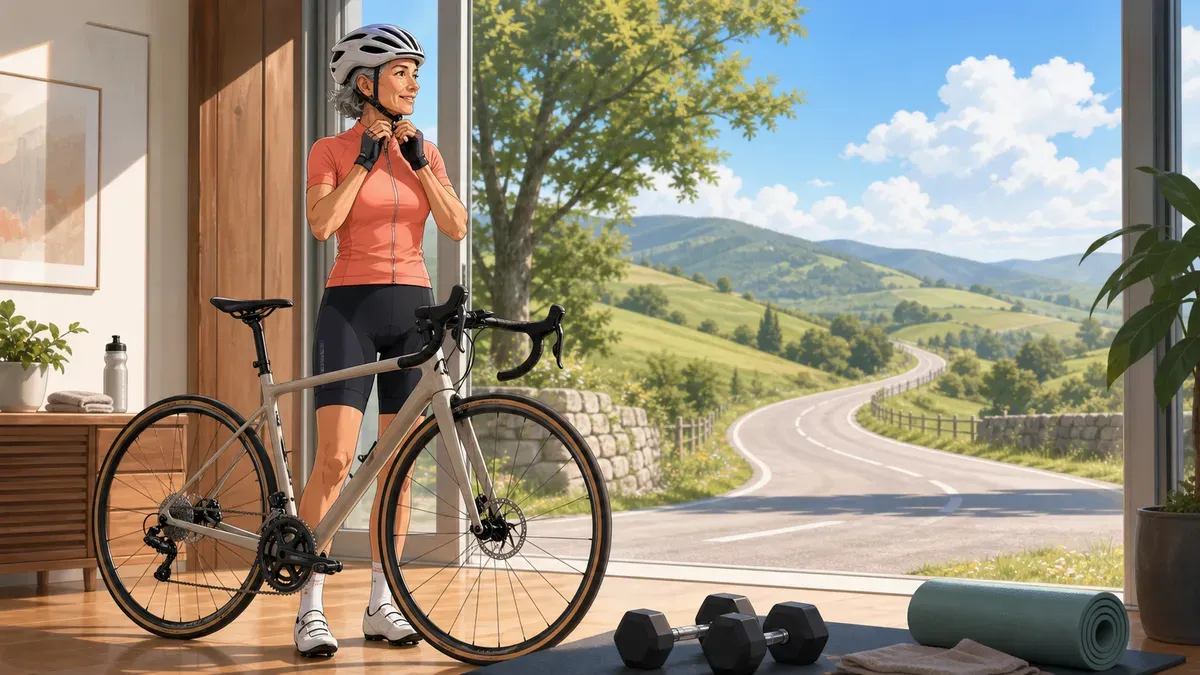
Cycling training after 50: build endurance, strength, and recovery
Cycling training after 50 needs steady endurance, targeted intervals, strength work, and enough recovery. Build a practical weekly plan that lasts.
Cycling training after 50 can still improve endurance, climbing, speed, and confidence. The useful change is not to make every ride easier because of your birthday. It is to give each session a clear job, preserve muscle and bone with strength work, and leave enough space to absorb the hard work.
That usually means a mostly easy riding week, one purposeful interval session, two short strength sessions, and at least one genuine recovery day. A newer or returning rider can progress with three rides per week. An experienced cyclist may tolerate four or five, but more volume only helps when performance, sleep, mood, and everyday energy remain stable.
This guide turns those principles into a practical plan for recreational cyclists and masters athletes. It is not a medical clearance or a race prescription. If you have chest pressure, unexplained fainting, unusual breathlessness, known cardiovascular disease, or a major change in exercise tolerance, pause and seek clinical advice before testing your limits.
Quick answer
The best cycling training plan after 50 combines three types of riding: easy endurance for aerobic capacity, a limited dose of intervals for high-end fitness, and a longer ride for durability. Add strength training twice per week, keep hard days separated by easier days, and progress one variable at a time.
A useful four-ride week is one interval ride, two easy endurance rides, and one longer easy ride. Start with 150 to 240 total riding minutes if you are returning, then add roughly 5% to 10% only after two stable weeks. If fatigue rises, keep frequency but shorten a ride before removing all intensity or abandoning consistency.
If your goal is a multi-day ride, our bike touring gear guide adds a practical method for balancing luggage, planning water, and rehearsing repairs.
Key facts
- Consistent cycling preserves aerobic capacity: regular training slows the fitness loss associated with reduced training volume.
- Easy rides build repeatable endurance: conversational work develops aerobic volume without turning every day into a recovery problem.
- Targeted intervals maintain high-end fitness: one well-executed hard session can supply a strong stimulus without dominating the week.
- Strength training protects function: progressive resistance work supports force production, lean mass, and the bone-loading that cycling lacks.
- Recovery converts stress into adaptation: sleep, fueling, and easier days determine whether training builds fitness or accumulates fatigue.
What changes after 50—and what does not
Age affects physiology, but it does not create one universal training response. Two 55-year-old riders can differ more from each other than either differs from a younger cyclist. Training history, menopause status, sleep, medication, injury history, work stress, nutrition, and chronic conditions all matter.
Research on masters athletes shows a gradual decline in maximal aerobic capacity and peak power with age, while exercise economy can remain relatively stable. A classic review by Tanaka and Seals found that lower training volume and intensity explain a meaningful part of the endurance-performance decline seen in older athletes. More recent analyses similarly link changes in masters athletes’ VO2 max to changes in training volume—not age alone.
The practical lesson is encouraging: do not stop training the capacities you want to keep. Instead, deliver enough stimulus to preserve them and adjust recovery from your actual response.
Aerobic capacity needs a reason to stay
Long, steady riding remains valuable, but endurance alone does not fully challenge maximal oxygen delivery. A small study of trained masters cyclists found that aerobic capacity was comparatively well preserved across ages 35 to 64 while short-duration anaerobic power declined more clearly. That does not prove everyone needs sprints. It does show why always riding at one comfortable pace can leave higher-intensity capacity untrained.
Muscle and power deserve direct work
Cycling can maintain substantial leg muscle in active older riders, yet the pedal stroke is repetitive and supported. It does not expose the body to every force, direction, or loading pattern needed for robust aging. Resistance training fills that gap and helps preserve the ability to accelerate, climb, stabilize the bike, and handle daily tasks off it.
Recovery becomes a measurement problem
It is common to say that everyone recovers more slowly after 50, but that is too crude. Some experienced masters cyclists tolerate considerable training because years of practice have built durability. Others need more time after high-intensity sessions, especially during poor sleep, energy deficit, illness, or high life stress.
Judge recovery by signals: stable easy-ride effort, normal appetite, good sleep, ordinary mood, and the ability to complete quality work without a multi-day performance collapse. Your calendar age informs the plan; your response controls it.
The four pillars of cycling training after 50
1. Easy endurance riding
Easy endurance is the foundation because it adds aerobic work at a cost you can repeat. Use the talk test: you should be able to speak in full sentences, breathing more deeply but without strain. On a 1-to-10 rating of perceived exertion (RPE) scale, most of the ride should feel like 2 to 4.
If you use heart rate or power, treat the number as a guardrail rather than a command. Heat, dehydration, altitude, caffeine, medication, and fatigue can change the relationship between output and heart rate. Our guide to heart-rate zones by sport explains why cycling zones should be set from cycling data rather than copied from another activity.
Start with 30 to 60 minutes. Build a longer ride gradually toward 90 minutes or more if your goals require it. A rider preparing for a charity event may progress from 15 miles (24 km) to 35 miles (56 km); a health-focused rider may never need that distance.
2. One purposeful intensity session
Intervals help maintain VO2 max, threshold, and the ability to respond to hills or changes of pace. More is not automatically better. Begin with one hard cycling session per week, particularly if you also lift weights or are returning after time away.
Choose one format that matches your goal:
| Goal | Main set | Recovery | Effort cue |
|---|---|---|---|
| Rebuild tolerance | 6 × 1 minute firm | 2 minutes easy | RPE 7, controlled throughout |
| Improve aerobic power | 4 × 4 minutes hard | 4 minutes easy | RPE 8, last rep resembles first |
| Develop threshold | 3 × 8 minutes strong | 4 minutes easy | RPE 7–8, sustainable not maximal |
| Preserve acceleration | 6 × 10 seconds fast | 3 minutes very easy | Crisp technique, full recovery |
Warm up for at least 10 to 15 minutes and include several brief cadence changes before hard work. End the session when technique, power, or pace drops sharply. The aim is repeatable quality, not exhaustion. For more options, use our HIIT cycling workout guide and choose only one interval family at a time.
3. Strength and bone-loading work
The World Health Organization recommends muscle-strengthening work on at least two days per week for adults. That is especially relevant to cyclists because riding is low impact. In a seven-year study of male masters cyclists, bone mineral density was lower than in nonathletes, while participants who did weight training or impact exercise lost less bone at the spine and femoral neck.
Two short full-body sessions can cover the essentials:
- Squat pattern: goblet squat, box squat, or leg press
- Hip hinge: Romanian deadlift, kettlebell deadlift, or hip bridge
- Single-leg pattern: split squat, step-up, or supported lunge
- Calf and ankle work: calf raise plus controlled ankle mobility
- Pull and push: row plus push-up or press
- Trunk stability: side plank, suitcase carry, or bird dog
Begin with 2 sets of 6 to 12 controlled repetitions. Leave two or three good repetitions in reserve and add load only when every repetition looks the same. A small controlled trial in masters road cyclists found that adding strength and sprint training improved lower-limb lean mass and sprint performance over 12 weeks. Broader cycling evidence also supports heavy strength work for performance, but the exact load should match technique, experience, and medical context.
Place strength after an easy ride or later on the same day as cycling intensity so that hard stress is consolidated. Avoid heavy lower-body lifting immediately before your most important interval or long ride. If the squat is new, start with our goblet squat technique and progression guide.
4. Recovery with objective rules
Recovery is not a passive bonus. It is part of the dose. Keep at least 24 to 48 hours between demanding lower-body sessions until your response shows that you can tolerate more. Easy spinning is recovery only when it stays easy; a group ride with repeated surges is another hard day.
Use three questions each morning:
- Does normal walking and stair climbing feel ordinary?
- Is easy cycling effort close to its usual relationship with pace, heart rate, or power?
- Am I mentally willing to train, without needing stimulants to feel functional?
One abnormal signal is context. Two or three persisting together justify a shorter easy ride or rest. If fatigue lasts beyond several days, performance keeps falling, or symptoms are focal and painful rather than general soreness, investigate instead of adding training. Our recovery-between-workouts guide provides a fuller decision framework.
A practical weekly cycling plan after 50
This four-ride template suits an established recreational cyclist. Move sessions to fit work and family life, but preserve the sequence of stress and recovery.
| Day | Session | Purpose |
|---|---|---|
| Monday | Rest or 20–30 minutes mobility and walking | Absorb the weekend |
| Tuesday | Intervals, 50–70 minutes total | Aerobic power or threshold |
| Wednesday | Strength, 35–50 minutes | Lean mass, force, bone loading |
| Thursday | Easy ride, 45–75 minutes | Aerobic volume |
| Friday | Rest or very easy spin, 20–40 minutes | Recovery |
| Saturday | Long easy ride, 90–180 minutes | Durability and fueling practice |
| Sunday | Easy ride, 45–60 minutes plus short strength | Technique and full-body strength |
This is a template, not a minimum. A returning rider can use Tuesday, Thursday, and Saturday only, replacing intervals with easy riding for the first two weeks. An experienced rider can add volume to Thursday or Sunday before adding a second hard day.
Progress without chasing weekly fatigue
Increase only one variable at a time: ride duration, interval repetitions, interval duration, or strength load. Hold the new dose for two weeks before judging it. A 5% to 10% increase can be a reasonable ceiling, not a requirement; riders returning from illness or injury may need smaller steps.
Every three to five weeks, reduce volume by roughly 20% to 35% while retaining a few short efforts. A recovery week should finish with more energy than it began. If you feel worse after the reduction, the problem may be sleep, nutrition, illness, medication, or accumulated stress rather than insufficient willpower.
An 8-week return-to-cycling progression
If you are restarting after months or years away, durability should precede intensity.
| Weeks | Rides | Focus | Longest ride |
|---|---|---|---|
| 1–2 | 3 | Easy cadence, handling, comfort | 45–60 minutes |
| 3–4 | 3 | Add 4–6 short hills at RPE 6 | 60–75 minutes |
| 5–6 | 3–4 | Add 6 × 1 minute firm efforts | 75–90 minutes |
| 7 | 4 | Maintain one interval day | 90–120 minutes |
| 8 | 3 | Reduce volume, review progress | 60–90 minutes |
Repeat a block rather than forcing the next step if soreness affects normal movement, easy rides feel progressively harder, or bike contact points remain painful. Saddle, hand, neck, and knee discomfort are often setup or load-management problems, not proof that cycling is unsuitable after 50.
Fueling, protein, hydration, and sleep
Under-fueling is easy to mistake for age-related decline. A long ride performed without enough carbohydrate can impair the next strength session; a chronic calorie deficit can reduce lean mass and recovery.
For rides under about 60 minutes at easy intensity, normal meals and water are often enough. For longer or harder sessions, practice taking carbohydrate and fluid before fatigue becomes obvious. Exact needs depend on heat, sweat rate, body size, duration, and gastrointestinal tolerance, so use training—not event day—to find what works.
Protein supports muscle repair, especially when paired with resistance training. The PROT-AGE position paper recommends at least 1.0 to 1.2 grams per kilogram of body weight per day for adults over 65, with at least 1.2 g/kg/day suggested for active older adults when clinically appropriate. Sports-nutrition guidance often uses a wider 1.4 to 2.0 g/kg/day range for healthy exercising adults. Kidney disease and some other conditions require individualized clinical advice; more protein is not automatically safer or better.
Distribute protein across meals instead of relying on one large evening serving. Carbohydrate remains the main fuel for hard cycling, while dietary fat supports overall energy intake and food quality. Our protein timing guide explains the meal-level details without requiring a supplement.
Sleep is the final training session. Protect a regular sleep window and watch trends rather than overreacting to one poor night. If sleep is consistently short, swap a hard ride for easy endurance before stacking more caffeine on top of fatigue.
Track adaptation with SuperAge, not just workload
After 50, the most useful training dashboard pairs what you did with how your body responded. Weekly miles alone cannot show whether fitness is improving.
Track a small set of signals:
- Easy-ride efficiency: similar route and conditions, with lower perceived effort or heart rate at the same pace or power
- Repeatability: smaller drop-off between interval repetitions
- Heart-rate recovery: how quickly heart rate falls after a standardized effort
- Strength progression: more load or cleaner repetitions without joint irritation
- Subjective recovery: sleep, soreness, motivation, and everyday energy
Avoid turning one wearable score into a veto. Heart rate variability, resting heart rate, sleep, and training load are most informative as trends interpreted alongside symptoms and performance. A low number after travel or poor sleep may confirm what you already know; it does not diagnose overtraining.
SuperAge helps combine Apple Health training, recovery, sleep, and cardiovascular trends into one longer-term view. Use it after the plan’s main work is defined: first decide what today’s ride is meant to accomplish, then use the data to see whether your body is adapting.
Use SuperAge: Download SuperAge to follow training load, recovery, resting heart rate, HRV, and biological-age signals across your cycling blocks.
Adjust the plan to your goal
Health and longevity
Use three easy rides, two strength sessions, and optional short controlled intervals. The WHO guideline range—150 to 300 minutes of moderate aerobic activity, or 75 to 150 minutes vigorous, plus strength work—provides a health floor, not a requirement to race. Cycling can supply the aerobic portion, but add weight-bearing movement and balance work.
A 50-mile or 100-km event
Build the long ride gradually and practice eating, drinking, clothing, and pacing. You do not need to cover the full event distance every weekend. Increase durability with a longer Saturday ride and a short easy Sunday ride, then reduce volume during the final week. On exposed routes, our guide to cycling in wind safely explains how to pace headwinds, manage gusts, and decide when a planned session should be shortened or postponed.
Faster group rides or racing
Keep one interval day and add race-specific work only after easy volume and recovery are stable. Threshold intervals help sustained climbs; short sprints help accelerations. Testing functional threshold power can help set power targets, but RPE and repeatability still decide whether the session is appropriate.
Technical gravity riding needs a separate skill progression rather than more interval volume. If that is your goal, use our beginner downhill mountain biking guide to build braking, body position, line choice, protection, and trail difficulty step by step. For general off-road conditioning, the eight-week beginner mountain bike plan combines easy endurance, strength, and skills before adding controlled intervals.
Weight management
Do not turn every ride into a calorie contest. Combine consistent riding with strength training and a modest, sustainable energy deficit if fat loss is the goal. Large deficits can reduce training quality and lean mass, particularly when protein and sleep are inadequate.
Safety: when to stop or get advice
Stop exercise and seek urgent medical assessment for chest pressure, fainting, new neurological symptoms, or severe unexplained breathlessness. Arrange non-urgent clinical review for a persistent unexplained performance decline, palpitations, recurring dizziness, swelling, or pain that changes your pedal stroke.
People with known cardiovascular, metabolic, or renal disease, or symptoms during activity, may need individualized screening before vigorous exercise. Riders using beta blockers should not rely on generic heart-rate percentages because the medication changes the heart-rate response. After a fracture, major surgery, or prolonged illness, use a clinician or qualified rehabilitation professional to set the return path.
Cycling should make life larger, not shrink it around fatigue or pain.
Key takeaways
- Build most weekly riding from easy, conversational endurance.
- Use one purposeful interval session before considering a second.
- Strength train twice weekly and include weight-bearing activity for bone health.
- Separate hard lower-body sessions and change the plan when recovery signals deteriorate.
- Progress one variable at a time, then use a lighter week to confirm adaptation.
- Fuel long and hard rides, distribute protein across the day, and protect sleep.
- Track performance and symptoms together; no single score replaces judgment.
Frequently asked questions
How many days a week should a 50-year-old cyclist train?
Three to five cycling days can work. A returning rider often progresses well with three rides, while an experienced cyclist may tolerate four or five. Include at least one low-load or rest day and judge the dose by stable performance, sleep, soreness, and everyday energy.
Is cycling enough exercise after 50?
Cycling is excellent aerobic exercise, but it is not a complete program. Add strength training at least twice per week, plus weight-bearing and balance activities when appropriate, because cycling alone provides limited bone-loading stimulus.
Should cyclists over 50 still do high-intensity intervals?
Many healthy, trained riders can benefit from intervals. Begin with one controlled session per week, warm up thoroughly, and stop before technique or output collapses. People with symptoms or relevant medical conditions should obtain individualized advice before vigorous exercise.
Do I need more recovery after age 50?
Possibly, but use your response rather than age alone. Separate demanding sessions by 24 to 48 hours at first and extend recovery when easy effort, sleep, mood, or performance remain abnormal. Training history and life stress can matter as much as chronological age.
What is the best cycling workout for someone returning after 50?
Start with three easy rides of 30 to 60 minutes. After two stable weeks, add a few short hills or six 1-minute firm efforts with generous recovery. Increase duration before adding a second hard session.
How important is strength training for older cyclists?
It is a core part of the plan. Strength training supports lean mass, force production, joint capacity, and bone-loading that cycling does not provide. Two concise full-body sessions are enough for many recreational riders.
Can I improve cycling speed after 50?
Yes. Speed can improve through better aerobic fitness, pacing, strength, technique, and consistency even though peak physiological capacity changes with age. Compare yourself with your recent baseline, not with an arbitrary younger version of yourself.
How do I know if I am training too hard?
Watch for a persistent fall in performance, unusually high effort on easy rides, disrupted sleep, irritability, loss of motivation, appetite changes, or soreness that affects normal movement. One signal can be noise; several lasting for days require a reduction and, when unexplained, clinical assessment.
References
- World Health Organization. Guidelines on physical activity and sedentary behaviour: at a glance (2020)
- Tanaka H, Seals DR. Endurance exercise performance in Masters athletes: age-associated changes and mechanisms (2008)
- Burtscher J, et al. The impact of training on cardiorespiratory fitness loss in aging masters endurance athletes (2022)
- Gent DN, Norton K. Aging has greater impact on anaerobic versus aerobic power in trained masters athletes (2013)
- Borges N, et al. Heart-rate training load and perceptual effort in masters and young cyclists (2020)
- Del Vecchio L, et al. Combined strength and sprint training in masters road cyclists (2019)
- Heavy strength training and endurance cycling performance: systematic review and meta-analysis (2025)
- Abe T, et al. Skeletal muscle mass, bone mineral density, and walking performance in masters cyclists (2014)
- Nichols JF, Rauh MJ. Longitudinal bone mineral density changes in male master cyclists (2011)
- Bauer J, et al. PROT-AGE protein intake recommendations for older people (2013)
- Jäger R, et al. International Society of Sports Nutrition position stand: protein and exercise (2017)
- American College of Sports Medicine. Guidelines for Exercise Testing and Prescription, selected chapters
Last reviewed: August 10, 2026. This article is educational and does not replace individualized medical, nutrition, bike-fit, or coaching advice.
Related Articles

How to work out on vacation without losing fitness or recovery
Use a flexible vacation workout plan to maintain strength and cardio, protect recovery, adapt to travel stress, and return home ready to train with confidence.