Rapamycin and mTOR inhibition: The most promising anti-aging drug?
Rapamycin extends lifespan in every species tested. Learn how mTOR inhibition works, what the PEARL trial revealed, and whether low-dose rapamycin is ready for human use.
No drug in history has extended lifespan in as many species as rapamycin. Yeast, worms, flies, mice — across the full spectrum of laboratory model organisms, inhibiting the mTOR pathway with this compound consistently delays aging and extends both lifespan and healthspan. In the landmark 2009 NIA Interventions Testing Program study, rapamycin extended median lifespan by 9% in male mice and 14% in females — even when treatment started at the mouse equivalent of age 60.
That was over fifteen years ago. Since then, rapamycin has become the most intensely studied pharmaceutical candidate for human aging intervention. In 2025, the PEARL trial — the longest controlled study of rapamycin in healthy aging adults — published its 48-week results. And ARPA-H awarded $38 million to the VITAL-H program, positioning it as the first Phase 3 clinical trial targeting aging in healthy adults aged 60–65.
Yet rapamycin remains a paradox. It was discovered as an antifungal compound from soil bacteria on Easter Island. It became an immunosuppressant for organ transplant patients. And now it’s being repurposed as the most credible pharmaceutical candidate for slowing human aging — despite the fact that its primary medical use involves suppressing the very immune system that protects against infection and cancer.
Understanding this paradox — and separating what we know from what we hope — is essential for anyone following longevity science.
What you’ll learn:
- How rapamycin works and why it extends lifespan across species
- What the PEARL trial and other human studies actually showed
- The critical difference between high-dose immunosuppression and low-dose longevity dosing
- Side effects, risks, and the safety profile at longevity doses
- How mTOR inhibition connects to other longevity pathways
What is rapamycin?
Rapamycin (sirolimus) is a naturally occurring compound produced by the bacterium Streptomyces hygroscopicus, first isolated from a soil sample collected on Rapa Nui (Easter Island) in 1972. It was initially developed as an antifungal agent, but researchers quickly discovered its potent immunosuppressive and antiproliferative properties.
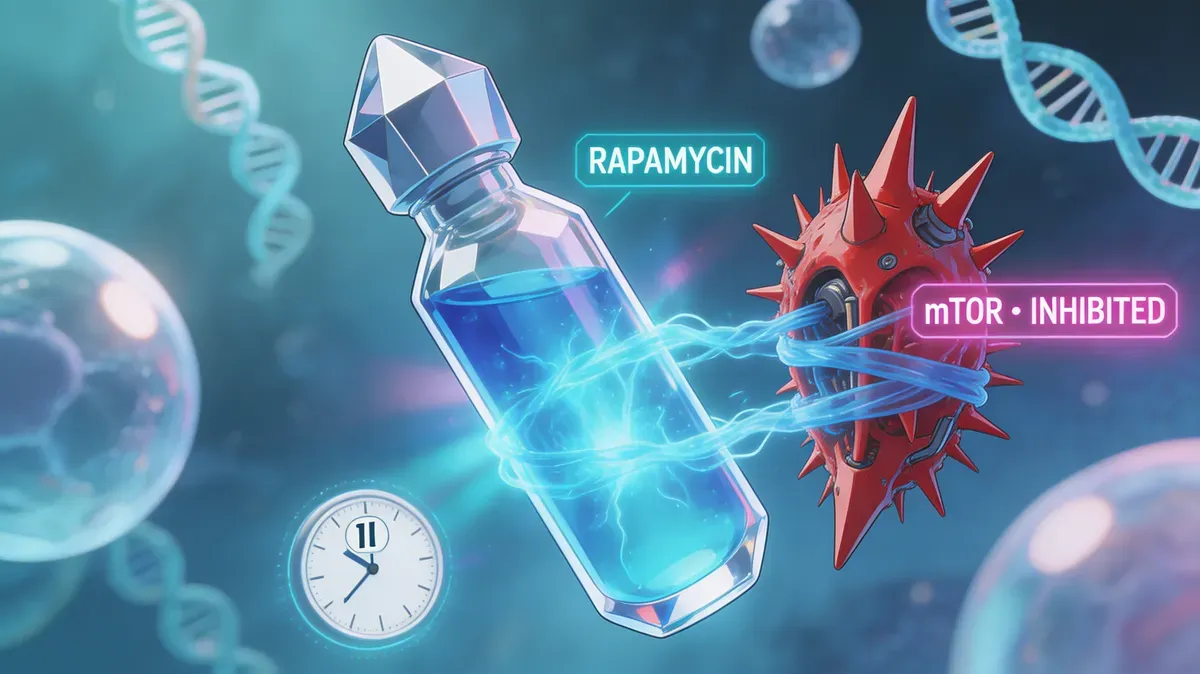
Quick definition: Rapamycin is a drug that inhibits mTOR (mechanistic target of rapamycin), a master regulator of cell growth and metabolism. By partially suppressing mTOR, rapamycin shifts cells from growth mode to repair mode — the same metabolic switch that underlies the longevity benefits of caloric restriction and fasting.
Rapamycin is FDA-approved for three indications:
- Organ transplant rejection prevention (immunosuppression)
- Lymphangioleiomyomatosis (a rare lung disease)
- Drug-eluting coronary stents (preventing restenosis)
Its use for longevity is entirely off-label — driven by preclinical evidence so compelling that thousands of physicians and biohackers have adopted low-dose protocols, even as definitive human longevity data remains incomplete.
The mTOR pathway — a quick refresher
If you’ve read our deep dive on mTOR: when to turn it off to live longer, you’ll know that mTOR exists in two complexes:
- mTORC1: Drives protein synthesis, cell growth, and inhibits autophagy. This is the complex rapamycin primarily inhibits. Chronic mTORC1 hyperactivation accelerates aging.
- mTORC2: Regulates cell survival, metabolism, and cytoskeletal organization. Rapamycin can inhibit mTORC2 with prolonged or high-dose exposure, and this is associated with some negative metabolic effects.
The key insight: rapamycin’s longevity benefits come from mTORC1 inhibition. Its side effects largely come from mTORC2 inhibition. This dose-dependent selectivity is why the difference between transplant dosing and longevity dosing matters enormously.
The science behind rapamycin and aging
Why mTOR inhibition extends lifespan
When cells are in a nutrient-rich, growth-promoting environment, mTORC1 is chronically active — driving protein synthesis and cell division while suppressing maintenance pathways. This is metabolically analogous to running a car at full throttle without ever performing an oil change.
Rapamycin partially inhibits mTORC1, shifting cells toward a maintenance phenotype:
| Process | mTORC1 Active (growth mode) | mTORC1 Inhibited (repair mode) |
|---|---|---|
| Protein synthesis | High | Reduced (quality over quantity) |
| Autophagy | Suppressed | Activated — cellular cleanup |
| Mitochondrial quality | Declining | Improved via mitophagy |
| Senescent cell accumulation | Accelerated | Slowed |
| Inflammation | Elevated | Reduced |
| Stem cell function | Exhaustion over time | Preserved |
This metabolic shift mirrors what happens during caloric restriction and activates many of the same downstream pathways — including AMPK, sirtuins, and autophagy.
Rapamycin and the hallmarks of aging
Rapamycin addresses an unusually broad range of aging hallmarks:
Deregulated nutrient sensing: mTOR is itself a nutrient sensor. Rapamycin directly corrects the chronic overactivation that characterizes aging in well-fed populations.
Disabled autophagy: By inhibiting mTORC1, rapamycin is one of the most potent autophagy activators known. This promotes clearance of damaged proteins, dysfunctional mitochondria, and cellular debris.
Cellular senescence: Rapamycin suppresses the SASP (Senescence-Associated Secretory Phenotype), reducing the inflammatory output of senescent cells without killing them — acting as a senomorphic rather than senolytic agent.
Stem cell exhaustion: Studies show rapamycin preserves stem cell function in aged tissues by preventing premature stem cell activation and depletion.
Mitochondrial dysfunction: mTORC1 inhibition activates mitophagy — the selective autophagy of damaged mitochondria — improving overall mitochondrial quality.
Loss of proteostasis: By reducing protein synthesis rate and enhancing autophagy-mediated protein quality control, rapamycin improves the balance between protein production and degradation.
What human clinical trials show
The PEARL trial (2024–2025)
The Participatory Evaluation of Aging with Rapamycin for Longevity trial is the most important rapamycin longevity study in humans to date:
- Design: Randomized, double-blind, placebo-controlled
- Participants: 114 healthy adults, ages 50–85
- Duration: 48 weeks
- Doses: 5 mg or 10 mg rapamycin, once weekly
- Primary outcomes: Body composition, bone density, metabolic markers
Key findings:
- Women taking 10 mg/week showed significant gains in lean muscle mass and reduced pain
- Participants taking 5 mg/week reported improved emotional well-being and general health
- No major changes in bone density
- Overall well-tolerated with manageable side effects
Limitation: The trial did not measure biological age clocks, epigenetic changes, or long-term healthspan/lifespan outcomes.
The low-dose immune enhancement study (2014)
Before PEARL, a pivotal study by Mannick et al. published in Science Translational Medicine showed that low-dose mTOR inhibition (RAD001, a rapamycin analogue) in older adults:
- Enhanced immune response to influenza vaccination by ~20%
- Reduced respiratory infections over the following winter
- Used doses of 0.5 mg daily or 5 mg weekly — far below transplant doses
This was counterintuitive: a drug known for immunosuppression actually improved immune function at low doses. The explanation is that low-dose mTOR inhibition clears senescent immune cells and restores T-cell diversity — effectively rejuvenating an aging immune system rather than suppressing it.
The GeroScience cardiovascular study (2025)
A pilot study in 6 healthy men aged 70–76 taking 1 mg rapamycin daily for 8 weeks showed:
- Significant improvements in diastolic heart function
- Enhanced microvascular endothelial function (nitric oxide–mediated vasodilation)
- No serious adverse events
The VITAL-H program (2025–ongoing)
ARPA-H awarded up to $38 million for VITAL-H — positioned as the first Phase 3 clinical trial targeting aging in healthy adults. It will randomize participants aged 60–65 to rapamycin, dapagliflozin, or semaglutide. Results are expected to take several years.
Dosing: transplant vs longevity
Understanding the dosing distinction is critical for evaluating rapamycin’s safety profile:
| Parameter | Transplant Dosing | Longevity Dosing |
|---|---|---|
| Typical dose | 2–5 mg daily (continuous) | 3–10 mg weekly (intermittent) |
| Weekly total | 14–35 mg | 3–10 mg |
| mTORC1 inhibition | Sustained, near-complete | Intermittent, partial |
| mTORC2 inhibition | Significant | Minimal at weekly dosing |
| Intent | Immunosuppression | Metabolic optimization |
| Side effect profile | Significant | Generally mild |
The intermittent dosing strategy is crucial. Weekly dosing allows mTOR levels to recover between doses, preferentially inhibiting mTORC1 while sparing mTORC2. This pulsed approach mimics the intermittent nutrient deprivation that characterizes caloric restriction.
The most common longevity protocols
Several protocols have emerged in the longevity medicine community (note: none are FDA-approved for aging):
- Conservative: 3–5 mg once weekly
- Standard: 5–7 mg once weekly (most popular)
- Aggressive: 6–10 mg once weekly
- Cycling: 8 weeks on, 2–4 weeks off
Most longevity physicians monitor fasting glucose, lipid panels, and complete blood counts during rapamycin use.
Side effects and risks
At longevity doses (3–10 mg weekly)
Common (reported in 5–15% of users):
- Mouth sores/canker sores (aphthous ulcers) — most common side effect
- Mildly elevated fasting glucose (typically reversible)
- Mildly elevated triglycerides or LDL cholesterol
- Minor skin irritation
Uncommon:
- Delayed wound healing
- Menstrual irregularities
- Upper respiratory infections
Important context: In the PEARL trial and other healthy adult studies, no serious adverse events were attributed to rapamycin at longevity doses. The mouth sore issue can often be managed with topical treatments or dose adjustment.
At transplant doses (daily, high-dose)
Higher doses carry significantly greater risks including immunosuppression, metabolic syndrome, dyslipidemia, new-onset diabetes, impaired wound healing, and increased infection risk. These side effects are largely irrelevant at longevity doses but are frequently cited in articles conflating the two dosing regimens.
Who should NOT take rapamycin
- Immunocompromised individuals
- People with active infections or wounds
- Pregnant or breastfeeding women
- Those taking strong CYP3A4 inhibitors (drug interaction risk)
- Anyone without physician supervision
The information provided does not replace professional medical advice. Rapamycin is a prescription medication. Never take it without medical supervision.
5 natural strategies that mimic rapamycin’s effects
If pharmaceutical mTOR inhibition isn’t right for you, several lifestyle strategies activate the same downstream pathways:
1. Periodic fasting
Fasting is the original mTOR inhibitor. When nutrient levels drop, mTORC1 activity decreases and autophagy increases — the same metabolic shift rapamycin induces pharmacologically.
- Time-restricted eating (10–12 hour window) provides mild mTOR modulation
- 24–48 hour fasts provide stronger mTORC1 suppression
- Caloric restriction consistently shows mTOR pathway suppression in human studies
2. Exercise — especially endurance training
Exercise activates AMPK, which directly inhibits mTORC1. Endurance exercise is particularly effective at suppressing mTOR during and immediately after training sessions.
- 150–300 minutes of moderate-to-vigorous aerobic activity weekly
- The mTOR suppression from exercise is transient — which is actually ideal (periodic inhibition, not chronic)
- Resistance training temporarily activates mTOR (necessary for muscle growth) followed by a recovery-phase suppression
3. Protein cycling
mTOR responds strongly to amino acids, particularly leucine. Cycling between higher and lower protein days mimics intermittent mTOR inhibition:
- Lower protein days (0.6–0.8 g/kg): Enhanced autophagy, reduced mTOR
- Higher protein days (1.2–1.6 g/kg): Muscle protein synthesis, mTOR activation
- This oscillation may capture the benefits of both growth and repair modes
4. Polyphenol-rich foods
Several dietary compounds show mTOR-modulating properties:
| Compound | Food Source | Mechanism |
|---|---|---|
| EGCG | Green tea | Direct mTORC1 inhibition |
| Resveratrol | Red grapes, berries | AMPK activation → mTOR suppression |
| Curcumin | Turmeric | mTOR pathway suppression |
| Quercetin | Onions, apples, capers | mTOR inhibition + senolytic |
| Sulforaphane | Broccoli, kale | Nrf2 activation, mTOR modulation |
| Spermidine | Wheat germ, aged cheese, natto | EP300 inhibition → autophagy (mTOR-independent) |
5. Cold exposure
Cold stress activates AMPK and suppresses mTOR signaling — potentially mimicking some of rapamycin’s metabolic effects. Cold exposure at 50–59°F (10–15°C) for 2–5 minutes, 2–3 times weekly, has been shown to activate brown adipose tissue and improve metabolic markers.
How to track and measure mTOR-related health
Since you can’t directly measure mTOR activity from routine tests, focus on downstream biomarkers:
| Biomarker | What It Reflects | Optimal Range |
|---|---|---|
| Fasting insulin | mTOR/insulin pathway activity | 2–6 μIU/mL |
| Fasting glucose | Metabolic control | 70–90 mg/dL (3.9–5.0 mmol/L) |
| IGF-1 | Growth signaling (mTOR activator) | Age-appropriate mid-range |
| hs-CRP | Inflammation (SASP, mTOR-driven) | < 1.0 mg/L |
| VO2 max | Mitochondrial function | Above age-average |
| HRV | Autonomic/metabolic resilience | Above age-average |
| Lean mass / body fat ratio | mTOR/AMPK balance | Healthy range for age |
How SuperAge helps you optimize mTOR balance
The mTOR pathway responds to exercise, fasting, sleep, and stress — all factors that SuperAge tracks automatically through your Apple Watch and iPhone.
Exercise tracking for mTOR modulation
SuperAge monitors your training load, intensity minutes, and workout distribution — helping you balance the mTOR-activating stimulus of resistance training with the mTOR-suppressing effects of endurance exercise.
Recovery and metabolic health
Training readiness and body energy scores reflect your autonomic and metabolic state — providing indirect feedback on whether your mTOR/AMPK balance is in a healthy range.
Biological age tracking
mTOR dysregulation accelerates biological aging. SuperAge calculates your biological age using multiple health inputs, showing you whether your overall strategy — including mTOR optimization — is paying off.
Frequently asked questions
Is rapamycin safe for healthy people?
At low, intermittent doses (3–10 mg weekly), rapamycin has been well-tolerated in healthy adult studies including the 48-week PEARL trial. The most common side effect is mouth sores. However, it remains a prescription medication, long-term safety data beyond 1 year is limited, and it should only be used under medical supervision.
Can rapamycin reverse aging?
Rapamycin has reversed several markers of aging in animal models — including immune dysfunction, cardiac decline, and stem cell exhaustion. In humans, the PEARL trial showed improved lean muscle mass and well-being, but no study has yet demonstrated that rapamycin reverses biological age as measured by epigenetic clocks.
How does rapamycin compare to metformin for longevity?
Both target nutrient-sensing pathways but through different mechanisms. Rapamycin inhibits mTOR directly; metformin primarily activates AMPK. Rapamycin has stronger preclinical lifespan extension data across species. The VITAL-H trial will directly compare rapamycin against other longevity candidates including semaglutide.
Can you get rapamycin’s benefits through fasting alone?
Partially. Fasting suppresses mTORC1 and activates autophagy through the same pathways rapamycin targets. However, rapamycin provides more consistent and potent mTORC1 inhibition than is achievable through diet alone. Many longevity researchers view them as complementary — fasting provides intermittent mTOR suppression, while low-dose rapamycin adds additional, calibrated inhibition.
What is the VITAL-H trial?
VITAL-H (Validation and Intervention Testing for Aging, Longevity and Healthspan) is an ARPA-H–funded Phase 3 clinical trial that will randomize healthy adults aged 60–65 to rapamycin, dapagliflozin, or semaglutide. It is the first large-scale trial designed to test whether aging itself can be treated pharmacologically.
Key takeaways
- Strongest preclinical evidence of any longevity drug: Rapamycin extends lifespan in every species tested, by 9–26% in mice — even when started late in life.
- Mechanism is well understood: mTORC1 inhibition shifts cells from growth to repair mode, activating autophagy, improving mitochondrial quality, and suppressing inflammation.
- Human data is promising but early: The PEARL trial showed muscle mass and well-being improvements, but definitive human longevity evidence is still years away.
- Dose matters enormously: Low-dose intermittent rapamycin (3–10 mg weekly) has a fundamentally different safety profile from daily transplant-dose immunosuppression.
- Natural alternatives exist: Fasting, exercise, protein cycling, polyphenols, and cold exposure activate many of the same mTOR-modulating pathways.
- The field is accelerating: VITAL-H will provide the first Phase 3 human aging trial data, potentially transforming rapamycin from a promising candidate to an evidence-based intervention.
Start optimizing your longevity pathways today
Whether or not pharmaceutical mTOR inhibition is in your future, the lifestyle strategies that modulate the same pathway are available right now — exercise, fasting, sleep, and metabolic optimization. And the earlier you start, the greater the cumulative benefit.
Ready to take control? Download SuperAge and start tracking the metrics that reflect your mTOR/AMPK balance — from VO2 max and HRV to training load and biological age.
References
- Harrison DE, et al. Rapamycin fed late in life extends lifespan in genetically heterogeneous mice. Nature. 2009;460:392-395.
- Mannick JB, et al. mTOR inhibition improves immune function in the elderly. Science Translational Medicine. 2014;6(268):268ra179.
- Kraig E, et al. Rapamycin for longevity: the pros, the cons, and future perspectives. Frontiers in Aging. 2025.
- Blagosklonny MV. Rapamycin for longevity: opinion article. Aging. 2019;11(19):8048-8067.
- Mannick JB, et al. TORC1 inhibition enhances immune function and reduces infections in the elderly. Science Translational Medicine. 2018;10(449):eaaq1564.
- López-Otín C, et al. Hallmarks of aging: an expanding universe. Cell. 2023;186(2):243-278.
- Saxton RA, Sabatini DM. mTOR signaling in growth, metabolism, and disease. Cell. 2017;168(6):960-976.
- Arriola Apelo SI, et al. Alternative rapamycin treatment regimens mitigate the impact of rapamycin on glucose homeostasis and the immune system. Aging Cell. 2016;15:28-38.
- Kaeberlein M. The biology of aging: citizen scientists and their pets as a bridge between research on model organisms and human subjects. Veterinary Pathology. 2016;53:291-298.
- Johnson SC, Rabinovitch PS, Kaeberlein M. mTOR is a key modulator of ageing and age-related disease. Nature. 2013;493:338-345.
Last updated: 2026-03-14. This article is regularly reviewed to ensure accuracy.
Related Articles
DHEA-S: The youth hormone that declines with age (and how to slow it down)
DHEA-S declines with age, but it is not a proven anti-aging target. Learn how to interpret levels, cortisol balance, lifestyle levers, and supplement risks.