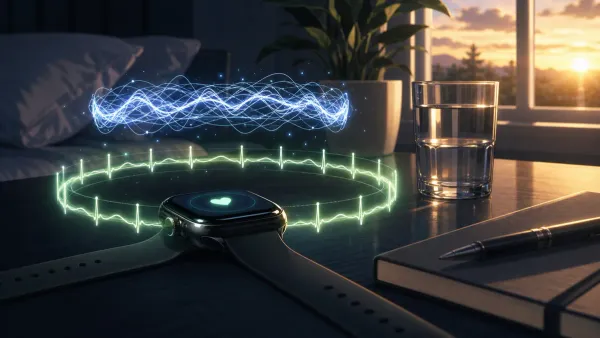
Body energy: How to monitor your energy reserves on iPhone and Apple Watch
Discover how SuperAge's Body Energy monitors your body's battery on iPhone and Apple Watch. Learn to interpret energy levels and optimize recovery and performance.
Have you ever wished you had a clearer estimate of how much energy you have available before tackling a workout or a demanding day? SuperAge’s Body Energy works like your smartphone’s battery indicator, but for your body.
Quick answer
Body Energy is an intelligent system that estimates your energy reserves on a scale from 0 to 100. By analyzing data from your Apple Watch and Health app, SuperAge updates your estimated “charge” throughout the day. It is a wellness and readiness signal, not a medical diagnosis.
Key facts
- Prevent overtraining: Know when your body needs rest
- Optimize performance: Train when you have high energy for better results
- Improve recovery: Understand how well you’re recovering during sleep
- Manage stress: See the impact of stress on your energy reserves
- HRV: What is heart rate variability and how to improve it
- How biological age is calculated in SuperAge | complete guide
- Walking vs running: Which burns more fat? Science has the answer
In this article:
- What is Body Energy?
- How energy is calculated
- The four energy levels
- How to read the 24-hour chart
- Tips to optimize your energy
- Frequently asked questions
What is Body Energy?
Body Energy is an intelligent system that estimates your energy reserves on a scale from 0 to 100. By analyzing data from your Apple Watch and Health app, SuperAge updates your estimated “charge” throughout the day.
How it works in practice
Think of your body like a smartphone:
- During sleep the battery recharges
- During the day the battery drains gradually
- Intense activities (workouts, stress) consume more battery
- Rest and relaxation slow down consumption
Unlike other fitness indicators that only show past data, Body Energy tells you how ready you are right now to tackle your activities.
Key benefits
- Prevent overtraining: Know when your body needs rest
- Optimize performance: Train when you have high energy for better results
- Improve recovery: Understand how well you’re recovering during sleep
- Manage stress: See the impact of stress on your energy reserves
How Energy is Calculated
SuperAge uses an evidence-informed algorithm that combines various biometric parameters collected from your Apple Watch.
Data that influences Body Energy
| Parameter | What it measures | Impact |
|---|---|---|
| HRV (RMSSD) | Parasympathetic nervous system tone | Primary recovery indicator |
| Resting Heart Rate | Cardiovascular efficiency | Lower RHR = better recovery |
| Sleep Quality | Sleep stages and duration | Nighttime battery recharge |
| Physical Activity | Workouts and movement | Energy consumption |
| Stress Level | Physical and mental tension | Extra battery drain |
A 2026 narrative review in Sensors (MDPI) supports RMSSD — the root mean square of successive differences between heartbeats — as a practical HRV metric for field-based recovery monitoring because it reflects parasympathetic activity and remains reliable in short recordings. The same review emphasizes that HRV works best as a personal trend: daily or near-daily measurements, weekly averages, and context are more useful than reacting to one isolated reading.
The daily energy cycle
-
Night (11:00 PM - 7:00 AM): During sleep, the battery recharges. Quality sleep can raise your score meaningfully, especially when HRV, resting heart rate, and sleep duration all point in the same direction.
-
Morning (7:00 AM - 12:00 PM): After a good night’s sleep, you start with high battery. This is the ideal time for demanding activities.
-
Afternoon (12:00 PM - 6:00 PM): The battery drains gradually under normal conditions, with faster drops after hard training, stress, poor sleep, or illness.
-
Evening (6:00 PM - 11:00 PM): Levels continue to drop. Relaxing activities help preserve energy for the next day.
Pro Tip: HRV (heart rate variability) is one of the most informative inputs in the calculation, but it should be interpreted against your own baseline. Higher HRV often reflects stronger parasympathetic recovery; lower HRV can reflect stress, illness, fatigue, alcohol, poor sleep, or measurement noise. Recent reviews emphasize 7-day trends and multi-signal interpretation rather than single-day HRV decisions.
The Four Energy Levels
SuperAge classifies your energy into four levels, each with specific recommendations.
High (70-100) - Green
You’re at your peak! Your body is fully recovered and ready for demanding challenges.
What you can do:
- High-intensity workouts (HIIT, interval training)
- Heavy strength sessions
- Competitions or performance tests
- Activities requiring maximum focus
Moderate (40-69) - Orange
Normal energy. You can handle most activities, but avoid extremes.
What you can do:
- Moderate workouts (light running, swimming)
- Medium-load strength sessions
- Regular work and daily activities
What to avoid:
- High-intensity workouts
- Maximum efforts
Low (25-39) - Light Red
Limited reserves. Your body is telling you to slow down.
What you can do:
- Light walks
- Yoga or stretching
- Relaxing activities
What to avoid:
- Any intense training
- Important decisions under stress
Recovery signal: A resting heart rate elevated by about 5 BPM or more above your personal baseline — sustained over several days alongside lower HRV, poor sleep, fatigue, or declining performance — can suggest insufficient recovery or oncoming illness. It is not diagnostic of overtraining by itself.
Critical (5-24) - Red
Absolute priority: recovery. Your reserves are nearly depleted.
What you must do:
- Complete rest
- Quality sleep (go to bed early)
- Nutritious food
- Avoid caffeine and alcohol
Warning: Prolonged critical levels may indicate overtraining, oncoming illness, or chronic stress. Listen to your body!
How to Read the 24-Hour Chart
The Body Energy chart shows your energy trends over the last 24 hours with an intuitive visualization.
Chart elements
-
Colored line: Your energy level over time
- Cyan/Green = High energy
- Yellow/Orange = Moderate energy
- Red = Low/critical energy
-
Light blue areas: Sleep periods (when the battery recharges)
-
Horizontal axis: Hours of the day (00, 06, 12, 18)
-
Vertical axis: Energy level (0-100%)
Typical patterns to recognize
Healthy pattern:
- Morning peak after waking (70-90%)
- Gradual decline during the day
- Rise during nighttime sleep
Overtraining pattern:
- No morning peak
- Levels consistently below 50%
- Insufficient nighttime recovery
Chronic stress pattern:
- Frequent fluctuations
- Sudden drops during the day
- Difficulty exceeding 60-70%
Tips to Optimize Your Energy
To increase nighttime recharge
- Keep regular hours: Go to bed and wake up at the same time
- Limit stimulating screen use before bed: A large 2025 adult cohort found that daily screen use in the hour before bed was associated with about 48 fewer minutes of sleep per week and a 33% higher prevalence of poor sleep quality. Blue light is not the only issue; timing, arousal, and content still matter. The practical advice holds: wind down at least 60-90 minutes before sleep
- Cool, dark room: Many adults sleep best in a cool bedroom, often around 65-68°F (18-20°C). A 2025 BMC Medicine study in older adults found that nighttime bedroom temperatures above about 75°F (24°C) were associated with higher odds of autonomic disruption and increased heart rate, with stronger effects as temperatures rose
- No intense evening workouts: Wait at least 3 hours before sleeping
To reduce daily consumption
- Manage stress: Meditation, breathing exercises, regular breaks
- Stay hydrated: Dehydration increases physical stress
- Balanced nutrition: Avoid blood sugar spikes
- Micro-breaks: 5-minute break every hour of intense work
To maximize performance
- Train when energy is high: Check your level before workouts
- Plan rest days: Not just when you’re tired
- Periodize: Alternate intense weeks with recovery weeks
- Listen to the numbers: If Body Energy says rest, trust it
Going further: Low recovery can show up in how you move: slower walking, shorter steps, or less stable gait on tired days. These are exactly the kinds of signals your iPhone tracks as Apple Watch gait metrics.
Frequently Asked Questions
Why is my energy low even after sleeping well?
Several factors can affect nighttime recovery:
- Alcohol consumed in the evening (reduces sleep quality)
- Heavy meal before bed
- Intense training in the evening hours
- Accumulated stress or sleep debt from previous days
How long does it take to see improvements?
With consistent habits, you’ll notice improvements in 1-2 weeks. The body needs time to adapt to new sleep and recovery routines.
Can I train with moderate energy (40-69%)?
Yes, but adjust the intensity. Opt for low-to-moderate intensity workouts and listen to your body’s signals during the session.
Does Body Energy work on Apple Watch too?
Yes! SuperAge syncs data with Apple Watch, allowing you to check your energy directly from your wrist. The 24-hour chart is available on both iPhone and Watch. Apple Watch heart-rate and RR-interval measurements show their strongest agreement with ECG during rest, while HRV-derived measures are more vulnerable to movement and measurement conditions. That is why SuperAge prioritizes nighttime and resting samples when calculating your Body Energy score.
How can I increase my HRV?
HRV improves with:
- Regular, quality sleep
- Moderate aerobic exercise
- Stress management (meditation, yoga)
- Balanced nutrition
- Reduced alcohol and caffeine
Start Monitoring Your Energy
Body Energy transforms complex data into simple, actionable information. Instead of guessing from isolated metrics, you have a structured readiness estimate to guide daily decisions.
Ready to discover how much energy you really have? Download SuperAge and start monitoring your body’s battery.

References
- Shaffer F, Ginsberg JP. (2017). “An Overview of Heart Rate Variability Metrics and Norms.” Frontiers in Public Health. https://doi.org/10.3389/fpubh.2017.00258
- Bellenger CR et al. (2016). “Monitoring Athletic Training Status Through Autonomic Heart Rate Regulation.” Sports Medicine. https://doi.org/10.1007/s40279-016-0484-2
- Esco MR et al. (2026). “Monitoring Training Adaptation and Recovery Status in Athletes Using Heart Rate Variability via Mobile Devices: A Narrative Review.” Sensors. https://doi.org/10.3390/s26010003
- Bonneval L et al. (2025). “Validity of Heart Rate Variability Measured with Apple Watch Series 6 Compared to Laboratory Measures.” Sensors. https://doi.org/10.3390/s25082380
- Addleman JS et al. (2024). “Heart Rate Variability Applications in Strength and Conditioning: A Narrative Review.” Journal of Functional Morphology and Kinesiology. https://doi.org/10.3390/jfmk9020093
- O’Connor F et al. (2025). “Effect of nighttime bedroom temperature on heart rate variability in older adults.” BMC Medicine. https://doi.org/10.1186/s12916-025-04513-0
- Zhong C et al. (2025). “Electronic Screen Use and Sleep Duration and Timing in Adults.” JAMA Network Open. https://doi.org/10.1001/jamanetworkopen.2025.2493
- Meredith-Jones KA et al. (2026). “Screens, Teens, and Sleep: Is the Impact of Nighttime Screen Use on Sleep Driven by Physiological Arousal?” Journal of Sleep Research. https://doi.org/10.1111/jsr.70288
- Bourdillon N, Millet GP. (2026). “Taking heart rate variability to the next level in sports: towards a multi-signal integration.” Frontiers in Sports and Active Living. https://doi.org/10.3389/fspor.2026.1720495
Last updated: July 7, 2026 - This article is regularly updated to ensure accuracy.
Related Articles
Best Apple Watch apps for HRV and recovery
Compare the best Apple Watch apps for HRV and recovery by use case, including readiness, training load, sleep context, coaching style, and data export.