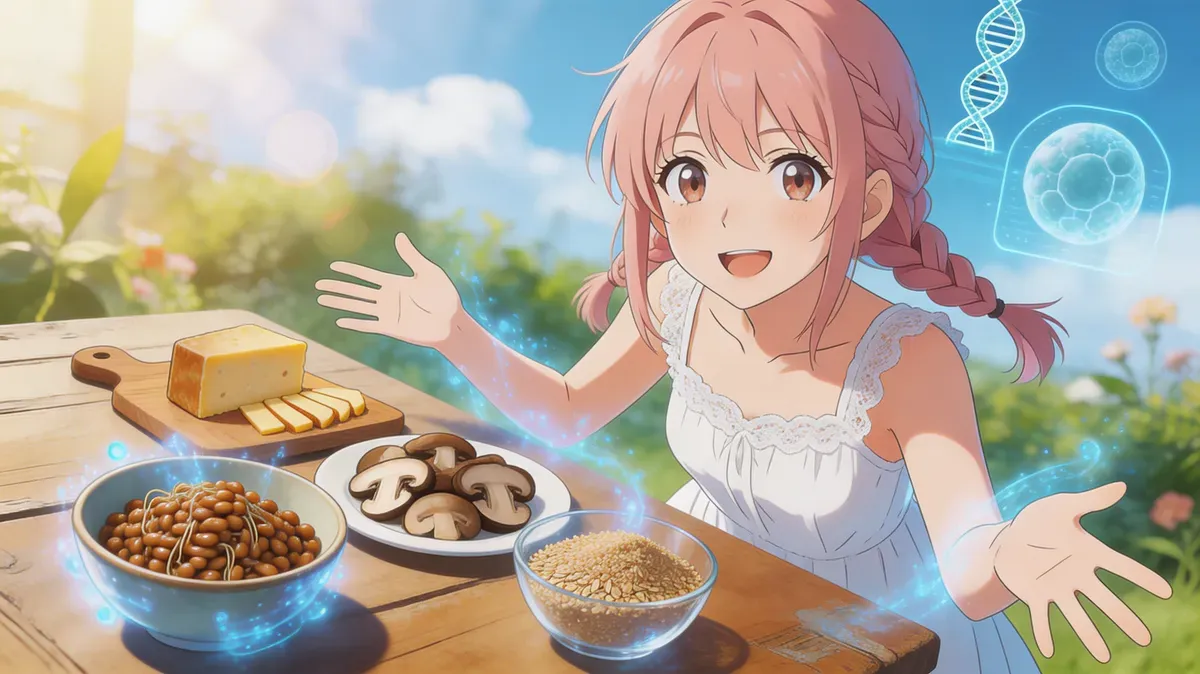
Spermidine: The autophagy activator hiding in common foods
Spermidine triggers autophagy and extends lifespan in every organism tested. Learn the food sources, dosage, and science behind this natural anti-aging polyamine.
Among all the longevity compounds studied in the past two decades, spermidine stands out for one remarkable reason: it extends lifespan in every model organism tested — from yeast and worms to flies and mice. No other natural compound has achieved this level of consistency across species.
Even more remarkable, spermidine isn’t some exotic pharmaceutical. It’s a polyamine found in wheat germ, soybeans, aged cheese, and mushrooms — foods you may already eat. A 2018 epidemiological study of over 800 Italians found that higher dietary spermidine intake was associated with reduced all-cause mortality and lower rates of cardiovascular disease and cancer. The top third of spermidine consumers lived an estimated 5.7 years longer than the bottom third.
The mechanism? Autophagy — the cellular self-cleaning process that declines with age and is now recognized as one of the most important hallmarks of aging.
What you’ll learn:
- Why spermidine is the most potent natural autophagy inducer discovered
- Which common foods deliver therapeutic amounts of spermidine
- What clinical trials show about cognitive protection and cardiovascular health
- How spermidine compares to other longevity interventions
What is spermidine?
Spermidine is a naturally occurring polyamine — a small organic molecule with multiple amino groups — found in all living cells. It was first isolated from semen in 1678 by Antonie van Leeuwenhoek (hence the name), but it’s present throughout the body, with highest concentrations in the brain, liver, kidney, and immune cells.
Quick definition: Spermidine is a polyamine naturally produced by the body and found abundantly in certain foods that powerfully induces autophagy — the cellular recycling process — and has extended lifespan in every model organism tested.
Your body’s spermidine levels decline with age
Endogenous spermidine production peaks in early adulthood and progressively declines. By age 60-70, tissue spermidine levels can drop by 50% or more compared to younger adults. This decline parallels the age-related decrease in autophagy — and restoring spermidine levels appears to restore autophagic function.
Three sources contribute to your total spermidine pool:
- Endogenous synthesis — your cells produce it from ornithine via ornithine decarboxylase
- Diet — food-derived spermidine absorbed through the gut
- Gut microbiome — intestinal bacteria synthesize significant amounts
How spermidine fights aging
The 2022 Nature Aging review identified autophagy as the most strongly supported mechanism behind spermidine’s geroprotective effects. But the compound works through multiple interconnected pathways.
Autophagy induction: the primary mechanism
Spermidine is the most potent naturally occurring autophagy inducer identified. It triggers autophagy through a mechanism distinct from caloric restriction or mTOR inhibition:
- EP300 acetyltransferase inhibition — Spermidine inhibits the enzyme EP300, which normally acetylates autophagy-related proteins and keeps them inactive
- Protein deacetylation — By inhibiting EP300, spermidine promotes deacetylation of key autophagy proteins (ATG5, ATG7, LC3), activating the autophagy machinery
- AMPK activation — Spermidine also activates AMPK, providing an additional autophagy stimulus
This EP300-dependent mechanism makes spermidine complementary to — not redundant with — other autophagy inducers like fasting or exercise.
Anti-inflammatory effects
Spermidine reduces chronic inflammation through multiple routes:
- Inhibits NF-kB signaling pathway
- Reduces pro-inflammatory cytokine production (IL-1beta, IL-6, TNF-alpha)
- Suppresses NLRP3 inflammasome activation
- Promotes anti-inflammatory macrophage polarization (M1 to M2 shift)
A year-long human dietary intervention with a polyamine-rich diet reduced markers of pro-inflammatory status, supporting spermidine’s role in healthier immune aging.
Mitochondrial protection
Spermidine preserves mitochondrial function by:
- Enhancing mitophagy (selective autophagy of damaged mitochondria) — a mechanism also activated by urolithin A, a complementary gut-derived compound from pomegranates
- Maintaining mitochondrial membrane potential
- Reducing reactive oxygen species (ROS) production
- Supporting mitochondrial biogenesis through PGC-1alpha activation
Epigenetic modulation
Spermidine influences histone acetylation patterns, essentially reprogramming gene expression toward a more youthful profile. This epigenetic effect may explain why its benefits extend across so many organ systems simultaneously.
Lifespan extension across every species tested
Spermidine’s consistency across organisms is unmatched by any other natural compound.
| Organism | Lifespan Extension | Study |
|---|---|---|
| Yeast (S. cerevisiae) | +120% chronological lifespan | Eisenberg et al., 2009 |
| Worms (C. elegans) | +15% | Eisenberg et al., 2009 |
| Fruit flies (D. melanogaster) | +10-30% | Eisenberg et al., 2009 |
| Mice | +10-25% (started at middle age) | Eisenberg et al., 2016 |
| Human epidemiology | 5.7 years longer (top vs. bottom tertile) | Kiechl et al., 2018 |
Critically, the mouse study started supplementation at 18 months of age (roughly equivalent to human age 50-55), demonstrating that spermidine works even when started in mid-life — you don’t need to have been taking it since youth.
Cardioprotection in aging mice
A landmark Nature Medicine study showed that lifelong spermidine supplementation in mice:
- Reduced cardiac hypertrophy and fibrosis
- Preserved diastolic function
- Lowered blood pressure
- Reduced arterial stiffness
- Activated cardiac autophagy and mitophagy
These cardiovascular benefits were directly dependent on autophagy — when researchers blocked autophagy, the cardioprotective effects disappeared.
Human clinical evidence
Unlike many longevity compounds, spermidine has meaningful human data.
The Bruneck cohort study
This prospective study followed 829 participants for 20 years in Bruneck, Italy. Key findings:
- Higher dietary spermidine intake was inversely associated with all-cause mortality
- The association remained significant after adjusting for age, sex, caloric intake, and cardiovascular risk factors
- The difference between highest and lowest tertiles of spermidine intake corresponded to approximately 5.7 years of life expectancy
Cognitive protection trials
A randomized controlled trial (SmartAge) found that 3 months of spermidine-rich wheat germ supplementation (3.3 mg spermidine/day) improved memory performance in older adults with subjective cognitive decline. Brain imaging showed enhanced hippocampal connectivity — similar to effects seen with exercise.
A follow-up study confirmed that spermidine supplementation (1.2 mg/day for 12 months) was safe and well-tolerated in older adults with mild cognitive impairment, though the cognitive outcomes were mixed.
Immune function
A dietary intervention study showed that a year-long polyamine-rich diet increased blood spermine levels and reduced markers of pro-inflammatory status, supporting the hypothesis that dietary spermidine may contribute to healthier immune aging.
Spermidine-rich foods: your dietary anti-aging toolkit
You don’t need a supplement to increase spermidine intake. Strategic food choices can deliver meaningful amounts.
Top food sources
| Food | Spermidine (mg per serving) | Serving Size |
|---|---|---|
| Wheat germ | 2.4-3.5 mg | 2 tablespoons (14 g / 0.5 oz) |
| Soybeans (dried) | 1.3-2.1 mg | 1/4 cup (43 g / 1.5 oz) |
| Aged cheese (cheddar, parmesan) | 1.0-2.0 mg | 1 oz (28 g) |
| Natto (fermented soy) | 1.5-2.5 mg | 1/4 cup (44 g / 1.5 oz) |
| Mushrooms (shiitake) | 0.6-1.2 mg | 1 cup (145 g / 5.1 oz) |
| Green peas | 0.5-0.9 mg | 1 cup (160 g / 5.6 oz) |
| Rice bran | 0.5-0.8 mg | 2 tablespoons (15 g / 0.5 oz) |
| Broccoli | 0.3-0.5 mg | 1 cup (91 g / 3.2 oz) |
| Pears | 0.2-0.4 mg | 1 medium (178 g / 6.3 oz) |
| Chicken liver | 0.3-0.6 mg | 3 oz (85 g) |
Daily target
The Bruneck cohort study’s top tertile consumed approximately 80-90 micromoles/day, equivalent to roughly 11-12 mg of spermidine daily. Practical ways to reach this:
Example high-spermidine day:
- Breakfast: 2 tablespoons wheat germ in yogurt (~3 mg)
- Lunch: Miso soup with tofu + mushrooms (~2 mg)
- Snack: 1 oz aged parmesan (~1.5 mg)
- Dinner: Green peas + broccoli as sides (~1.5 mg)
- Total: ~8 mg (within therapeutic range)
Adding natto or fermented soy products can easily push this above 10 mg/day.
Spermidine vs. other autophagy activators
| Intervention | Autophagy Mechanism | Convenience | Evidence Strength | Cost |
|---|---|---|---|---|
| Spermidine | EP300 inhibition (unique) | Daily food/supplement | Strong (all species) | Free (food) or $0.50-1.00/day |
| Fasting (16-24h) | mTOR suppression, AMPK | Requires willpower | Strong | Free |
| Exercise | AMPK activation | Requires time/effort | Very strong | Free |
| Rapamycin | Direct mTOR inhibition | Prescription only | Strong preclinical | $2-5/dose |
| Metformin | AMPK activation | Prescription only | Moderate (in non-diabetics) | $0.10/day |
| Resveratrol | SIRT1/AMPK | Supplement only | Weak in humans | $0.30-1.00/day |
Spermidine’s advantage: it activates autophagy through a mechanism that’s complementary to fasting and exercise. Taking spermidine while also practicing time-restricted eating would activate autophagy through two independent pathways simultaneously. For guidance on how spermidine fits within a full evidence-based longevity supplement stack — including Tier 1 foundations, NAD+ precursors, and senolytic compounds — that article covers the pathway-first approach in detail.
Dosage, safety, and practical considerations
Supplementation dosages
- Dietary target: 8-12 mg/day from food (Bruneck cohort optimal range)
- Supplement dose: 1-6 mg/day (most clinical trials use wheat germ extract)
- SmartAge trial: 3.3 mg/day (wheat germ-based)
- Upper range in research: 6 mg/day
Safety profile
Spermidine has an excellent safety record:
- No significant adverse effects reported in any clinical trial up to 12 months
- GRAS status — generally recognized as safe as a food component
- No known drug interactions at dietary doses
- Gastrointestinal: Mild bloating possible with wheat germ supplement in some individuals
Who should exercise caution
- Cancer patients: Polyamines support cell growth — while spermidine has anti-cancer properties through autophagy, active cancer patients should consult their oncologist before supplementation
- Those with wheat allergies: Wheat germ-based supplements may trigger reactions
How SuperAge helps you optimize cellular health
Spermidine’s primary benefit — enhanced autophagy — manifests as improved cellular function across every organ system. SuperAge tracks the physiological outputs of that cellular health.
Monitoring autophagy outcomes
You can’t directly measure autophagy with a wearable, but you can track its downstream effects: improved cardiovascular efficiency (lower resting heart rate, higher HRV), better exercise capacity (VO2 max), faster recovery from stress, and more consistent energy throughout the day.
Biological age tracking
SuperAge’s biological age calculation integrates multiple metrics that reflect cellular maintenance quality — the very thing autophagy optimizes. As you increase dietary spermidine and maintain other longevity habits, SuperAge shows whether your biological age is moving in the right direction.
Frequently asked questions
Is spermidine the same as spermine?
No. Spermidine and spermine are related polyamines but structurally distinct. Spermidine has three amino groups while spermine has four. Both promote autophagy, but spermidine is the more studied anti-aging compound. The body converts spermidine to spermine as part of normal polyamine metabolism.
Can I get enough spermidine from food alone?
Yes. The Bruneck cohort study’s longevity-associated intake (~11-12 mg/day) is achievable through a diet rich in wheat germ, fermented soy, aged cheese, and mushrooms. Supplements are optional if your diet consistently includes these foods.
Does spermidine cause cancer?
This is a common concern because polyamines support cell growth. However, spermidine’s dominant anti-cancer mechanism is autophagy — which eliminates pre-cancerous cells and damaged DNA. Epidemiological data consistently shows higher spermidine intake correlates with lower cancer rates, not higher. Active cancer patients should still consult their oncologist.
When is the best time to take spermidine?
If supplementing, morning dosing aligns with the body’s circadian autophagy rhythms. However, food-derived spermidine throughout the day is effective regardless of timing. Combining spermidine-rich foods with time-restricted eating windows may maximize autophagy activation.
How long until I see benefits from spermidine?
The SmartAge cognitive trial showed measurable improvements in 3 months at 3.3 mg/day. Cardiovascular benefits in animal studies emerge over months of consistent intake. Spermidine is a long-term strategy, not an acute intervention.
Key takeaways
- Unique consistency: Spermidine extends lifespan in every model organism tested — yeast, worms, flies, and mice — with human epidemiological data showing 5.7 years of additional life expectancy
- Autophagy is the key: Spermidine activates autophagy through EP300 inhibition, a mechanism complementary to fasting and exercise
- Food-first is feasible: Wheat germ, fermented soy, aged cheese, and mushrooms deliver therapeutic amounts without supplementation
- Strong safety profile: No significant adverse effects in clinical trials up to 12 months, making spermidine one of the safest longevity interventions available
Start fueling your cellular cleanup today
Spermidine represents something rare in longevity science: a compound with consistent evidence across species, achievable through diet alone, with an excellent safety profile. Whether through wheat germ at breakfast or a targeted supplement, supporting autophagy is one of the most evidence-based anti-aging strategies available.
Ready to track your progress? Download SuperAge and monitor how your biological age responds to dietary and lifestyle changes — including autophagy-boosting strategies like spermidine.
References
- Eisenberg T et al. (2009) — “Induction of autophagy by spermidine promotes longevity,” Nature Cell Biology. Foundational study showing lifespan extension across yeast, worms, and flies.
- Eisenberg T et al. (2016) — “Cardioprotection and lifespan extension by the natural polyamine spermidine,” Nature Medicine. Mouse longevity and heart protection study.
- Kiechl S et al. (2018) — “Higher spermidine intake is linked to lower mortality: a prospective population-based study,” American Journal of Clinical Nutrition. Bruneck cohort, 20-year follow-up.
- Wirth M et al. (2018) — “The effect of spermidine on memory performance in older adults at risk for dementia,” Cortex. SmartAge trial results.
- Madeo F et al. (2018) — “Spermidine in health and disease,” Science. Comprehensive review of mechanisms and evidence.
- Nature Aging (2022) — “Mechanisms of spermidine-induced autophagy and geroprotection.” Updated review of autophagy as primary mechanism.
- Madeo F et al. (2018) — “Spermidine: a physiological autophagy inducer acting as an anti-aging vitamin in humans?” Autophagy.
- Oxford Healthspan (2026) — Summary of 2026 Nature review on spermidine and healthy aging.
Last updated: 2026-03-15. This article is regularly reviewed to ensure accuracy.
The information provided does not replace professional medical advice. Consult your healthcare provider before starting any supplementation.
Related Articles

Resveratrol: Anti-aging miracle or overhyped supplement?
Does resveratrol actually slow aging? A science-based review of sirtuins, bioavailability, clinical trials, and whether this polyphenol deserves a place in your longevity stack.