NAD+ and aging: The coenzyme your mitochondria are running out of
NAD+ levels drop by 50% by age 40 and fuel every cellular repair process. Learn why NAD+ declines, how it drives aging, and 7 evidence-based ways to restore it.
Your cells run on a molecule most people have never heard of. It’s not glucose, not oxygen, not ATP — it’s the coenzyme that makes all three work together. Nicotinamide adenine dinucleotide, or NAD+, sits at the intersection of virtually every metabolic process that keeps you alive. And you’re losing it — steadily, silently — every year after your mid-twenties.
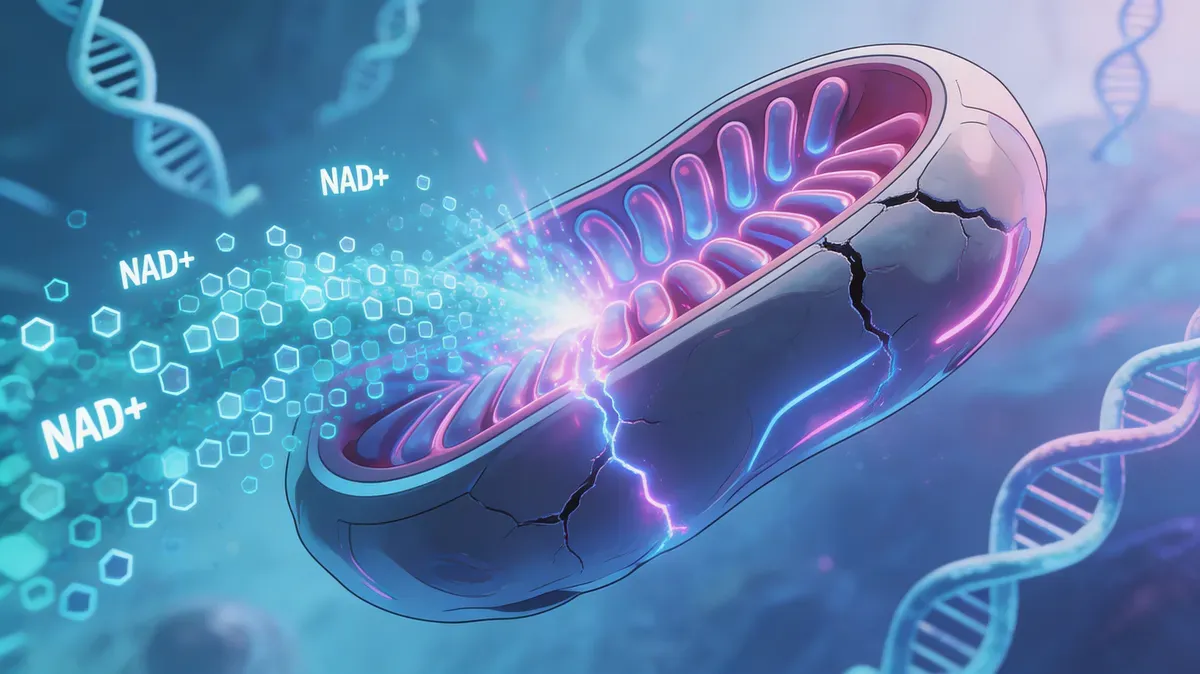
By age 40, most people have roughly half the NAD+ they had in their youth. By 60, levels can drop by 80% or more. This isn’t a minor inconvenience. NAD+ fuels the enzymes that repair your DNA, protect your mitochondria, regulate inflammation, and communicate cellular stress signals. When NAD+ runs low, these repair systems don’t just slow down — they begin to fail.
The science is clear: declining NAD+ is not merely correlated with aging. A 2024 review in Nature Metabolism confirmed it as a causal driver of multiple aging processes simultaneously. The encouraging news is that NAD+ levels respond to lifestyle interventions — exercise, fasting, sleep, and specific nutrients can measurably restore this critical coenzyme, even in later life.
What you’ll learn:
- What NAD+ is and why every cell in your body depends on it
- How and why NAD+ levels decline with age
- The connection between NAD+ depletion and the hallmarks of aging
- 7 evidence-based strategies to boost NAD+ naturally
- What the latest science says about NAD+ precursors
What is NAD+?
NAD+ is a coenzyme found in every living cell. It exists in two forms: NAD+ (the oxidized form) and NADH (the reduced form). Together, they function as electron carriers in hundreds of metabolic reactions — shuttling electrons between molecules to produce energy, repair damage, and maintain cellular homeostasis.
Quick definition: NAD+ (nicotinamide adenine dinucleotide) is a coenzyme essential for energy production, DNA repair, and cellular signaling — and its levels decline dramatically with age.
Think of NAD+ as the universal currency your cells use to power their repair and maintenance systems. Without enough of it, those systems can’t function — no matter how well you eat, sleep, or exercise.
Why NAD+ matters for your health
NAD+ participates in over 500 enzymatic reactions in the human body. Its two most critical roles for aging involve serving as a substrate for:
- Sirtuins (SIRT1–SIRT7): A family of seven proteins that regulate DNA repair, inflammation, mitochondrial biogenesis, and gene expression. Sirtuins literally cannot function without consuming NAD+.
- PARPs (poly-ADP-ribose polymerases): Enzymes that detect and repair DNA damage. PARP1 alone consumes large amounts of NAD+ to fix the thousands of DNA breaks your cells experience daily.
When NAD+ is abundant, these repair systems operate efficiently. When it runs low, sirtuins and PARPs compete for a shrinking pool — and critical maintenance gets deferred.
The science behind NAD+ decline
How NAD+ levels change across your lifespan
NAD+ levels peak during childhood and begin declining in early adulthood. The trajectory is roughly:
| Age Range | Estimated NAD+ Level (vs. peak) | Key Changes |
|---|---|---|
| 0–20 | 100% | Peak levels, rapid growth and repair |
| 20–40 | 50–70% | Gradual decline begins in mid-20s |
| 40–60 | 30–50% | Noticeable metabolic and repair slowdown |
| 60–80 | 10–30% | Significant cellular dysfunction |
| 80+ | 1–10% | Severe depletion in most tissues |
A 2019 study in Cell Metabolism measured NAD+ in human skin tissue and found levels approximately 50% lower in subjects aged 61–77 compared to subjects aged 23–30. Similar declines have been documented in brain, liver, muscle, and blood tissues.
Why does NAD+ decline?
Three primary mechanisms drive age-related NAD+ depletion:
1. Increased consumption by CD38
CD38 is an enzyme whose expression rises dramatically with age and chronic inflammation. It degrades NAD+ directly, and research from the Buck Institute for Research on Aging demonstrates that CD38 activity increases 2- to 3-fold between ages 30 and 70 — accounting for much of the age-related NAD+ decline.
2. Reduced biosynthesis
Your body synthesizes NAD+ through multiple pathways, primarily the salvage pathway (recycling nicotinamide) and the de novo pathway (from tryptophan). Both pathways become less efficient with age as key enzymes — particularly NAMPT (nicotinamide phosphoribosyltransferase) — decline in activity.
3. Increased DNA damage
As you age, accumulated DNA damage activates PARPs more frequently, consuming more NAD+ for repair. This creates a vicious cycle: less NAD+ means less efficient repair, which means more damage, which consumes more NAD+.
NAD+ and longevity: what the research says
The connection between NAD+ and lifespan has been established across multiple species:
- Yeast: Boosting NAD+ through the salvage pathway extends replicative lifespan by 30–70% (Lin et al., 2000).
- Worms (C. elegans): NAD+ supplementation extends lifespan by 10–15% and improves mitochondrial function (Mouchiroud et al., 2013).
- Mice: Late-life NR supplementation increased median lifespan by approximately 5% and improved muscle stem cell function (Zhang et al., 2016, Science).
- Humans: Clinical trials show NAD+ precursors raise blood NAD+ by 40–90%, though long-term lifespan data is not yet available.
New to aging science? Read our guide on the 12 hallmarks of aging to understand the broader framework.
How NAD+ depletion drives the hallmarks of aging
NAD+ decline doesn’t cause just one problem — it accelerates multiple hallmarks of aging simultaneously. This is what makes it such a high-leverage target for longevity interventions.
Mitochondrial dysfunction
NAD+ is essential for the electron transport chain — the process by which mitochondria produce ATP. When NAD+ drops, mitochondrial efficiency declines, reactive oxygen species (ROS) increase, and cells lose the energy they need for repair and function. A 2016 Science paper demonstrated that restoring NAD+ in aged mice reversed mitochondrial dysfunction and rejuvenated muscle tissue.
Genomic instability
PARP enzymes require NAD+ to repair DNA single-strand and double-strand breaks. With insufficient NAD+, DNA damage accumulates faster than it can be repaired — a primary driver of cancer risk and cellular aging.
Epigenetic alterations
Sirtuins — particularly SIRT1 and SIRT6 — are NAD+-dependent deacetylases that maintain epigenetic patterns. When NAD+ is depleted, sirtuin activity drops and epigenetic drift accelerates, changing which genes are expressed and silenced in ways that promote aging.
Cellular senescence
NAD+ depletion promotes cellular senescence — the state where cells stop dividing but remain metabolically active, secreting inflammatory molecules. Studies show that restoring NAD+ levels can reduce the accumulation of senescent cells in aged tissues.
Chronic inflammation (inflammaging)
Low NAD+ activates NF-κB inflammatory signaling while simultaneously reducing sirtuin-mediated anti-inflammatory pathways. The result is the chronic, low-grade inflammation that characterizes aging — measurable through markers like hs-CRP.
Stem cell exhaustion
The 2016 Science study by Zhang et al. showed that NAD+ repletion specifically rejuvenated muscle and neural stem cells in aged mice, restoring their regenerative capacity to near-youthful levels.
7 evidence-based ways to boost NAD+ naturally
1. Exercise — the most powerful NAD+ booster
Why it works: Exercise activates AMPK and PGC-1α, which upregulate NAMPT — the rate-limiting enzyme in NAD+ salvage biosynthesis. High-intensity exercise produces the strongest effect.
How to do it:
- Aim for 150–300 minutes of moderate activity per week (about 2.5–5 hours)
- Include 2–3 sessions of high-intensity interval training (HIIT)
- Add resistance training 2–3 times weekly — it independently activates NAD+ pathways
Expected results: Studies show exercise can increase NAD+ levels by 20–50% within weeks, with sustained elevation during regular training. A 2019 study found that endurance-trained adults had significantly higher NAD+ levels than sedentary controls of the same age.
Exercise also activates AMPK, the metabolic switch that independently promotes longevity through mitochondrial biogenesis and autophagy. Natural compounds like cordyceps also activate AMPK and support mitochondrial ATP production, making them a complementary tool alongside exercise for adults looking to preserve aerobic capacity after 40.
2. Time-restricted eating and fasting
Why it works: Caloric restriction and fasting upregulate NAMPT expression and activate sirtuins. The NAD+-sirtuin-AMPK axis is one of the primary pathways through which fasting promotes cellular repair. For a dietary approach that activates autophagy independently of fasting, spermidine works through EP300 inhibition — a complementary mechanism that pairs well with fasting-induced NAD+ recovery.
How to do it:
- Practice time-restricted eating with a 10–12 hour eating window
- Consider periodic 24–36 hour fasts (once or twice monthly)
- Even overnight fasting of 12+ hours activates NAD+ biosynthesis
Expected results: Animal studies show 20–30% increases in tissue NAD+ levels with caloric restriction. Human studies on time-restricted eating show improved markers of NAD+-dependent pathways (sirtuin activity, mitochondrial function).
3. Prioritize deep sleep
Why it works: NAD+ biosynthesis follows circadian rhythms — NAMPT expression peaks during sleep. Disrupted sleep patterns suppress NAMPT and reduce NAD+ regeneration.
How to do it:
- Maintain consistent sleep/wake times (within 30 minutes)
- Target 7–9 hours of total sleep with adequate deep sleep phases
- Avoid blue light 1–2 hours before bed to protect melatonin-driven circadian rhythms
Expected results: Restoring circadian rhythm alignment has been shown to normalize NAMPT cycling and improve NAD+-dependent cellular processes within 2–4 weeks.
4. Consume NAD+ precursor-rich foods
Why it works: Several B3 vitamins serve as direct precursors for NAD+ biosynthesis. Tryptophan (an amino acid) feeds the de novo pathway.
Key food sources:
| Food | NAD+ Precursor | Serving |
|---|---|---|
| Chicken breast | Niacin (B3) | 3 oz / 85 g provides ~60% DV |
| Salmon | Niacin + tryptophan | 3 oz / 85 g provides ~50% DV |
| Tuna | Niacin | 3 oz / 85 g provides ~55% DV |
| Turkey | Tryptophan + niacin | 3 oz / 85 g provides ~45% DV |
| Green peas | Niacin | 1 cup / 160 g provides ~15% DV |
| Mushrooms | Niacin + NR traces | 1 cup / 70 g provides ~20% DV |
| Edamame | Niacin + tryptophan | 1 cup / 155 g provides ~10% DV |
| Avocado | Niacin | 1 medium provides ~15% DV |
Expected results: A balanced diet rich in B3 vitamins supports baseline NAD+ production, though dietary intake alone may not fully compensate for age-related decline.
5. Reduce chronic inflammation
Why it works: Chronic inflammation upregulates CD38 — the enzyme that destroys NAD+. Reducing inflammatory burden directly preserves NAD+ levels.
How to do it:
- Follow an anti-inflammatory dietary pattern (Mediterranean-style)
- Include polyphenol-rich foods — compounds like resveratrol activate SIRT1 through AMPK, directly supporting NAD+-dependent pathways
- Consider flavonoids that directly inhibit CD38 — apigenin (found in parsley and chamomile) is one of the most potent natural CD38 inhibitors identified, potentially slowing NAD+ degradation at the source
- Maintain a healthy body fat percentage — visceral fat is a major source of inflammatory cytokines
- Manage stress — chronic cortisol elevation drives systemic inflammation
- Monitor hs-CRP as a proxy for inflammatory burden
Expected results: Reducing chronic inflammation can slow CD38-mediated NAD+ degradation, potentially preserving 20–40% more NAD+ over time.
6. Cold and heat exposure
Why it works: Both cold exposure and sauna use activate stress-response pathways (hormesis) that upregulate NAD+ biosynthesis and sirtuin activity.
How to do it:
- Cold showers: 2–3 minutes at the end of a regular shower
- Cold immersion: 50–59°F (10–15°C) for 2–5 minutes, 2–3 times per week
- Sauna: 170–210°F (77–99°C) for 15–20 minutes, 2–4 times per week
Expected results: Heat shock activates SIRT1 and HSP70. Cold activates AMPK and PGC-1α. Both pathways converge on NAD+ metabolism. A Finnish sauna study showed 40% reduced cardiovascular mortality in frequent sauna users — a benefit partly attributed to NAD+-sirtuin pathway activation.
7. Limit alcohol consumption
Why it works: Alcohol metabolism directly consumes NAD+. Metabolizing a single alcoholic drink can temporarily shift the NAD+/NADH ratio in the liver by up to 50%, depleting the oxidized form your repair enzymes need.
How to do it:
- Limit to 1–2 drinks per occasion, with several alcohol-free days per week
- Avoid binge drinking (4+ drinks) — the NAD+ depletion effect is exponential, not linear
- Monitor GGT levels as a marker of alcohol’s metabolic impact
Expected results: Reducing alcohol intake preserves hepatic NAD+ pools and supports liver-based sirtuin activity — the organ where NAD+-dependent detoxification is most critical.
NAD+ precursors: NMN, NR, and niacin
Beyond lifestyle strategies, three NAD+ precursor compounds have garnered significant scientific attention:
Nicotinamide mononucleotide (NMN)
NMN is a direct precursor to NAD+ in the salvage pathway. Animal studies have shown remarkable results — improved insulin sensitivity, enhanced mitochondrial function, and extended healthspan in aged mice. A 2024 Science paper confirmed NMN supplementation reverses age-related vascular dysfunction in mice. Human trials show NMN raises blood NAD+ by 40–60% at doses of 250–1000 mg daily, though long-term outcome data remains limited.
Nicotinamide riboside (NR)
NR is another NAD+ precursor that enters the salvage pathway through a different enzyme (NRK1/NRK2). The CHROMADIET trial demonstrated that 1000 mg daily NR raised blood NAD+ by approximately 90% in older adults. NR is currently the most clinically studied NAD+ precursor in humans. For a detailed head-to-head analysis of both compounds — including tissue distribution, clinical trial data, and a decision framework — see our NMN vs NR comparison. If you want to understand how NAD+ precursors fit alongside CoQ10, spermidine, and other evidence-based compounds, our guide to building a longevity supplement stack covers the pathway-first approach with tiered recommendations.
Niacin (vitamin B3)
Standard niacin (nicotinic acid) is the oldest and most affordable NAD+ precursor. At doses of 500–1000 mg, it effectively raises NAD+ levels and has decades of safety data. The main limitation is the “niacin flush” — a temporary vasodilation causing skin redness and warmth — though extended-release formulations reduce this effect.
What the evidence actually says
It’s important to maintain scientific rigor here. While NAD+ precursors consistently raise blood NAD+ levels in humans, the clinical translation to measurable anti-aging outcomes is still evolving:
- Established: NAD+ precursors raise circulating NAD+ levels (40–90%)
- Promising but preliminary: Improvements in mitochondrial function, insulin sensitivity, inflammation markers
- Not yet established: Lifespan extension, disease prevention, biological age reversal in humans
- Challenging recent findings: A 2025 University of Copenhagen study found mice retained normal muscle function even with 85% NAD+ reduction, questioning whether supplementation beyond lifestyle optimization provides meaningful additional benefit
The information provided does not replace professional medical advice. Consult your healthcare provider before starting any supplementation.
How to track and measure NAD+ status
Direct NAD+ measurement requires specialized lab tests not yet widely available in standard blood panels. However, several accessible biomarkers serve as indirect indicators of NAD+-related metabolic health:
| Biomarker | What It Indicates | Optimal Range |
|---|---|---|
| hs-CRP | Inflammation (CD38 driver) | < 1.0 mg/L |
| Fasting glucose | Metabolic efficiency | 70–90 mg/dL (3.9–5.0 mmol/L) |
| HbA1c | Long-term glucose control | < 5.5% |
| GGT | Liver NAD+ stress | < 30 U/L |
| Triglyceride/HDL ratio | Metabolic syndrome proxy | < 2.0 |
| VO2 max | Mitochondrial function | Above age-average |
| HRV | Autonomic/cellular resilience | Above age-average |
These markers collectively paint a picture of how well your NAD+-dependent systems are functioning — without needing a direct NAD+ assay.
How SuperAge helps you protect NAD+ health
You can’t measure NAD+ from your wrist — but you can track the biomarkers and behaviors that directly influence it. SuperAge turns your Apple Watch and iPhone into a comprehensive NAD+ optimization dashboard.
Mitochondrial function monitoring
SuperAge tracks VO2 max — the single best non-invasive proxy for mitochondrial capacity. Watch your VO2 max trend over weeks and months to see whether your NAD+-boosting strategies are improving cellular energy production.
Exercise and activity tracking
Since exercise is the most powerful natural NAD+ booster, SuperAge monitors your training load, intensity minutes, and exercise consistency — ensuring you’re hitting the thresholds that activate AMPK and upregulate NAMPT.
Sleep and recovery optimization
NAD+ biosynthesis peaks during sleep. SuperAge tracks your sleep duration and recovery metrics, helping you maintain the circadian consistency that maximizes nocturnal NAD+ regeneration.
Your biological age, tracked
All of these factors feed into your biological age — the number that integrates dozens of health metrics into a single, actionable score. Improving NAD+-related markers directly lowers your biological age in SuperAge’s algorithm.
Frequently asked questions
What happens when NAD+ levels drop?
When NAD+ declines, your cells lose the ability to efficiently produce energy, repair DNA, and regulate inflammation. This manifests as fatigue, slower recovery, metabolic dysfunction, and accelerated aging. NAD+ depletion impairs sirtuins and PARPs — the two enzyme families most critical for cellular maintenance and longevity.
Can you increase NAD+ without supplements?
Yes. Exercise (particularly HIIT and resistance training), time-restricted eating, quality sleep, cold/heat exposure, and a diet rich in niacin and tryptophan all boost NAD+ production through natural biosynthetic pathways. These lifestyle strategies can increase NAD+ levels by 20–50% and should be the foundation of any NAD+ optimization approach.
At what age does NAD+ start declining?
NAD+ levels begin declining in the mid-twenties, with the rate accelerating after 40. By age 50, most people have lost approximately 50% of their peak NAD+ levels. The decline is driven by increased CD38 enzyme activity, reduced NAMPT expression, and accumulated DNA damage requiring more PARP-mediated repair.
Is NAD+ the same as vitamin B3?
Not exactly. Vitamin B3 (niacin, nicotinamide) is a precursor that your body converts into NAD+ through biosynthetic pathways. Other precursors include NMN (nicotinamide mononucleotide) and NR (nicotinamide riboside). NAD+ itself is the active coenzyme — B3 vitamins are the raw materials used to build it.
How does NAD+ relate to biological age?
NAD+ depletion accelerates multiple hallmarks of aging simultaneously — mitochondrial dysfunction, genomic instability, epigenetic drift, chronic inflammation, and stem cell exhaustion. Because biological age reflects the cumulative burden of these processes, restoring NAD+ levels can potentially slow biological aging rate.
Key takeaways
- NAD+ is essential for life: This coenzyme powers over 500 enzymatic reactions including DNA repair, mitochondrial energy production, and inflammatory regulation.
- Decline is dramatic and consequential: NAD+ drops by ~50% by age 40 and up to 90% by age 80, directly impairing sirtuins, PARPs, and cellular maintenance systems.
- Multiple hallmarks are affected: NAD+ depletion simultaneously drives mitochondrial dysfunction, genomic instability, epigenetic alterations, cellular senescence, and chronic inflammation.
- Lifestyle is the foundation: Exercise, fasting, sleep optimization, anti-inflammatory nutrition, and stress management are the most evidence-based strategies to restore NAD+ naturally.
- Precursors show promise but need more data: NMN, NR, and niacin raise blood NAD+ levels, but long-term human outcome data is still emerging.
- You can track your progress: Monitoring VO2 max, HRV, inflammatory markers, and metabolic biomarkers provides an indirect but actionable picture of NAD+ health.
Start protecting your NAD+ today
Every year of NAD+ decline makes the next year’s decline harder to reverse. The metabolic, mitochondrial, and inflammatory consequences compound — but so do the benefits of intervention. Whether you’re 30 and optimizing proactively or 60 and reversing years of depletion, the strategies work at any age.
Ready to take control? Download SuperAge and start tracking the biomarkers that reflect your NAD+ health — from VO2 max and HRV to sleep quality and biological age.
References
- Yoshino J, Baur JA, Imai SI. NAD+ intermediates: the biology and therapeutic potential of NMN and NR. Cell Metabolism. 2018;27(3):513-528.
- Camacho-Pereira J, et al. CD38 dictates age-related NAD decline and mitochondrial dysfunction through an SIRT3-dependent mechanism. Cell Metabolism. 2016;23(6):1127-1139.
- Zhang H, et al. NAD+ repletion improves mitochondrial and stem cell function and enhances life span in mice. Science. 2016;352(6292):1436-1443.
- Massudi H, et al. Age-associated changes in oxidative stress and NAD+ metabolism in human tissue. PLoS ONE. 2012;7(7):e42357.
- Imai SI, Guarente L. NAD+ and sirtuins in aging and disease. Trends in Cell Biology. 2014;24(8):464-471.
- Rajman L, Chwalek K, Sinclair DA. Therapeutic potential of NAD-boosting molecules. Cell Metabolism. 2018;27(3):529-547.
- Elhassan YS, et al. Nicotinamide riboside augments the aged human skeletal muscle NAD+ metabolome and induces transcriptomic and anti-inflammatory signatures. Cell Reports. 2019;28(7):1717-1728.
- López-Otín C, et al. Hallmarks of aging: an expanding universe. Cell. 2023;186(2):243-278.
- Martens CR, et al. Chronic nicotinamide riboside supplementation is well-tolerated and elevates NAD+ in healthy middle-aged and older adults. Nature Communications. 2018;9:1286.
- Covarrubias AJ, et al. NAD+ metabolism and its roles in cellular processes during ageing. Nature Reviews Molecular Cell Biology. 2021;22:119-141.
Last updated: 2026-03-14. This article is regularly reviewed to ensure accuracy.
Related Articles
NMN vs NR: Which NAD+ precursor actually works for longevity?
NMN and NR both boost NAD+ levels, but they differ in absorption, tissue distribution, and clinical evidence. Compare the science behind each precursor.