CoQ10 and Ubiquinol: Fueling mitochondria after 40
CoQ10 supports mitochondrial energy and may help heart failure or statin muscle pain. Longevity effects remain unproven. Learn dose and form choices.
CoQ10 is a molecule your mitochondria use to move electrons and make ATP. It also helps protect lipid membranes from oxidation. CoQ10 status often changes with age, cardiometabolic disease, and statin therapy, but the size of that change varies by tissue, health status, and supplement formulation.
This matters because mitochondrial dysfunction is one of the 12 hallmarks of aging, and CoQ10 sits at the intersection of energy production and oxidative protection. That makes it biologically plausible as a longevity supplement, but plausibility is not the same as proof.
The honest answer is narrower than supplement marketing. CoQ10 has meaningful clinical evidence in chronic heart failure and some evidence for statin-associated muscle symptoms. For healthy adults trying to slow aging, the evidence supports targeted mitochondrial support, not proven lifespan extension.
What you’ll learn:
- Why CoQ10 matters for mitochondrial function and how it declines with age
- The critical difference between CoQ10 (ubiquinone) and ubiquinol — and which to take
- What clinical evidence shows for cardiovascular health, exercise performance, and aging
- Honest limitations and who benefits most from supplementation
Quick answer
CoQ10 supports mitochondrial energy production and antioxidant defense, but it is not a proven anti-aging drug. The strongest human evidence is as an adjunct in chronic heart failure and as a modest option for some people with statin-associated muscle symptoms.
Ubiquinol can raise blood CoQ10 efficiently, but formulation matters at least as much as the chemical form. A well-made oil-based ubiquinone softgel can be competitive, while poorly formulated products of either form may absorb badly.
Key facts
- CoQ10 -> mitochondrial electron transport: it moves electrons between Complex I or II and Complex III, helping mitochondria make ATP.
- Ubiquinol -> antioxidant form: the reduced form helps protect lipid membranes and lipoproteins from oxidative damage.
- Heart failure -> strongest clinical signal: Q-SYMBIO tested 300 mg/day as add-on therapy in chronic heart failure, not as a replacement for standard care.
- Blood pressure -> modest effect: a 2025 meta-analysis found about a 3.4 mmHg systolic reduction and no significant diastolic effect.
- Statin muscle symptoms -> mixed but plausible: a 2025 meta-analysis found modest pain reduction across seven RCTs, with four positive and three neutral trials.
- Longevity -> unproven: a 2025 lifetime mouse study found no significant lifespan extension in normal-aging female C57BL/6J mice.
Related guides: mitochondrial dysfunction, NAD+, PQQ.
What is Coenzyme Q10?
Coenzyme Q10 (CoQ10) is a fat-soluble, vitamin-like molecule present in virtually every cell of the human body. It plays two essential roles that are central to healthy aging.
Quick definition: CoQ10 is a fat-soluble molecule that helps mitochondria make ATP and protect lipid membranes. CoQ10 status can decline or become insufficient with age, statin therapy, and cardiometabolic disease, but supplementation evidence is strongest for targeted clinical contexts.
Role 1: mitochondrial energy production
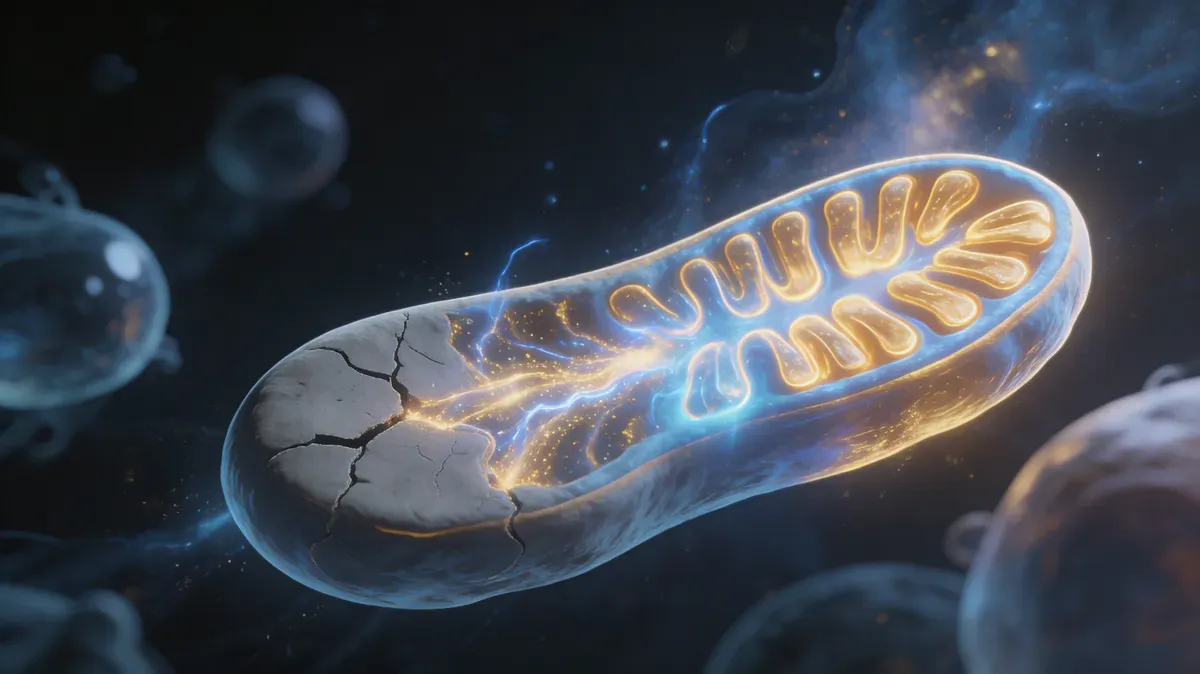
CoQ10 functions as an electron carrier in the mitochondrial electron transport chain (ETC) — the process that generates 95% of your body’s ATP (cellular energy). Specifically, CoQ10 shuttles electrons from Complex I and Complex II to Complex III, a step without which oxidative phosphorylation cannot proceed.
Without adequate CoQ10, your mitochondria produce less ATP and generate more reactive oxygen species (ROS) — essentially becoming less efficient and more damaging simultaneously.
Role 2: antioxidant protection
In its reduced form (ubiquinol), CoQ10 is one of the most powerful lipid-soluble antioxidants in the body. It:
- Protects mitochondrial membranes from oxidative damage
- Regenerates vitamin E (alpha-tocopherol) from its oxidized form
- Prevents lipid peroxidation in cell membranes and LDL cholesterol
- Neutralizes free radicals at the site where they’re produced (inside mitochondria)
This dual role — both producing energy and protecting against the damage that energy production creates — makes CoQ10 uniquely important for cellular aging.
CoQ10 vs. ubiquinol: what actually matters
CoQ10 supplements come in two redox forms: ubiquinone and ubiquinol. The difference is real, but it is often marketed too simplistically.
Ubiquinone
Ubiquinone is the oxidized form used in many traditional CoQ10 supplements. Your body can reduce ubiquinone into ubiquinol after absorption, and several clinical trials used standard CoQ10 rather than ubiquinol.
Ubiquinone is usually less expensive. Its main weakness is absorption: dry powder capsules often perform poorly, while oil-based soft gels and solubilized formulations perform better.
Ubiquinol
Ubiquinol is the reduced form and the main antioxidant form in blood and membranes. Some small studies show higher plasma CoQ10 levels with ubiquinol than with ordinary ubiquinone products.
The caveat is formulation. Human bioavailability studies show that carrier oils, solubilization, crystal dispersion, and individual absorption differences can matter as much as the ubiquinone-versus-ubiquinol label. Ubiquinol is reasonable after 40, but it is not automatically superior to every well-formulated ubiquinone product.
Which should you take?
If cost is not a problem, choose an oil-based ubiquinol soft gel from a reputable manufacturer. If cost matters, a well-formulated ubiquinone soft gel taken with food is a defensible option.
For heart failure, statin muscle symptoms, anticoagulant use, kidney disease, pregnancy, or complex medication lists, decide with your clinician. CoQ10 is a supplement, not a substitute for cardiovascular care.
How CoQ10 changes with age
The broad pattern is clear: CoQ10 is tied to aging biology, statin exposure, oxidative stress, and high-energy tissues. The exact percentage decline is not a universal number. It varies by tissue, assay, disease status, and whether studies measure plasma, cells, or organ tissue.
Tissue-specific pattern
- Heart and skeletal muscle: high energy demand makes these tissues especially relevant when CoQ10 availability is low.
- Blood and lipoproteins: plasma CoQ10 reflects transport in lipoproteins and can rise with supplementation, but it does not perfectly measure tissue stores.
- Brain: CoQ10 is biologically relevant to neuronal mitochondria, yet human cognitive outcome data remain limited.
- Statin therapy: statins inhibit the mevalonate pathway, which can lower endogenous CoQ10 synthesis.
Why CoQ10 may decline or become insufficient
Several factors can contribute: reduced biosynthesis through the mevalonate pathway, statin medications, higher oxidative stress, cardiometabolic disease, and mitochondrial dysfunction. These mechanisms make supplementation plausible in specific contexts, especially when symptoms or clinical risk factors point toward impaired mitochondrial or cardiovascular function.
The science: what CoQ10 supplementation actually does
Cardiovascular health
The strongest clinical evidence for CoQ10 comes from heart-failure research. The Q-SYMBIO trial randomized 420 patients with chronic heart failure and tested 300 mg/day of CoQ10 as add-on therapy for two years. The CoQ10 group had fewer major adverse cardiovascular events and lower cardiovascular and all-cause mortality.
That result is clinically interesting, but it applies to people with chronic heart failure receiving standard care. It does not mean healthy adults should treat CoQ10 as a universal longevity drug.
Blood pressure: older reviews reported large reductions, but newer pooled evidence is more conservative. A 2025 meta-analysis of 45 randomized trials found a modest systolic blood-pressure reduction of about 3.4 mmHg, with no significant diastolic or heart-rate effect. That may still matter at population level, but it is not comparable to antihypertensive medication. CoQ10 may complement, not replace, the work of monitoring blood pressure and arterial stiffness.
Statin-associated muscle symptoms: statins can reduce CoQ10 synthesis, so the mechanism is plausible. A 2025 meta-analysis of seven RCTs found a modest reduction in muscle-pain intensity, but the individual trials were mixed: four showed significant benefit and three did not. A time-limited trial of 100-200 mg/day is reasonable for some people with SAMS, but it is not guaranteed and should not be used as a reason to stop statin therapy without medical advice.
Exercise performance
CoQ10 reliably raises blood CoQ10 levels. Performance effects are much less consistent. A recent systematic review and meta-analysis found at most small, context-dependent benefits from chronic supplementation, with low to very low certainty and no stable dose-response pattern.
This fits the biology. CoQ10 may help when mitochondrial stress, low baseline status, or medication effects are present. In trained people with already robust mitochondrial adaptations, the added performance signal is usually small. For a complementary pathway, cordyceps targets AMPK and adenosine-like signaling rather than replacing CoQ10 in the electron transport chain.
Cognitive function
CoQ10 is relevant to brain mitochondria and oxidative stress, but human cognitive data are still early and mixed. Animal studies look more promising than clinical trials. Current evidence supports CoQ10 as a mitochondrial-support candidate, not a treatment for cognitive decline or dementia.
Fertility
CoQ10 has supportive evidence in fertility contexts, especially sperm motility and oocyte-quality protocols, because reproductive cells are energy intensive. Doses in these studies are often higher than general wellness doses and should be individualized with a fertility clinician.
The longevity question: does CoQ10 extend lifespan?
Direct lifespan evidence remains weak.
Unlike spermidine, which has broader animal and epidemiologic support around autophagy, CoQ10 lifespan studies are inconsistent. The same is true when comparing CoQ10 with NAD+ strategies: both relate to mitochondrial function, but neither should be treated as a stand-alone aging reversal tool.
The most important recent update is negative. A 2025 lifetime supplementation study in normal-aging female C57BL/6J mice found no significant improvement in median, late-life, or maximum lifespan. The study did find a temporary improvement in senescence grading around middle age, which supports context-dependent healthspan effects rather than robust lifespan extension.
Who is most likely to benefit?
CoQ10 is most defensible for adults over 40 with cardiovascular risk, heart failure under medical care, statin-associated muscle symptoms, low energy plus cardiometabolic disease, or high oxidative-stress burden. For young, metabolically healthy, non-medicated adults, the expected benefit is probably small.
Dosage, absorption, and practical guidelines
Typical dose ranges
- General mitochondrial support after 40: 100-200 mg/day with food.
- Statin-associated muscle symptoms: 100-200 mg/day for 8-12 weeks is a reasonable trial; judge by symptom change.
- Chronic heart failure adjunct: Q-SYMBIO used 300 mg/day, usually split with meals, under medical supervision.
- Exercise or fatigue experiments: 100-300 mg/day for at least 4-12 weeks; benefits are not guaranteed.
- Fertility protocols: 200-600 mg/day is common in studies, but dosing should be clinician-guided.
Absorption tips
CoQ10 is fat-soluble. Take it with a meal that contains fat. Soft gels and solubilized products usually absorb better than dry powder capsules. Divided doses can work better than one large dose, especially above 200 mg/day.
Do not choose by the word “ubiquinol” alone. Look for an oil-based or solubilized formulation, third-party testing when available, clear dose labeling, and stable packaging that protects the product from heat and light.
Side effects and cautions
CoQ10 is generally well tolerated. Mild nausea, diarrhea, appetite changes, or insomnia can occur, especially at higher doses or when taken late in the day.
CoQ10 may interact with warfarin or other anticoagulation management, and anyone with heart failure, kidney disease, pregnancy, active cancer therapy, or multiple medications should review it with a clinician.
How SuperAge tracks your mitochondrial health
Mitochondrial function determines how much energy your cells can produce, how quickly you recover from exertion, and how fast oxidative damage accumulates. SuperAge tracks the physiological outputs of mitochondrial health through Apple Health integration.
VO2 max: the mitochondrial capacity marker
Your VO2 max is arguably the best non-invasive proxy for mitochondrial function. SuperAge tracks this metric continuously through Apple Watch data, showing trends that reflect whether your mitochondria are improving or declining. If you want to actively move the needle on this number, our guide on how to improve VO2 max covers the exact training protocols with the strongest evidence.
Recovery and energy metrics
Body energy, training readiness, and HRV all reflect mitochondrial efficiency. When mitochondria function well, recovery is faster, energy is more stable, and heart rate variability is higher. SuperAge integrates these metrics into your biological age calculation.
Tracking intervention effectiveness
Whether you’re supplementing with CoQ10, optimizing exercise, or both, SuperAge provides the longitudinal data to see whether your efforts are translating into measurable biological age improvement.
Frequently asked questions
Should everyone over 40 take CoQ10?
No. CoQ10 is most compelling when there is a clear reason: statin use, cardiovascular disease, heart failure under medical care, low energy with cardiometabolic risk, or a clinician-guided fertility protocol. For a healthy, active adult with no medications, it is optional.
Is ubiquinol always better than ubiquinone?
No. Ubiquinol can be a good choice, especially after 40, but formulation matters. A high-quality oil-based ubiquinone soft gel can outperform a poorly formulated ubiquinol product.
Does CoQ10 help with statin muscle pain?
Sometimes. A 2025 meta-analysis found a modest average pain reduction, but the trials were mixed. If you suspect statin-associated muscle symptoms, discuss a trial with your clinician instead of stopping the statin on your own.
How long until I feel the effects of CoQ10?
If CoQ10 helps, the signal usually appears after 4-12 weeks. Some people notice less muscle pain or fatigue; many healthy people feel nothing. Track symptoms, training, sleep, and medications so you can judge whether the experiment is useful.
Can I get enough CoQ10 from food?
Dietary sources include organ meats, sardines, mackerel, beef, chicken, soy oil, and peanuts. Food contributes to baseline intake, but typical dietary intake is far below the 100-300 mg/day used in many clinical studies.
What is the difference between CoQ10 and PQQ?
PQQ is studied for mitochondrial biogenesis signaling, while CoQ10 supports electron transport inside existing mitochondria. They are complementary ideas, not interchangeable supplements. For broader context, see our guide to an evidence-based longevity supplement stack.
Key takeaways
- CoQ10 supports mitochondria: it helps move electrons for ATP production and acts as a lipid-soluble antioxidant.
- The strongest evidence is targeted: chronic heart failure and some statin-associated muscle symptoms are more evidence-based than general anti-aging use.
- Ubiquinol is not magic: chemical form matters, but formulation and absorption matter too.
- Blood-pressure and exercise effects are modest: newer reviews point to smaller, more context-dependent benefits than older claims.
- Longevity extension is unproven: CoQ10 may support healthspan in selected people, but it has not shown consistent lifespan extension.
Power your mitochondria, power your aging trajectory
Your mitochondria are the engines of every cell in your body. Whether you support them through CoQ10 supplementation, exercise, or both, monitoring their functional output tells you whether your aging trajectory is on the right track.
Ready to track your mitochondrial health? Download SuperAge and monitor the biomarkers — from VO2 max to HRV — that reveal how your mitochondria are performing.
References
- Mortensen SA et al. - “The Effect of Coenzyme Q10 on Morbidity and Mortality in Chronic Heart Failure” - JACC: Heart Failure (2014) - PubMed
- de Barcelos IP and Haas RH - “CoQ10 and Aging” - Biology (2019) - PMC
- Díaz-Casado ME et al. - “The Paradox of Coenzyme Q10 in Aging” - Nutrients (2019) - PMC
- López-Lluch G et al. - “Bioavailability of coenzyme Q10 supplements depends on carrier lipids and solubilization” - Nutrition (2019) - DOI
- Igarashi Y et al. - “Effects of lifetime supplementation with ubiquinol 10 on the lifespan and progression of aging in female C57BL/6 mice” - Experimental Gerontology (2025) - DOI
- Karimi M et al. - “Effects of coenzyme Q10 administration on blood pressure and heart rate in adults” - International Journal of Cardiology Cardiovascular Risk and Prevention (2025) - PubMed
- Kovacic S et al. - “Effects of coenzyme Q10 supplementation on myopathy in statin-treated patients” - Journal of Nutritional Science (2025) - PubMed
- Deng Y et al. - “Coenzyme Q10 supplementation increases blood concentrations but shows limited and inconsistent effects on exercise performance” - British Journal of Nutrition (2026) - PubMed
- Chang DH et al. - “Coenzyme Q10 and Cognition: A Review” - Nutrients (2025) - PMC
Last updated: 2026-06-07. This article is regularly reviewed for accuracy.
The information provided does not replace professional medical advice. Consult your healthcare provider before starting any supplementation.
Related Articles

Mitochondrial dysfunction: When cellular energy declines with age
Learn how mitochondrial dysfunction contributes to aging — from declining ATP production to oxidative stress — and evidence-based ways to support mitochondrial health.