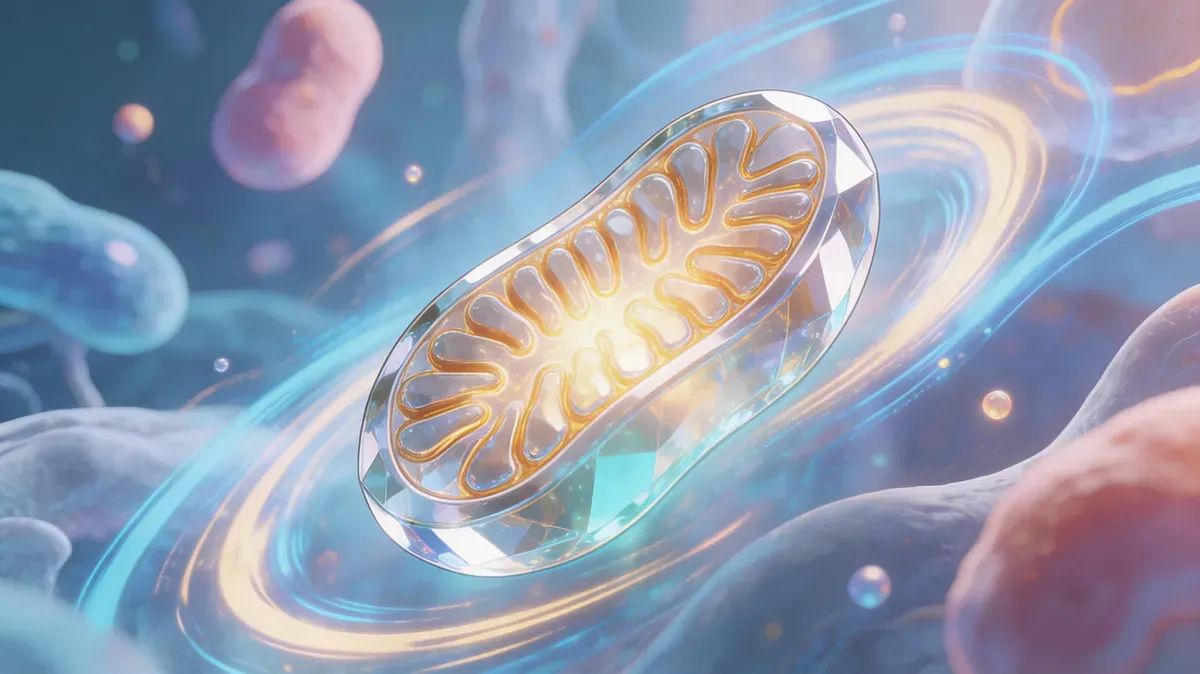
PQQ: mitochondrial biogenesis supplement guide
PQQ stimulates mitochondrial biogenesis — the creation of new mitochondria. Explore the science, food sources, dosing, and how it connects to cellular aging.
In 1964, a chemist at the University of Michigan named J. G. Hauge was studying bacterial enzymes when he encountered an unusual cofactor — a small organic molecule helping a particular bacterial dehydrogenase do its job. It wasn’t NAD+, it wasn’t FAD, it wasn’t any of the known redox cofactors in cellular biology. He called it pyrroloquinoline quinone, or PQQ. For decades it was considered an obscure bacterial molecule of interest mainly to biochemists. Then in 2003, a paper in Nature claimed PQQ was an essential nutrient for mammals — and later research showed that animals deprived of PQQ developed fragility, reduced mitochondrial function, and impaired fertility.
The “essential nutrient” claim was later softened (PQQ is no longer classified as a vitamin), but the underlying observation that PQQ affects mitochondrial function turned out to be real — and more interesting than anyone expected. In particular, PQQ appears to stimulate mitochondrial biogenesis, the process by which cells create entirely new mitochondria. This is significant because mitochondrial decline is one of the most consistent features of aging, and compounds that stimulate new mitochondrial formation are rare.
What you’ll learn:
- What mitochondrial biogenesis is and why it matters for aging
- How PQQ activates PGC-1α and stimulates the formation of new mitochondria
- What human trials have and haven’t shown
- Dosing, food sources, and honest limits of the evidence
What is PQQ?
Pyrroloquinoline quinone (PQQ) is a small redox-active molecule first identified as a bacterial enzyme cofactor. In mammals, it’s present in trace amounts in many foods, including fermented soybeans, parsley, green peppers, kiwi, papaya, and human breast milk.
Quick definition: PQQ is a redox-active compound that stimulates mitochondrial biogenesis by activating PGC-1α, the master regulator of new mitochondrial formation, and also acts as a potent antioxidant that can cycle thousands of times without being destroyed.
The redox superpower
Most antioxidants — vitamin C, glutathione, coenzyme Q10 — work by accepting a free radical electron, becoming oxidized themselves, and then requiring regeneration before they can work again. PQQ is different: it can cycle through thousands of oxidation-reduction reactions without being degraded. Lab studies suggest it can handle roughly 5,000 redox cycles, compared to around 4 for vitamin C. This makes it one of the most efficient antioxidants identified.
Mitochondrial biogenesis
The number of mitochondria in a given cell isn’t fixed. Under certain conditions — exercise, cold exposure, caloric restriction — cells create new mitochondria through a process called mitochondrial biogenesis. This process is governed by a master transcriptional coactivator called PGC-1α (peroxisome proliferator-activated receptor gamma coactivator 1-alpha).
When PGC-1α is activated, it coordinates the expression of hundreds of genes needed to build new mitochondria. This is one of the reasons exercise is such a powerful anti-aging intervention: it activates PGC-1α and literally makes your cells more mitochondrial-dense.
Why mitochondrial biogenesis matters for aging
Mitochondrial dysfunction is a core hallmark of aging. With age, people lose both mitochondrial quantity and quality. Individual mitochondria accumulate damaged mtDNA, lose membrane potential, and become less efficient at producing ATP. In parallel, the overall number of functional mitochondria in many tissues declines — a process described in detail in our guide to mitochondrial dysfunction and aging.
Compounds that support mitochondrial biogenesis are rare. Exercise — particularly Zone 2 training — is the gold standard. PQQ is one of the few natural compounds with preclinical evidence supporting a direct biogenesis effect. Urolithin A works differently, by clearing out damaged mitochondria via mitophagy, making these two compounds mechanistically complementary.
The science behind PQQ
Mechanisms
- PGC-1α activation: PQQ increases PGC-1α expression and activity, triggering the mitochondrial biogenesis program.
- Antioxidant cycling: its exceptional redox capacity protects mitochondrial membranes from oxidative damage.
- Sirtuin activation: some studies show PQQ increases SIRT1 and SIRT3 expression, both of which regulate mitochondrial function and aging — the same sirtuins that require NAD+ to function and decline with age.
- Nerve growth factor support: PQQ has been shown to stimulate NGF production in some cell systems, overlapping with lion’s mane mushroom.
- Inflammation modulation: reduces pro-inflammatory markers in animal models.
- Reproductive and developmental effects: the original essential-nutrient claims were based on fertility and developmental impairments in PQQ-deprived mice.
What human trials show
The human evidence base is small but not absent:
- Acute antioxidant effects (2013): a study of 10 human subjects showed that a single 20 mg dose of PQQ altered multiple mitochondrial-related metabolites in urine, consistent with effects on mitochondrial metabolism.
- Fatigue and sleep (2016): a small Japanese trial found that 20 mg/day PQQ for 8 weeks improved fatigue, quality of life, sleep, and appetite scores in middle-aged adults.
- Cognitive function (2012): a study of 71 middle-aged and elderly adults using BioPQQ at 20 mg/day for 12 weeks showed improvements in memory and attention tests, with effects enhanced when combined with coenzyme Q10.
- Inflammation (2013): 10 adults taking 0.2 mg/kg/day PQQ for 3 days showed reduced CRP and IL-6.
What’s missing: long trials, mitochondrial biogenesis measurements directly in humans, and dose-response data.
PQQ and biological aging
PQQ targets mitochondrial decline, which makes it mechanistically aligned with VO2 max preservation and the core physiological changes of aging. However, the human data directly linking PQQ supplementation to biological age markers is not yet strong.
What’s biologically plausible:
- Muscle mitochondrial density: mitochondrial biogenesis in skeletal muscle would support aerobic capacity and insulin sensitivity.
- Brain mitochondrial function: neurons are heavily dependent on mitochondrial energy; improvements here could affect cognitive aging.
- Cardiac mitochondrial health: heart muscle has the highest mitochondrial density of any tissue; mitochondrial decline drives heart aging.
- Reduced oxidative damage: over decades, cumulative oxidative damage contributes to most aging processes.
PQQ is more “mechanism-rich” than “outcome-proven” at this stage.
6 ways to approach PQQ
1. Start with food
Small amounts of PQQ are present in many foods:
| Food | PQQ content (per 100 g) |
|---|---|
| Natto (fermented soy) | ~60 μg |
| Parsley | ~34 μg |
| Green tea | ~30 μg |
| Green pepper | ~28 μg |
| Kiwi | ~27 μg |
| Papaya | ~27 μg |
Typical Western diets provide 0.1-1 mg per day. A diet rich in parsley, kiwi, natto, and green tea can increase this intake modestly — but reaching supplement-level doses through food is not realistic.
2. Use a clinically studied dose
The most common supplement dose is 10-20 mg/day. This matches the doses used in the main human trials. Higher doses (up to 60 mg/day) have been used without major concerns but are not clearly more effective.
3. Consider combining with CoQ10
Cognitive function studies suggest PQQ and coenzyme Q10 may have complementary effects. CoQ10 is essential for the electron transport chain; PQQ supports mitochondrial biogenesis. This combination is common in longevity protocols.
4. Timing is flexible
PQQ is well absorbed and has a relatively long half-life. Morning dosing with food is typical. Some people split the dose morning and afternoon.
5. Don’t expect dramatic acute effects
Like most mitochondrial interventions, PQQ’s effects are gradual and cumulative. If you’re going to experiment, give it at least 8-12 weeks before judging.
6. Watch for sleep disruption
Some users report vivid dreams or mild sleep changes, particularly at higher doses. If sleep is affected, move the dose earlier in the day or reduce it.
The information provided does not replace professional medical advice. Consult your healthcare provider before starting any supplementation.
How to track mitochondrial-related markers
| Metric | How to measure | Relevance |
|---|---|---|
| VO2 max | Apple Watch estimate, fitness test | Core mitochondrial capacity marker |
| Resting heart rate | Wearable | Cardiac efficiency |
| HRV | Wearable | Autonomic balance |
| Fasting glucose, HbA1c | Blood test | Mitochondrial-driven metabolic health |
| Time to exhaustion (fixed pace) | Training log | Aerobic performance |
| Biological age | SuperAge, PhenoAge | Integrated readout |
How SuperAge helps with mitochondrial tracking
Mitochondrial health is invisible without the right data. SuperAge turns Apple Health signals into a continuous view of the systems most sensitive to mitochondrial function:
VO2 max trajectory
VO2 max is the single most mitochondrial-sensitive biomarker available to consumers. SuperAge shows you the trend over time, so you can see whether interventions are actually shifting your aerobic fitness.
Cardiovascular age
Combining VO2 max, resting heart rate, and HRV, SuperAge estimates how “old” your cardiovascular system is compared to biological age norms.
Biological age estimate
A single number that reflects the cumulative impact of aerobic, metabolic, and recovery-related factors.
Frequently asked questions
Is PQQ really essential?
No. The original “essential vitamin” claim was softened after further research. PQQ is not a classified vitamin in any official nutritional framework, but it does appear to have physiological effects at supplement doses.
Does PQQ actually build new mitochondria in humans?
Animal studies show increased mitochondrial biogenesis markers. Direct human measurements are limited but consistent with a mild biogenesis effect at 10-20 mg/day.
Is PQQ safe?
Clinical doses up to 60 mg/day have been used without significant adverse effects in short-term studies. Long-term safety beyond one year is less characterized.
Can PQQ replace exercise for mitochondrial health?
No. Exercise remains by far the most potent stimulus for mitochondrial biogenesis, with effects orders of magnitude larger than any supplement. PQQ is an amplifier, not a substitute.
Does PQQ help with brain fog?
Small trials show improvements in cognitive function and fatigue, but individual responses vary. Brain fog has many causes, and PQQ is not specifically validated for it.
Key takeaways
- PQQ supports mitochondrial biogenesis by activating PGC-1α — one of the rare natural compounds with this mechanism.
- It’s an exceptional recycling antioxidant, capable of thousands of redox cycles.
- Human evidence is small but positive for fatigue, cognition, and inflammation at 10-20 mg/day.
- Food sources are limited — meaningful supplementation doses are only reachable with capsules.
- Exercise dwarfs any supplement for mitochondrial health. PQQ is an amplifier, not a foundation.
Start tracking your mitochondrial health today
Mitochondria are where aging happens in real time. The best way to protect them is exercise — and the best way to measure whether it’s working is objective tracking.
Ready to take control? Download SuperAge and start tracking your biological age while you experiment with mitochondrial interventions.
References
- Rucker R. et al. — Potential physiological importance of pyrroloquinoline quinone. Alternative Medicine Review, 2009.
- Harris C. B. et al. — Dietary pyrroloquinoline quinone (PQQ) alters indicators of inflammation and mitochondrial-related metabolism in human subjects. Journal of Nutritional Biochemistry, 2013.
- Nakano M. et al. — Effect of pyrroloquinoline quinone (PQQ) on mental status of middle-aged and elderly persons. FOOD Style 21, 2012.
- Chowanadisai W. et al. — Pyrroloquinoline quinone stimulates mitochondrial biogenesis through cAMP response element-binding protein phosphorylation and increased PGC-1α expression. Journal of Biological Chemistry, 2010.
- Stites T. et al. — Pyrroloquinoline quinone modulates mitochondrial quantity and function in mice. Journal of Nutrition, 2006.
Last updated: 2026-04-09. This article is regularly reviewed to ensure accuracy.
Related Articles

Astaxanthin: super-carotenoid for skin, eyes and aging
Astaxanthin may support skin UV resilience, eye fatigue, and oxidative-stress markers. Review doses, safety limits, food sources, and realistic aging claims.