Lion's mane mushroom: nerve growth factor and brain aging
Lion's mane mushroom contains compounds that stimulate nerve growth factor (NGF). Explore the science behind hericenones, erinacines, cognitive aging, and longevity.
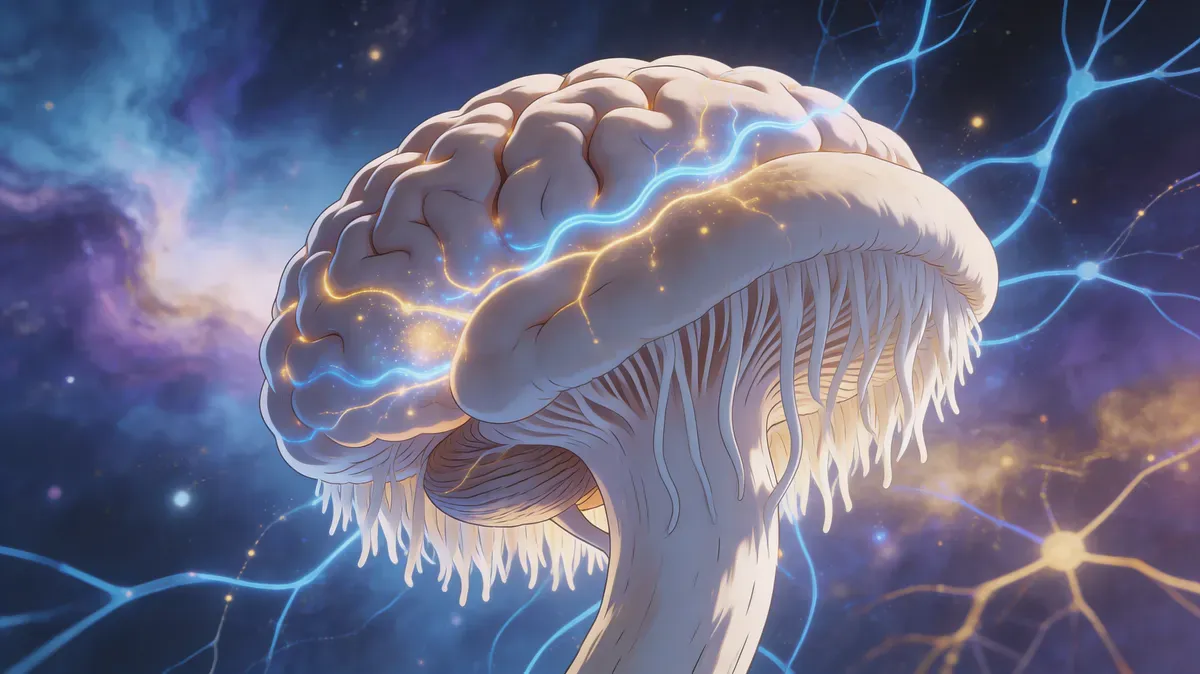
In 1991, Japanese chemist Hirokazu Kawagishi isolated two families of molecules from a shaggy white mushroom growing on old oak trees. The compounds — which he named hericenones and erinacines — did something no one had seen before from a food: they crossed the blood-brain barrier and stimulated the production of nerve growth factor (NGF), a protein essential for keeping neurons alive. The mushroom was Hericium erinaceus, known in English as lion’s mane. Three decades later, it has become one of the most studied natural nootropics in the world.
Lion’s mane sits at an unusual intersection. It’s a culinary mushroom prized in East Asian cuisine, a traditional remedy documented in Chinese medical texts for over a thousand years, and — increasingly — a compound drawing serious attention from neuroscientists studying cognitive aging, mild cognitive impairment, and neurodegeneration. In 2023, a randomized trial in Frontiers in Aging Neuroscience found that lion’s mane supplementation improved processing speed in healthy adults in just 28 days.
But the hype around lion’s mane has also outpaced the evidence in ways that deserve honest examination. Here’s what the research actually supports.
What you’ll learn:
- How hericenones and erinacines stimulate NGF and BDNF in the brain
- Why NGF matters for cognitive aging and neurodegenerative disease
- What human clinical trials have actually demonstrated
- Food vs. extract: dosing, forms, and realistic expectations
What is lion’s mane?
Lion’s mane (Hericium erinaceus) is an edible and medicinal mushroom characterized by long, cascading white spines that resemble a lion’s mane or a waterfall of icicles. It grows on hardwood trees — particularly oak, beech, and maple — in temperate forests across North America, Europe, and Asia.
Quick definition: Lion’s mane is an edible mushroom containing hericenones and erinacines, unique compounds that cross the blood-brain barrier and stimulate nerve growth factor (NGF) synthesis, supporting neuronal health and cognitive function.
The active compounds
Lion’s mane contains two families of neuroactive molecules found in virtually no other food:
- Hericenones (H1-H10): concentrated in the fruiting body (the visible mushroom cap). Aromatic compounds that stimulate NGF synthesis in nerve cells.
- Erinacines (A through K): concentrated in the mycelium (the underground root-like network). Diterpenoid compounds that are among the most potent known inducers of NGF, and — critically — small enough to cross the blood-brain barrier.
This matters because most growth factors discovered in laboratories don’t work as oral supplements — they’re too large to reach the brain. Erinacines are one of the rare exceptions.
Why NGF matters for aging
Nerve growth factor was discovered by Rita Levi-Montalcini in 1952, a finding that earned her the 1986 Nobel Prize. NGF keeps neurons alive, promotes the growth of new dendrites, and maintains synaptic plasticity — the biological basis of learning and memory.
NGF levels decline with age. In Alzheimer’s disease, cholinergic neurons in the basal forebrain (the region most affected early in the disease) are particularly dependent on NGF for survival. Lower NGF is associated with faster cognitive decline and greater brain atrophy in older adults.
The science behind lion’s mane
How hericenones and erinacines work
Unlike pharmaceutical drugs that target a single receptor, lion’s mane compounds appear to work through multiple parallel mechanisms:
- NGF induction: hericenones and erinacines stimulate astrocytes and other brain cells to produce NGF. In cell culture, erinacine A induces NGF synthesis more potently than any other known natural compound.
- BDNF upregulation: lion’s mane also increases brain-derived neurotrophic factor (BDNF), another critical molecule for neurogenesis and memory.
- Neurogenesis in the hippocampus: in animal models, lion’s mane stimulates the growth of new neurons in the dentate gyrus — the same region where adult neurogenesis has been documented in humans.
- Anti-inflammatory and antioxidant activity: lion’s mane reduces oxidative stress and neuroinflammation, both of which accelerate cognitive decline and brain aging.
- Myelin repair: some evidence suggests lion’s mane supports remyelination — the repair of the protective sheath around nerves, relevant in conditions like multiple sclerosis.
What the human trials show
The human evidence base is still modest but genuinely interesting:
- Mild cognitive impairment (2009, Japan): 30 older adults with mild cognitive impairment received 3 g/day of lion’s mane powder or placebo for 16 weeks. The lion’s mane group showed significantly improved cognitive function scores. When supplementation stopped, scores declined again within 4 weeks — suggesting the effect requires continued intake.
- Healthy adults (2023): a randomized controlled trial found that a single 1.8 g dose improved reaction time, and 28 days of supplementation improved subjective stress and cognitive performance.
- Depression and anxiety (2010, 2019): small trials reported reductions in anxiety and depressive symptoms, possibly mediated by BDNF and neurogenesis effects.
- Alzheimer’s pilot (2020): a Taiwanese trial using erinacine A-enriched mycelia showed modest improvements in cognitive scores in mild Alzheimer’s patients over 49 weeks.
What’s missing: large, long-duration trials. Most studies involve fewer than 50 participants and last under a year. Lion’s mane is not a validated treatment for any disease, and claims that it “reverses dementia” are unsupported.
Lion’s mane and biological aging
Brain aging is one of the most visible dimensions of biological aging — and one of the most feared. Cognitive decline isn’t just a loss of ability; it’s a loss of self. This is why interventions that target neurological aging specifically are of such interest for longevity.
Lion’s mane connects to several hallmarks of aging:
- Loss of proteostasis: lion’s mane may reduce accumulation of misfolded proteins like amyloid-beta in animal models.
- Stem cell exhaustion: by supporting neural stem cell activity, lion’s mane may partially counter the decline of adult neurogenesis.
- Chronic inflammation (inflammaging): its anti-inflammatory polysaccharides target one of the core drivers of age-related disease.
- Mitochondrial dysfunction: lion’s mane extracts improve mitochondrial function in neurons under stress.
None of this means lion’s mane will extend your lifespan. But preserving cognitive function during the second half of life is arguably the most important component of healthspan — and the evidence here is stronger than for most “anti-aging” compounds.
6 proven ways to use lion’s mane
1. Choose the right form
Lion’s mane is sold as whole mushroom powder, fruiting-body extract, mycelium extract, or dual extract (both). The active compounds are different:
- Fruiting body: richer in hericenones and beta-glucans
- Mycelium: contains erinacines (the more potent NGF inducers), but often grown on grain substrate that dilutes the extract
- Dual extract: captures both compound families; generally the most studied form
Practical advice: look for products that specify “fruiting body” on the label. Mycelium-on-grain products are legal but often contain more grain than mushroom.
2. Know the dosage range
Human trials have used doses ranging from 1 g to 3 g per day of dried mushroom or extract equivalent. The 3 g/day dose used in the 2009 mild cognitive impairment study is the most validated.
- General cognitive support: 500-1000 mg of concentrated extract daily
- Clinical-style protocol: 1000-3000 mg of dried mushroom equivalent daily
Higher doses have not shown clearly superior effects in the available trials.
3. Eat it as food when possible
Fresh lion’s mane is delicious — its texture is often compared to crab or lobster. A 100 g serving of fresh mushroom contains meaningful amounts of bioactive compounds (though concentration varies). Culinary use won’t replicate clinical doses, but it’s a real contribution and comes with zero risk.
4. Take it consistently, not sporadically
The 2009 trial showed that benefits disappeared within 4 weeks of stopping. Lion’s mane appears to work via ongoing NGF stimulation, not via a permanent change. Consistent daily intake over 8-16 weeks is the standard protocol.
5. Pair it with other neuroprotective habits
Lion’s mane is not a substitute for the lifestyle factors that actually protect brain aging:
- Regular aerobic exercise — one of the strongest known BDNF inducers
- Adequate sleep and treatment of sleep apnea (sleep is critical for memory consolidation)
- Mediterranean-style diet
- Social engagement and cognitive challenge
- Management of vascular risk factors (blood pressure, glucose, lipids) — for direct cerebral circulation support, ginkgo biloba addresses these vascular mechanisms through a complementary pathway
Think of lion’s mane as a potential amplifier, not a shortcut. For memory consolidation specifically, Bacopa monnieri is a well-studied complement — it works through different mechanisms (acetylcholinesterase inhibition and dendritic branching) and stacks logically with lion’s mane’s NGF-focused approach.
6. Be cautious with certain conditions
Lion’s mane is well tolerated in most people but can cause skin rashes or breathing difficulty in those with mushroom allergies. Because it may modestly affect blood clotting, consult a healthcare provider if you’re on anticoagulants. It has not been studied adequately in pregnancy.
The information provided does not replace professional medical advice. Consult your healthcare provider before starting any supplementation.
How to track the effects
Cognitive changes from supplements are hard to perceive subjectively. If you’re going to try lion’s mane, treat it like an experiment with real measurements:
| Metric | How to measure | Timeframe |
|---|---|---|
| Processing speed | Online cognitive tests (Cambridge Brain Sciences, Quantified Mind) | Baseline + 8 weeks |
| Subjective memory | Structured journal: 3 things per day | Weekly review |
| Sleep quality | HRV, sleep tracker (via Apple Watch or similar) | Continuous |
| Mood | Validated scale (PHQ-9) | Baseline + 4, 8 weeks |
| Biological age markers | PhenoAge panel if accessible | 6-month intervals |
Without baseline measurements, you can’t tell whether lion’s mane — or any nootropic — is actually helping you.
How SuperAge helps you with cognitive aging
Tracking whether a supplement is genuinely moving your health forward is hard without objective data. SuperAge turns Apple Health signals into a continuous picture of how your body is aging:
Biological age, continuously updated
SuperAge integrates heart rate, HRV, VO2 max, resting heart rate, sleep architecture, and activity patterns into a biological age estimate that updates over time — so you can see whether interventions like lion’s mane are associated with real changes in your underlying physiology.
Sleep and HRV trends
Many cognitive benefits depend on sleep consolidation and autonomic recovery. SuperAge surfaces these trends automatically, giving you an early signal if a supplement is helping — or hurting — your recovery.
Personalized healthspan insights
Rather than generic advice, SuperAge shows which levers (VO2 max, HRV, sleep, weight, cardio load) are most affecting your biological age, so you know where to focus.
Frequently asked questions
Does lion’s mane actually cross the blood-brain barrier?
Erinacines — the compounds concentrated in the mycelium — are small diterpenoids that animal studies have shown cross the blood-brain barrier. Hericenones are larger and their direct brain penetration is less clear, though they appear to stimulate peripheral NGF which can indirectly affect the central nervous system.
How long until I notice effects?
Clinical trials show measurable cognitive changes at 4-16 weeks. A single dose may produce mild acute effects on reaction time in healthy adults, but meaningful benefits require consistent daily use for weeks to months.
Is lion’s mane safe long-term?
It has been used as food for centuries and clinical trials up to a year have reported no significant adverse events. That said, there is no long-term safety data comparable to common medications. People with mushroom allergies should avoid it.
Can lion’s mane prevent or treat Alzheimer’s?
No supplement has been proven to prevent or treat Alzheimer’s disease. Lion’s mane has shown modest cognitive benefits in small trials including patients with mild cognitive impairment, but it is not a substitute for medical care and should not be marketed as a treatment.
Should I take it with fat for absorption?
Hericenones are fat-soluble, so taking lion’s mane with a meal containing some fat may improve absorption. This is a reasonable practice even without direct evidence.
What’s the difference between lion’s mane and reishi?
Both are medicinal mushrooms studied for longevity, but they target different systems. Lion’s mane acts primarily on the nervous system — stimulating NGF and BDNF for cognitive and neurological support. Reishi focuses on immune modulation and inflammation — its beta-glucans enhance NK cell and macrophage activity, while triterpenes suppress NF-κB-driven inflammaging. Many protocols use both for complementary coverage.
Key takeaways
- Lion’s mane is unique: its hericenones and erinacines are among the only known natural compounds that stimulate nerve growth factor in the brain.
- Human evidence is modest but real: small trials show improvements in cognitive function, reaction time, and mood, particularly in people with mild cognitive impairment.
- It’s not a miracle cure: lion’s mane is an amplifier of brain health, not a substitute for exercise, sleep, and vascular health — the real pillars of cognitive aging.
- Consistency matters: benefits require daily use over 8-16 weeks and may disappear when supplementation stops.
- Track objectively: use cognitive tests, HRV, sleep data, and biological age markers to know whether it’s working for you.
Start tracking your brain aging today
Cognitive decline is not inevitable — but it is cumulative. The earlier you start measuring and acting, the more room you have to shape the trajectory.
Ready to take control? Download SuperAge and start tracking your biological age alongside any cognitive intervention you try.
References
- Kawagishi H. et al. — Isolation and characterization of hericenones from Hericium erinaceum. Tetrahedron Letters, 1991.
- Mori K. et al. — Improving effects of the mushroom Yamabushitake (Hericium erinaceus) on mild cognitive impairment: a double-blind placebo-controlled clinical trial. Phytotherapy Research, 2009.
- Docherty S. et al. — The acute and chronic effects of lion’s mane mushroom supplementation on cognitive function, stress and mood in young adults. Frontiers in Aging Neuroscience, 2023.
- Li I. et al. — Prevention of early Alzheimer’s disease by erinacine A-enriched Hericium erinaceus mycelia pilot double-blind placebo-controlled study. Frontiers in Aging Neuroscience, 2020.
- Chong P. S. et al. — Therapeutic potential of Hericium erinaceus for depressive disorder. International Journal of Molecular Sciences, 2019.
Last updated: 2026-04-09. This article is regularly reviewed to ensure accuracy.
Related Articles

Ginkgo biloba: cerebral circulation and cognitive aging
Ginkgo biloba may support cognition in impairment, but prevention data are mixed. Review EGb 761 evidence, dosing, safety risks, and limits.