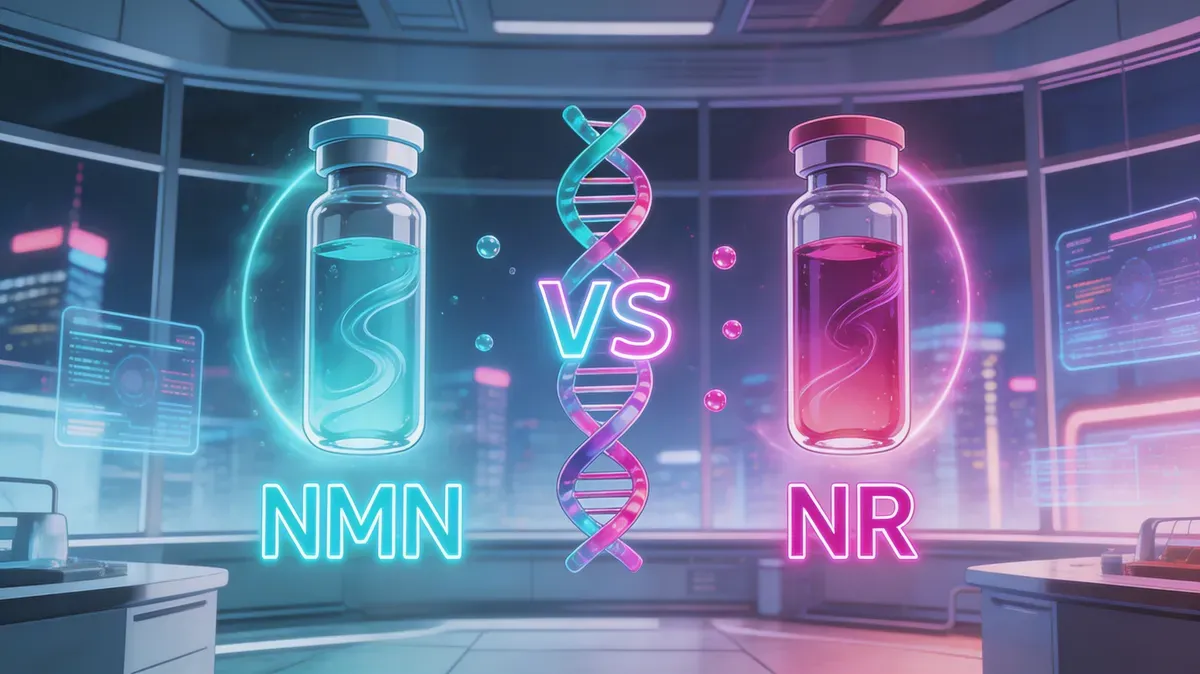
NMN vs NR: Which NAD+ precursor actually works for longevity?
NMN and NR both boost NAD+ levels, but they differ in absorption, tissue distribution, and clinical evidence. Compare the science behind each precursor.
The supplement shelves are crowded with NAD+ boosters — and the two names that dominate every longevity conversation are NMN (nicotinamide mononucleotide) and NR (nicotinamide riboside). Both promise to replenish the coenzyme your mitochondria are running out of, but they take different biochemical routes to get there — and the clinical evidence behind them tells a more nuanced story than most supplement companies want you to hear.
Here’s what makes this comparison genuinely difficult: NMN and NR are closely related molecules that both raise NAD+ levels in humans. The question isn’t whether they work — they do. The question is how well, where in your body, and whether the differences actually matter for your long-term health.
A 2025 review in Food Frontiers directly compared all available preclinical and clinical data for both compounds, and the results challenge several popular assumptions. Neither molecule is a clear winner across all outcomes. Understanding the trade-offs requires looking beyond marketing claims and into the actual biochemistry.
What you’ll learn:
- How NMN and NR differ at the molecular level
- What human clinical trials actually show for each compound
- Which precursor reaches which tissues — and why that matters
- The overlooked third option: plain niacin
- How to make an informed decision based on evidence, not hype
What are NMN and NR?
Both NMN and NR are forms of vitamin B3 — precursors that your body converts into NAD+ (nicotinamide adenine dinucleotide). They occupy adjacent positions in the NAD+ biosynthesis pathway, which means they’re one enzymatic step apart.
Quick definition: NMN and NR are NAD+ precursors — molecules your body converts into NAD+, the coenzyme essential for energy production, DNA repair, and cellular aging defense.
The biosynthesis pathway
Here’s the simplified route from dietary precursor to active NAD+:
Tryptophan → (de novo pathway, 8 steps) → NAD+

Niacin → Nicotinamide → NMN → NAD+
                ↑
               NR → NMN → NAD+
Notice something important: NR must first be converted to NMN before it can become NAD+. This means NMN is technically one step closer to the final product. However, “closer” doesn’t automatically mean “better” — cellular biology rarely works that simply.
Key molecular differences
| Property | NMN | NR |
|---|---|---|
| Molecular weight | 334.2 g/mol | 255.2 g/mol |
| Steps to NAD+ | 1 (via NMNAT) | 2 (NRK → NMNAT) |
| Cell entry mechanism | Slc12a8 transporter (direct) + conversion to NR | Equilibrative nucleoside transporters |
| Gut stability | High | Lower (degrades faster in GI tract) |
| Key converting enzyme | NMNAT1/2/3 | NRK1/NRK2 |
The science behind each precursor
How NMN works in your body
NMN enters cells through two routes. The first was discovered in 2019 — a dedicated transporter called Slc12a8 that shuttles NMN directly into cells, particularly in the gut and hypothalamus. The second route involves NMN being converted to NR outside the cell, entering via nucleoside transporters, then being reconverted to NMN inside.
Once inside, NMN is converted to NAD+ in a single step by NMNAT enzymes — a fast, efficient reaction that occurs in the cytoplasm, mitochondria, and nucleus.
Preclinical highlights:
- Reversed age-related vascular dysfunction in aged mice (2024, Science)
- Improved insulin sensitivity in prediabetic aged mice
- Enhanced muscle mitochondrial oxidative metabolism
- Activated SIRT3 — the mitochondrial sirtuin linked to longevity
- Improved exercise capacity in middle-aged runners
How NR works in your body
NR enters cells via equilibrative nucleoside transporters (ENTs), which are widely expressed throughout the body. Once inside, NR is phosphorylated by NRK1 or NRK2 enzymes to become NMN, which then follows the same single-step conversion to NAD+.
Preclinical highlights:
- Rejuvenated muscle stem cells in aged mice (Zhang et al., 2016, Science)
- Protected against noise-induced hearing loss
- Reduced neuroinflammation and improved cognitive function in Alzheimer’s models
- Enhanced cardiac function after heart failure
- Anti-inflammatory effects in aged human skeletal muscle (Elhassan et al., 2019)
NMN and NR in longevity: what the research says
Both molecules connect directly to the aging mechanisms that drive biological age. By restoring NAD+ pools, they reactivate sirtuins, support PARP-mediated DNA repair, and improve mitochondrial function — addressing multiple hallmarks of aging simultaneously.
However, there’s an important caveat: while both precursors raise NAD+ levels, the National Institute on Aging’s Interventions Testing Program found that NR supplementation alone did not extend maximum lifespan in mice. NMN studies have shown healthspan improvements in mice, but definitive lifespan data remains limited.
Head-to-head: clinical trial evidence in humans
This is where the comparison gets concrete. As of early 2026, here’s what human trials have demonstrated:
NAD+ elevation
| Study | Compound | Dose | Duration | NAD+ Increase |
|---|---|---|---|---|
| Martens et al., 2018 | NR | 1000 mg/day | 6 weeks | ~60% (blood) |
| Elhassan et al., 2019 | NR | 1000 mg/day | 3 weeks | ~100% (muscle) |
| CHROMADIET, 2023 | NR | 1000 mg/day | 6 weeks | ~90% (blood) |
| Yi et al., 2023 | NMN | 600 mg/day | 60 days | ~38% (blood) |
| Liao et al., 2021 | NMN | 250 mg/day | 12 weeks | ~40% (blood) |
| Direct comparison, 2024 | Both | 300 mg/day | 2 weeks | NR: +161%, NMN: +69% |
The direct comparison study is particularly informative: at equal doses, NR raised blood NAD+ 2.3-fold more than NMN. However, blood NAD+ doesn’t tell the whole story — tissue-specific distribution matters enormously.
Tissue distribution — the crucial difference
This is where the debate gets most interesting:
NMN advantages:
- Better distribution to muscle, brain, and heart tissue (preclinical data)
- The Slc12a8 transporter provides direct cellular entry in gut and hypothalamus
- Higher gut stability means more reaches systemic circulation
NR advantages:
- More thoroughly studied in human muscle tissue
- ENT transporters are ubiquitous, allowing entry into virtually all cell types
- Superior blood NAD+ elevation at equivalent doses
Clinical outcomes beyond NAD+ levels
| Outcome | NMN Evidence | NR Evidence |
|---|---|---|
| Insulin sensitivity | Improved in prediabetic women (Yoshino, 2021) | Mixed results |
| Muscle function | Improved grip strength, walking speed (older adults) | Anti-inflammatory effects in aged muscle |
| Sleep quality | Improved in aged adults (250 mg, afternoon dosing) | Not yet demonstrated |
| Cardiovascular markers | Reduced LDL, body weight, diastolic BP | Improved endothelial function |
| Cognitive function | Limited human data | Neuroprotective in preclinical models |
| Inflammation | Reduced in some trials | Consistent anti-inflammatory effects |
| Telomere length | Some evidence of preservation | Not yet demonstrated |
Safety profile
Both compounds have excellent safety records in human trials:
- NMN: Doses up to 1000 mg twice daily (2000 mg total) for 14 days showed no adverse effects (Harvard study). Typical study doses: 250–1200 mg/day.
- NR: Doses up to 2000 mg/day well tolerated. Typical study doses: 250–1000 mg/day.
- Neither compound has shown serious adverse events in any published clinical trial to date.
The overlooked third option: niacin
While NMN and NR dominate headlines, standard niacin (nicotinic acid) deserves attention as the oldest, cheapest, and most clinically validated NAD+ precursor:
- Decades of safety data across thousands of cardiovascular trials
- Reliably raises NAD+ at doses of 500–1000 mg
- Additional benefits: Raises HDL cholesterol, lowers triglycerides, improves insulin sensitivity
- Limitation: The “niacin flush” — temporary skin redness and warmth from vasodilation
- Cost: Roughly 10–20x cheaper than NMN or NR
Nicotinamide (vitamin B3’s other form) raises NAD+ less effectively. A direct comparison study found that nicotinamide did not significantly increase circulating NAD+ at standard doses, while both NMN and NR doubled levels within two weeks.
How to choose: a decision framework
Rather than declaring a “winner,” here’s an evidence-based framework for evaluating your options:
Start with lifestyle — always
No precursor replaces the fundamentals. Exercise, time-restricted eating, quality sleep, and stress management boost NAD+ by 20–50% through natural biosynthetic pathways. Precursors work best as an addition to — not a replacement for — these strategies. For context on how NMN or NR fits within a complete multi-pathway approach, our evidence-based longevity supplement stack explains how to layer NAD+ precursors with CoQ10, omega-3, magnesium, and senolytic compounds for maximum synergy.
Consider the other side of the NAD+ equation
NMN and NR increase NAD+ synthesis — but CD38, an enzyme that rises with age and inflammation, drives NAD+ degradation. Some protocols address both sides by pairing a precursor with a CD38 inhibitor. Apigenin — a flavonoid in parsley and chamomile — is one of the most potent natural CD38 inhibitors identified, and may complement precursor supplementation by slowing degradation simultaneously.
Consider your primary goals
- Metabolic health focus (insulin sensitivity, body composition, metabolic markers): NMN has slightly stronger evidence, particularly the Yoshino 2021 trial in prediabetic women.
- Neuroprotection and brain health: NR has more preclinical evidence for cognitive protection and neuroinflammation reduction.
- Systemic NAD+ boost on a budget: Niacin (with physician guidance for dose titration and flush management).
- Anti-inflammatory effects: Both show promise, but NR’s human muscle data is more robust.
What science doesn’t yet tell us
- Long-term safety (> 1 year) for either compound at supplemental doses
- Whether raising blood NAD+ translates to tissue-specific increases in humans at clinically meaningful levels
- Whether either compound actually extends human lifespan or merely healthspan markers
- Optimal dosing timing — though NMN may be better in the morning (aligning with NAMPT circadian expression) and afternoon NMN showed improved sleep quality in one trial
The information provided does not replace professional medical advice. Consult your healthcare provider before starting any supplementation.
How to track and measure NAD+ precursor effects
You can’t easily measure NAD+ at home, but you can monitor the downstream biomarkers that NAD+ restoration should improve:
| Biomarker | What It Reflects | Target Direction |
|---|---|---|
| Fasting glucose | Insulin sensitivity | < 90 mg/dL (5.0 mmol/L) |
| HbA1c | Long-term glycemic control | < 5.5% |
| hs-CRP | Systemic inflammation | < 1.0 mg/L |
| Triglyceride/HDL ratio | Metabolic health | < 2.0 |
| VO2 max | Mitochondrial function | Increasing trend |
| HRV | Autonomic resilience | Increasing trend |
| Resting heart rate | Cardiovascular efficiency | Decreasing trend |
| Sleep quality | Circadian NAD+ cycling | Improving deep sleep % |
Track these markers over 3–6 months when implementing any NAD+-boosting strategy. Changes in VO2 max, HRV, and inflammatory markers provide the most actionable signal of whether your approach is working.
How SuperAge helps you monitor NAD+ restoration
Whether you boost NAD+ through exercise, fasting, sleep optimization, or precursor supplementation, the key question is: Is it working? SuperAge helps you answer that by tracking the biomarkers most directly influenced by NAD+ status.
Mitochondrial function tracking
VO2 max is the best non-invasive proxy for mitochondrial capacity. SuperAge tracks your VO2 max trends automatically through Apple Watch, showing whether your NAD+-boosting strategies are translating into real mitochondrial improvements.
Recovery and resilience metrics
NAD+ restoration should improve recovery capacity. SuperAge monitors your HRV trends, training readiness, and body energy — giving you daily feedback on autonomic function and cellular resilience.
Sleep quality analysis
Since NAD+ biosynthesis follows circadian rhythms, sleep quality is both a driver and an outcome of NAD+ status. SuperAge tracks your sleep patterns to ensure your circadian rhythms support maximum NAD+ regeneration.
Biological age integration
All of these metrics feed into your biological age — the single number that reflects your overall cellular health. Improving NAD+-related biomarkers directly contributes to a younger biological age.
Frequently asked questions
Is NMN better than NR for anti-aging?
Neither is definitively better. NMN shows slightly stronger evidence for metabolic health (insulin sensitivity, body composition), while NR has more robust data for anti-inflammatory effects and neuroprotection. A 2025 Food Frontiers review of all available data found both compounds effective at raising NAD+, with different strengths in tissue distribution and clinical outcomes.
Can you take NMN and NR together?
There’s no published clinical evidence on combining both precursors. Since they convert through the same pathway (NR → NMN → NAD+), combining them is unlikely to be harmful but may be redundant. Most longevity researchers recommend choosing one or the other rather than doubling costs for uncertain additional benefit.
How long does it take for NMN or NR to work?
Blood NAD+ levels increase within days to two weeks of starting either precursor. However, functional benefits (improved energy, sleep quality, exercise capacity) typically take 4–12 weeks to become noticeable. Blood work changes (inflammatory markers, metabolic markers) may take 3–6 months to stabilize.
What dose of NMN or NR should you take?
Clinical trials have used 250–1200 mg/day for NMN and 250–2000 mg/day for NR, with 600 mg NMN and 1000 mg NR being the most common effective doses. However, optimal dosing likely varies by age, health status, and individual metabolism. Always consult a healthcare provider before starting supplementation.
Does NAD+ supplementation replace exercise and healthy habits?
No. Exercise alone can increase NAD+ by 20–50% and provides mitochondrial, cardiovascular, and metabolic benefits that no supplement replicates. NAD+ precursors are best viewed as a complement to — not a replacement for — regular physical activity, quality sleep, and a nutrient-dense diet.
Key takeaways
- Both work: NMN and NR reliably raise NAD+ levels in humans by 40–160%, with excellent safety profiles across all published trials.
- Different strengths: NMN shows advantages for metabolic health and tissue distribution; NR demonstrates superior blood NAD+ elevation and anti-inflammatory effects.
- No clear winner: The best choice depends on your health priorities, budget, and tolerance — not marketing claims.
- Don’t overlook niacin: Standard vitamin B3 is the cheapest, most clinically validated NAD+ precursor, with decades of safety data.
- Lifestyle comes first: Exercise, fasting, sleep, and stress management boost NAD+ by 20–50% naturally — no supplement replaces these foundations.
- Track your progress: Monitor VO2 max, HRV, inflammatory markers, and metabolic biomarkers to assess whether your approach is working.
Start tracking your cellular health today
The NAD+ debate matters — but what matters more is whether your overall strategy is actually improving your health at the cellular level. Whether you choose NMN, NR, niacin, or lifestyle optimization alone, the proof is in your biomarkers.
Ready to see the data? Download SuperAge and start tracking VO2 max, HRV, sleep quality, and biological age — the metrics that reveal whether your cells are actually getting younger.
References
- Yang Y, et al. An updated review on the mechanisms, pre-clinical and clinical comparisons of nicotinamide mononucleotide (NMN) and nicotinamide riboside (NR). Food Frontiers. 2025.
- Yoshino M, et al. Nicotinamide mononucleotide increases muscle insulin sensitivity in prediabetic women. Science. 2021;372(6547):1224-1229.
- Elhassan YS, et al. Nicotinamide riboside augments the aged human skeletal muscle NAD+ metabolome and induces transcriptomic and anti-inflammatory signatures. Cell Reports. 2019;28(7):1717-1728.
- Martens CR, et al. Chronic nicotinamide riboside supplementation is well-tolerated and elevates NAD+ in healthy middle-aged and older adults. Nature Communications. 2018;9:1286.
- Grozio A, et al. Slc12a8 is a nicotinamide mononucleotide transporter. Nature Metabolism. 2019;1:47-57.
- Yi L, et al. The efficacy and safety of β-nicotinamide mononucleotide (NMN) supplementation in healthy middle-aged adults. GeroScience. 2023;45:29-43.
- Zhang H, et al. NAD+ repletion improves mitochondrial and stem cell function and enhances life span in mice. Science. 2016;352(6292):1436-1443.
- Liao B, et al. Nicotinamide mononucleotide supplementation enhances aerobic capacity in amateur runners. Journal of the International Society of Sports Nutrition. 2021;18:54.
- Covarrubias AJ, et al. NAD+ metabolism and its roles in cellular processes during ageing. Nature Reviews Molecular Cell Biology. 2021;22:119-141.
- Remie CME, et al. Nicotinamide riboside supplementation alters body composition and skeletal muscle acetylcarnitine concentrations in healthy obese humans. American Journal of Clinical Nutrition. 2020;112(2):413-426.
Last updated: 2026-03-14. This article is regularly reviewed to ensure accuracy.
Related Articles
NAD+ and aging: The coenzyme your mitochondria are running out of
NAD+ levels drop by 50% by age 40 and fuel every cellular repair process. Learn why NAD+ declines, how it drives aging, and 7 evidence-based ways to restore it.