What age can you start kitesurfing? Readiness for children and adults
Find out how age, swimming confidence, body size, health, and attention affect kitesurfing readiness. Ask better questions before booking a first lesson.
Quick answer
The right age to start kitesurfing depends on the learner and the teaching program. For children, assess development, willingness, swimming confidence, equipment fit, and ability to follow safety instructions together. For adults, current health and functional capacity matter more than a birthday. Neither a minimum booking age nor being physically fit guarantees readiness for powered-kite lessons.
The International Kiteboarding Organization suggests starting lessons at 12 years and at least 77 lb (35 kg) in its child-teaching guidance. Treat this as that organization’s guidance, not a universal legal threshold or an automatic clearance. Ask a qualified school to assess the individual. Younger introductory activities and independent riding are different decisions.
Key facts
- Developmental readiness combines physical and cognitive skills with emotional willingness.
- Equipment fit determines access to controls as well as comfort.
- Swimming confidence supports water learning but does not remove wind and rescue hazards.
- Current capacity guides adult preparation more usefully than an age label alone.
- Supervised assessment identifies the next appropriate step, which may be preparation or postponement.
Separate age, eligibility, and competence
A family asking whether a child is old enough may actually need three answers. Will the school accept a booking? Is this learner ready for the proposed lesson? What must they demonstrate before practicing with less support? A yes to the first question does not settle the other two.
Ask what the advertised course includes. An introduction on land, supervised water practice, and independent kiteboarding expose learners to different demands. A parent’s consent cannot replace a suitable teaching environment, and a confident adult still needs instruction.
Our kitesurfing beginner guide explains the general lesson sequence. This article focuses on deciding whether to begin that sequence now, adapt it, or prepare first.
Readiness and sport preference are separate questions. For a learner considering another wind-powered activity, our kitesurfing vs windsurfing comparison explains how the first-course tasks differ; choosing either sport still requires an individual suitability assessment.
Assess the child’s whole readiness
The American Academy of Pediatrics describes sports readiness through physical, mental, and social development. It notes that many children develop skills for more complex sports around ages 10–12, while individual development varies. This general guidance does not establish a kitesurfing minimum age.
For a school conversation, consider the following observations. They are discussion prompts, not a validated screening test or permission for parents to test kite handling themselves.
| Area | Useful observation to share | Reason to request an adapted introduction |
|---|---|---|
| Willingness | The child wants to try and can also say no | The goal mainly belongs to the parent or sibling |
| Attention | The child listens, asks questions, and responds to a stop signal | Instructions become difficult to process when excited |
| Water confidence | The child can describe their swimming experience honestly | Distress appears with splashing or unfamiliar water |
| Communication | The child tells an adult when cold, frightened, or tired | Discomfort is hidden to avoid disappointing someone |
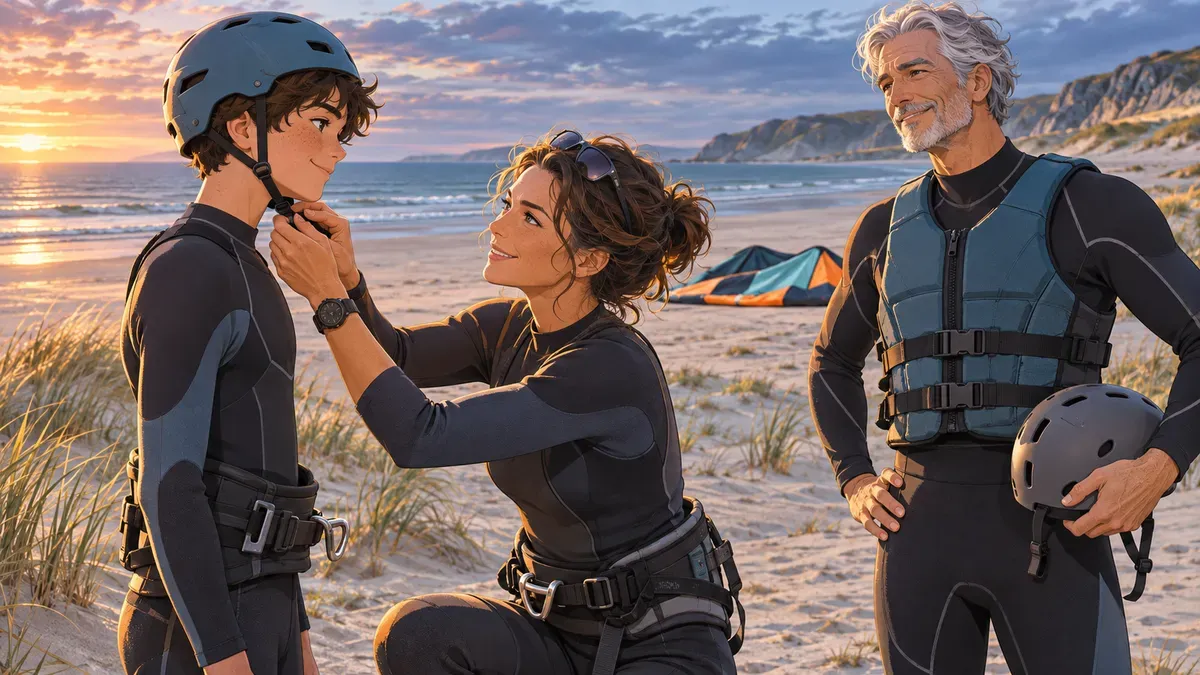
| Equipment access | The instructor can fit equipment and assess access to safety controls | Fit or control access remains uncertain |
Avoid treating one strong area as compensation for another. A good swimmer who does not want to participate still needs a different plan. A highly motivated child whose equipment cannot be fitted appropriately should not be hurried into a standard course.
Body size matters without becoming a safety formula
Body mass affects the relationship between the learner and the kite’s pull. Reach, harness fit, protective equipment, and access to the actual safety controls also need assessment. Meeting a school’s weight criterion answers only part of the suitability question.
The IKO guidance explicitly places its age and weight suggestion within a discussion of development and individualized teaching. Do not turn 77 lb (35 kg) into a target a child must reach quickly, or assume that a heavier child can use adult equipment. The instructor must choose the setup and conditions together.
Send the school the learner’s age, approximate height and weight, swimming background, and any relevant health information through its usual booking process. Ask whether it has appropriate equipment available before paying for a course. Do not buy a powerful kite to discover whether the child can manage it.
Make the first experience easy to stop
Ask for a child-appropriate explanation of the session before it begins. Who gives instructions? How does the learner signal a problem? Where does a parent wait? What happens if the child wants to stop? These questions clarify the teaching arrangement without directing the instructor’s technical methods.
The American Medical Society for Sports Medicine highlights interest, attention, and physical coordination as separate readiness considerations. Apply that distinction to expectations: enthusiasm at breakfast may change when unfamiliar equipment, noise, and water are involved.
An illustrative family plan is to book an assessment or introductory session, leave the rest of the day flexible, and discuss the next step afterward. Avoid promising that the child will ride by lunchtime. If the child enjoys watching and asking questions but does not want to enter the water, the day can still provide useful information.
For families comparing sports, the ski starting-age guide explores another setting where development and teaching design interact. Readiness in one sport does not certify readiness in another.
Starting after 40, 50, or 60
An age label cannot tell an instructor how comfortably you swim, move, or recover. Describe what you currently do, any limitations, and what worries you. Someone who walks regularly but has not swum for years may need water practice before a course; an experienced swimmer may need help accommodating a painful shoulder.
General activity guidance supports building capacity gradually. The CDC recommendations for adults 65 and older include aerobic activity, strength work on at least two days each week, and balance activities. These are health goals, not entrance tests for kitesurfing and not evidence that meeting them makes the sport suitable for everyone.
For preparation, choose familiar activities you can repeat comfortably. Pool practice, walking, and appropriately selected strength work can build a more useful starting routine than one exhausting fitness challenge. Our exercise and longevity guide provides a broader framework, and the balance-training guide discusses land-based practice. Neither replaces water instruction.
Discuss health concerns before committing
The NIDDK’s older-adult guidance advises discussing chronic conditions and symptoms such as chest discomfort, dizziness, or joint pain with a health professional. Healthy older adults increasing ordinary activity gradually generally do not need blanket medical clearance; a demanding water sport brings additional questions about immersion, exertion, and rescue.
Tell your clinician what the activity involves and tell the instructor about relevant restrictions. Ask about unresolved injuries, medication effects, or symptoms that could interfere with communication or movement. New chest pain, fainting, or severe breathing difficulty warrants urgent assessment rather than a trial lesson. Do not use an online checklist to decide that a symptom is harmless.
The instructor assesses teaching suitability and conditions; the clinician addresses medical questions. Neither assessment guarantees that every future session will be appropriate.
Ask the school for a decision you can understand
Use a short conversation before choosing a course. A specific answer is more useful than a claim that the sport suits everyone.
| Question | What the answer should clarify |
|---|---|
| What age and size policies apply to this course? | The school’s actual eligibility rules and assessment process |
| Who teaches children or older beginners? | Relevant teaching experience and communication arrangements |
| How do you assess swimming and equipment suitability? | What is checked before powered-kite practice |
| How can the lesson be shortened or postponed? | Options when attention, weather, cold, or fatigue changes the plan |
| What rescue support is available? | How assistance works at this teaching site |
| What does finishing the course mean? | Skills demonstrated, limits that remain, and the next supervised step |
The RNLI’s kitesurfing advice emphasizes suitable conditions, capable company, a way to call for help, and telling someone your plan. Those principles apply across ages. The site’s emergency arrangements and local requirements still need checking with the school.
Know the limits of reassuring numbers
There is no age cutoff proven by the injury study cited here. A prospective cohort of 194 kitesurfers included participants aged 13–59 and recorded 177 injuries over 16,816 hours. It included different skill levels and riding styles, with many injuries during tricks or jumps.
That cohort cannot establish safety for younger children, people over 60, or a particular beginner course. It also cannot show that a fit 50-year-old and a 12-year-old face the same risks. Use the study to recognize uncertainty, not to calculate personal clearance from an average.
Keep adult preparation visible with SuperAge
For adult learners, a simple record of regular activity, sleep, and how you feel after exercise can support planning. SuperAge can place available Apple Health activity and recovery trends alongside your own notes. Use that context to notice an overloaded week and leave space between demanding sessions; our recovery guide explains the wider principle.
A biological-age estimate or recovery score cannot determine whether a child is ready, whether equipment fits, or whether the wind is suitable. Those decisions require direct assessment. This application is for the adult’s own preparation, not a child eligibility assessment.
Frequently asked questions
What is the minimum age for kitesurfing?
There is no single age that establishes suitability everywhere. IKO suggests lessons from age 12 and at least 77 lb (35 kg); schools may have their own policies. Confirm eligibility and request an individual readiness assessment.
Can an 8-year-old begin?
Do not assume that a standard powered-kite course is appropriate. Ask a school experienced with children whether a suitable introductory activity exists or whether waiting is preferable. Participation must remain voluntary.
Is reaching the minimum weight enough?
No. Development, swimming confidence, communication, equipment fit, access to controls, and the proposed conditions also matter. A weight guideline is not a safety certificate.
Am I too old to start at 50 or 60?
Age alone cannot answer. Discuss current swimming ability, fitness, injuries, and health with the instructor, and seek medical advice for relevant conditions or symptoms. Choose a course that can adapt the pace.
Does my child need to swim?
Ask the school about its swimming requirements and assessment. Give an accurate account of your child’s ability. Flotation and parental supervision do not replace the school’s water-safety and rescue arrangements.
Can children and parents take the same lesson?
Ask whether a shared session can meet each learner’s needs. Different attention spans, equipment, and confidence may require separate instruction. A family booking should not force everyone to progress together.
What if the learner becomes frightened or tired?
Use the agreed stop signal and tell the instructor promptly. Pause or end the activity and reconsider the next step. A prepaid course is not a reason to continue through distress.
Does completing lessons mean independent riding is safe?
No. Ask which competencies were demonstrated and what remains supervised. Age eligibility, course attendance, and readiness for less support are separate judgments.
Key takeaways
- Ask about the exact lesson rather than seeking one universal starting age.
- Consider a child’s development, willingness, swimming, and equipment suitability together.
- Match adult preparation to current capacity and relevant health concerns.
- Keep a clear option to pause, adapt, or postpone.
- Use direct assessment and demonstrated skills to decide the next step.
Prepare for a useful first conversation
Write down the learner’s experience, questions, and constraints before contacting a school. Adult learners using Apple Health can download SuperAge to review available activity and recovery trends alongside their preparation notes.
References
- International Kiteboarding Organization. Teaching kitesurfing to children.
- American Academy of Pediatrics. Is your child ready for sports?. Updated 2024.
- American Medical Society for Sports Medicine. When is my child ready for more organized sport?.
- Centers for Disease Control and Prevention. Older adult activity: an overview. Updated 2025.
- National Institute of Diabetes and Digestive and Kidney Diseases. Health tips for older adults.
- Royal National Lifeboat Institution. Kitesurfing safety advice.
- van Bergen CJA et al. Kitesurf injury trauma evaluation study: a prospective cohort study evaluating kitesurf injuries. World Journal of Orthopedics. 2020.
Related Articles
Kitesurfing for beginners: lessons, safety, and progression
Start kitesurfing with a clear plan for lessons, wind, safety systems, fitness, and learning milestones. Prepare for your first session and progress with care.