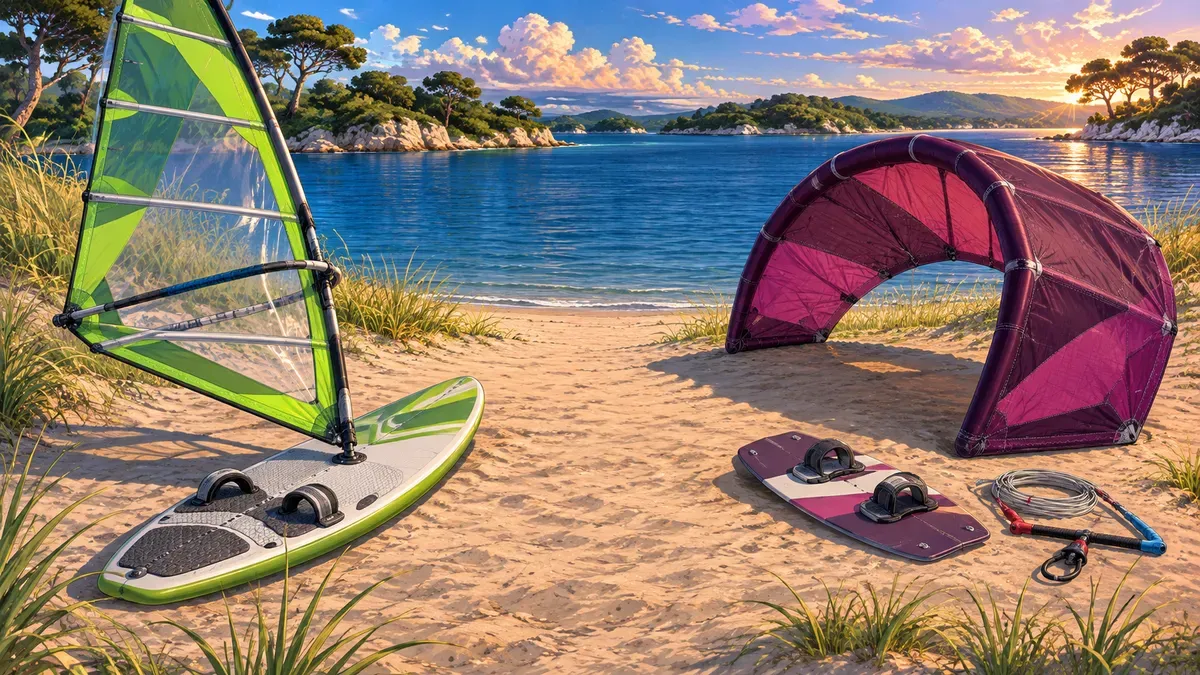
Kitesurfing vs windsurfing: choose your first wind sport
Compare kitesurfing vs windsurfing by lesson skills, physical demands, conditions, and safety. Choose a first course that fits your goals and build confidence.
Quick answer
Choose between kitesurfing and windsurfing by comparing the learning experience you want and the supervised practice you can access. Kitesurfing teaches control of a flying kite before combining it with a board. Windsurfing teaches balance and sail control on a board with an attached mast. Neither sport has a universal advantage in learning speed, physical ease, or personal safety.
For a first course, prioritize qualified instruction, conditions suitable for beginners, and a clear rescue plan. A supervised taster can help you discover which control system feels more understandable and enjoyable. Buy equipment after that experience, rather than choosing a sport around an equipment purchase.
Key facts
- A kitesurfing kite transmits force through lines and a harness to the rider.
- A windsurfing rig attaches the sail and mast to the board.
- Beginner instruction separates skills before combining them into controlled travel.
- Wind direction changes drift and the consequences of losing control.
- Repeated access to suitable practice supports learning more reliably than a promised course duration.
Compare the controls before comparing the spectacle
Videos often compare jumps, speed, or dramatic waves. Those are poor previews of a beginner lesson. The useful difference is where the sail sits, how its force reaches you, and which tasks you must coordinate.
In kitesurfing, the kite flies away from the rider on lines. A control bar steers it, while the harness takes much of its load. You must learn how kite position and movement change the pull before adding the challenge of standing on a board. Familiarity with the safety system is part of that learning, not a final accessory.
In windsurfing, the mast connects to the board through a movable joint, and the rider holds a boom around the sail. Early practice commonly uses a stable board and a manageable sail in light conditions. You learn to balance, bring the rig into position, steer, and turn. Later planing, harness, and foot-strap skills add different demands.
| First-course question | Kitesurfing | Windsurfing |
|---|---|---|
| Where is the wind-catching surface? | A kite connected to the rider by lines and controls | A sail on a mast attached to the board |
| What is the early coordination task? | Control the kite and its pull before combining kite and board | Balance on the board while positioning and controlling the rig |
| What may practice look like before riding? | Supervised kite handling and movement through water without the board | Balance, rig handling, and short controlled journeys on a stable board |
| What must progress include? | Releases, recovery, stopping, traffic awareness, and return skills | Steering, turning, stopping, recovery, and returning within the teaching area |
| What is a misleading success marker? | One lucky water start | One straight run without a controlled return |
These are orientation points, not instructions for operating either system. Our kitesurfing beginner guide explains the separate kite-learning pathway. A handheld wing is a third system; see the wing foiling guide rather than assuming the names describe interchangeable lessons.
A conventional sailboat has a separate set of controls and crew tasks. Our downwind sailing guide explains broad reaching, running, and boom awareness; experience with a kite or windsurfing rig does not replace boat-specific instruction.
Use milestones to judge the learning curve
“Which is easier?” becomes more useful when you specify the task. Getting moving, turning both ways, returning to the start, and handling a problem are different milestones. Someone may enjoy balancing on a large windsurfing board immediately while finding kite control unfamiliar. Another learner may understand kite flying quickly but need repeated practice to coordinate a water start.
The RYA windsurfing pathway separates beginner learning from non-planing, planing, and advanced skills. The British Kitesports training scheme introduces kite handling and water movement before board starts. These pathways support staged teaching; they do not establish which sport every person learns faster.
Ask the instructor to describe a successful first session without promising independence. Useful answers include understanding stop signals, making a controlled turn, or performing a supervised recovery task. Less useful answers revolve entirely around how many hours it takes to look good in a photograph.
Previous sailing, board-sport, or kite experience may help with some concepts. It can also encourage assumptions that need correcting. Tell the instructor what you have done, then let them assess the actual skills. A beginner course should leave you with a clear account of what remains supervised.
Match the lesson to the venue and your routine
The sport you can practice regularly with good support may be a better choice than the one that looks easier on paper. Compare the whole learning arrangement: suitable water, instructor availability, weather cancellation policy, equipment provision, and what happens after the introductory course.
For kite lessons, ask about clear launching space, line management, how learners communicate with the instructor, and how recovery is supported. For windsurfing, ask how the board and sail are matched to you, how drifting learners are assisted, and how the teaching boundary is maintained. A larger open area does not automatically make either activity suitable.
Do not use one internet wind-speed threshold as permission to go. Gusts, wind direction, current, shore hazards, equipment, water temperature, and rescue cover change the decision. Offshore wind can carry a struggling learner away from land. Direct onshore wind can push someone toward obstacles. Your instructor must assess the site as a whole.
The RNLI kitesurfing guidance emphasizes company, appropriate conditions, communication, and telling someone your plan. Confirm the emergency arrangements for your own venue; phone coverage and rescue access vary. This is a globally useful planning principle, not a recommendation for a particular destination.
Compare physical comfort without calling either sport effortless
Both activities combine skill, attention, and physical work. Beginners often tire because movements are unfamiliar and they grip too hard. The amount of effort changes with the equipment, conditions, technique, session length, and number of falls or restarts.
In early windsurfing, repeatedly climbing onto a board and lifting the rig can feel demanding. In kitesurfing, water movement, board starts, harness pressure, and maintaining control can be tiring. The kite harness carries load, but that does not make the sport effortless or remove shoulder, back, knee, or ankle demands. There is no sound basis here for declaring one sport the better whole-body workout for every beginner.
Explain previous injuries and movement limitations before booking. Ask whether a shorter session, more breaks, or an adapted teaching setup is possible. Exertional chest pain, fainting, or unexplained breathlessness require medical assessment before a demanding water sport. Persistent joint pain also deserves individual advice rather than a sport chosen from an online comparison.
Swimming confidence supports both choices, but pool competence does not establish open-water readiness. Our pool-to-open-water guide covers that distinction. The National Weather Service warns that sudden immersion in water at 50–60°F (10–15°C) can cause dangerous cold shock. Match thermal protection and flotation to the activity and conditions with the school.
Read injury comparisons with their limits attached
It is reasonable to ask which sport is safer. The evidence does not give a personal safety ranking for two first lessons.
A 2016 hospital-based comparison included 25 injured windsurfers and 32 injured kitesurfers seen over two years. It reported higher estimated injury incidence for kitesurfing, with no detected difference in injury severity between groups. The study was small, retrospective, and concerned people presenting to one coastal hospital. It cannot tell you the probability of injury in a current supervised beginner course.
A later prospective kitesurfing cohort followed varied skill levels and riding styles, with many injuries occurring during tricks or jumps. Its findings should not be applied directly to a lesson that does neither. Different study methods also make headline injury rates difficult to compare.
Use these findings to take both sports seriously. Ask about helmets, appropriate flotation, safe equipment checks, rescue practice, and stopping rules. Never treat a release device, protective item, fitness score, or confident instructor as a guarantee that accidents cannot happen.
Make a choice you can repeat and recover from
Choose a taster based on the task that interests you and the support available. You do not need to commit to one sport forever. A useful first experience can end with “I want to repeat this skill,” rather than a purchase or a claim of independence.
| Your priority or concern | Useful next step |
|---|---|
| You want to explore board balance and a directly held rig | Ask for a beginner windsurfing taster in suitable light conditions |
| You are curious about kite control and accept a staged introduction before board riding | Ask about a supervised kitesurfing introduction and its recovery curriculum |
| One school offers much better teaching support and reliable follow-up | Give that practical advantage weight in your choice |
| You have a previous injury or feel unsure about swimming | Discuss suitability and preparation before paying for either course |
| You mainly want a sustainable activity habit | Choose the experience you enjoy and can revisit without excessive fatigue or travel burden |
General conditioning can support participation without deciding which sport you should choose. The WHO physical activity guidance recommends 150–300 minutes of moderate aerobic activity weekly, or an equivalent vigorous combination, plus muscle strengthening on at least two days. These are health goals, not entry tests or a validated wind-sport injury-prevention plan.
For long-term health, repeatable movement matters more than the label on a hobby. Our exercise and longevity guide places skill-based sport within a wider routine. Leave room for recovery between demanding sessions while learning.
Put your learning in context with SuperAge
Keep a simple lesson record: conditions, skills practiced, what still needs supervision, and how you felt afterward. SuperAge can help you review available Apple Health activity and recovery trends alongside those notes. That context may help you notice when a demanding week leaves less energy for learning.
Biological-age estimates and wearable trends do not measure kite control, wind judgment, rescue competence, or readiness to practice independently. Use them for broader health context while your instructor assesses practical progression. For children or adults returning later in life, our kitesurfing age and readiness guide helps frame a separate suitability conversation.
Frequently asked questions
Is windsurfing easier than kitesurfing?
It depends on the task and learner. Early windsurfing combines board balance with rig handling; kitesurfing establishes kite control before board riding. Compare supervised milestones rather than a universal difficulty ranking.
Which sport can I learn in a weekend?
A weekend can introduce useful skills in either sport, but conditions and progress vary. Completing booked hours does not establish independent competence. Ask what you can demonstrate and what still requires supervision.
Do I need stronger arms for windsurfing?
Arm strength alone is a poor selection test. Technique, equipment fit, balance, and fatigue matter in both sports. A kitesurfing harness carries much of the pull, but the rider still needs physical capacity and control.
Is kitesurfing more dangerous?
Some research reports higher injury incidence, but study populations and methods limit direct comparisons. Those results cannot rank your two possible beginner lessons. Evaluate instruction, conditions, equipment, and rescue arrangements for each.
Should I buy equipment before lessons?
Use school equipment first where available. That gives the instructor room to adapt the setup and lets you understand your preferences before making a purchase. This comparison does not recommend products.
Can I start after 40 or 50?
Age alone does not decide suitability. Current health, swimming confidence, mobility, recovery, and appropriate teaching matter. Discuss medical conditions or prior injuries and adapt the learning plan to your capacity.
Does learning one sport let me teach myself the other?
No. Wind awareness may transfer, but controls, recovery, and hazards differ. Take instruction specific to the second sport rather than assuming previous experience covers its safety systems.
What if I am not a confident swimmer?
Tell the school before booking and ask what swimming competence its program requires. Work on water confidence in a suitable supervised setting. Flotation and fitness do not replace swimming ability or rescue planning.
Key takeaways
- Compare control systems and first-course tasks before spectacular riding footage.
- Choose qualified instruction, suitable conditions, and a workable rescue plan.
- Judge progress by controlled skills, recovery, and return competence.
- Treat injury research as limited population evidence, not a personal forecast.
- Favor an enjoyable routine you can practice and recover from consistently.
Start with one useful lesson record
Book a suitable supervised taster and write down your next learning goal afterward. If you use Apple Health, download SuperAge on the App Store to review available activity and recovery trends alongside your practice notes.
References
- Royal Yachting Association. Windsurfing courses and progression pathway.
- British Kitesports Association. Learn: staged kiteboarding training scheme.
- Royal National Lifeboat Institution. Kitesurfing safety guidance.
- National Weather Service. Cold water hazards and safety.
- van Bergen CJA et al. Windsurfing vs kitesurfing: injuries at the North Sea over a 2-year period. World Journal of Orthopedics. 2016.
- van Bergen CJA et al. Kitesurf injury trauma evaluation study: a prospective cohort study evaluating kitesurf injuries. World Journal of Orthopedics. 2020.
- World Health Organization. Physical activity recommendations.
Related Articles
Wing foiling for beginners: gear, technique, wind, and safety
Learn wing foiling for beginners: choose a stable setup, read wind and water, build first-flight skills, fall safely, and progress without rushing.