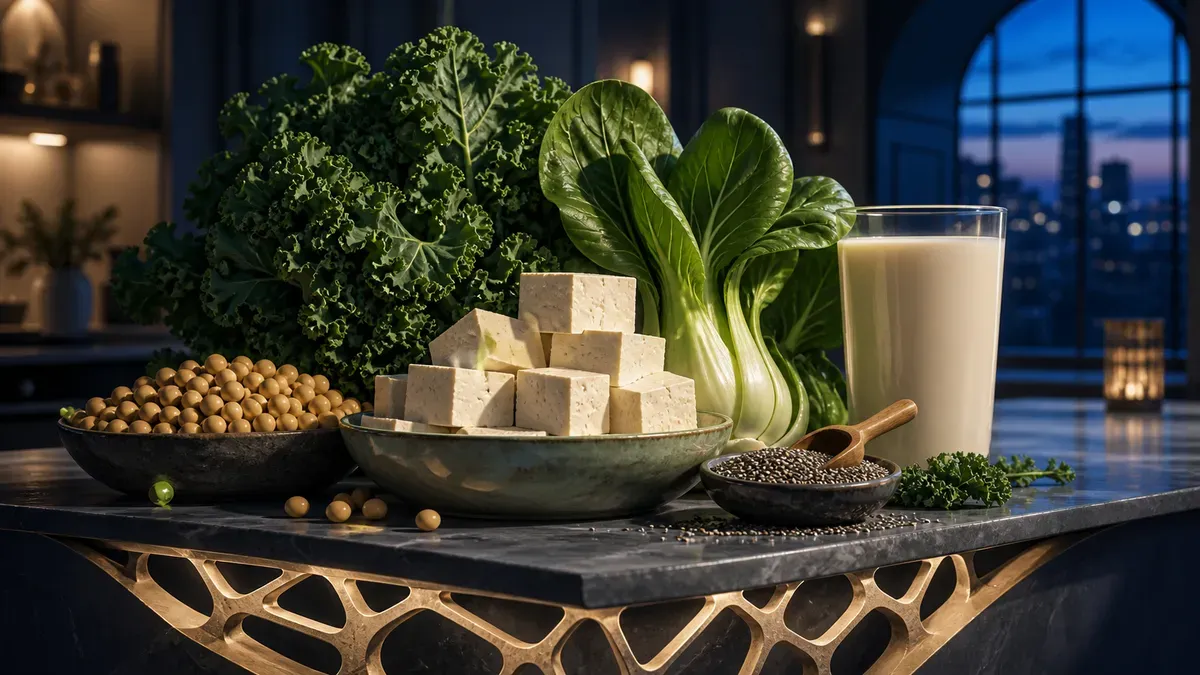
Calcium-rich plant foods: how to get enough and absorb it
Calcium-rich plant foods can meet daily needs with fortified staples, calcium-set tofu, and lower-oxalate greens. Learn how to build a practical daily plan.
Calcium-rich plant foods can cover an adult’s needs, but a long list of vegetables, nuts, and seeds is not automatically a high-calcium diet. The reliable strategy is to use a few calcium anchors—often a fortified plant drink, calcium-set tofu, or a generous serving of lower-oxalate greens—then let beans, seeds, grains, and other vegetables add smaller amounts across the day.
The number on a food table is only the starting point. Portion size, fortification, the calcium salt used to make tofu, oxalate and phytate, vitamin D status, age, and the total calcium eaten at one time all influence how much calcium reaches the body. You do not need a perfect absorption hack. You need a repeatable pattern whose labels and portions add up.
Quick answer
To get enough calcium from plant foods, choose two or three dependable sources every day: a calcium-fortified plant drink, tofu made with calcium sulfate, and lower-oxalate greens such as kale, broccoli, or bok choy. Check the label because unfortified drinks and tofu made with other coagulants may contain far less calcium. Shake fortified drinks before pouring when the package instructs you to, spread calcium-rich choices across meals, and make sure vitamin D is adequate.
Spinach contains calcium on paper, but its oxalate makes most of that calcium difficult to absorb. Nuts, seeds, beans, and unfortified grains still contribute; they are simply less efficient as the only calcium foundation.
Key facts
- Calcium builds and maintains the mineral structure of bones and teeth while also supporting muscle contraction, nerve signaling, blood clotting, and hormone release.
- Calcium-set tofu and fortified plant drinks provide concentrated plant-based calcium when their labels confirm the amount per serving.
- Oxalate sharply reduces calcium absorption from spinach even though food tables show substantial calcium content.
- Kale, broccoli, and cabbage provide relatively bioavailable calcium but usually less calcium per ordinary serving than a fortified drink.
- Vitamin D supports active calcium absorption in the intestine but does not turn a chronically low-calcium diet into an adequate one.
How much calcium do adults need?
Calcium targets vary by country and life stage. The US and Canadian Recommended Dietary Allowance is 1,000 milligrams (mg) per day for most adults ages 19–50. It rises to 1,200 mg for women ages 51–70 and for all adults over 70. The European Food Safety Authority sets a population reference intake of 950 mg for adults age 25 and older. UK guidance uses 700 mg for most adults.
| Life stage | US and Canadian daily target | Practical note |
|---|---|---|
| Adults 19–50 | 1,000 mg | Use your local recommendation if it differs |
| Men 51–70 | 1,000 mg | Absorption tends to decline with age |
| Women 51–70 | 1,200 mg | Menopause increases bone-loss risk |
| Adults 71+ | 1,200 mg | Nutrition, vitamin D, strength, balance, and fall risk all matter |
| Pregnant or breastfeeding adults | 1,000 mg | Teens have a higher target and need age-specific guidance |
These are daily planning values, not a demand to hit an exact number at every meal. A three- to seven-day food record is more informative than one unusually high or low day. Use the nutrition label and the reference value used in your country rather than applying a US table as a universal prescription.
Blood calcium is also a poor home scorecard for dietary adequacy. The body keeps blood calcium within a narrow range, drawing on bone when necessary. The NIH calcium review explains that serum calcium does not reliably reflect calcium nutrition; a clinician assesses fracture risk, dietary intake, medicines, vitamin D, and bone density in context.
Calcium content and calcium absorption are different numbers
Calcium content is the amount in a serving. Fractional absorption is the percentage that crosses the intestine. Absorbed calcium depends on both. A food with excellent fractional absorption may still contribute little if the serving contains only a small amount, while a concentrated fortified food can remain useful even if its fractional absorption is not exceptional.
The NIH estimates that adults absorb roughly 25% of dietary calcium overall, with wide variation. Absorption is more efficient at lower intakes and less efficient as the calcium load rises. Calcium from dairy foods and fortified foods averages about 30% absorption, but the fortificant and food matrix matter.
Plant compounds change the picture:
- Oxalate binds calcium strongly. The NIH cites absorption of about 5% from spinach versus 27% from milk.
- Phytate can reduce mineral availability in grains, legumes, nuts, and seeds, although ordinary variety and adequate intake make single-meal effects less important for many people.
- Food structure and preparation affect what digestion can release. Cooking, soaking, fermenting, and leavening can change the matrix, but none guarantees a precise absorption increase in a mixed human diet.
- Vitamin D status affects active calcium transport. Low vitamin D can reduce absorption even when the menu contains calcium.
A 2023 laboratory digestion study found striking variation in the bioaccessible calcium supplied by different plant foods and fortification salts. That is useful warning evidence, but it was an in vitro model, not a fracture trial or a direct measure of absorption in free-living people. Use it to justify label checking and dietary variety, not to rank every food with false precision.
For the broader distinction between food content, bioavailability, and exaggerated pairing rules, see our guide to food pairings for nutrient absorption.
The most useful calcium-rich plant foods
The values below come from the NIH table of selected foods and US food-composition data. Brands, varieties, cooking methods, serving weights, and national fortification policies vary, so the package label or local food database outranks the example.
| Plant food | Example serving | Approximate calcium | What to verify |
|---|---|---|---|
| Calcium-fortified orange juice | 1 cup (240 mL) | 349 mg | Fortification, serving size, added sugar, and whether juice fits your diet |
| Calcium-fortified soy drink | 1 cup (240 mL) | 299 mg | Calcium and vitamin D per serving; shake instructions; protein content |
| Firm tofu made with calcium sulfate | 1/2 cup (about 4.5 oz/125 g) | 253 mg | Coagulant and calcium on the label |
| Soft tofu made with calcium sulfate | 1/2 cup (about 4 oz/115 g) | 138 mg | Calcium varies widely by manufacturing method |
| Cooked soybeans | 1/2 cup (about 3 oz/85 g) | 131 mg | Portion and sodium if canned |
| Cooked turnip greens | 1/2 cup (about 3 oz/85 g) | 99 mg | Cooked volume is more concentrated than raw leaves |
| Cooked kale | 1 cup (about 4.5 oz/130 g) | 94 mg | Variety and cooked weight |
| Chia seeds | 1 tablespoon (about 0.4 oz/12 g) | 76 mg | Small servings contribute but rarely anchor the day |
| Raw bok choy | 1 cup shredded (about 2.5 oz/70 g) | 74 mg | A larger cooked portion can be easier to eat |
| Pinto beans | 1/2 cup (about 3 oz/85 g) | 54 mg | Useful contribution, not usually a stand-alone anchor |
| Corn tortilla | One 6-inch (15 cm) tortilla | 46 mg | Processing and local recipe change the amount |
Fortified plant drinks: concentrated but label-dependent
A fortified plant drink can supply close to 300 mg per cup (240 mL), making it one of the easiest plant-based anchors. “Plant-based” does not mean “calcium-fortified,” however. Two cartons with similar fronts may have very different calcium, vitamin D, protein, sugar, and energy content.
Use this label check:
- Confirm calcium per serving in milligrams, not just a front-of-pack claim.
- Compare the listed serving with the amount you actually pour.
- Check whether vitamin D is added; calcium fortification does not guarantee it.
- Check protein if the drink is replacing a protein-rich food rather than serving only as a beverage.
- Follow the package’s shake instructions.
An analysis of plant-based drinks sold in New Zealand found that calcium and protein sometimes differed between shaken and unshaken samples. The study does not prove the same settling in every product, but it supports a low-cost habit: if the carton says “shake well,” do it before every pour.
Calcium-set tofu: read the coagulant
Tofu is not one fixed calcium food. Tofu made with calcium sulfate can provide a substantial amount because the coagulant becomes part of the curd. Tofu made mainly with magnesium chloride, nigari, or glucono-delta-lactone may have much less calcium unless it is fortified separately.
Look for calcium sulfate in the ingredient list, then check the nutrition panel. Do not infer calcium from firmness, package size, or the word “traditional.” Calcium-set tofu also contributes protein, which makes it easier to build a meal rather than add a mineral in isolation.
Tempeh can contribute calcium too, but its content is often lower and variable. In a small randomized crossover study of 20 postmenopausal women, fractional calcium absorption from a tempeh meal was similar to milk when both test meals contained 130 mg of calcium. Because ordinary tempeh provided less calcium per serving, a larger quantity was needed to deliver the same absorbed amount. The lesson is content plus absorption—not that one food universally replaces another gram for gram.
Lower-oxalate greens: bioavailable but less concentrated
Kale, broccoli, cabbage, bok choy, and turnip greens are useful because their calcium is generally more available than calcium from spinach. They also add fiber, vitamin K, folate, carotenoids, and other nutrients. Their limitation is volume: a small garnish cannot compete with a full cooked serving or a fortified staple.
Think of greens as one daily contributor and use a concentrated anchor when needed. A stir-fry with bok choy and calcium-set tofu, for example, combines two sources without requiring a special absorption ritual.
Beans, seeds, nuts, and grains: valuable supporting sources
Beans, chickpeas, soybeans, tahini, almonds, chia, and some breads or tortillas can add calcium across the day. They also bring protein, fiber, unsaturated fat, or other minerals. Yet serving sizes, energy density, phytate, and oxalate mean that a teaspoon of seeds or a few almonds should not carry the entire plan.
Fortified bread and cereal can be meaningful in countries where fortification is common. Elsewhere, the same food name may supply little calcium. This is why a local label beats an online “top 10” list.
The spinach trap: high content, low usable calcium
Boiled spinach can list more than 100 mg calcium per half cup, but oxalate binds much of it in the gut. The NIH estimates only about 5% is absorbed. Spinach remains a nutritious vegetable; it is simply a weak choice when the specific job is delivering calcium.
Do not try to “cancel” oxalate with a supplement or eliminate every oxalate-containing food. Choose a lower-oxalate calcium source for the calcium job and keep overall variety. If you have recurrent calcium oxalate kidney stones, follow a stone-specific plan. The NIDDK advises getting enough calcium from food because calcium in the digestive tract can bind substances involved in stone formation; blindly cutting dietary calcium can be counterproductive.
Build a calcium day with anchors, not arithmetic anxiety
Use a three-step method:
- Set the target. Use the recommendation for your age, sex, life stage, and country.
- Choose two or three anchors. Examples include 1 cup (240 mL) fortified plant drink, a calcium-set tofu serving, or a substantial cooked serving of lower-oxalate greens.
- Let the rest accumulate. Beans, soybeans, seeds, bread, tortillas, and vegetables fill the remaining gap.
An illustrative day could include:
- breakfast oats made with 1 cup (240 mL) calcium-fortified soy drink;
- lunch with beans, a calcium-containing tortilla, and vegetables;
- dinner with about 1/2 cup (4.5 oz/125 g) calcium-set tofu and cooked kale or bok choy;
- chia, nuts, bread, or another locally available source as a smaller contributor.
Using the example NIH values, that structure can approach a 1,000 mg day once the supporting foods are counted. It is not a prescription, and brand-specific totals may differ by hundreds of milligrams. Calculate with the packages in your kitchen, not with the sample numbers alone.
If you prefer a flexible meal framework before counting nutrients, pair this approach with our healthy pantry staples guide. If your overall diet is plant-forward, our plant-based diet evidence review covers the larger pattern without treating one nutrient as the whole diet.
Improve the pattern without chasing absorption hacks
Spread concentrated sources across the day
Fractional absorption falls as the calcium load rises. That does not mean food portions need laboratory precision, but two or three moderate calcium-rich meals are more sensible than expecting one huge dose to solve the day.
Keep vitamin D adequate
Vitamin D promotes active calcium absorption and normal bone mineralization. Needs, testing, sun exposure, food fortification, and supplement policy differ by location and risk group. Do not megadose vitamin D to compensate for a low-calcium diet. Our vitamin D and longevity review separates established bone biology from broader claims.
Use food preparation for practicality, not perfection
Cook greens to make a meaningful volume easier to eat. Soak and fully cook dried legumes for safety and digestibility. Fermented or leavened foods can alter phytate, but human outcomes depend on the whole diet. You do not need to sprout every seed or combine calcium with a particular fruit at the same sitting.
Protect the rest of the bone system
Calcium is necessary but not sufficient. Bone also responds to vitamin D, adequate energy and protein, hormones, smoking and alcohol exposure, medicines, resistance exercise, weight-bearing activity, and fall risk. The US physical activity guidelines recommend muscle-strengthening activity at least two days a week, while exercise should be individualized for anyone with osteoporosis or a prior fragility fracture.
Our osteoporosis and bone-aging guide explains screening, fractures, and treatment. The calcium paradox guide addresses why normal dietary calcium, supplements, coronary calcium, and bone calcium should not be collapsed into one alarming story.
Plant-based diets and bone health: avoid both hype and fear
A plant-based diet is not automatically low in calcium, and a vegan label does not guarantee adequacy. A 2023 systematic review and meta-analysis covering 74 studies found that vegan participants had lower mean calcium intakes than vegetarians and omnivores. That describes a planning gap across study populations, not a biological rule that plants cannot provide calcium.
In the EPIC-Oxford cohort, vegans had higher observed risks of several fracture outcomes, especially hip fracture, than meat eaters. Adjustment for body mass index, calcium, and protein attenuated some associations but did not settle cause and effect. The study was observational, diet was not randomly assigned, and its results should not be turned into a verdict on every well-planned plant-based diet.
The practical response is neither fear nor a supplement reflex. Verify calcium, vitamin D, protein, energy intake, strength training, and individual fracture risks. A dietary pattern earns its health claim through what it reliably supplies.
When food may not be enough
Food-first planning may still leave a gap because of allergy, appetite loss, a highly restricted diet, malabsorption, bariatric surgery, osteoporosis treatment, or a clinician-defined need. Supplements can fill a measured shortfall, but “more” is not a safer target.
The NIH notes that calcium supplement absorption is highest at doses of 500 mg or less. Calcium carbonate is more dependent on stomach acid and is generally taken with food; calcium citrate is less dependent on stomach acid. Supplements can cause constipation, gas, or bloating and can interact with medicines including levothyroxine, lithium, dolutegravir, and some quinolone antibiotics. Kidney disease, high blood calcium, hyperparathyroidism, recurrent stones, and osteoporosis medication plans require individualized advice.
Ask a clinician or registered dietitian for help if you have:
- a fragility fracture, osteoporosis, or rapidly declining bone density;
- chronic kidney disease, recurrent kidney stones, or abnormal calcium or parathyroid hormone results;
- celiac disease, inflammatory bowel disease, pancreatic disease, or previous bariatric surgery;
- long-term glucocorticoid use, an eating disorder, very low body weight, or major food exclusions;
- pregnancy, adolescence, frailty, or persistent low intake;
- a supplement plan that overlaps with medicines or several fortified foods.
Use SuperAge to track the whole bone-health pattern
You cannot feel calcium absorption after a meal, and a daily readiness score cannot diagnose calcium deficiency. Use SuperAge to follow the behaviors that sit around bone health—strength sessions, weight-bearing activity, sleep, recovery, body-composition trends, and clinician-ordered measurements—while a food record checks whether your calcium anchors are actually present.
This wider view matters for biological aging. Maintaining muscle, balance, mobility, and skeletal strength helps preserve independence, but no calcium-rich food can by itself lower biological age or prevent a fracture.
Key takeaways
- Build the day around two or three verified calcium anchors rather than a long list of trace sources.
- Check labels on plant drinks and tofu because fortification and coagulants change calcium content.
- Favor kale, broccoli, cabbage, bok choy, and similar lower-oxalate greens for usable vegetable calcium.
- Keep spinach for variety, not as the main calcium source.
- Spread concentrated sources across meals and keep vitamin D adequate.
- Treat beans, seeds, nuts, grains, and vegetables as useful contributors without inflating small portions.
- Protect bones with enough protein and energy, resistance and weight-bearing activity, fall prevention, and clinical care when risk is high.
Make your calcium plan visible
Want to connect a repeatable nutrition plan with strength, activity, sleep, and recovery? Download SuperAge and track the health pattern around your calcium choices rather than chasing one perfect food.
FAQ
What is the best plant source of calcium?
There is no universal winner. A calcium-fortified plant drink is often the easiest concentrated source, while calcium-set tofu combines calcium with protein. Lower-oxalate greens provide highly usable calcium but usually less per ordinary serving. The best source is one whose label, portion, availability, and wider nutrition fit your routine.
Can you get enough calcium without dairy?
Yes. Many people can reach local calcium targets with fortified plant drinks, calcium-set tofu, lower-oxalate greens, beans, seeds, and fortified staples. The plan must be deliberate because unfortified substitutions may contain much less calcium than the food they replace.
Is spinach a good source of calcium?
Spinach contains calcium, but its oxalate binds much of it. The NIH estimates calcium absorption from spinach at about 5%. Keep eating spinach if you enjoy it, but use kale, broccoli, cabbage, bok choy, fortified foods, or calcium-set tofu as more dependable calcium sources.
Do I need vitamin D at the same meal as calcium?
No. Vitamin D supports the intestinal machinery that absorbs calcium, but the two do not have to enter the mouth in the same bite. What matters is adequate vitamin D status and enough calcium over time. Follow local vitamin D guidance rather than self-prescribing a high dose.
Should I shake a fortified plant drink?
Yes, when the package instructs you to. Some added minerals can settle, and one analysis found different calcium concentrations in shaken and unshaken samples of several plant drinks. Label instructions and the actual nutrient panel remain the product-specific guide.
Does soaking nuts and beans make all their calcium absorbable?
No. Soaking, cooking, fermenting, or leavening can change phytate and the food matrix, but the effect depends on the food and method. Preparation improves safety, digestibility, and culinary quality; it does not create a guaranteed absorbed-calcium number.
Are calcium supplements necessary on a vegan diet?
Not automatically. First estimate intake from actual labels and portions. A supplement may help when food consistently leaves a gap or a clinician identifies a need, but dose, form, medicines, kidney health, and total intake matter. Use the smallest plan that closes a real shortfall.
Scientific references
- NIH Office of Dietary Supplements. Calcium: fact sheet for health professionals. Updated July 11, 2025.
- National Academies of Sciences, Engineering, and Medicine. Dietary reference intakes for calcium and vitamin D.
- European Food Safety Authority. Dietary reference values for nutrients: summary report.
- NIH Office of Dietary Supplements. Vitamin D: fact sheet for health professionals.
- Muleya M, et al. A comparison of the bioaccessible calcium supplies of plant-based products relative to bovine milk. Food Research International. 2024.
- Haron H, et al. Absorption of calcium from milk and tempeh in postmenopausal women. International Journal of Food Sciences and Nutrition. 2010.
- Craig WJ, et al. Nutritional assessment of plant-based beverages in comparison to bovine milk. Frontiers in Nutrition. 2022.
- Bickelmann FV, et al. Calcium intake in vegan and vegetarian diets: a systematic review and meta-analysis. Critical Reviews in Food Science and Nutrition. 2023.
- Tong TYN, et al. Vegetarian and vegan diets and risks of total and site-specific fractures. BMC Medicine. 2020.
- National Institute of Diabetes and Digestive and Kidney Diseases. Eating, diet, and nutrition for kidney stones.
- US Department of Health and Human Services. Physical Activity Guidelines for Americans. Second edition.
Related Articles

Vitamin D3 vs D2: What's the difference and which should you take?
Vitamin D3 vs D2 explained: learn the key differences in absorption, effectiveness, and sources. Plus, what VITAL and DO-HEALTH really show about vitamin D3 and aging.