Body rafting for beginners: safety, technique, and preparation
Use this body rafting guide to assess river risks, choose proper supervision, learn safe swimming positions, and prepare for your first descent in whitewater.
Quick answer
Body rafting is a guided whitewater activity in which you descend a moving river mainly by floating and swimming rather than sitting in a raft. It can be exciting and physically demanding, but it is not ordinary open-water swimming. Cold shock, submerged obstacles, foot entrapment, strainers, hydraulics, changing flow, and limited exits make professional route selection and supervision essential for a beginner.
For a first session, choose a qualified local guide, disclose health conditions honestly, check recent weather and river levels, and use a correctly fitted whitewater personal flotation device, helmet, thermal protection, and closed-toe footwear. Learn the defensive floating position before entering current, never try to stand in fast water, and be willing to cancel when conditions change.
Key facts
- Body rafting uses controlled floating and swimming to travel with a river current.
- A fitted whitewater PFD provides flotation and impact protection during an unexpected swim.
- Cold water triggers involuntary gasping, rapid breathing, and cardiovascular strain before hypothermia develops.
- Fast current converts a trapped foot into a potentially fatal submersion hazard.
- A qualified guide manages route selection, group spacing, rescue cover, and changing river conditions.
Body rafting puts the participant close to the river: you feel the current accelerate, read the shape of waves, and use your whole body to maintain position. That direct contact is the attraction. It is also why a calm appearance from the bank tells you very little about the actual risk.
Natural water can conceal current, rocks, woody debris, sharp objects, poor visibility, pollution, sudden depth changes, and difficult exits. The US Centers for Disease Control and Prevention recommends checking forecasts, using the buddy system, and recognizing these hidden hazards before activities in or near natural water. In whitewater, a beginner needs a more conservative standard: an organized session with competent local leadership, appropriate equipment, and a route matched to the least experienced person.
This guide explains how to evaluate that first experience. It does not qualify you to assess a rapid, lead a group, or perform a rope rescue.
What body rafting is—and what it is not
Names vary by country and operator. “Body rafting” generally describes descending a river with your body as the main means of flotation and control. Some routes are continuous whitewater swims; others combine floating, short walks, calm pools, and carefully managed passages through a gorge.
The label alone is not enough to understand an activity. Ask the organizer what you will actually do.
| Activity | Main means of travel | Typical distinction |
|---|---|---|
| Body rafting | Body, PFD, and swimming technique | No raft; the swimmer is directly exposed to the current |
| Riverboarding or hydrospeed | A purpose-built river board, often with fins | The board adds flotation and a platform for steering |
| Rafting | Inflatable raft and paddle | Participants travel together in a craft |
| Canyoning | Walking, scrambling, swimming, rappelling, or jumping | The route may require vertical rope skills as well as water movement |
| Open-water swimming | Sustained self-propelled swimming | Usually emphasizes distance or pace rather than descending whitewater |
Do not assume that experience in one category transfers automatically to another. A strong pool swimmer may have no practice reading current, keeping feet clear of rocks, or responding to cold-water gasping. Likewise, aerobic fitness does not replace river judgment.
If your goal is craft-based flatwater recreation rather than direct whitewater exposure, our canoe vs kayak comparison explains how hull, paddle, and rescue systems change the decision.
Why body rafting deserves a safety-first decision
The river is dynamic rather than fixed. Rain upstream can change depth, speed, debris load, water quality, and the usefulness of an exit. A route that was manageable yesterday can be unsuitable today. A narrow channel can concentrate current; a fallen tree can become a strainer; a recirculating hydraulic can hold a swimmer; and even apparently smooth water can push hard against an obstruction.
The American Whitewater Safety Code, revised in 2024, frames river safety around knowledge, preparation, humility, flexible decisions, and group responsibility. The useful lesson for a beginner is simple: there is no universal checklist that makes every river safe. Local expertise and a real-time go/no-go decision matter.
Use a guide, not a social-media route description
A first outing should be led by a guide or organization with verifiable whitewater competence, knowledge of the exact section, an emergency plan, appropriate insurance where required, and rescue equipment they are trained to use. Ask direct questions:
- What training and current rescue qualifications do the guides hold?
- What water levels or weather conditions trigger cancellation?
- What is the guide-to-participant ratio?
- Where are the entry, exit, and emergency access points?
- Which hazards require a portage or alternate line?
- Is all protective equipment designed for whitewater and fitted individually?
- What swimming ability and prior experience are required?
- How does the plan change if a participant becomes cold, tired, or frightened?
Clear, specific answers are a positive signal. Pressure to continue despite unsuitable conditions is not.
Know when not to enter
Postpone the session if the river is outside the organizer’s operating range, thunderstorms or heavy rain threaten the catchment, the water-quality authority advises against contact, essential equipment does not fit, or you cannot demonstrate the required swim skills. Alcohol, recreational drugs, sedating medication, acute illness, fever, and significant sleep deprivation are also reasons not to participate.
People with unstable heart or lung disease, fainting episodes, poorly controlled seizures, severe cold-triggered conditions, recent major injury, or pregnancy should obtain individual medical advice before considering whitewater immersion. A guide needs relevant information, but a guide cannot provide medical clearance.
The equipment that changes the risk
Equipment cannot turn a hazardous line into a safe one, yet unsuitable or poorly fitted equipment can make a manageable incident worse.
Whitewater personal flotation device
Wear a snug vest-style PFD appropriate to whitewater and the local regulatory standard. It should not ride over your chin when pulled upward at the shoulders. The 2024 American Whitewater code emphasizes that a PFD provides flotation for a whitewater swim and some protection from impact. A pool toy, inflatable ring, or casual buoyancy aid is not a substitute.
Whitewater helmet
The helmet should be designed for repeated water impacts, cover the vulnerable parts of the head, stay secure when wet, and allow normal vision and hearing. A loose helmet can shift during a swim; a cycling helmet is built for a different impact environment.
Thermal protection
Dress for the water, not the air. Depending on temperature, exposure time, and route, that may mean a properly fitted wetsuit or drysuit plus synthetic or wool layers. Avoid cotton, which loses insulation when wet. The correct system is a local decision because prolonged immersion, wind, shade, and repeated entries can cool the body even on a warm day.
Sudden immersion can cause a cold-shock response—gasping, hyperventilation, increased heart rate, and increased blood pressure—well before core hypothermia. A physiological review in Experimental Physiology describes cold water as a potential precursor to drowning and cardiac arrest, with risk depending on the circumstances and the individual (Tipton et al., 2017). Thermal clothing helps, but it does not eliminate the first-minute breathing response.
Footwear and small essentials
Use secure, closed-toe footwear with traction and no loose laces or straps that can snag. The sole should protect against sharp rock while still allowing ankle movement. The guide should manage communication, first-aid supplies, emergency insulation, and rescue equipment. Do not clip yourself to a rope or carry a throw bag unless you have been trained for that exact system; rope in moving water introduces its own entanglement hazards.
Four movement skills to learn before the descent
A responsible briefing includes practice in calm or controlled water. You should be able to hear a signal, adopt a position, change direction, and reach an exit before committing to the main current.
1. Control breathing before making a hard move
On cold entry, focus first on keeping your airway clear and allowing breathing to settle. Frantic swimming during uncontrolled gasping wastes energy and can increase aspiration risk. Facial immersion can also activate a diving response at the same time as cold shock; researchers have described this opposing autonomic activation as a possible arrhythmia mechanism in susceptible people (Shattock and Tipton, 2012).
This is not a reason to rehearse dangerous exposure. It is a reason to enter only as instructed, stay close to rescue cover, and tell the guide immediately if breathing, chest symptoms, or panic do not settle.
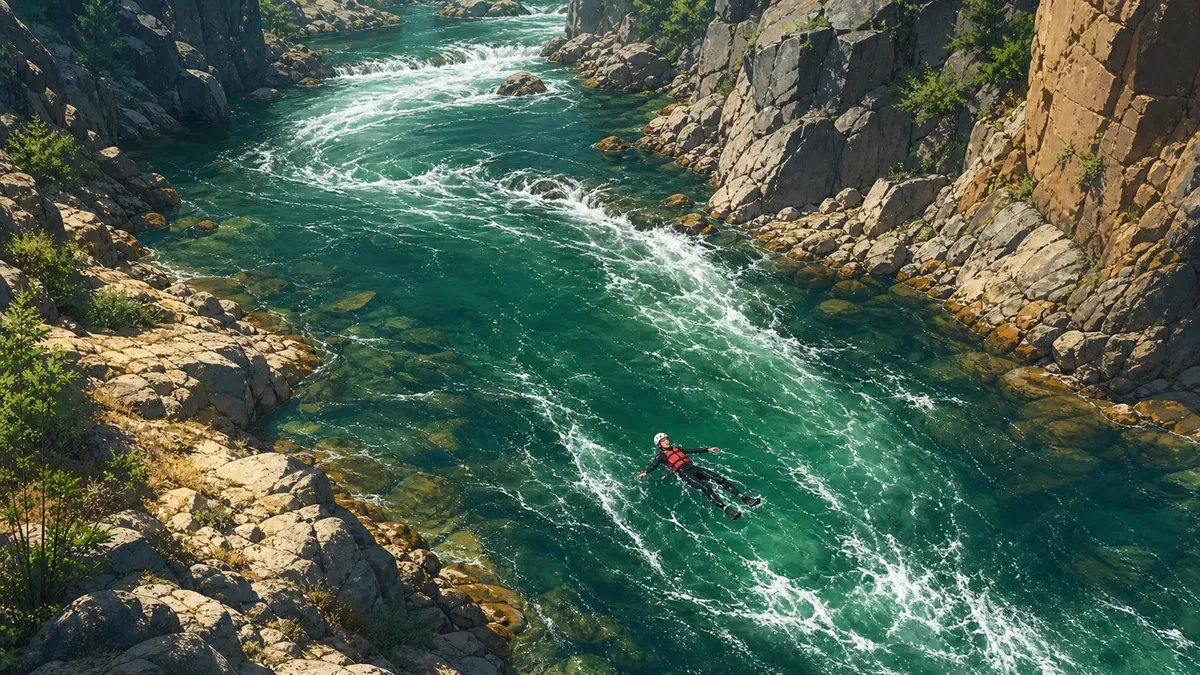
2. Use a defensive float through obstructed current
When directed to float defensively:
- lie on your back with your head upstream;
- keep your hips near the surface;
- point your feet downstream with knees slightly bent;
- keep toes visible above the surface;
- look downstream past your feet;
- use your arms to adjust angle and protect your line.
The feet can help absorb or push away from a rock, but do not lock the knees or try to stop the river. The National Park Service river-safety guidance recommends this position in shallow or obstructed rapids and warns against standing in fast current.
3. Switch to active swimming for a reachable exit
Defensive floating protects you while you assess the line. Active swimming is used when the guide identifies a safe eddy or bank that you can reach. Rotate toward the target, keep a strong body position, and swim across the current at the angle taught in the briefing rather than fighting directly upstream.
Current often carries you downstream while you move sideways. Start early. A late sprint toward an exit can fail even when the bank looks close.
4. Stand only in slow, shallow water
Never put your feet down in fast current. If a foot wedges between rocks, the force on your legs and torso can fold you downstream and hold your face underwater. Move into slow or very shallow water first, then roll to hands and knees or stand according to the guide’s instruction.
This single habit—feet up until the current is genuinely weak—deserves repeated practice.
Read the river at a beginner level
River reading takes years to master, but a first-timer should understand the vocabulary used in a safety briefing.
- Eddy: slower or upstream-moving water behind an obstruction; often used as a stopping place, but the boundary can be turbulent.
- Eddy line: the seam between the main current and the eddy; it can spin or destabilize a swimmer.
- Downstream V: a tongue of smoother water that may show a route between obstacles, but only a qualified leader should choose the line.
- Strainer: branches, a fallen tree, fencing, or debris that lets water pass while trapping a person. Avoid it early and aggressively.
- Hydraulic or recirculation: water folding back on itself below a drop; some can hold a swimmer.
- Undercut: a rock or bank where current flows underneath an overhang.
- Foot-entrapment zone: shallow, fast, rocky water where attempting to stand is particularly dangerous.
The goal is not to diagnose every feature from the bank. It is to recognize why group spacing, signals, scouting, and strict line choice are safety systems rather than formalities.
A practical first-session sequence
A beginner-friendly experience should progress rather than begin with the hardest feature.
- Before travel: check the organizer’s message, weather, river-level guidance, water quality, medication needs, and cancellation policy.
- At the site: disclose health changes, remove jewelry and loose items, fit every piece of equipment, and inspect it with the guide.
- On land: learn hand and whistle signals, hazards, group order, lost-contact procedure, and the emergency plan.
- In controlled water: practice cold entry, defensive floating, active swimming, eddy entry, and assisted exit.
- On the route: maintain spacing, keep the next guide or safety position in view, and follow stop or portage instructions immediately.
- At the exit: change into dry insulated layers, warm gradually, drink and eat as appropriate, and report symptoms or impacts.
You retain the right to stop. Anxiety that improves after briefing and practice is different from escalating panic, loss of coordination, persistent breathlessness, or a feeling that you cannot follow instructions.
How to prepare physically without pretending fitness equals safety
Body rafting may demand repeated short swimming efforts, trunk control, shoulder endurance, leg positioning, balance on slippery approaches, and enough aerobic reserve to make decisions while tired. General conditioning helps you tolerate the session; it does not teach hydrology or rescue.
For three to four weeks before a beginner outing:
- swim once or twice per week, including relaxed floating and short controlled intervals;
- build 20–40 minutes of easy aerobic work two or three times per week;
- train pulling, pushing, carries, squats, and anti-rotation trunk work twice per week;
- practice balance training and controlled step-downs;
- leave recovery between harder sessions, following the principles in our rest-day science guide.
If you are returning after a long break, use the broader exercise guide for longevity to rebuild a base. Pool swimming is especially useful for comfortable breathing and sustained movement; our review of swimming and cardiovascular aging explains the wider evidence, but pool performance should never be treated as proof of whitewater readiness. Our pool-to-open-water transition guide covers navigation, pacing, and outdoor safety, but it does not confer whitewater competence.
The World Health Organization recommends 150–300 minutes of moderate aerobic activity or 75–150 minutes of vigorous activity per week for adults, plus muscle strengthening on at least two days (WHO guidelines). Body rafting may contribute vigorous activity, but a short adventure should complement—not replace—a repeatable weekly routine.
What body rafting can—and cannot—do for health
The activity combines outdoor movement, water confidence, coordination, and bursts of whole-body work. Those features can make it an engaging way to be active, and the challenge may strengthen confidence when it is voluntary, appropriately graded, and competently supervised.
However, there is no strong body of clinical research showing that body rafting itself extends lifespan, reverses biological age, or delivers a unique cardiovascular effect. Claims about health should be borrowed from the broader evidence for physical activity, swimming, and time in nature—not invented for a niche sport.
If the experience motivates you to train consistently, you can monitor changes that general conditioning can influence, such as resting heart rate, recovery, and cardiorespiratory fitness. Our guide to improving VO2 max covers evidence-based training. Keep the measurement in perspective: fitness age and biological age describe different dimensions of health, and neither one makes a hazardous river safe.
Using SuperAge after the adventure
SuperAge can help you place an occasional high-intensity adventure inside the larger pattern that matters: regular aerobic work, strength, sleep, recovery, and long-term trends. Log the session honestly, note unusual fatigue or soreness, and avoid using one demanding day to justify an abrupt increase in weekly load.
The useful signal is not that you completed a dramatic route. It is whether your training supports health and capability repeatedly without accumulating pain, exhaustion, or avoidable risk.
After the river, download SuperAge to review recovery trends and plan the next training week around what your body can sustain.
Cold, water quality, and recovery after the river
Change out of wet clothing promptly and rewarm with dry layers, shelter, and warm fluids if you are fully alert and able to swallow. Shivering can be an expected response, but confusion, slurred speech, unusual drowsiness, loss of coordination, persistent chest symptoms, severe breathlessness, or worsening condition requires urgent medical assessment. Follow local emergency guidance rather than attempting an improvised extreme rewarming protocol.
Also pay attention to water quality. Heavy rain can wash sewage, animal waste, and runoff into rivers. The European Environment Agency notes that river bathing water can change quickly with upstream pressure and rainfall; its 2025 assessment found that only 47% of roughly 1,200 designated European river bathing sites achieved excellent quality (EEA briefing). Check the current local advisory, cover cuts, avoid swallowing water, and seek medical advice for significant gastrointestinal illness, fever, infected wounds, or other concerning symptoms after exposure.
A concise go/no-go checklist
Proceed only when every essential answer is yes:
- Is the route currently open and within the organizer’s operating range?
- Is the leader qualified, locally experienced, and equipped for rescue?
- Do I meet the stated swimming and health requirements?
- Does my PFD, helmet, thermal protection, and footwear fit correctly?
- Have I practiced the required positions and signals in controlled water?
- Are weather, upstream rainfall, flow, and water quality acceptable?
- Are entry, exit, portage, and emergency access plans clear?
- Am I free from alcohol, impairing drugs, acute illness, and pressure to continue?
- Can I stop or bypass a feature without argument?
If any essential answer is no, postponing is the competent decision.
Key takeaways
- Body rafting is direct whitewater participation, not ordinary recreational swimming.
- Beginners should use qualified local supervision and a conservative route.
- A fitted whitewater PFD, helmet, thermal protection, and secure footwear are baseline equipment.
- Control breathing after cold entry, float defensively with feet downstream, and never stand in fast current.
- Weather, river level, hidden hazards, exits, and water quality can change the decision on the day.
- General fitness supports the experience but never replaces river-specific skill and rescue cover.
- The best first descent is one you can stop, adapt, or cancel without pressure.
FAQ
Do I need to be a strong swimmer for body rafting?
You should meet the organizer’s stated swim standard and be comfortable floating, putting your face in water, and following instructions while breathing hard. Strong pool swimming helps but does not replace whitewater technique. A beginner should not use a commercial session to discover whether they can remain calm in moving water.
Is body rafting the same as hydrospeed?
Not necessarily. Hydrospeed or riverboarding normally uses a purpose-built board and often fins, while body rafting uses the body and PFD as the main means of travel. Names vary locally, so ask what equipment, obstacles, and techniques the specific session includes.
Can I go body rafting without a guide?
A first-timer should not. Independent participation requires river assessment, self-rescue, group rescue, route knowledge, and judgment that cannot be learned from an article. Choose qualified local instruction and progress through formal whitewater training.
What should I wear under a wetsuit?
Follow the outfitter’s system and the water temperature. A close-fitting synthetic or wool layer may be appropriate; cotton is generally unsuitable because it insulates poorly when wet. Avoid bulky layers that compromise PFD fit or movement.
Why should I not stand in fast-moving water?
Your foot can wedge between rocks while the current forces your body downstream, submerging your airway. Keep your feet up until you reach slow or very shallow water, then stand using the method taught by the guide.
Is body rafting safe after age 50?
Chronological age alone does not decide suitability. Swimming competence, cardiopulmonary health, mobility, cold response, medication, injury history, and route difficulty matter more. Ask the provider for the actual demands and obtain medical advice when a health condition could change risk.
What is the biggest beginner mistake?
Treating the activity as a thrill ride controlled entirely by equipment. The safer mindset is active: disclose limitations, listen to the briefing, practice the positions, maintain spacing, watch the guide, and accept a cancellation or portage immediately.
References
- American Whitewater. Safety Code. Revised 2024.
- American Whitewater. Safety Code 2024: personal protective equipment and river practices.
- US National Park Service, Canyonlands. River Safety.
- US Centers for Disease Control and Prevention. Preventing Drowning.
- Tipton MJ, Collier N, Massey H, Corbett J, Harper M. Cold water immersion: kill or cure?. Experimental Physiology. 2017;102(11):1335–1355.
- Shattock MJ, Tipton MJ. “Autonomic conflict”: a different way to die during cold water immersion?. The Journal of Physiology. 2012;590(14):3219–3230.
- World Health Organization. WHO guidelines on physical activity and sedentary behaviour. 2020.
- World Health Organization. Global status report on drowning prevention 2024.
- European Environment Agency. European bathing water quality in 2025. 2026.
Related Articles
Rafting for beginners: gear, commands, safety, and first-trip prep
Learn rafting for beginners: choose a guided trip, understand rapid classes, fit essential gear, follow paddle commands, and respond safely after a swim.