Day hike packing list: essentials, water, and a better pack
Build a day hike packing list around weather, water, navigation, and an unexpected delay. Learn what to carry, how to pack it, and what to check before leaving.
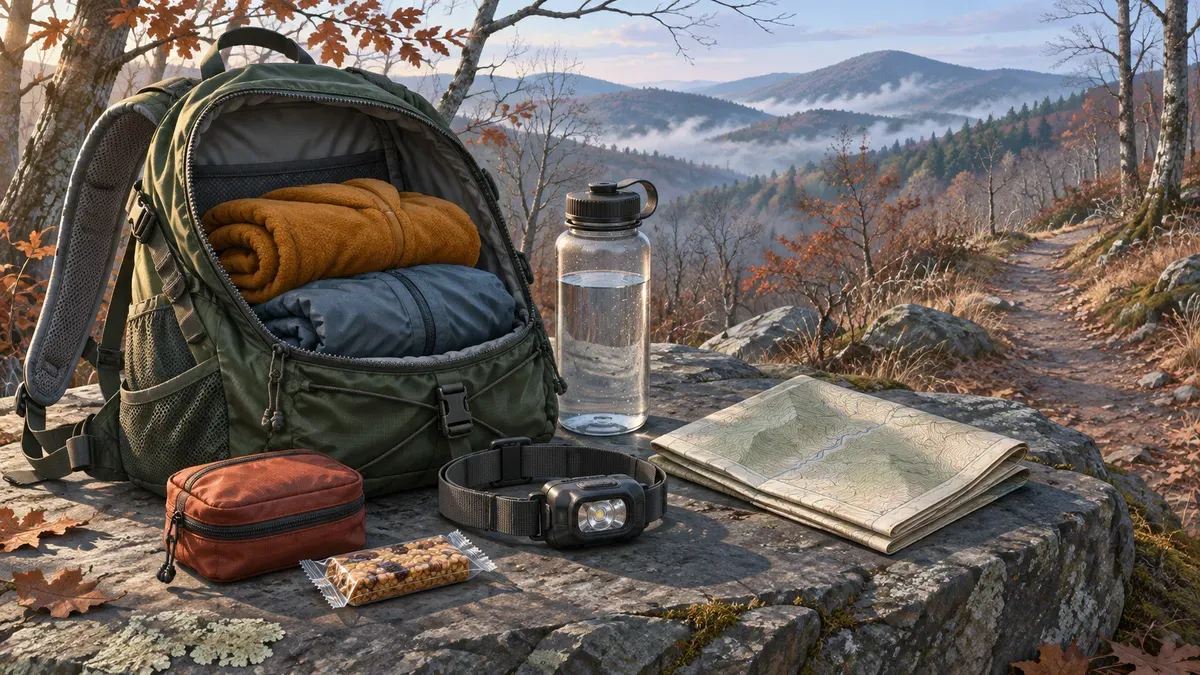
A day hike packing list should cover the walk you expect and a delay you did not plan. Bring navigation, drinking water, food plus a reserve, adjustable clothing, rain protection, a headlamp, first aid, sun protection, repair supplies, emergency shelter, and a suitable way to request help. Choose quantities and protection from the forecast, terrain, duration, and people coming with you.
The useful question is not whether an item appears on somebody else’s checklist. Ask what you would do if the return took longer, a water source was dry, or one person could no longer walk. This guide covers ordinary nontechnical day hiking; snow, avalanche terrain, climbing, and remote expeditions require additional skills and planning.
Quick answer
For a first day hike, choose a short marked route with an easy exit. Pack a map you can use offline plus an independent backup, water sufficient to reach a verified safe refill or finish with a margin, a meal and extra snacks, a rain shell and warm spare layer, headlamp and spare power, personal medication and first aid, sun protection, a whistle, simple repair items, and emergency weather protection. Leave a route and overdue plan with someone staying behind.
Test the packed bag before departure. You should be able to walk, bend, and take steps without numb shoulders, rubbing, or an unstable load. If the necessary supplies are too heavy, shorten or change the route rather than removing the protection that makes it feasible.
Key facts
- Route exposure determines packing needs: remoteness, weather, and escape options matter alongside mileage.
- Extra carried mass increases walking work: unnecessary weight spends energy without increasing your safety margin.
- Independent backups reduce shared failures: a phone that provides maps, light, and communication can lose all three functions together.
- Accessible supplies support early action: reachable water, food, and rainwear make small adjustments easier.
- Emergency shelter limits exposure during a delay: it does not turn an unsafe forecast into a safe outing.
Start with a route card, then choose the bag
Write the expected walking time, elevation gain, latest return time, weather, known water sources, and the most difficult section. Include the descent and stops. A 4-mile (6.4-km) rocky circuit can be more demanding than a longer smooth path. Mark where you can turn back or shorten the walk.
Check current access and official hazard information. The National Park Service’s Hike Smart guidance emphasizes matching the route to the group, checking conditions, and leaving a trip plan. Apply those principles wherever you walk; local requirements still need local verification.
Tell your contact the route, participants, parking or starting point, expected return, and when to seek help if you are overdue. A bag cannot compensate for an unknown itinerary. For the movement side of preparation, use the separate uphill hiking pacing guide.
For an outing that stays within a built-up area, use urban hiking route planning to choose pedestrian space, rest points, and an early exit; adapt your kit to the actual exposure and available support.
Build the kit around functions
The Ten Essentials framework groups equipment by the problems it solves. The following is an adapted working checklist, not a guarantee that these items are sufficient for every trail.
| Function | What to consider carrying | Check before departure |
|---|---|---|
| Find the route | Offline map, physical map, compass if you can use it | Can you locate yourself without reception? |
| Stay supplied with water | Filled bottles or reservoir; treatment if needed | Are refills reliable, permitted, and treatable? |
| Maintain energy | Familiar meal, snacks, extra no-cook food | Can everyone eat it, including during a delay? |
| Manage weather | Rain shell, insulation, appropriate spare clothing | Will it protect a stationary person? |
| See after dark | Headlamp and compatible spare power | Does it work independently of the phone? |
| Handle minor problems | First aid, blister supplies, personal medicines | Do you know how and when to use them? |
| Reduce sun and insect exposure | Hat, sunglasses, sunscreen, suitable repellent | Is protection suited to the environment? |
| Repair a failure | Small repair kit and appropriate simple tool | Can you fix a loose strap or damaged fastening? |
| Wait and signal | Emergency shelter, whistle, suitable communication | Can you use the system with cold or wet hands? |
| Manage hygiene and waste | Hand hygiene, toilet supplies as appropriate, waste bag | Do you know local disposal requirements? |
Fire-making capability belongs in some emergency systems, but fire restrictions, fuel, wind, and your skills determine whether it is usable. Never depend on lighting a fire to replace carried insulation or shelter. Technical tools and blades also need to meet local rules.
Plan water by the interval between safe refills
Do not pack a fixed bottle merely because it usually fits your bag. Estimate time to the next verified safe supply, including a delay. Heat, exposure, climbing, individual sweat losses, and unavailable sources can change the amount substantially.
The American Hiking Society offers about 17 US fl oz (0.5 L) per hour as a planning guideline for moderate temperatures and terrain. For four hours, that gives roughly 2.1 US qt (2 L) before adding a route-specific margin. This is an initial carrying calculation, not a compulsory drinking rate or a promise of enough water in heat.
Keep water accessible and adjust drinking to conditions and your needs. Do not force fluid simply to empty the bottle on schedule. If the forecast or refill uncertainty makes the required load impractical, choose a cooler time, shorter route, or better-supported walk. The exercise hydration guide explains why fluid needs vary and why overdrinking can also be dangerous.
Clear stream water is not automatically safe. CDC water-treatment guidance recommends boiling to kill germs, or filtering followed by disinfection when boiling is not possible. Treatment methods have different limitations; follow their instructions. Boiling or disinfecting cannot make chemically contaminated water safe. Do not assume a seasonal stream will be running.
Carry food you will actually eat
Choose familiar, portable food that remains safe in the expected temperature: a suitable packed meal, fruit, crackers, nuts if tolerated, or another easy snack. Place a portion where you can reach it without unloading everything. Keep a separate reserve for unexpected extra time; no-cook food avoids depending on fuel or a working stove.
There is no universal calorie target for a daypack. Duration, intensity, body size, appetite, and medical needs differ. Start with what works on shorter walks and record leftovers and shortages. People managing diabetes, food allergies, or another condition should carry their usual supplies and follow their individual plan.
Keep weather protection dry and available
Wear footwear that fits and grips the intended surface, with socks already tested on walks. Pack an adjustable warm layer and rain protection suited to the most exposed part of the route, not just the parking area. A warm moving body can cool when it stops.
Use a waterproof liner or separate dry bags for insulation, medicines, and electronics. A pack cover alone may not protect every opening. Put the rain shell near the top and change layers before you are drenched in sweat or rain. The BMC’s hill-walking equipment guidance supports accessible frequently used items and protected packing.
An emergency blanket or bivy is a backup for waiting, with performance depending on design, wind, moisture, and how it is used. It is not a sleeping system for a planned night. For cold-season traction and insulation decisions, use the dedicated winter hiking guide. A rain shell or emergency blanket is not lightning shelter; see hiking thunderstorm safety before an exposed outing.
Separate navigation, light, and communication failures
Download the map and test it without a signal. Carry a usable independent navigation backup and learn it on low-consequence terrain. A paper map offers little help if you cannot orient it. The mountain navigation guide covers those skills separately.
A phone torch drains the same battery needed for maps and calls, so carry a headlamp. Check spare cells or a charged compatible power source and cable. Protect devices from water and temperature extremes.
Choose communication for actual coverage and remoteness. A satellite emergency device may be appropriate where mobile service is unreliable, but activation, subscriptions where required, battery, sky view, and user knowledge matter. No device guarantees immediate rescue. Keep the group together and distribute essentials so one lost pack does not remove everything.
Pack for stable movement and a quick response
Place dense items close to your back, protect fragile objects, and secure loose straps. Keep water, a snack, rainwear, and first aid reachable. Put equipment for a delay where you can identify it quickly instead of burying small items loose at the bottom.
In a small treadmill study of eight adults, additional backpack load increased mechanical work and metabolic cost (Huang and Kuo, 2014). That supports removing unnecessary duplication; it does not establish a safe universal percentage of body weight or justify leaving essentials behind.
Try the loaded bag on stairs or a short local walk. Adjust it if it swings, rubs, changes your balance, or causes tingling. Carrying comfort is a test, not a label on the pack. Choose capacity after laying out the necessary kit, allowing room for a removed layer.
Turn the list into a departure routine
| Moment | Practical check |
|---|---|
| The evening before | Review forecast and access; fill supplies; charge and test equipment |
| At the trailhead | Recheck conditions, group readiness, water, and turnaround time |
| After the first short section | Adjust layers and straps; address rubbing; confirm the route |
| At a planned decision point | Compare progress, weather, water, and group condition with the return margin |
| Back at the finish | Tell your contact you are safe; note shortages and unused nonessential items |
Turn back when the agreed time arrives or the route exceeds the group’s skills, supplies, or conditions. Stop for confusion, collapse, chest pain, severe unusual breathlessness, or an injury that prevents safe movement, and seek appropriate emergency help. Buying more equipment does not solve a poor route choice.
Connect preparation to repeatable activity
An enjoyable hike can support an active routine, but one demanding weekend does not replace regular movement and strength work. WHO guidance recommends 150–300 minutes of moderate aerobic activity weekly, or an equivalent vigorous combination, plus strength work on at least two days. Build from manageable outings; the exercise and longevity guide places that routine in context.
SuperAge can help you review available Apple Health activity and recovery trends alongside your own notes about route, load, effort, and next-day fatigue. Those trends do not measure water safety, weather exposure, navigation competence, or readiness for a specific trail. They cannot certify that an outing is safe.
FAQ
What should a beginner bring on a day hike?
Bring navigation with a backup, water, food and extra snacks, rainwear and insulation, headlamp, first aid and medicines, sun protection, emergency weather protection, repair supplies, and a way to signal or request help. Adapt the kit to the route and test it before leaving.
How much water should I carry for a four-hour hike?
About 2.1 US qt (2 L) follows a moderate-condition planning guideline of 17 US fl oz (0.5 L) per hour. Add a margin and account for heat, effort, individual needs, and reliable refills. It is not a mandatory intake or a hot-weather guarantee.
Do I need a large backpack for a day hike?
You need enough capacity for the complete route-specific kit and a layer you may remove. Lay out your supplies first, then test their fit and carrying comfort. Capacity alone says little about whether the contents are adequate.
Can my phone replace a map and headlamp?
A phone can provide useful navigation, but battery loss or damage can remove several functions at once. Carry independent light and a navigation backup you know how to use. Download maps before departure and protect the battery.
Should I carry emergency shelter if I will return before dark?
Yes, consider weather protection for an unplanned stop or injury even on a day outing. Select it for the conditions and learn its use. A lightweight emergency item does not make a planned overnight stay or severe weather acceptable.
Are hiking boots always necessary?
Footwear must match terrain, traction, weather, fit, and your experience. A simple dry path and a rough wet trail create different needs. Test the footwear with your intended socks; do not make a long hike its first use.
Is a filter enough to make stream water safe?
Not necessarily. Filters differ in the organisms they remove, and some hazards require additional treatment or avoiding the source altogether. Follow authoritative treatment guidance and equipment instructions. Clear appearance does not establish safety.
What should each person carry in a group?
Each person needs accessible water, food, personal medicines, clothing, and essentials appropriate to separation or a delay. Some equipment can be shared deliberately, but avoid placing all navigation, shelter, light, or communication in one pack.
Key takeaways
- Define the route, weather, return margin, and emergency contact before packing.
- Cover essential functions and a plausible delay, then remove unnecessary weight.
- Plan water around verified supplies and conditions rather than bottle size.
- Keep insulation dry and navigation, light, and communication resilient.
- Test the loaded pack and turn back when the plan’s limits are reached.
Prepare one manageable outing
Lay out your kit, test the bag on a short walk, and choose a route within your current experience. If you use Apple Health, download SuperAge to review your available activity and recovery trends as part of a consistent routine.
References
- National Park Service. Ten Essentials.
- National Park Service. Hike Smart.
- American Hiking Society. The Ten Essentials of Hiking.
- CDC. Water treatment options when hiking, camping, or traveling.
- British Mountaineering Council. What to wear and what to take when hill walking.
- Huang TP, Kuo AD. Mechanics and energetics of load carriage during human walking. 2014.
- World Health Organization. Physical activity recommendations.
This article provides general education. It does not replace local conditions information, outdoor training, emergency advice, or individual medical care.
Related Articles

Downwind sailing: broad reach, running, and safer control
Learn downwind sailing basics: broad reach versus running, apparent wind, boom awareness, and a supervised practice plan for better control and confidence.