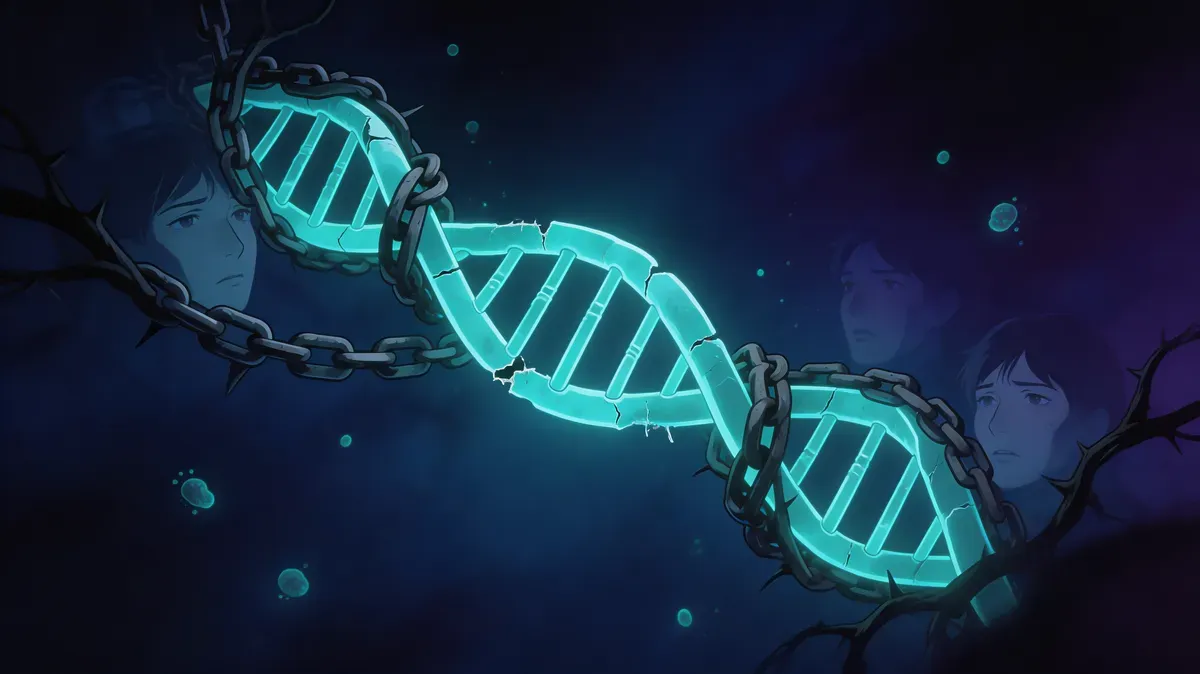
Chronic stress and epigenetic aging: how trauma writes into DNA
Chronic stress is linked with faster epigenetic aging through cortisol, inflammation, and DNA methylation. Learn what trauma studies show and what can help.
Stress does not change the letters of your DNA. But chronic stress and trauma can leave measurable marks on the chemical tags that control gene expression, especially DNA methylation. That is why stress now shows up in studies of epigenetic clocks, biological age, and pace of aging.
A 2023 JAMA Network Open analysis of CARDIA participants found that people reporting 4 or more adverse childhood experiences had modest but measurable differences in several epigenetic-aging measures in midlife, including GrimAge and DunedinPACE. The signal was not identical across every clock, and it did not prove that a single stressful event permanently ages you.
The practical question is more useful: which stress signals are persistent enough to affect biology, which ones recover, and which habits help your body return to baseline?
What you’ll learn:
- What epigenetic aging means, and why it is not a DNA mutation
- How cortisol, inflammation, sleep disruption, and HPA-axis signaling connect stress to methylation
- What childhood trauma and adult chronic stress studies actually show
- 6 ways to reduce stress load and support recovery without promising a full biological reset
Quick answer
Chronic stress and trauma are associated with faster epigenetic aging, especially in studies using DNA methylation clocks such as GrimAge and DunedinPACE. The most plausible pathway runs through HPA-axis activation, cortisol signaling, inflammation, sleep disruption, and metabolic strain.
This does not mean stress changes your DNA sequence, or that every hard period permanently ages you. Epigenetic clocks are probabilistic biomarkers. Some stress-related biological-age signals appear partly reversible with recovery, sleep, exercise, therapy, social support, and reducing the stressor itself.
For longevity, the target is not a stress-free life. It is a better stress-to-recovery ratio: fewer persistent stressors, faster return to baseline, higher HRV, better sleep, and lower inflammation over time.
Key facts
- Chronic stress -> HPA-axis activation: repeated stress keeps cortisol and sympathetic signaling active longer than acute stress.
- Cortisol signaling -> DNA methylation changes: glucocorticoid-response regions overlap with some CpG sites used in epigenetic clocks.
- Trauma exposure -> higher biological-age signals: meta-analyses and cohorts link traumatic stress, ACEs, and cumulative life stress with accelerated DNA methylation age, but effect sizes vary by clock and population.
- Recovery -> partial plasticity: biological age can rise during severe stress and fall after recovery in some human and animal datasets.
- What to track -> HRV, sleep, resting heart rate, hs-CRP, and trends: these are practical signals of stress load before an epigenetic test is repeated.
What is epigenetic aging?
Epigenetic aging refers to the progressive changes in DNA methylation — chemical methyl groups attached to cytosine bases in your DNA — that accumulate over time. These changes do not alter your genetic code, but they control which genes are turned on or off, effectively changing how your body functions.
Quick definition: Epigenetic aging is the measurable change in DNA methylation patterns over time. Epigenetic clocks use these patterns to calculate biological age — how old your body actually is, regardless of your birth date.
How epigenetic clocks work
Researchers have identified hundreds of specific DNA sites (CpG sites) whose methylation states change predictably with age. Algorithms like the Horvath clock, GrimAge, and DunedinPACE combine these sites into a single number: your biological age. When your epigenetic age exceeds your chronological age, you are aging faster than normal. When it is lower, you are aging slower.
Deep dive: Read our full explanation of PhenoAge and KDM biological age calculations for the technical details.
Why stress matters for epigenetic aging
The critical discovery linking stress to epigenetic aging came from Wolf et al. (2018), whose meta-analysis across multiple cohorts found that traumatic stress exposure was significantly associated with accelerated DNA methylation age. The effect was not subtle: individuals with PTSD showed epigenetic ages years older than their chronological age.
The science: from cortisol to DNA methylation
The glucocorticoid pathway
A leading mechanism is glucocorticoid signaling:
- Stress activates the HPA axis -> hypothalamus releases CRH -> pituitary releases ACTH -> adrenal glands release cortisol
- Cortisol binds glucocorticoid receptors (GRs) throughout the body and brain
- GRs bind to glucocorticoid response elements (GREs) in DNA, which regulate gene expression
- Repeated cortisol exposure can shift methylation patterns at stress-responsive regions
- Zannas et al. found that 85 of 353 Horvath clock CpG sites were located within GREs, supporting a plausible cortisol-to-clock pathway
This helps explain why psychological stress can correlate with biological-aging biomarkers. The signal is molecular, but it is not deterministic: methylation clocks are also influenced by immune-cell mix, smoking, body composition, sleep, disease, and the clock algorithm being used.
Childhood trauma and lifelong consequences
The ACE literature supports a real but nuanced stress-aging connection:
- 4 or more ACE categories: associated with higher GrimAge acceleration and DunedinPACE in midlife in the CARDIA cohort.
- Traumatic stress exposure: linked with small but significant associations with accelerated DNA methylation age in meta-analysis.
- Cumulative life stress: associated with faster epigenetic aging in an urban cohort, with GRE overlap supporting a cortisol pathway.
- Childhood maltreatment timing: associations differ by exposure type, timing, tissue, and clock.
The mechanism is best understood as stress-system programming, not destiny. Early adversity can tune the HPA axis, immune signaling, sleep, and behavior in ways that persist into adulthood. That can raise biological risk over decades, but it does not mean every methylation mark is permanent or every person with trauma follows the same trajectory.
Adult chronic stress
Childhood trauma is not the only pathway. Adult chronic stress also appears in epigenetic-aging research, although the effect depends on the clock and population:
- Cumulative lifetime stress predicted accelerated epigenetic aging in the HANDLS cohort (Genome Biology, 2015).
- Cumulative stress and low emotion regulation were associated with higher GrimAge acceleration in a community sample (Translational Psychiatry, 2021).
- Severe acute stressors such as surgery, pregnancy, and severe infection can transiently raise biological-age signals, with partial recovery afterward (Cell Metabolism, 2023).
- Caregiving stress has strong telomere evidence, while direct epigenetic-clock estimates vary across studies.
The practical takeaway is not that one stressful month adds a fixed number of years. It is that persistent stress without recovery can become biologically visible through cortisol, inflammation, sleep loss, metabolic strain, and autonomic imbalance.
The bidirectional feedback loop
Chronic stress and epigenetic aging create a vicious cycle:
Chronic stress → Cortisol elevation → DNA methylation changes
    ↑                                         ↓
Increased stress    ←    Impaired stress response
  sensitivity              (altered GR expression)
Stress-induced methylation changes silence glucocorticoid receptor genes, meaning the body becomes less efficient at shutting off its own stress response. This leads to more cortisol, more methylation damage, and faster aging — a self-reinforcing cycle that must be actively interrupted.
How stress aging shows up in your body
Epigenetic aging from chronic stress does not produce a single obvious symptom. Instead, it accelerates the entire aging process:
Immune dysfunction
Stress-accelerated immunosenescence — the aging of the immune system — manifests as more frequent infections, slower wound healing, and reduced vaccine effectiveness. Elevated NLR (neutrophil-to-lymphocyte ratio) is an accessible blood marker of stress-driven immune aging.
Cardiovascular aging
Chronic stress accelerates arterial stiffness, blood pressure elevation, and atherosclerosis. The Lancet Whitehall II study found that low sense of control at work doubled cardiovascular mortality — an effect mediated by sustained cortisol exposure.
Cognitive decline
Stress-induced methylation changes reduce BDNF expression and impair hippocampal neurogenesis. This manifests as memory problems, difficulty concentrating, and earlier onset of cognitive decline.
Sleep disruption
Cortisol-driven hyperarousal reduces deep sleep duration — the stage most critical for DNA repair and cellular restoration. Poor sleep then compounds stress, creating another reinforcing cycle.
Accelerated telomere shortening
Chronic stress shortens telomeres through multiple pathways: oxidative stress, reduced telomerase activity, and direct cortisol effects. Caregivers under chronic stress showed telomere shortening equivalent to approximately 9–17 years of additional aging.
6 strategies to reverse stress-driven epigenetic aging
1. Address the stressor, not just the stress response
Why it works: Resilience interventions are valuable, but the strongest evidence for epigenetic age reversal comes from removing or reducing the source of chronic stress itself. A 2021 study in Translational Psychiatry found that psychological and biological resilience modulated the effects of stress on epigenetic aging — but the largest effect came from reducing stress exposure.
How to do it:
- Identify your top 3 chronic stressors (relationships, work, financial, health)
- Classify each as: changeable (act), reframable (perspective shift), or removable (exit)
- Take one concrete action per week on your highest-impact stressor
- Seek professional support for trauma processing (EMDR, CPT, and somatic therapies have the best evidence)
Expected results: measurable cortisol reduction within weeks of addressing a major chronic stressor.
2. Practice daily stress-recovery routines
Why it works: The epigenetic damage from stress is not caused by acute stress episodes — it is caused by insufficient recovery between episodes. HRV is the most accessible marker of this balance: high HRV indicates good recovery capacity; low HRV signals chronic stress accumulation.
How to do it:
- Track your HRV daily to identify recovery trends
- Implement 10–20 minutes of vagal stimulation daily: slow breathing, cold face immersion, or meditation
- Consider evidence-based adaptogens like rhodiola rosea for burnout-pattern HPA axis dysregulation — clinical trials show meaningful improvements in cortisol rhythm and fatigue over 4–12 weeks
- Monitor your stress tracking to identify recovery gaps
- Ensure at least one “stress-free” period per day (60+ minutes without demands)
Expected results: HRV improvement within 2–4 weeks; sustained autonomic rebalancing over months.
3. Prioritize sleep quality above all else
Why it works: Deep sleep is when DNA repair mechanisms are most active. Stress-disrupted sleep means less time for the enzymatic processes that maintain healthy methylation patterns. A single night of poor sleep elevates inflammatory markers; chronic sleep disruption compounds into measurable epigenetic aging.
How to do it:
- Non-negotiable sleep schedule (±30 minutes, including weekends)
- Address sleep apnea if present — it is one of the most potent hidden stress accelerators
- Bedroom environment: 65–68 °F (18–20 °C), complete darkness, no screens for 60 minutes before bed
- Limit caffeine to before 12 PM if stress sensitivity is high
Expected results: improved deep sleep percentage within 1–2 weeks; downstream cortisol reduction within 4 weeks.
4. Use exercise as a stress-recovery tool
Why it works: Regular physical activity lowers perceived stress, improves sleep and insulin sensitivity, and can buffer stress-related telomere shortening. Human exercise studies also show broad DNA methylation changes in metabolic tissues, but the exact epigenetic-age “years reversed” estimate varies by clock and should not be treated as a guarantee.
How to do it:
- 150+ minutes per week of moderate activity (3.1 mph / 5 km/h walking pace or higher)
- Include both strength training and cardiovascular exercise
- Avoid overtraining — excessive exercise becomes a stressor itself
- Exercise consistency matters more than intensity
Expected results: HRV, sleep, and mood can improve within weeks; epigenetic-age changes, if measured, usually require months and vary by clock.
5. Build social buffering
Why it works: Social isolation doubles the epigenetic impact of chronic stress. Conversely, strong social support “buffers” stress at the biological level — people with robust social networks show lower cortisol reactivity and slower epigenetic aging even when exposed to the same stressors.
How to do it:
- Maintain 3–5 close relationships with regular contact
- Physical co-presence (not just digital) activates oxytocin release
- Reciprocal support is key — both giving and receiving help
- Community belonging (group activities, volunteering) provides structural support — research on purpose and longevity shows that contribution to others is a particularly powerful stress buffer, with the mortality benefit of purpose strongest when it involves social engagement
Expected results: reduced cortisol reactivity within weeks; sustained epigenetic protection with ongoing social engagement.
6. Consider therapeutic intervention for trauma
Why it works: For individuals with significant ACE exposure or PTSD, self-help strategies alone may not be sufficient. Evidence-based trauma therapies can interrupt the cortisol-methylation cycle at its root:
| Therapy | Mechanism | Evidence for biological aging |
|---|---|---|
| EMDR | Reprocesses traumatic memories, reducing cortisol reactivity | Reduced inflammatory markers post-treatment |
| CPT (Cognitive Processing Therapy) | Restructures trauma-related cognitions | Improved HRV and stress recovery |
| Somatic Experiencing | Releases stored stress from the nervous system | Improved autonomic balance |
| MBSR/MBCT | Mindfulness-based approaches for ongoing stress | Reduced epigenetic age acceleration |
Expected results: significant reduction in stress biomarkers within 8–16 weeks of therapy; potential partial reversal of stress-related epigenetic aging.
How to track and measure stress-driven aging
Key metrics to monitor
| Metric | What it reveals | Target |
|---|---|---|
| HRV (RMSSD) | Autonomic recovery capacity | Above age-adjusted median |
| Resting heart rate | Chronic stress burden | 55–65 bpm |
| Deep sleep % | DNA repair opportunity | 15–25% of total sleep |
| Cortisol awakening response | HPA axis regulation | Lab test |
| hs-CRP | Stress-driven inflammation | Below 1.0 mg/L |
| Biological age | Net effect of stress on aging | Below chronological age |
How SuperAge helps you break the stress-aging cycle
Stress-driven epigenetic aging is invisible — until it is not. SuperAge gives you the real-time biomarker data to interrupt the cycle before the damage accumulates.
Continuous stress monitoring
SuperAge tracks your stress levels through HRV analysis throughout the day. Identifying your stress patterns — when, where, and why your body enters a sustained stress state — is the first step toward interrupting the cortisol-methylation cycle.
Resilience score as recovery metric
The resilience score measures how quickly you return to baseline after stress episodes. Declining resilience signals that chronic stress is overwhelming your recovery capacity — exactly the condition that accelerates epigenetic aging.
Biological age trends
SuperAge’s biological age calculation integrates the markers most affected by chronic stress: HRV, sleep quality, resting heart rate, and exercise patterns. Tracking your biological age trend over months reveals whether your stress management strategies are working at the deepest level.
Frequently asked questions
Can epigenetic aging from stress be reversed?
Partly, but not in a guaranteed “erase the past” way. Stress-related biological-age signals can improve when the stressor resolves and recovery improves, and exercise, sleep, social support, therapy, and better metabolic health may all reduce stress load. Severe early-life trauma may leave persistent methylation signatures, but risk can still be buffered by treatment and recovery.
How much does chronic stress age you biologically?
There is no single number. In the 2023 CARDIA ACE study, adults with 4 or more ACE categories had about 0.61 years higher GrimAge acceleration and 1% higher DunedinPACE in the fully adjusted model, while other clocks were weaker or inconsistent. Telomere studies in high-stress caregivers have reported larger apparent aging gaps, but telomeres and epigenetic clocks measure different biology.
Is all stress equally damaging?
No. Acute stress with adequate recovery is not only tolerable — it can be beneficial (hormesis). The damage comes from chronic stress without sufficient recovery, and from traumatic stress that overwhelms coping capacity. The critical factor is the ratio of stress to recovery, which is why HRV monitoring is so valuable.
Do genetics determine how much stress ages you?
Partially. Genetic variants in genes like FKBP5 (which regulates glucocorticoid receptor sensitivity) and the serotonin transporter gene moderate the epigenetic effects of stress. It’s also worth noting that chronic stress and depression are deeply intertwined at the biological level — both conditions operate through the same cortisol-methylation pathway, and each can trigger and sustain the other. However, epigenetics is the mechanism through which environment overrides genetics — meaning lifestyle interventions can counteract genetic vulnerability.
How long does it take to see improvement?
HRV and sleep metrics can improve within 2–4 weeks of consistent stress management. Blood inflammatory markers like hs-CRP may take 2–3 months. Epigenetic age changes typically require 6+ months of sustained intervention to become measurable, though the beneficial trajectory begins immediately.
Key takeaways
- Chronic stress is linked with faster epigenetic aging, but the size of the effect depends on the clock, tissue, and population.
- Cortisol is one plausible pathway: glucocorticoid-response regions overlap with some CpG sites used in epigenetic clocks.
- Childhood trauma and cumulative stress matter, but they are risk signals, not deterministic forecasts.
- Recovery is biologically relevant: some stress-related biological-age signals appear partly reversible after recovery.
- Track the practical signals: HRV, sleep, resting heart rate, inflammation, and biological-age trends reveal whether stress load is improving.
Break the stress-aging cycle today
You cannot undo every stressful experience in your past. But you can interrupt the cycle right now — with better sleep, consistent movement, deeper social connections, and real-time data on how your body is responding.
Ready to see how stress is aging you? Download SuperAge and start tracking the stress, recovery, and biological age markers that reveal whether chronic stress is writing into your DNA — or whether you are writing it back.
References
- Wolf EJ et al. - “Traumatic stress and accelerated DNA methylation age: A meta-analysis” - Psychoneuroendocrinology (2018) - PubMed
- Simons RL et al. - “Association of adverse childhood experiences with accelerated epigenetic aging in midlife” - JAMA Network Open (2023) - JAMA Network
- Zannas AS et al. - “Lifetime stress accelerates epigenetic aging in an urban, African American cohort: relevance of glucocorticoid signaling” - Genome Biology (2015) - Genome Biology
- Harvanek ZM et al. - “Psychological and biological resilience modulates the effects of stress on epigenetic aging” - Translational Psychiatry (2021) - Nature
- Poganik JR et al. - “Biological age is increased by stress and restored upon recovery” - Cell Metabolism (2023) - PMC
- Epel ES et al. - “Accelerated telomere shortening in response to life stress” - PNAS (2004) - PubMed
- Belsky DW et al. - “DunedinPACE, a DNA methylation biomarker of the pace of aging” - eLife (2022) - eLife
- Chang X et al. - “Childhood maltreatment and longitudinal epigenetic aging” - JAMA Network Open (2024) - JAMA Network
- Puterman E et al. - “The power of exercise: buffering the effect of chronic stress on telomere length” - PLoS One (2010) - PubMed
Last updated: 2026-06-07. This article is regularly reviewed to ensure accuracy.
Related Articles

Depression and accelerated aging: the biological link
Depression is linked with inflammation, cortisol disruption, telomere shortening, and faster biological aging. Learn what evidence shows and when to seek help.