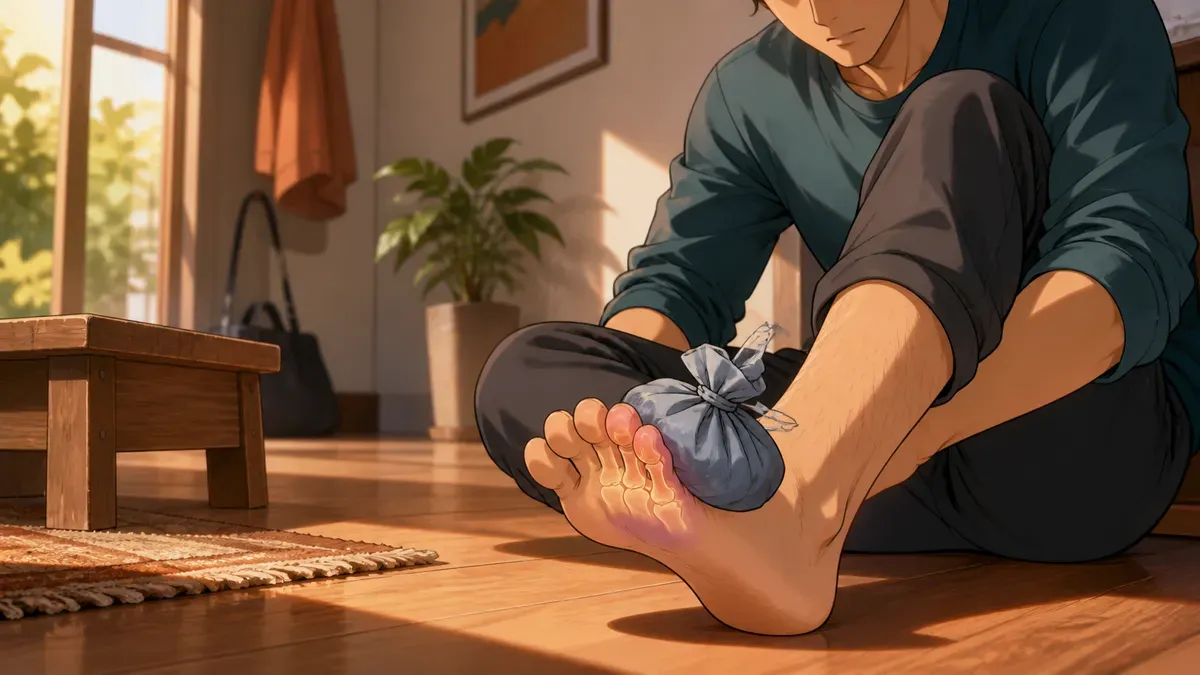
Broken toe or bruise? First aid, red flags, and recovery
Broken toe or bruised toe? Learn which signs overlap, when an X-ray matters, safe first aid, buddy-taping limits, red flags, recovery, and when to seek care.
Quick answer
A broken toe and a badly bruised toe can both cause immediate pain, swelling, discoloration, tenderness, and difficulty walking. Those symptoms do not reliably separate bone injury from soft-tissue injury at home. A toe that remains straight, has intact skin and normal sensation, and gradually improves can often be protected while you arrange routine advice. A toe that is crooked or rotated, has an open wound, feels numb or cold, involves the big toe, or follows a major crush needs prompt assessment.
For an uncomplicated injury, stop the aggravating activity, elevate the foot, apply wrapped ice for up to 20 minutes at a time, and use a wide shoe with a firm sole if walking is comfortable. Do not pull a deformed toe straight, tape an angled or big toe, place ice directly on skin, or keep walking through a worsening limp. An X-ray can confirm many fractures, but whether imaging changes care depends on which toe is injured and whether alignment, a joint, circulation, or a wider area of the foot may be involved.
Key facts
- A toe bruise and a toe fracture share pain, swelling, discoloration, and painful walking.
- Visible angulation or rotation signals loss of normal alignment and a need for prompt assessment.
- Open skin, altered sensation, or poor circulation requires urgent care rather than home taping.
- Protected movement and a firm-soled shoe reduce painful bending in many stable lesser-toe injuries.
- Recovery decisions should follow function and symptom trend, not the calendar alone.
A direct impact can injure skin, nail, soft tissue, a joint, or one of the small phalangeal bones—or several at once. The safe question is therefore not only “Is it broken?” It is “Does this injury have a feature that changes what I should do next?”
Medical note: This guide is for adults with a recent toe injury and cannot diagnose a fracture. Children, people with diabetes, neuropathy, poor circulation, immune suppression, or a current foot ulcer should get individualized advice early. Use local urgent or emergency services for an open injury, compromised circulation, severe deformity, or rapidly worsening symptoms.
Bruise, sprain, dislocation, or fracture?
Several injuries can look alike during the first hours:
- A contusion, or bruise, damages small blood vessels and soft tissue after a blow or crush.
- A sprain stretches or tears ligaments around a toe joint, often after the toe bends or twists.
- A dislocation moves joint surfaces out of their normal relationship and commonly changes the toe’s shape.
- A fracture cracks or breaks a phalanx. It may stay aligned, shift, rotate, extend into a joint, or communicate with a skin wound.
- A nail-bed injury can bleed under the nail, split the nail, or accompany a fracture at the tip of the toe.
Stubbing the toe creates an axial load; dropping an object creates a crush; catching the toe while the foot continues forward can add bending or rotation. Mechanism helps a clinician frame the examination, but it does not prove which tissue is injured. A small impact can fracture vulnerable bone, while a dramatic bruise can occur without a break.
This distinction is different from delayed exercise soreness. DOMS develops after unfamiliar loading, usually across a muscle group rather than at one sharply tender toe immediately after impact.
Can symptoms tell whether a toe is broken?
Pain intensity alone cannot answer the question. The American Academy of Orthopaedic Surgeons lists pain, swelling, discoloration, and pain with weight bearing among common fracture symptoms; all can also occur with a contusion or sprain. A straight toe and the ability to walk do not exclude a nondisplaced fracture.
Use the whole pattern to judge urgency:
| Pattern | What it may mean | Sensible next step |
|---|---|---|
| Mild swelling and bruising, straight toe, normal feeling, improving day by day | Contusion, sprain, or stable fracture may all fit | Protect it, monitor function, and seek routine advice if improvement stalls |
| Sharp focal tenderness over one bone, swelling, and painful push-off | Fracture becomes more plausible, but examination or imaging may be needed to confirm it | Arrange clinical assessment, especially for the big toe or persistent pain |
| Toe points sideways, overlaps a neighbor, looks shortened, or the nail faces a different direction | Displacement, rotation, or dislocation | Prompt in-person assessment; do not straighten it yourself |
| Split skin, deep cut, visible bone, or significant nail-bed wound | Open fracture or deeper soft-tissue injury is possible | Urgent assessment to clean, protect, and manage infection risk |
| Numbness, tingling, unusual coldness, pallor, blue color, or worsening tight swelling | Nerve or blood-flow compromise may be present | Emergency or urgent assessment now |
| Pain extends through the forefoot or midfoot, or four steps are not possible after a substantial injury | The injury may extend beyond one toe | Clinical assessment for a broader foot injury |
A sound at the moment of injury is not a home diagnostic test. A crack can accompany a fracture, but a pop may also come from a joint or soft tissue. Likewise, bruising under the nail shows bleeding, not the exact state of the bone.
Red flags: when a toe injury needs faster care
Seek emergency or urgent assessment now
Get immediate help when:
- bone is visible or a wound may reach the fracture;
- the toe is clearly angled, rotated, or dislocated;
- the toe or foot becomes numb, cold, pale, blue, or increasingly difficult to move;
- bleeding will not stop, the crush was severe, or pain and swelling escalate rapidly;
- the injury followed major trauma and there may be other foot, ankle, head, or body injuries.
Open fractures need rapid treatment because bacteria can reach bone. Loss of sensation or a color and temperature change can signal neurovascular injury. These are not situations for buddy taping or a wait-and-see test.
Arrange prompt clinical advice
The threshold for assessment should also be lower when:
- the big toe is involved, because it contributes more to balance and push-off;
- a child or adolescent may have injured a growth plate;
- pain is severe, walking is not possible, or tenderness extends beyond one toe;
- there is diabetes, reduced foot sensation, peripheral artery disease, a foot ulcer, or impaired immunity;
- pain and swelling are not beginning to ease after about five days;
- walking remains painful around six weeks after the injury;
- repeated low-trauma fractures raise a broader bone-health question.
Diabetes can reduce protective sensation and delay recognition of skin damage. The American Diabetes Association advises prompt attention to foot problems because neuropathy and reduced blood flow can make an ordinary injury more consequential.
If a fall caused the injury, address why the fall happened as well as the toe. Our balance training after 50 guide explains evidence-based prevention, but new dizziness, fainting, weakness, or repeated falls requires assessment before exercise progression.
What to do in the first 48 hours
Early care should protect the toe without creating a new skin, nerve, or circulation problem.
For a confirmed sprain, strain, or contusion elsewhere, the PEACE and LOVE injury-recovery framework explains why brief protection should lead into progressive movement; it does not replace assessment when a toe may be fractured or dislocated.
1. Stop the provoking activity
Pause running, jumping, kicking, heavy carrying, or any movement that sharply increases pain. This is relative rest, not a requirement to stay in bed. Short necessary walking may be reasonable if the toe is straight, there are no warning signs, and you can move without severe pain.
Do not repeatedly “test” the injury by hopping, squeezing, or forcing the toe to bend. Each test adds load without settling the diagnosis.
2. Elevate the foot
Support the foot above heart level when practical during the early swollen phase. Remove tight footwear, rings, or toe jewelry before swelling increases. Check that socks or bandages are not leaving deep marks.
3. Use protected cold
Wrap a cold pack in a towel and apply it for up to 20 minutes every few hours during the first days, allowing the skin to return to normal temperature between applications. Never place ice directly on skin or use it over an area with reduced sensation or impaired circulation without professional advice.
Cold can reduce pain and swelling; it does not speed bone union or prove that an injury is minor.
4. Choose footwear that limits painful bending
A wide, flat shoe with a firm or rigid sole can reduce toe movement and leave room for swelling. Avoid narrow toe boxes, high heels, flexible shoes that increase painful push-off, and barefoot walking on hard or cluttered floors. If you cannot fit a shoe without pressure or cannot walk safely, seek advice about a cast shoe, boot, or mobility support rather than improvising.
5. Use pain medicine safely
Paracetamol or an anti-inflammatory medicine may be suitable for some adults, but the correct choice depends on kidney or liver disease, ulcers or bleeding, cardiovascular disease, blood-pressure treatment, anticoagulants, pregnancy, allergies, alcohol use, and other medicines. Follow the label and ask a pharmacist or clinician if uncertain. Do not combine products containing the same active ingredient, and do not use pain relief to justify painful sport.
When buddy taping is—and is not—reasonable
Buddy taping uses the neighboring toe as a light splint. It is commonly used for stable, straight fractures of the second through fifth toes, often with a rigid-soled shoe. It is not a universal first-aid step.
Do not tape at home if:
- the injured toe is the big toe;
- the toe is angled, rotated, overlapping, or shortened;
- there is an open wound, blister, skin infection, or significant nail injury;
- sensation or circulation is reduced;
- swelling is severe or the diagnosis is uncertain after a substantial injury.
When a clinician or local service says taping is appropriate, place a small piece of dry gauze between the toes, apply tape loosely enough to preserve circulation, and check the skin at least daily. Remove it and seek advice if pain rises, skin breaks down, or the toe becomes numb, cold, pale, or blue. Never tape tightly enough to force alignment.
Published guidance varies with the injury: the NHS broken-toe guidance describes two to three weeks of taping for suitable home-managed injuries, while an American Family Physician review describes four to six weeks for confirmed stable lesser-toe fractures. That range is a reason to match duration to the actual injury and symptom trend, not to keep taping indefinitely.
When does a toe injury need an X-ray?
An X-ray is useful when the result could change alignment, immobilization, follow-up, or referral decisions. It is more likely to matter for:
- a suspected big-toe fracture;
- visible angulation, rotation, shortening, or dislocation;
- an open injury or significant nail-bed damage;
- severe focal tenderness with major functional loss;
- possible joint involvement;
- pain across the forefoot or midfoot rather than one isolated lesser toe;
- symptoms that do not follow the expected improving course.
For many straight, closed lesser-toe injuries, initial care may be similar whether the injury is a bruise or stable fracture. That is why some health systems do not image every uncomplicated case. The decision is still individualized: a clinician examines alignment, nail bed, skin, sensation, circulation, adjacent bones, and the joints above and below the tender area.
When toe radiographs are needed, professional guidance commonly uses front, side, and oblique views. The American College of Radiology acute foot-trauma criteria also make an important distinction: the Ottawa foot rules assess selected midfoot injuries, not every abnormality in the toes. A negative rule for midfoot imaging should not be repurposed as proof that a painful, deformed toe is uninjured.
Most acute fractures appear on X-rays, but tiny or stress-related cracks can be less obvious early. A clinician may repeat imaging or choose another test when the mechanism, examination, and first image do not agree.
Recovery timeline: follow function, not just the date
Many uncomplicated toe fractures heal in roughly four to six weeks, but pain, shoe tolerance, and return to sport can take longer. The big toe, a displaced fracture, joint involvement, a severe crush, delayed treatment, poor circulation, and high-impact sport can all extend recovery.
| Phase | Useful goals | Reasons to step back or get reviewed |
|---|---|---|
| First 48 hours | Protect, elevate, control swelling, preserve skin and circulation | Rising pain, deformity, numbness, color change, open wound |
| Days 3–7 | Swelling and pain begin to trend down; short walking becomes easier | No improvement, spreading redness, drainage, fever, inability to fit safe footwear |
| Weeks 2–4 | More comfortable daily walking; less tenderness; gradual motion if advised | Persistent sharp focal pain, worsening limp, tape-related skin injury |
| Weeks 4–6 | Stable lesser-toe injuries often approach functional healing | Painful push-off, swelling after small loads, poor alignment, inability to walk normally |
| Weeks 6–8 and beyond | Progressive return to impact when function allows | Ongoing walking pain, recurrent swelling, loss of motion, or failed return attempts |
Do not interpret one good morning as proof of full healing. Look for a stable trend across several days: less swelling, less focal tenderness, normal skin, better shoe tolerance, and walking without a protective limp.
If a toe injury changes your stride, review walking asymmetry as a trend rather than treating one phone measurement as a diagnosis. A limp is a reason to reduce load and restore comfortable walking, not to chase a symmetry score while the toe still hurts.
Returning to walking, running, and sport
Start with ordinary walking in supportive footwear. Increase duration before speed, hills, jumping, or rapid changes of direction. A reasonable progression requires that each stage is comfortable during the activity and does not cause a meaningful increase in pain or swelling later that day or the next morning.
Before returning to impact, aim to:
- walk briskly without a limp;
- tolerate normal push-off in a suitable shoe;
- move the toe through its comfortable range without sharp pain;
- complete low-load balance and calf-raise tasks without protecting the foot;
- finish a short sport-specific drill without a delayed flare.
Do not tape the toe and use painkillers simply to pass a test. A 2023 systematic review of return to sport after toe phalanx fractures found that the evidence base was limited and reported a very wide range of return times. Most acute sport-related fractures were managed conservatively, but displaced joint and growth-plate injuries were different. The practical lesson is to use diagnosis and function, not a universal countdown.
Runners should restart on a flat, predictable surface before adding descents, where braking and foot placement increase task complexity. The downhill running safety guide can structure that later progression; it is not a substitute for healing the acute injury first. Space harder sessions with the principles in our workout recovery guide.
Toe fractures, age, and bone health
One stubbed toe does not diagnose osteoporosis. Most toe injuries reflect a direct force that would hurt healthy bone and soft tissue. Toe fractures are also not the same as the hip, vertebral, wrist, or humeral fractures commonly used in major osteoporotic-fracture risk calculations.
The broader context still matters. If a fracture followed unusually little force, fractures are recurring, or there are risk factors such as long-term glucocorticoid use, very low body weight, premature menopause, malabsorption, or prior fragility fracture, discuss bone health with a clinician. Our osteoporosis and DEXA guide explains formal risk assessment without turning every toe impact into a bone-density emergency.
During recovery, adequate food, protein, calcium, vitamin D, sleep, and avoidance of smoking support general tissue health. No supplement can realign a fracture or compensate for unsafe loading. Avoid high-dose products marketed as fracture shortcuts unless a clinician identifies a specific need.
Using mobility data without letting it overrule the injury
A painful toe can temporarily reduce steps, walking speed, and stride length while increasing asymmetry or double-support time. Those changes may show that you are protecting one side; they cannot reveal whether the bone is broken.
The Apple Health mobility metrics guide explains how to compare weekly trends in walking speed, step length, steadiness, and asymmetry. During an acute injury, the useful signal is recovery toward your own baseline after clinical red flags have been addressed. It is not a target that should push you to walk farther while pain is rising.
Use SuperAge as a timeline tool: note the injury date, symptom trend, activity changes, and return-to-walking milestones. Share that context with a clinician when recovery stalls. App data cannot examine alignment, skin, sensation, circulation, or an X-ray.
Frequently asked questions
Can I walk on a broken toe?
Many stable lesser-toe fractures allow walking as tolerated in a wide, firm-soled shoe. Stop and get assessed if walking causes severe pain, the toe is deformed, the big toe is involved, sensation or circulation changes, or pain extends through the foot. A limp that worsens with each day means the load is too high or the injury needs review.
Can I tell a broken toe from a bruise without an X-ray?
Not reliably. Both can cause pain, swelling, bruising, and difficulty walking. Deformity, rotation, focal bone tenderness, an open wound, or persistent loss of function raises concern, but a straight toe can still have a nondisplaced fracture. Examination and imaging settle the question when the result would change care.
Should I buddy-tape my injured toe immediately?
Only if it is a straight lesser toe, skin and sensation are intact, circulation is normal, and local guidance says taping is appropriate. Do not tape a big toe, an angled or rotated toe, an open injury, or a toe with numbness or color change. Place gauze between the toes and keep tape loose.
How long does a broken toe take to heal?
Uncomplicated fractures often heal in about four to six weeks, while full comfort in sport can take six to eight weeks or longer. Big-toe, displaced, joint, stress, and severe crush injuries may follow different timelines. Improvement in walking, swelling, tenderness, and shoe tolerance matters more than the date alone.
Does a black toenail mean the toe is broken?
No. Dark color under the nail usually reflects trapped blood after impact, and it can occur with or without a fracture. A large painful collection, split nail, deep cut, or disrupted nail edge deserves assessment because nail-bed injury and a tip fracture can occur together. Do not drill or burn a hole in the nail at home.
When discoloration appears without a clear impact—or when diabetes is part of the concern—use the nail changes and high blood sugar guide to separate trauma, infection, suspicious pigment, and the need for validated glucose testing.
When should persistent pain be checked?
Get advice sooner for severe pain or any red flag. For an otherwise uncomplicated injury, seek review if pain and swelling are not beginning to ease after about five days, if symptoms worsen after initial improvement, or if walking remains painful around six weeks.
Can I run as soon as the swelling is gone?
Swelling is only one marker. First restore pain-limited walking without a limp, comfortable push-off, suitable shoe tolerance, and low-load movement without a later flare. Then progress from short flat sessions to speed, hills, and direction changes. A confirmed complicated fracture needs the clinician’s return plan.
Key takeaways
- A broken toe and a severe bruise can look almost identical during the first hours.
- Deformity, an open wound, numbness, coldness, color change, big-toe injury, or severe crush changes the urgency.
- Protect, elevate, and use wrapped ice; choose wide, firm-soled footwear when walking is comfortable.
- Buddy taping is for selected straight lesser-toe injuries, not every painful toe.
- Imaging matters most when it can change alignment, immobilization, follow-up, or referral.
- Many uncomplicated fractures heal in four to six weeks, but return to sport should be function-led.
- Mobility data can document recovery; it cannot diagnose or clear a fracture.
Track the recovery pattern
Write down the injury date, which toe is affected, whether the shape and sensation are normal, and how walking changes over the next several days. If you already use wearable data, download SuperAge to keep activity and mobility trends in one timeline. Bring the pattern to care when progress stalls—never use the app to delay urgent assessment.
References
- American Academy of Orthopaedic Surgeons. Toe and forefoot fractures. OrthoInfo.
- NHS. Broken toe. Reviewed March 2026.
- Bica D, Sprouse RA, Armen J. Diagnosis and management of common foot fractures. American Family Physician. 2016;93(3):183–191.
- American College of Radiology. ACR Appropriateness Criteria: acute trauma to the foot.
- US National Library of Medicine. Toe injuries and disorders. MedlinePlus. Updated August 2026.
- Robertson GAJ, Sinha A, Hodkinson T, Koç T. Return to sport following toe phalanx fractures: a systematic review. World Journal of Orthopedics. 2023;14(6):471–484.
- American Diabetes Association. Foot complications.
Related Articles

Relaxation techniques for stress: how to choose and practise them
Compare relaxation techniques for stress, anxiety, and sleep, with practical breathing, muscle relaxation, imagery, and clear safety guidance for daily use.