Solar eclipse eye safety: protect your retina and spot delayed injury
Solar eclipse eye safety requires certified viewers or indirect projection. Learn totality rules, retinal warning signs, and when to seek prompt eye care.
A solar eclipse does not make the Sun safe to stare at. During every partial phase and throughout an annular eclipse, the visible solar surface remains intense enough to injure the light-sensing tissue at the back of the eye. Regular sunglasses, exposed film, dark plastic, and improvised filters do not make direct viewing safe.
The practical rule is simple: use a purpose-made solar viewer that complies with the ISO 12312-2 standard, or watch an indirectly projected image with your back to the Sun. A total eclipse has one narrow exception—direct viewing is safe only during totality, when the Moon completely covers the Sun’s bright face. The moment any bright solar surface reappears, protection must go back on.
Quick answer
For safe solar eclipse viewing, keep certified eclipse glasses or a handheld solar viewer over your eyes during all partial and annular phases. Inspect the viewer before use and discard it if it is scratched, torn, punctured, or loose. Do not look through binoculars, a telescope, or a camera lens while wearing eclipse glasses; magnifying optics need a correctly fitted solar filter on the Sun-facing front of the device. If direct-viewing equipment is uncertain, use a pinhole projector instead.
After unprotected viewing, do not wait for pain. Solar retinal injury is often painless and symptoms may emerge hours later. New central blur, a dark or blank spot, wavy lines, altered color, or difficulty reading warrants prompt assessment by an eye-care professional.
Key facts
- ISO 12312-2 solar viewers reduce solar radiation to a level intended for direct observation of the Sun.
- Unfiltered magnifying optics concentrate sunlight and can cause severe retinal injury.
- Solar retinopathy damages the central retina and can distort fine detail, color, and straight lines.
- Retinal symptoms can begin after the exposure rather than during it.
- Indirect projection lets viewers follow partial phases without looking toward the Sun.
Which eclipse phases require eye protection?
The word eclipse covers different visual conditions. Use the phase, not the darkness of the sky, to decide what is safe.
| Eclipse situation | Direct viewing without a solar viewer? | Safe action |
|---|---|---|
| Partial solar eclipse | No | Wear a compliant solar viewer continuously or use indirect projection |
| Annular or “ring of fire” eclipse | No | Wear a compliant solar viewer continuously or use indirect projection |
| Partial phase before totality | No | Keep the viewer on |
| Complete totality, with no bright solar surface visible | Yes, briefly | Remove the viewer only after totality is confirmed locally |
| First return of the bright Sun after totality | No | Replace the viewer immediately |
| Telescope, binoculars, or camera aimed at the Sun | Never without a front-mounted solar filter | Use equipment-specific solar filtration and expert setup advice |
There is no naked-eye interval during a partial or annular eclipse. Even when most of the Sun is covered, the remaining crescent is still photospheric sunlight. During a total eclipse, totality is visible only from a narrow path. People outside it will see a partial eclipse and must keep protection on throughout.
Use official local eclipse timing only as a planning aid. Clouds, excitement, a countdown, or the behavior of nearby spectators are not safety signals. If you are unsure whether totality has started or ended, keep the viewer on or stay with projection.
How sunlight injures the retina
The retina converts light into signals the brain interprets as vision. At its center, the macula and its small central zone, the fovea, handle reading, faces, color discrimination, and fine detail. Intense visible and near-infrared solar energy focused by the eye can trigger photochemical injury in photoreceptors and the retinal pigment epithelium. Clinicians call this solar retinopathy, solar maculopathy, or photic retinopathy.
This is different from ordinary glare and different from digital eye strain. A screen can contribute to dryness, fatigue, headache, and circadian disruption, but it does not deliver the concentrated solar irradiance created when the eye focuses the Sun on the retina. A contact lens stuck under an eyelid is also a front-of-eye first-aid problem, not a retinal light injury, and follows a different removal and escalation path.
The central retina does not produce a reliable pain warning while the injury is happening. A person may look away feeling fine, then notice a central spot or distortion later. That mismatch is why “it did not hurt” and “it was only a quick look” cannot prove that no injury occurred. There is no universally safe unprotected exposure duration to use as a personal test.
Solar retinopathy is also not the same as cumulative age-related eye disease. For the wider picture—macular degeneration, cataracts, smoking, vascular risk, and preventive exams—use our eye aging and vision-loss guide.
Why common substitutes fail
Regular sunglasses are not solar viewers
Ordinary sunglasses are designed for ambient outdoor light. Solar viewers are thousands of times darker and must attenuate ultraviolet, visible, and infrared radiation within a purpose-specific standard. Stacking sunglasses, choosing a very dark tint, or adding polarized lenses does not transform them into eclipse protection.
Homemade dark filters are unpredictable
Smoked glass, exposed photographic film, X-ray film, CDs, snack wrappers, tinted plastic, and similar materials can appear dark while transmitting unsafe wavelengths or developing tiny defects. Appearance is not a transmission test. Avoid any direct-viewing filter whose purpose, condition, or provenance you cannot verify.
Clouds do not make direct viewing safe
Cloud cover can reduce brightness without reliably reducing radiation to a safe direct-viewing level. It also changes quickly. Keep the same eye-protection rule whether the sky looks clear, hazy, or overcast.
Eclipse glasses do not protect behind magnifying optics
Binoculars, telescopes, and camera lenses collect and concentrate light. Looking through them while wearing eclipse glasses can send concentrated energy onto the viewer, damage the filter, and injure the eye. The solar filter belongs securely on the front—the side facing the Sun—of each optical path. Get device-specific guidance from an experienced solar observer or the equipment manufacturer before use.
Two reliable ways to watch
Option 1: purpose-made direct solar viewing
Use eclipse glasses or a handheld viewer intended for direct solar observation and compliant with ISO 12312-2. A printed standard number by itself is not proof of quality, so obtain viewers through a source that can establish conformity and follow the supplied instructions.
Before the event:
- Check both sides under normal room light for scratches, punctures, tears, separation, or a loose frame.
- Read the maker’s instructions, including any age, storage, or time-of-use limitations.
- Put the viewer on before turning toward the Sun.
- Look away from the Sun before removing it.
- Supervise children directly; fit and attention matter as much as the filter.
Through a safe viewer, the Sun should be the only obviously bright object. If the view is uncomfortably bright, hazy, or uneven, look away and stop using it. Never test questionable glasses by taking an unprotected glance.
Option 2: indirect projection
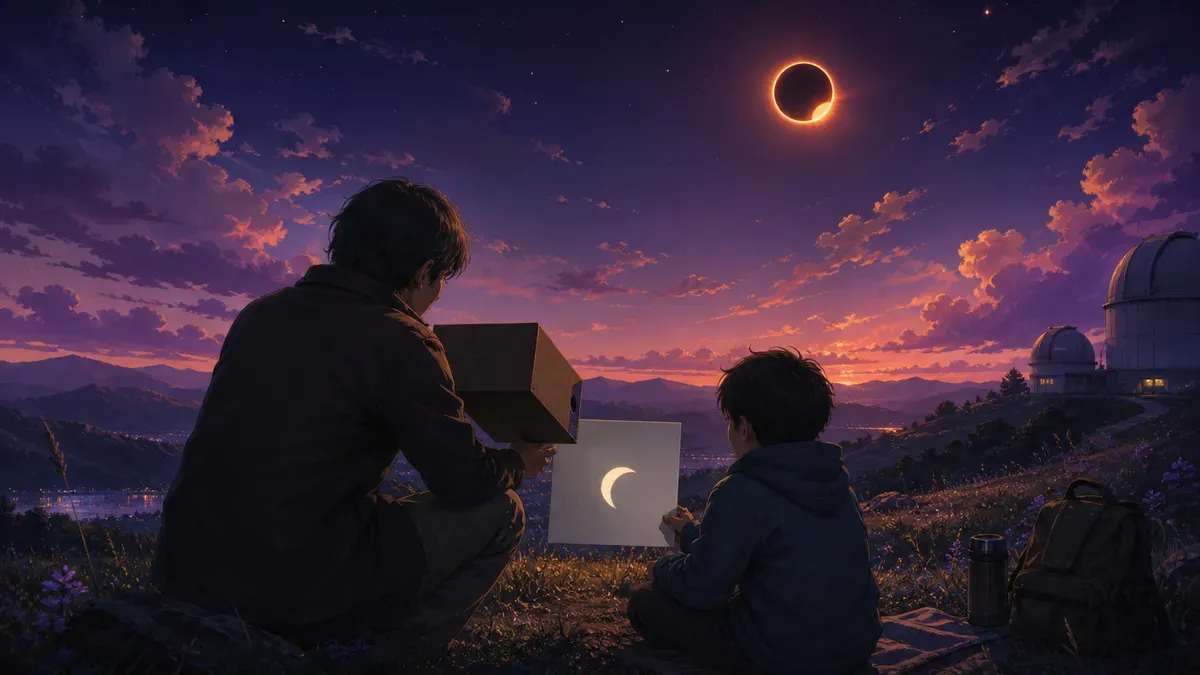
Projection is the simplest product-agnostic fallback because your eyes face an image, not the Sun. A pinhole in card or foil can cast a small solar image onto a second surface. Stand with your back to the Sun, let sunlight pass through the opening, and look only at the projected image. Do not look through the pinhole.
Natural gaps between leaves or holes in a colander can project many crescent images during partial phases. A closed-box pinhole projector can make the image easier for children to view while helping keep faces turned away from the Sun.
Do not improvise projection with binoculars or a telescope unless an experienced observer has designed and supervised the setup. Concentrated sunlight can heat internal components, damage equipment, or reach an eye unexpectedly.
A five-minute safety plan
The best protection is decided before the sky changes.
- Name the eclipse type and your location’s phase. Confirm whether totality is actually possible where you will stand.
- Choose one primary method and one backup. For example, direct viewers plus a pinhole projector.
- Inspect every viewer in advance. Do not pass damaged viewers through a crowd.
- Assign child supervision. One attentive adult should manage when viewers go on and off.
- Keep unfiltered optics put away. A phone, camera, binoculars, or telescope can become an impulsive shortcut.
- Set the totality rule out loud. No one removes protection until complete coverage is confirmed; everyone replaces it at the first bright reappearance.
Photography requires its own equipment plan. A digital screen showing a remote or already recorded image is not the same as looking directly at the Sun, but aiming a camera at the Sun without the correct front-mounted filter can damage the sensor and creates opportunities for accidental direct viewing. Do not use an optical viewfinder for unfiltered solar observation.
What to do after an accidental look
An accidental glance does not let you predict the outcome from duration alone. Do not look again to compare eyes, test a blind spot against the Sun, or repeatedly inspect bright lights. Move indoors or into shade and note what happened: approximate time, whether optics were involved, which eye was exposed, and whether a filter was damaged or absent.
Watch for a new change in central vision over the following hours and days:
- blurred or dim central vision
- a central or near-central blank, gray, or dark spot
- straight lines that look bent, rippled, or broken
- letters or faces with missing detail
- altered color perception
- unusual light sensitivity
- a persistent afterimage-like patch
- headache associated with visual change
New visual symptoms after solar exposure deserve prompt assessment by an optometrist or ophthalmologist. Sudden major vision loss, severe eye pain, a curtain-like shadow, new weakness or speech difficulty, or other neurologic symptoms require urgent medical evaluation because causes other than solar retinopathy may be time-sensitive.
Eye soreness alone does not diagnose a retinal burn. Dryness, squinting, prolonged outdoor exposure, and headache can cause discomfort, while the retina itself may be injured without pain. The meaningful signal is a new visual-function change, not whether the eye feels “burned.”
How solar retinopathy is diagnosed and followed
There is no reliable home test that can clear the retina after unsafe viewing. An eye-care professional combines the exposure history with visual-acuity testing, a dilated retinal examination, and often optical coherence tomography (OCT). OCT can show focal disruption in the outer retinal layers near the fovea, even when the retina initially looks subtle on examination.
The 2024 clinical literature review found that symptoms are typically bilateral but can be asymmetric. Common patterns include reduced central acuity, central or paracentral blind spots, color change, light sensitivity, and metamorphopsia—the distortion that makes straight lines look wavy. Imaging and follow-up also help distinguish solar injury from macular disease, inflammatory conditions, vascular events, or other causes of sudden central-vision change.
No treatment has consistently been shown to reverse solar retinopathy. Steroids and other interventions appear in case reports, but evidence is insufficient for self-treatment or a routine cure. Many people regain useful visual acuity over weeks to months, yet a central blind spot or distortion can persist even when an eye-chart score improves. Prevention remains more reliable than treatment.
If a clinician chooses observation, follow the scheduled review rather than judging recovery only by day-to-day impressions. Fine-detail tasks, reading speed, color, and distortion may tell a different story from headline visual acuity.
Where this fits in long-term eye health
Eclipse protection prevents an acute exposure; it does not replace routine eye care. Age, diabetes, blood pressure, smoking, and existing retinal disease affect the wider risk landscape. Cataracts and cognitive aging also show why preserving usable vision supports movement, reading, independence, and social participation.
Sunlight should not become an all-or-nothing fear. Daylight supports circadian timing, while chronic ultraviolet exposure calls for ordinary skin and eye protection. Our guide to morning light versus blue light at night explains the timing benefit, and the UV damage and photoaging guide covers cumulative exposure beyond eclipse viewing. The eclipse rule is narrower: never stare at the visible Sun without purpose-made protection.
Use SuperAge for the broader health pattern
SuperAge cannot detect solar retinopathy, certify a viewer, or replace an eye examination. It can help you follow the systemic factors that also matter to long-term eye health—activity, sleep, cardiovascular fitness, blood pressure context, metabolic markers, and biological-age trends—without confusing a wellness trend with an acute diagnosis.
If vision changes after solar exposure, contact an eye-care professional first. Use tracking later to support the broader routines that protect healthy aging.
FAQ
Can I look at a partial eclipse for one second?
There is no recommended “safe second” for unprotected direct viewing. Exposure risk varies, and the absence of immediate pain does not establish safety. Use a compliant solar viewer or indirect projection for every partial phase.
Are regular sunglasses safe if they are very dark or polarized?
No. Sunglasses manage ordinary environmental glare; they do not meet the transmission requirements for direct observation of the Sun. Darkness, price, polarization, and stacking lenses are not substitutes for purpose-made eclipse viewers.
Is an annular eclipse safe during the ring of fire?
No. The bright ring is visible solar surface, so eye protection stays on for the entire event. Annularity is not totality.
When can eclipse glasses come off during a total eclipse?
Only during confirmed totality, when the Moon fully blocks the Sun’s bright face at your location. Put protection back on as soon as any bright point or crescent returns. If your location is outside the path of totality, the glasses do not come off.
How soon do solar-retinopathy symptoms appear?
Symptoms may appear within hours and sometimes become clearer over the next day or two. Central blur, a blind spot, distortion, or color change after solar viewing warrants prompt professional assessment even if the eyes do not hurt.
Will solar retinopathy heal completely?
Many reported patients improve over weeks to months, but recovery is variable. Some retain a central blind spot, distortion, or subtle loss of detail despite better visual acuity. There is no proven home remedy or guaranteed treatment, which is why prevention and follow-up matter.
Can I watch safely through a phone screen?
Watching a livestream or recording on a screen away from direct sunlight does not expose the retina to concentrated solar light. Pointing a phone or camera at the Sun is a different equipment problem: use appropriate solar filtration and avoid looking around the device at the Sun. Never use an unfiltered optical viewfinder.
Key takeaways
- Partial and annular phases always require purpose-made solar viewing protection or indirect projection.
- Only confirmed totality creates a brief naked-eye exception, and only within the path of totality.
- Eclipse glasses and handheld viewers should comply with ISO 12312-2 and be intact, correctly fitted, and used as instructed.
- Binoculars, telescopes, and cameras need solar filters on the Sun-facing front; eclipse glasses worn behind magnifying optics are unsafe.
- Solar retinal injury can be painless and delayed. New central blur, blind spots, distortion, or color change needs prompt eye care.
- Solar retinopathy has no consistently effective treatment, and some visual defects can persist.
Prepare before you look up
Make the safe method the default before the eclipse begins: verify the phase, inspect the viewers, prepare a projection backup, and assign supervision. For the larger health context behind lifelong vision, download SuperAge and track the systemic patterns that support healthy aging—without treating an app as an eye-safety device or diagnostic tool.
References
- NASA Science. Eclipse viewing safety.
- International Organization for Standardization. ISO 12312-2:2015: Filters for direct observation of the sun.
- National Eye Institute. How to watch an eclipse, safely.
- American Astronomical Society. How to view a solar eclipse safely.
- American Academy of Ophthalmology EyeWiki. Solar retinopathy.
- Khatib N, Knyazer B, Lifshitz T, et al. (2024). Solar retinopathy: a literature review. Oman Journal of Ophthalmology, 17(2), 173-180.
- Jain A, Desai RU, Charalel RA, et al. (2023). Long-term anatomical and functional findings of solar maculopathy. Ophthalmic Surgery, Lasers and Imaging Retina, 54(7), 388-394.
- Rothkoff L, Kushelevsky A, Blumenthal M. (1978). Solar retinopathy: visual prognosis in 20 cases. Israel Journal of Medical Sciences, 14(2), 238-243.
- American Medical Association. Safely viewing solar eclipses. JAMA patient page.
Related Articles
Cataracts and cognitive aging: shared risk or vision-loss effect?
Cataracts and cognitive aging may overlap through vision loss, shared vascular risk, activity changes, and confounding. Learn what the evidence suggests.