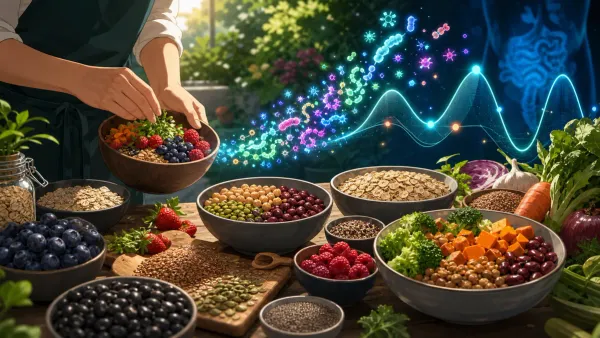
Resistant starch: the prebiotic fiber that improves gut health and blood sugar
Discover resistant starch — the prebiotic fiber that feeds gut bacteria, lowers blood sugar, and supports longevity. Learn the 4 types, best food sources, and how to increase your intake.
There’s a type of starch hiding in your food that your body can’t digest — and that’s exactly why it’s so good for you. Resistant starch passes through your stomach and small intestine intact, arriving in your colon where trillions of gut bacteria ferment it into butyrate — a short-chain fatty acid that reduces inflammation, strengthens the gut barrier, and improves insulin sensitivity. This process sits at the heart of the probiotics, prebiotics, and postbiotics framework — resistant starch is one of the most potent prebiotic substrates available from whole food.
A 2024 study in Nature Medicine found that supplementing with resistant starch for just 4 months shifted the gut microbiome toward an anti-aging profile, reducing markers associated with metabolic syndrome and biological aging. And the best part? You don’t need supplements. Resistant starch forms naturally when you cook and cool everyday foods like rice, potatoes, and pasta.
Resistant starch keeps some starch in the meal; a konjac noodle substitutes for most of it. If that is the comparison you need, our shirataki noodles guide covers the different evidence, nutritional tradeoffs, digestive tolerance, and safety precautions.
If you care about gut health, blood sugar control, or healthy aging, resistant starch is one of the most underappreciated tools in your nutritional toolkit.
What you’ll learn:
- The 4 types of resistant starch and where they’re found
- How resistant starch feeds gut bacteria and produces butyrate
- The best food sources and how to increase resistant starch through cooking methods
- How resistant starch connects to blood sugar control and aging
What is resistant starch?
Resistant starch is a type of starch that “resists” digestion in the small intestine. Unlike regular starch — which is broken down into glucose and absorbed into the bloodstream — resistant starch passes to the large intestine intact, where it acts as a prebiotic fiber, feeding beneficial gut bacteria.
Quick definition: Resistant starch is a type of dietary fiber that escapes digestion in the small intestine and ferments in the colon, producing butyrate and other short-chain fatty acids that support gut health, blood sugar control, and reduced inflammation.
The 4 types of resistant starch
| Type | Where it’s found | How it works |
|---|---|---|
| RS1 — Physically trapped | Whole grains, seeds, legumes | Starch granules are physically protected by cell walls |
| RS2 — Native granular | Raw potatoes, green bananas, high-amylose corn | Granular structure resists enzymes |
| RS3 — Retrograded | Cooked and cooled rice, potatoes, pasta | Cooling rearranges starch molecules into resistant crystals |
| RS4 — Chemically modified | Some processed foods, supplements | Industrially created (less relevant for whole-food diets) |
Why resistant starch matters for your health
The average Western diet provides only 3–8 g of resistant starch daily. Traditional diets — including those of Blue Zone centenarians — provided 30–40 g daily through legumes, tubers, and whole grains. This gap may partly explain why modern populations have less diverse gut microbiomes, higher rates of metabolic disease, and more chronic inflammation than traditional populations.
The science behind resistant starch
How resistant starch benefits your body
1. Butyrate production — the gut’s preferred fuel
When gut bacteria ferment resistant starch, they produce butyrate — the primary energy source for colonocytes (cells lining the colon). Butyrate strengthens the gut barrier, reduces intestinal permeability (“leaky gut”), suppresses inflammatory signaling, and may even have anti-cancer properties in the colon.
2. Blood sugar and insulin improvement
Resistant starch improves insulin sensitivity through two mechanisms: it replaces rapidly digestible starch (lowering the meal’s glycemic load), and butyrate itself enhances insulin signaling in peripheral tissues. A meta-analysis of 18 clinical trials found that resistant starch supplementation reduced fasting insulin by 18% and post-meal glucose by 8–12% in people with metabolic syndrome.
3. Microbiome diversity
Resistant starch selectively feeds Bifidobacterium, Ruminococcus, and Eubacterium rectale — bacteria associated with anti-inflammatory profiles and healthy aging. Greater microbial diversity is consistently linked to lower biological age. Pairing resistant starch with fermented foods further amplifies this diversity by introducing live microbial populations alongside the prebiotic substrate that keeps them thriving.
4. Satiety and weight management
Resistant starch increases PYY and GLP-1 (satiety hormones) while reducing ghrelin (the hunger hormone). A 2023 study found that meals containing resistant starch reduced subsequent calorie intake by 10–15% compared to meals with the same calories from digestible starch.
5. Reduced colon cancer risk
The CAPP2 trial — a large randomized controlled study — found that resistant starch supplementation (30 g/day) reduced colorectal cancer risk by 60% in Lynch syndrome patients over a 10-year follow-up period. This protection is attributed to butyrate’s ability to promote apoptosis of damaged colon cells.
Best food sources of resistant starch
Top whole-food sources
| Food | Resistant starch per serving | Best form |
|---|---|---|
| Green (unripe) bananas | 8–12 g per medium banana | Raw, sliced into smoothies |
| Cooked and cooled potatoes | 3–5 g per medium potato | Potato salad, cooled baked potatoes |
| Cooked and cooled rice | 3–4 g per cup (195 g) | Day-old rice, rice salad |
| Lentils | 3–5 g per ½ cup (100 g) cooked | Soups, salads, stews |
| Chickpeas | 3–4 g per ½ cup (82 g) cooked | Hummus, salads, roasted |
| Oats (rolled, raw or cooled) | 3–4 g per ½ cup (40 g) | Overnight oats (best), cooked and cooled |
| White beans | 4–5 g per ½ cup (90 g) cooked | Soups, stews, salads |
| Plantains (green) | 6–8 g per medium | Boiled or baked green plantains |
| Cooked and cooled pasta | 2–3 g per cup (140 g) | Pasta salad |
| Cashews | 1–2 g per oz (28 g) | Raw snacking |
The cook-and-cool trick
The most practical way to increase resistant starch is to cook starchy foods normally, then refrigerate them for at least 12 hours. This process — called retrogradation — converts 5–10% of digestible starch into RS3 (retrograded resistant starch).
Key insight: Lightly reheating retrograded starch doesn’t fully reverse the process. Reheated day-old rice retains about 60–70% of the resistant starch formed during cooling. So leftover rice is legitimately healthier than freshly cooked rice.
5 practical strategies to increase resistant starch
1. Master overnight oats
Why it works: Raw rolled oats soaked in liquid overnight develop both RS1 (from intact oat cell walls) and RS2 (from granular starch). This is the easiest daily resistant starch boost.
How to do it:
- Combine ½ cup (40 g) rolled oats with ¾ cup (180 ml) milk or yogurt
- Add chia seeds, berries, and nuts
- Refrigerate overnight — eat cold or lightly warmed
Expected results: 4–6 g of resistant starch per serving, plus the fiber benefits of oats.
2. Cook rice a day ahead
Why it works: Cooked and cooled rice contains 2–3x more resistant starch than freshly cooked rice. A 2015 study found that adding coconut oil during cooking and cooling for 12 hours increased resistant starch by up to 10x.
How to do it:
- Cook a large batch of rice on Sunday
- Refrigerate in portions for the week
- Reheat lightly or eat cold in grain bowls and salads
3. Add legumes to every meal
Why it works: Legumes are the only food group that’s simultaneously high in resistant starch, protein, and soluble fiber. They deliver RS1 naturally without any cooking tricks needed.
How to do it:
- Add ½ cup (90 g) of beans or lentils to soups, salads, tacos, or grain bowls daily
- Keep canned beans (rinsed) stocked for quick additions
- Make hummus as a snack — chickpeas are rich in RS1
4. Use green banana flour or green banana in smoothies
Why it works: Green (unripe) bananas contain the highest concentration of RS2 of any common food — 8–12 g per banana. As bananas ripen, the resistant starch converts to sugar, so color matters.
How to do it:
- Buy bananas green and use them before they yellow
- Add one green banana to morning smoothies (the flavor is mild when blended)
- Green banana flour (1–2 tablespoons / 15–30 g) can be added to smoothies or baked goods
5. Make potato salad your go-to side
Why it works: Boiled and cooled potatoes are one of the richest sources of RS3. Potato salad — dressed with olive oil and vinegar — combines resistant starch with the vinegar’s blood sugar-lowering effect for a double benefit.
How to do it:
- Boil potatoes, cool completely (minimum 4 hours, ideally overnight)
- Dress with olive oil, vinegar, herbs, and mustard
- Can be reheated lightly — RS3 is partially heat-stable
How to track your gut and metabolic health
Key metrics to monitor
| Metric | Target | What it indicates |
|---|---|---|
| Stool consistency | Bristol Type 3–4 | Healthy transit and gut function |
| Fasting insulin | 2–6 μIU/mL | Metabolic health and insulin sensitivity |
| HbA1c | < 5.4% | Long-term blood sugar control |
| Bloating/gas | Temporary increase, then resolves | Microbiome adjustment (normal for 1–2 weeks) |
| hsCRP | < 1.0 mg/L | Systemic inflammation reduction |
Note: Increasing resistant starch may cause temporary bloating and gas as your microbiome adapts. Start with 5–10 g/day and increase gradually over 2–4 weeks to allow gut bacteria populations to adjust. This gradual approach is the same principle recommended in the gut-brain axis context — rapid microbiome shifts can transiently worsen symptoms before improving.
Resistant starch and biological age: what the research says
Resistant starch influences biological aging through multiple pathways that converge on the gut-systemic health axis:
- Butyrate and inflammation: Butyrate produced from resistant starch fermentation directly suppresses NF-κB signaling — a master inflammatory pathway that drives chronic low-grade inflammation associated with accelerated aging. Resistant starch is the most potent whole-food source of butyrate precursors — as explained in our complete guide to dietary fiber and longevity
- Insulin sensitivity: Improved insulin signaling reduces the chronic hyperinsulinemia that activates pro-aging mTOR and IGF-1 pathways
- Microbiome rejuvenation: The Nature Medicine study found that resistant starch supplementation shifted gut microbiome composition toward profiles typically seen in younger, metabolically healthier individuals
- Epigenetic modulation: Butyrate is a histone deacetylase (HDAC) inhibitor — it directly influences epigenetic gene expression in ways that may slow cellular aging
Want to go deeper? Read our guide on how biological age is calculated to understand how gut health and metabolic markers factor into biological age.
How SuperAge helps you track the impact
Improving your resistant starch intake enhances gut health, blood sugar control, and inflammatory profiles — all of which affect how fast your body ages. SuperAge helps you see these improvements in real time.
Automatic health monitoring
SuperAge integrates with Apple Health to track biomarkers responsive to metabolic changes — resting heart rate, HRV, and cardiorespiratory fitness. These metrics improve as insulin sensitivity and inflammation improve.
Your biological age, tracked
Track your biological age over time as dietary improvements in gut health and blood sugar control take effect — providing objective evidence that your nutritional strategy is working.
Frequently asked questions
Is resistant starch the same as dietary fiber?
Resistant starch is classified as a type of dietary fiber because it resists digestion in the small intestine. However, it behaves differently from soluble and insoluble fiber. Its unique property is that it’s preferentially fermented into butyrate (rather than other short-chain fatty acids), making it particularly beneficial for colon health and inflammation reduction.
Can resistant starch help with weight loss?
Resistant starch may support weight management through increased satiety, reduced calorie absorption (it provides about 2 calories/g vs. 4 calories/g for regular starch), and improved insulin sensitivity. However, it’s not a weight-loss supplement — it works best as part of a balanced, whole-food diet.
How much resistant starch should I eat daily?
Research suggests 15–30 g/day for optimal gut health benefits. Most Western diets provide only 3–8 g. Start with 5–10 g and increase gradually over 2–4 weeks. You can reach 15–20 g through food alone by including overnight oats, cooled rice/potatoes, and legumes daily.
Does heating destroy resistant starch?
Cooking initially breaks down resistant starch, but cooling recreates it (retrogradation). Lightly reheating retrograded starch preserves about 60–70% of the resistant starch. Microwave reheating preserves more than stovetop boiling. The cook-cool-reheat cycle is the practical sweet spot.
Key takeaways
- Resistant starch is a prebiotic: It feeds beneficial gut bacteria, which produce butyrate — a short-chain fatty acid that reduces inflammation and strengthens the gut barrier
- Cook and cool: The simplest way to increase resistant starch is to cook rice, potatoes, and pasta, then refrigerate overnight before eating
- Blood sugar benefits: Resistant starch reduces fasting insulin by 18% and post-meal glucose by 8–12% in metabolic syndrome
- Legumes are the best daily source: Beans, lentils, and chickpeas deliver resistant starch, protein, and fiber in one food
- Biological age connection: Butyrate production, improved insulin sensitivity, and microbiome diversity all influence the pace of biological aging
Start boosting your resistant starch intake today
You don’t need supplements or specialty foods. Tonight, cook an extra batch of rice and refrigerate it. Tomorrow, you’ll have a meal with 2–3x more resistant starch — feeding your gut bacteria the fuel they need to keep you healthy and aging well.
Ready to track the impact? Download SuperAge and start monitoring how your metabolic and gut health improvements affect your biological age.
For a narrower decision guide, see Fiber target after 40: how much supports glucose and aging?.
References
- Bojarczuk, A., et al. (2024). Resistant starch supplementation shifts gut microbiome toward anti-aging profile. Nature Medicine. — 4-month clinical intervention
- Higgins, J.A. (2014). Resistant starch and energy balance. Current Opinion in Gastroenterology, 30(2), 120-127. — Metabolic effects review
- Burn, J., et al. (2020). Cancer prevention with aspirin in hereditary colorectal cancer (CAPP2). The Lancet, 395(10240), 1855-1863. — 60% colorectal cancer risk reduction with RS
- Robertson, M.D., et al. (2012). Insulin-sensitizing effects of dietary resistant starch. American Journal of Clinical Nutrition, 95(4), 932-940. — 18% fasting insulin reduction
- Birt, D.F., et al. (2013). Resistant starch: promise for improving human health. Advances in Nutrition, 4(6), 587-601. — Comprehensive review
Last updated: 2026-03-29. This article is regularly reviewed to ensure accuracy.
Related Articles

Glycemic index vs glycemic load: why carb quality matters for aging
Compare glycemic index and glycemic load, learn why carb quality affects blood sugar, and use practical food-pairing tactics for healthier aging.