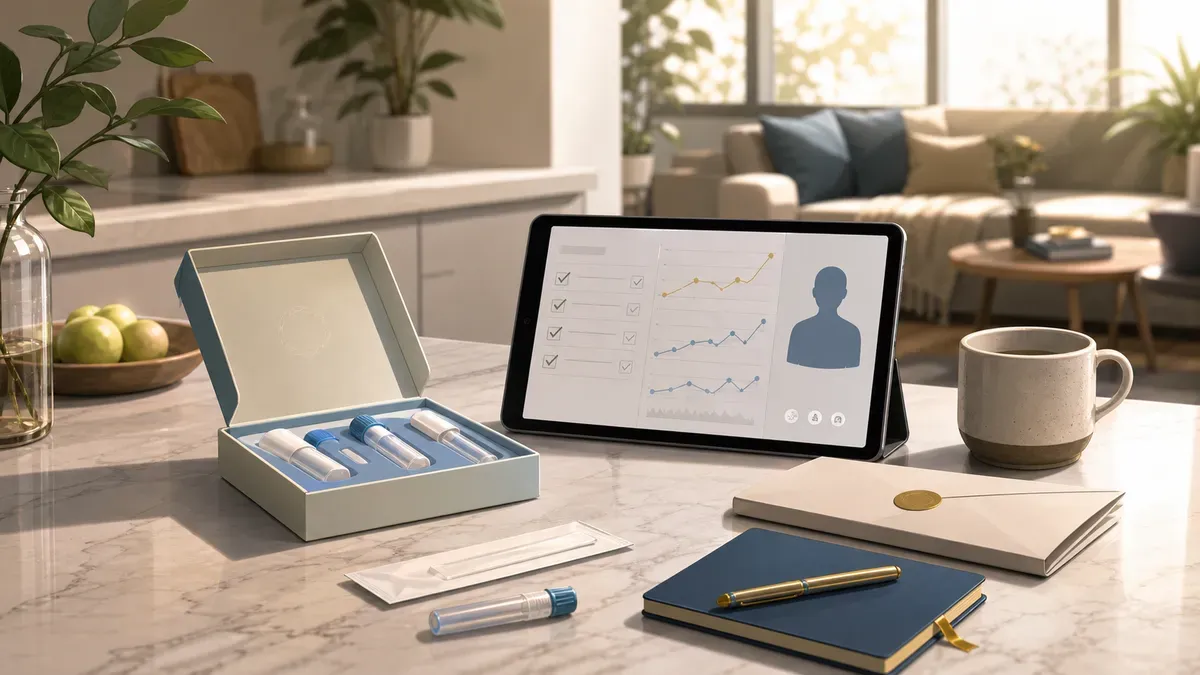
Best home biomarker tests for longevity: what to compare before buying
Compare the best home biomarker tests longevity buyers should evaluate by quality, supervision, repeatability, privacy, and actionability. SuperAge.
Home biomarker testing can be useful for longevity tracking, but the best home biomarker tests for longevity are not the ones with the longest menus, the most dramatic dashboards, or the boldest “optimize everything” claims. The better question is whether the test can produce repeatable, clinically interpretable data that you and a qualified clinician can use without overreacting.
That is a different buyer’s guide than a brand roundup. Longevity panels often mix routine blood chemistry, lipids, glucose metabolism, inflammation markers, hormones, nutrients, kidney markers, liver enzymes, and sometimes newer biological-age or genetics outputs. Some are collected at home and analyzed in a central lab. Some require a nearby venous blood draw. Some use finger-prick dried blood spots. Some include clinician review; others send a report directly to the customer with limited context.
The goal is not to find the biggest test. The goal is to find a testing setup that answers a specific decision: what should you monitor, how often should you repeat it, which collection method is appropriate, and what result would change your next step?
If you are still deciding what belongs in a longevity panel at all, start with our guide to blood tests for longevity and how often to repeat them. This article focuses on the buying decision after you already know you want to test from home or through a hybrid home-plus-lab service.
Quick answer
Home biomarker testing can be useful for longevity tracking, but the best home biomarker tests for longevity are not the ones with the longest menus, the most dramatic dashboards, or the boldest “optimize everything” claims. The better question is whether the test can produce repeatable, clinically interpretable data that you and a qualified clinician can use without overreacting.
Key takeaways
- A good home biomarker test is defined by test quality, sample quality, repeatability, review process, and clear next steps, not by the number of markers.
- CLIA certification matters for U.S. lab operations, but it does not automatically prove that every longevity claim is clinically meaningful.
- FDA status matters most when the test is marketed for medical use, higher-risk decisions, over-the-counter use, or home collection claims. Low-risk general wellness tests may not be reviewed by FDA before sale.
- Venous blood draws are usually better for larger chemistry panels; finger-prick samples can be useful but have more limitations for volume-sensitive or method-sensitive analytes.
- The best panel is one you can repeat under similar conditions and interpret against the same method, reference ranges, and clinical context.
- Home tests do not replace clinician care, especially for abnormal, unexpected, or symptom-linked results.
What “home biomarker test” really means
“Home test” can describe several different workflows:
| Workflow | What happens at home | What happens elsewhere | Main tradeoff |
|---|---|---|---|
| Finger-prick kit | You collect capillary blood at home | A lab analyzes the sample | Convenient, but limited sample volume and more collection variability |
| Dried blood spot | You place drops of blood on a card | A lab measures compatible analytes | Easy shipping, but not equivalent to serum/plasma for every marker |
| Home phlebotomy | A trained collector draws venous blood at home | A lab runs standard assays | Better sample quality, higher cost and scheduling friction |
| Lab draw ordered online | You buy or request the panel online | A draw site collects venous blood | Less “home,” but often better for comprehensive panels |
| At-home device or OTC test | You run or initiate the test yourself | Result may appear at home or through a lab | Useful for some narrow tests, risky if claims exceed validation |
For longevity tracking, most useful biomarkers still come from laboratory testing. Wearables are strong for continuous behavior signals, but blood markers remain better for lipids, glucose metabolism, kidney function, liver enzymes, inflammation, blood counts, and many nutrient or hormone questions. The practical challenge is combining occasional lab snapshots with daily trends without making every fluctuation feel urgent. For that broader workflow, see how to combine wearable trends with blood tests.
The regulatory frame: what FDA and CLIA can, and cannot, tell you
Regulatory language can be confusing because “tested in a CLIA lab,” “FDA-cleared,” “doctor-reviewed,” and “clinically validated” do not mean the same thing.
The FDA explains that some direct-to-consumer tests are reviewed while others are not. In general, tests for non-medical, general wellness, or low-risk medical purposes may not be reviewed by FDA before they are offered. Direct-to-consumer tests for moderate- to high-risk medical purposes are generally reviewed to determine whether test claims are valid. In that review, FDA evaluates analytical validity, clinical validity, and the claims made about the test.
Analytical validity asks whether the test accurately and reliably measures what it says it measures. Clinical validity asks whether that measurement predicts or corresponds to the health state being claimed. Claims review asks whether the company is saying something the evidence supports.
FDA also maintains a public database where consumers can look up home and lab tests that have been approved or cleared. For at-home or over-the-counter tests, that database can help confirm whether a test has FDA marketing authorization for the intended use being advertised.
CLIA is different. CMS says CLIA regulates laboratory testing performed on human specimens in the United States to establish quality standards for patient test results. That matters. You generally want testing performed by a CLIA-certified lab, and CAP accreditation can add another layer of quality systems and proficiency expectations. But CLIA quality requirements are not the same as FDA review of clinical claims. A lab can be competent at measuring an analyte while the marketing around that analyte’s longevity meaning is still weak.
That distinction is especially important for longevity tests, where a routine biomarker may be valid, but a proprietary score, risk label, or biological-age interpretation may be less established. If a panel includes a biological-age estimate, compare it with our explanation of PhenoAge and KDM biological-age blood tests and our guide to biological age from blood tests vs wearables. Do not assume every score has the same evidence base.
A practical comparison framework
Use this framework before buying any home biomarker test for longevity.
1. Lab accreditation and quality claims
Start with the laboratory, not the dashboard. Ask:
- Is the testing laboratory CLIA-certified if testing is performed in the United States?
- Does the company identify the lab or only make vague “certified lab” claims?
- Is CAP accreditation mentioned, and does the claim apply to the actual testing lab?
- Does the report show the test method, sample type, and reference laboratory?
- Are repeat tests processed by the same lab and method, or can methods change?
For longevity tracking, method consistency matters because you are often watching small changes over time. A one-time result can identify a possible issue, but trends only become useful when the pre-analytic and analytic conditions are similar enough to compare.
2. FDA status where applicable
Not every useful lab test is FDA-cleared for every use, and FDA review is not required for every general wellness claim. But if a home test is being marketed for a medical decision, diagnosis-adjacent claim, higher-risk interpretation, or over-the-counter home use, look for more than “lab tested.”
Ask:
- Is the test itself FDA-cleared, FDA-approved, or otherwise authorized for the advertised use?
- Is the collection kit cleared or approved, or only the laboratory method?
- Does the FDA database show the test, company, intended use, and decision summary?
- Are claims limited to wellness education, or do they imply diagnosis or treatment decisions?
- If the test is not FDA-reviewed, does the company clearly say what that means?
This is not about rejecting every non-FDA-reviewed test. It is about matching claim strength to evidence strength. A low-risk wellness panel should not be presented as a substitute for medical evaluation.
3. Venous draw vs finger-prick limitations
The collection method can change what the panel should include. Venous blood is still the preferred route for many comprehensive chemistry panels because it provides enough sample volume and aligns with common laboratory reference methods. Finger-prick capillary blood can be convenient, but collection quality depends on technique, hydration, temperature, squeezing, drying time, contamination, and shipping.
Finger-prick testing may be reasonable for some markers when the method has been validated for that sample type. It is less ideal when the analyte is sensitive to sample volume, hemolysis, timing, clotting, or serum/plasma separation. If a panel includes hormones, inflammatory markers, advanced lipids, or nutrient markers, verify that the sample type is appropriate for each analyte rather than assuming the entire panel is equally robust.
The best services make these limits visible. They tell you which markers are unavailable by finger-prick, which results may need confirmation by venous draw, and when an abnormal home result should be repeated through standard clinical testing.
4. Repeatability and trend design
Longevity tracking is mostly about repeatable trend interpretation. A single panel can uncover blind spots, but the value grows when you can compare results every 3, 6, or 12 months under similar conditions.
Compare:
- Can you repeat the same panel, not a changing menu?
- Are the same analytes, units, sample type, and lab method used over time?
- Does the company show biological and analytical variability, not just red-yellow-green flags?
- Does the report distinguish a meaningful change from normal noise?
- Can you export results into your own record?
For retesting strategy, see how often to measure biological age and retest biomarkers. The same principle applies here: do not retest so often that noise drives decisions, and do not wait so long that important patterns are missed.
5. Clinician review and escalation
Home access is useful, but interpretation still matters. A good service should make it clear whether a licensed clinician reviews results, whether that clinician can order confirmatory testing, and what happens when results are abnormal.
Look for:
- Pre-test screening for symptoms, pregnancy, medications, known disease, or urgent concerns
- Post-test review by a qualified clinician, not only automated text
- Clear escalation instructions for critical or unexpected results
- A way to share results with your primary care clinician
- Conservative language around supplements, prescriptions, and disease claims
This is especially important for kidney markers, liver enzymes, blood counts, thyroid results, hormones, and inflammatory markers. Even when a result is part of a longevity panel, it may point to a regular medical issue that deserves ordinary care.
6. Privacy and data use
Longevity testing can generate sensitive health data: lab values, symptom surveys, medications, family history, genetics, wearable trends, and inferred risk categories. Before buying, read the privacy policy as part of the product comparison.
Ask:
- Who receives your sample and your data?
- Are results shared with third parties, advertisers, affiliates, employers, insurers, or data partners?
- Can data be de-identified and used for research or product development?
- Can you delete your account and request data deletion?
- Are genetic, hormonal, reproductive, or mental-health-related results handled differently?
- Is the service covered by HIPAA, and if not, what protections apply?
Convenience is not worth unclear data rights. A good testing service should make privacy boringly specific.
7. Pre-analytic instructions
Many “bad” biomarker results are not disease signals. They are collection artifacts or poorly controlled pre-test conditions.
Compare the instructions:
- Fasting or non-fasting, and for how long
- Morning vs afternoon collection
- Avoiding hard training before testing
- Alcohol timing
- Acute illness or poor sleep before testing
- Medication and supplement disclosure
- Hydration and collection technique
- Shipping temperature and timing
Pre-analytic control is central for glucose, insulin, triglycerides, cortisol-related tests, some hormones, inflammatory markers, kidney markers, and muscle-related enzymes. If the test does not tell you how to prepare, it is harder to trust small changes.
8. Reference ranges and interpretation
Reference ranges are not the same as optimal ranges. A lab reference range often describes where most results fall in a reference population. A longevity-oriented interpretation may use tighter targets, risk-based thresholds, or trend-based context.
That can be helpful, but it can also become overconfident. Ask:
- Does the report separate standard lab reference ranges from optional “optimal” targets?
- Are targets adjusted by age, sex, risk category, medication status, and medical history?
- Does the report explain uncertainty and biological variation?
- Are flagged values linked to clear next steps rather than generic fear language?
- Does it avoid diagnosing from a single marker?
For example, ApoB, fasting insulin, HbA1c, hs-CRP, eGFR, and thyroid markers all require context. A result may be “normal” but worth watching, or “out of range” but explainable by timing, training, illness, medication, or collection method. That is why decision mapping matters.
9. Decision mapping
Before you buy, write down what each result would change.
Use this simple map:
| Result pattern | Better next step |
|---|---|
| Clearly abnormal or symptom-linked | Discuss with a clinician and consider confirmatory testing |
| Borderline but expected | Repeat under controlled conditions before changing much |
| Normal but high-risk history | Use clinician-guided cadence, not reassurance alone |
| Improved trend | Confirm it persists before declaring success |
| Worsened trend after illness, travel, or hard training | Retest after recovery before overreacting |
| Proprietary score changed but raw markers did not | Treat it as a scoring issue until explained |
The best home biomarker tests for longevity make this map easier. The worst ones sell a large panel and leave you with anxiety, disconnected recommendations, and no idea which result matters first.
What a strong longevity home panel usually includes
This article is not a full panel prescription, but a practical at-home longevity panel often starts with routine, clinically interpretable markers:
- Lipids: ApoB if available, LDL-C, HDL-C, triglycerides, non-HDL cholesterol
- Glucose metabolism: fasting glucose, HbA1c, fasting insulin when appropriate
- Inflammation: hs-CRP, interpreted carefully and often repeated if unexpectedly high
- Kidney: creatinine, eGFR, and sometimes cystatin C
- Liver: ALT, AST, GGT, alkaline phosphatase, bilirubin
- Blood count: CBC with differential, including WBC and RDW
- Nutrients when indicated: vitamin D, B12, ferritin or iron studies
- Thyroid when indicated: TSH first, with free T4 and additional markers when clinically relevant
The panel should not be broad just because more is possible. A good test menu aligns with age, history, symptoms, medications, family risk, prior results, and what you are willing to repeat. For general interpretation basics, see our blood work guide for longevity.
If you are deciding how to collect the sample, compare doctor-ordered labs vs at-home kits.
Where SuperAge fits
SuperAge is useful after the test, not as a replacement for a lab or clinician. The app helps you organize lab markers alongside Apple Health trends, wearable recovery signals, fitness metrics, and biological-age context. That makes it easier to see whether blood markers, sleep, activity, HRV, cardio fitness, and body-composition signals are moving in the same direction.
The practical advantage is trend discipline. Instead of treating one home panel as a verdict, you can track whether a result repeats, whether it lines up with your wearable data, and whether your next test confirms the pattern. That is especially helpful for longevity work, where the real question is not “What is my score today?” but “Are the systems I can influence moving in the right direction?”
Red flags before buying
Avoid or pause before buying when you see:
- Named disease promises without clinician involvement
- Huge panels with no explanation of sample-method limits
- Biological-age scores without raw marker transparency
- “Clinically validated” claims with no accessible evidence
- Vague lab quality language
- No clear retesting strategy
- No privacy detail on data sharing or deletion
- Supplement or treatment recommendations tied directly to one result
- Reports that make every borderline value sound urgent
- No pathway for abnormal results
Home testing should lower friction, not lower standards.
FAQ
Are home biomarker tests accurate enough for longevity tracking?
Some can be, depending on the analyte, collection method, laboratory process, and claim being made. Venous blood draws processed by established labs are usually better for broad panels. Finger-prick tests can be useful for selected markers when validated for that sample type, but they are not automatically interchangeable with venous blood.
Does CLIA certification mean a longevity test is clinically valid?
No. CLIA certification is important for laboratory quality and analytical performance, but it does not automatically prove that a longevity interpretation, proprietary score, or health claim is clinically valid. Treat CLIA as a baseline quality screen, not the whole answer.
Should I choose the biggest panel?
Usually not. Choose the panel that matches a decision and can be repeated. More markers can create more false alarms, more incidental findings, and more unclear recommendations. A focused, repeatable panel with clinician review is often more useful than a very broad one.
Do home tests replace my doctor?
No. Home tests can help you collect data and notice trends, but abnormal results, symptoms, medication questions, pregnancy-related questions, and disease risk decisions should be reviewed with a qualified clinician.
How often should I repeat a home longevity panel?
For many routine markers, every 6 to 12 months is enough unless a clinician recommends otherwise. Shorter intervals can be useful after a specific intervention or abnormal result, but repeat under similar conditions so you are comparing signal rather than noise.
References
- U.S. Food and Drug Administration. Direct-to-consumer tests.
- U.S. Food and Drug Administration. Find all FDA-approved home and lab tests.
- U.S. Food and Drug Administration. Public databases for IVD regulatory assistance.
- Centers for Medicare & Medicaid Services. Clinical Laboratory Improvement Amendments.
- Centers for Disease Control and Prevention. CLIA test complexities.
- National Academies / NCBI Bookshelf. Regulation of predictive tests.
Related Articles
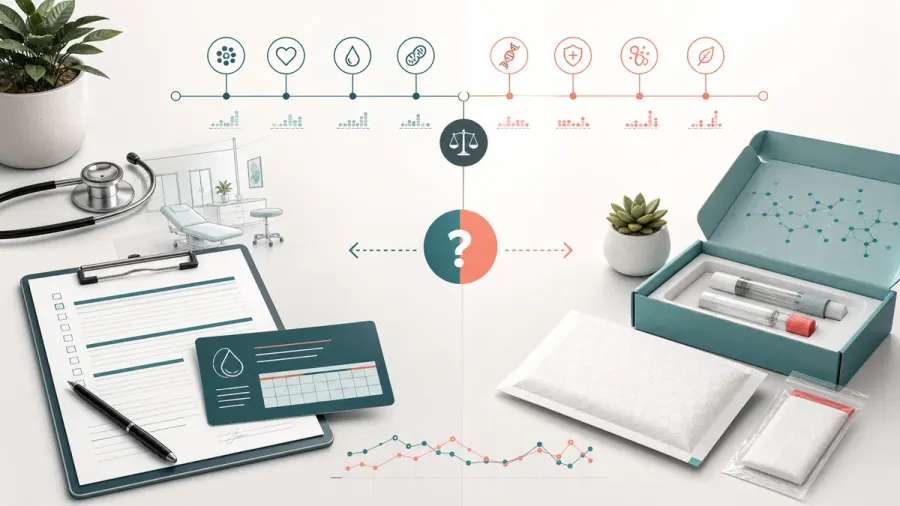
Doctor-ordered labs vs at-home kits for longevity tracking
Doctor-ordered labs are best for diagnosis and medication decisions; at-home kits can help low-risk trend tracking. Learn accuracy, CLIA, FDA, and follow-up rules.