Yin yoga for beginners: supported poses and safe practice
Try yin yoga for beginners with supported poses, sensible hold times, clear stop signs, and an honest look at the evidence. Build a comfortable first session.
Yin yoga is a slow style of yoga built around sustained, mostly floor-based positions. For a beginner, the useful skill is finding a supported, comfortable shape and staying attentive to its sensations. Reaching farther or enduring discomfort is not the goal.
You can try the approach without committing to several-minute stretches. Start with brief holds, keep your breathing easy, and leave a position whenever it stops feeling appropriate. This guide focuses on passive, supported practice; our daily yoga routine covers a more active sequence with standing movement and balance.
Quick answer
For a first yin yoga session, warm up with easy movement, then try supported seated butterfly and a gentle reclining figure-four, followed by rest with your calves on a chair. Begin with 30 seconds per stretch and stay up to one minute only if comfortable. These are conservative starting suggestions, not a scientifically established yin dose. Stop for joint pain, tingling, numbness, or increasing discomfort, even before the timer finishes.
Key facts
- Yin yoga uses sustained positions and attentive breathing to create a slow movement practice.
- Support reduces the need to force a shape that your current range cannot comfortably accommodate.
- Pain signals require a change of position rather than a longer hold.
- Yin-specific research suggests possible benefits for some psychological symptoms, with important limitations.
- A complete exercise week includes aerobic activity and progressive strength work alongside flexibility practice.
Choose the kind of stillness you want
The label on a class does not tell you its exact intensity. Yin sessions commonly use stretches held for several minutes. Restorative sessions emphasize rest with extensive support and little demand to increase range. Cleveland Clinic’s guide to yoga styles describes both as slow, floor-based practices with different aims.
If you want to rest without a noticeable stretch, a restorative class may fit better. If you want to explore comfortable sustained positions, try a beginner yin class whose teacher welcomes shorter holds and alternatives. Neither choice requires you to become extremely flexible first.
Passive stretching means that gravity or external support helps maintain the position. It does not mean that muscles switch off completely, that joints have no load, or that every sensation is harmless. Our guide to stretching methods explains how passive and static describe different aspects of a stretch.
Set a sensation limit before a time target
Choose a mild, manageable muscular pull, with enough room to breathe normally and adjust the position. Avoid a strong sensation concentrated inside a knee, hip, or other joint. More intensity is not evidence of a better session.
The American Heart Association’s flexibility advice recommends warming up first, moving smoothly, breathing normally, and stopping for sharp or joint pain. Its ordinary stretching guidance uses 10-30-second holds; it does not establish a requirement for multi-minute yin holds.
Use this decision process throughout the session:
- Settle: choose a smaller range than your maximum and add support before waiting.
- Check: notice whether breathing stays easy and the sensation stays mild.
- Adjust: reduce the range or add another cushion when the position becomes demanding.
- Leave: stop for sharp pain, burning, pins and needles, numbness, or symptoms that build.
Coming out early is a successful adjustment. Do not ask a partner to push you farther, place weights on your knees, or stay motionless to prove that you can tolerate discomfort.
A supported first session
This sampler introduces the pacing of yin practice without copying the dose of a full class. Use a comfortable mat or carpet, firm cushions, a folded blanket, and a stable chair that will not slide. Keep enough floor space to roll onto your side and get up safely.
The suggested times are upper limits for this first attempt, not obligations. Shortening a hold or replacing a stretch with neutral rest is always an option.
| Part | Suggested time | What to check |
|---|---|---|
| Easy walking and comfortable joint movement | 4 minutes | You feel warmer without fatigue |
| Supported seated butterfly | Up to 1 minute | The hips feel a mild pull; the knees feel comfortable |
| Neutral seated or lying rest | 1 minute | No lingering symptoms |
| Reclining figure-four | Up to 1 minute per side | No knee pain or nerve-like sensation |
| Transitions between positions | About 1 minute total | You can move slowly without forcing |
| Calves-on-chair rest | 2 minutes | The back and breathing feel comfortable |
| Roll to the side and rise gradually | About 1 minute | No dizziness or loss of balance |
With full suggested times, this takes about 12 minutes. Start stretches at 30 seconds and reassess before extending them. The rest positions are part of the session, not wasted time.
Supported seated butterfly
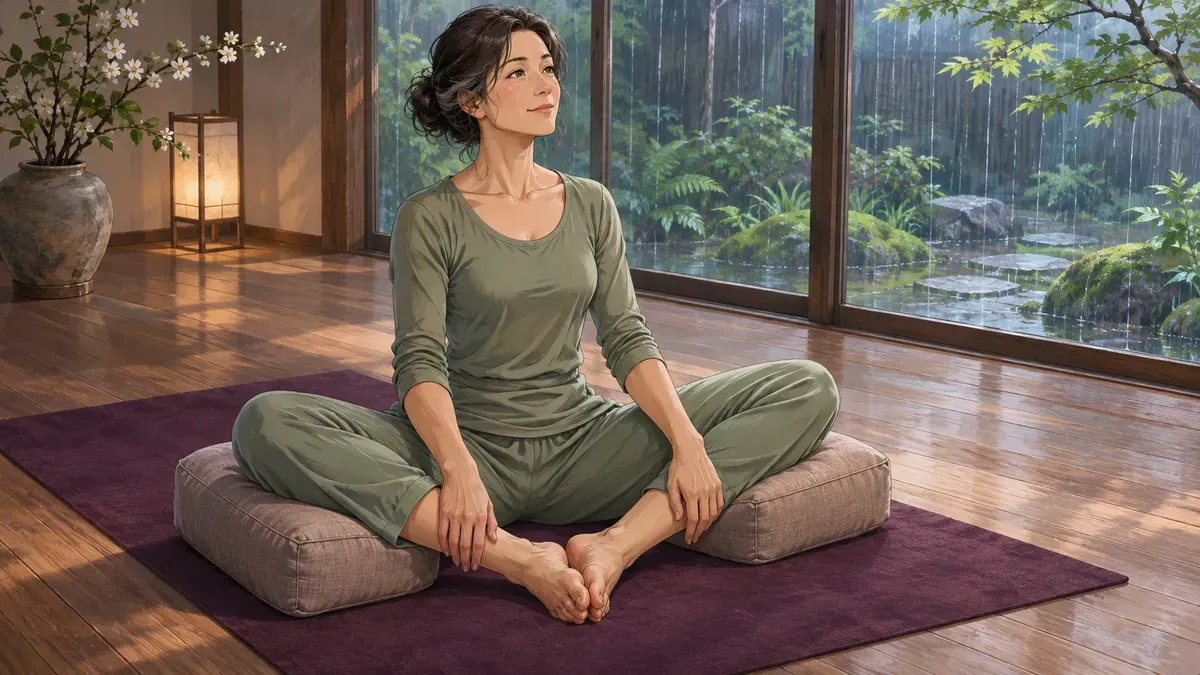
Sit on a folded blanket if that helps you stay comfortable. Bring the soles of your feet together in front of you, leaving them far enough from your pelvis that the knees do not feel compressed. Support each outer thigh with a firm cushion so the legs do not hang unsupported.
Stay upright or lean back slightly onto your hands. Keep your spine comfortable rather than rounding forward to reach a target. Let the thighs settle only as far as the supports allow. Do not press down on the knees.
To leave, use your hands to help bring the thighs together, then place the feet on the floor. If the knees hurt despite support, skip the position and rest in a comfortable seat.
Gentle reclining figure-four
Lie on your back with both knees bent and feet on the floor. Rest your right ankle across your left thigh, above the knee, without pressing the right knee away. Keep the left foot on the floor; there is no need to pull the legs toward your chest.
You may feel a mild stretch around the right buttock. If getting into the shape is difficult, the hip pinches, or the knee complains, return both feet to the floor. A comfortable neutral position is the appropriate alternative.
Uncross slowly, pause with both feet down, and then change sides. Follow any hip-replacement or surgical restrictions rather than trying this generic example.
Calves-on-chair rest
Place a stable chair near the mat. Lie on your back with your lower legs resting on the seat, adjusting your distance so the knees and hips feel comfortable. Put a small folded towel under the head if needed, keeping the neck relaxed.
This is a neutral rest, not a stretch to deepen. If lying flat is uncomfortable or medically unsuitable, rest on your side with a cushion between your knees instead. Finish by rolling onto your side and using your arms to help you sit up.
Understand the benefits without overstating them
A 2018 randomized trial assigned 105 stressed adults to yin yoga, yin yoga combined with mindfulness and psychoeducation, or a control group. The yoga programs lasted five weeks, with two sessions each week. Both intervention groups improved anxiety and sleep-problem scores relative to control; significant improvements in perceived stress and depression were found only in the combined program.
The trial was short, lacked an active comparison treatment, and could not blind participants. Its biomarker findings do not establish disease prevention, longer life, or a reversal of biological aging. It also does not show that the brief home sampler above reproduces the supervised intervention.
The broader NCCIH yoga overview reports possible wellness benefits, but yoga styles and study populations vary. Evidence about yoga as a broad category cannot automatically be assigned to yin alone.
Use observable outcomes: whether the practice feels comfortable, whether it fits your week, and whether symptoms remain settled afterward. Claims that a pose detoxifies organs, releases a specific stored emotion, or requires a painful hold to remodel fascia go beyond what these sources establish. For the wider stress question, see our review of stretching and mental health.
Fit yin around the movement you need
Try one or two short sessions in a week initially, leaving time to notice your response. This is a practical experiment, not a validated optimum. If the session causes pain or worsens your next day’s movement, reduce or stop it and seek advice when symptoms persist.
Use a separate, progressive warm-up before demanding exercise. A quiet floor session does not rehearse running, lifting, or rapid changes of direction. Likewise, feeling relaxed after stretching does not prove that an injured muscle has healed or that you have recovered from a hard workout.
The WHO physical activity guidelines recommend 150-300 minutes of moderate aerobic activity, or 75-150 minutes of vigorous activity, each week for adults, plus muscle-strengthening work on at least two days. A gentle yin session generally serves a different purpose. Keep walking, other aerobic activity, and strength work in the plan.
For healthy aging, usable range and control matter together. Our flexibility-versus-mobility guide explains why reaching a deeper passive position is not the same as controlling that range during everyday movement.
Keep the wider picture with SuperAge
SuperAge can help you view activity and recovery trends in the context of your broader habits. A brief note about comfort, sleep, and the next day’s movement is more useful than expecting one calm session to transform a health score.
Neither a wearable trend nor a biological-age estimate can tell you whether a joint position is safe. Use your symptoms and any professional restrictions to guide the session. Explore SuperAge to keep that wider health context alongside your movement practice.
When to modify or get individual advice
Being still does not make every pose suitable for every person. Ask an appropriately qualified clinician or teacher for modifications if you have a recent injury or operation, a joint replacement, persistent pain, osteoporosis, pregnancy, balance problems, glaucoma, or a condition affected by your position. The NCCIH safety guidance emphasizes adapting practice to health needs.
For symptomatic hypermobility, increasing range may be the wrong priority. The NHS advises protecting hypermobile joints through muscle strength and fitness and avoiding overextension. Work within a controlled range under individual guidance rather than hanging at your end range.
Stop the provoking position for numbness, tingling, joint pain, or increasing symptoms. Seek assessment for persistent pain, recurrent instability, or new weakness. Chest pain, fainting, or sudden severe breathlessness requires urgent medical attention, not another breathing exercise.
Frequently asked questions
How long should a beginner hold a yin yoga pose?
Start with 30 seconds and reassess. Up to one comfortable minute is enough for the sampler here. Traditional classes may use several-minute holds, but there is no need to copy that immediately or stay through symptoms.
Is yin yoga the same as restorative yoga?
They overlap in their slow pace and use of support. Yin generally includes sustained stretching; restorative practice primarily supports rest with minimal physical demand. Ask the teacher what the class actually involves.
Should yin yoga hurt?
No. A mild muscular pull can be acceptable, but sharp pain, joint discomfort, burning, tingling, numbness, or an increasing sensation is a reason to adjust or leave the pose.
Can yin yoga improve flexibility?
Stretching can help range of motion, but more range is not always needed. Yin-specific evidence does not establish the best hold time or show superiority over other flexibility approaches. Add controlled movement and strength rather than chasing depth alone.
Is yin yoga good after a hard workout?
It may feel pleasant when the positions remain comfortable. It does not prove faster tissue healing or restore every aspect of performance. Avoid stretching an acutely painful area and keep the session easy or choose rest.
Can people with hypermobile joints do yin yoga?
Some may practice modified positions, but symptomatic hypermobility calls for individual advice. Prioritize strength, stability, and controlled range; do not use a long hold to push an already mobile joint farther.
Does yin yoga treat anxiety or insomnia?
Small studies suggest possible symptom benefits, but they do not establish yin as a substitute for evidence-based treatment. Persistent anxiety or sleep difficulties deserve assessment and an appropriate treatment plan.
Do I need special equipment?
No specialized device is required. A comfortable surface, firm cushions, a folded blanket, and a stable chair can support the introductory session. Support should make the pose easier to leave as well as easier to hold.
Key takeaways
- Start with a mild sensation and brief holds; the timer never overrides symptoms.
- Use support to reduce strain rather than to force a deeper shape.
- Leave time for neutral rest and slow transitions.
- Treat research findings as limited evidence, not promises of tissue repair or rejuvenation.
- Keep aerobic exercise, strength, and controlled mobility in your week.
- Judge the first session by comfort during and afterward, including the following day.
References
- Cleveland Clinic. Yoga styles and choosing a practice.
- American Heart Association. Flexibility exercise and stretching safety.
- Daukantaitė D, et al. Five-week yin yoga-based interventions in stressed adults: randomized controlled trial. PLOS ONE. 2018;13:e0200518.
- National Center for Complementary and Integrative Health. Yoga: effectiveness and safety.
- World Health Organization. Guidelines on physical activity and sedentary behaviour. 2020.
- NHS. Joint hypermobility syndrome and joint care.
Related Articles
SUP yoga for beginners: poses, balance, and water safety
Try SUP yoga with stable beginner poses, realistic benefits, and a supervised first-session plan. Learn what to practice on land and what to check on water.